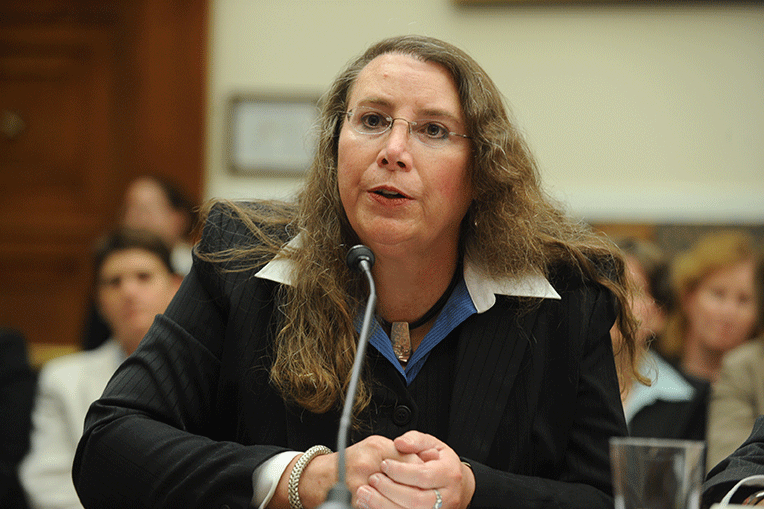
The trial in Diane Schroer's case against the Library of Congress came to a close on Friday afternoon in federal court in Washington, D.C., Ms. Schroer is the decorated Special Forces Colonel who, after retiring, was offered a job as a terrorism researcher for the Library, only to have it snatched away when she told her boss she planned to start work as Diane, not David.Reading the tea leaves of a judge's comments during a trial is always a risky business. It is easy to read too much into casual questions, into annoyance that can really be about pace or focus, and so on. And sometimes, things look very different after a trial ends and you begin to think about how to decide.With that warning, though, by the end of the trial here, the case seemed pretty clear. No one really thought Diane Schroer was "dishonest" or "lacked integrity" for not saying when she applied for the job that she was going to become Diane. (The Library had suggested it had lost confidence in her honesty and integrity since she didn't.) And no one really tried to find out if she'd have any trouble holding on to her security clearance after she transitioned (the Library said it was very worried, but it did nothing to find out if there could be a problem). The Library wouldn't hire Ms. Schroer because she was becoming Diane.So in the end, it all seems to come down to what we mean by sex and sex discrimination. Or, to put it a little more precisely, whether a person's sex includes gender identity, and whether sex discrimination includes gender identity discrimination.The judge heard expert witnesses from both sides on what sex means. Ms. Schroer's was Dr. Walter Bockting, who testified that sex is made up of several factors, including chromosomes, anatomy, and a person's sense of their sex—their gender identity. To the government's expert, Dr. Chester Schmidt, sex is chromosomes. He said only biologically determined factors could be a part of sex. It would, according to him, be too messy otherwise. Gender identity, Dr. Schmidt said, could be biological, but there's too little evidence to know yet.So now it's up to the judge to figure out just what that simple, charged, deeply important word sex means.To the government, sex meant men and women by either biology or body (they aren't clear about which) when the 1964 Civil Rights Act passed. It has to mean that forever unless Congress changes it.To Ms. Schroer and the ACLU, gender identity — a man's sense of himself as a man and a woman's sense of herself as a woman — has always been a part of a person's sex. Congress may not have thought about people for whom chromosomes, anatomy and identity did not line up, the ACLU says, but that's beside the point. We don't refuse to apply laws to unanticipated situations; if we did, we couldn't function as a society.We should know what the judge thinks fairly soon. Stay tuned.Want to be part of making equality a reality for transgender people? Get busy! Interested in making change in your community on a variety of LGBT issues? Get equal!
Related Issues
Related Content
-
Press ReleaseJun 2026

LGBTQ Rights
Women's Rights
Attorneys For Transgender Student-athletes Respond To Supreme Court Ruling In Bpj And Hecox. Explore Press Release.Attorneys for Transgender Student-Athletes Respond to Supreme Court Ruling in BPJ and Hecox
WASHINGTON - This morning, the Supreme Court of the United States issued its ruling in two cases — West Virginia v. B.P.J. and Little v. Hecox — brought to the Supreme Court by states defending categorical bans on transgender women and girls participating on women’s and girls’ sports teams. The Supreme Court upheld Idaho and West Virginia’s sports bans, holding that these laws do not violate either Title IX or the Equal Protection Clause. “This is a heartbreaking ruling for our clients and transgender girls like them who’ve asked for nothing more than the same opportunities afforded to their peers.” said Joshua Block, Senior Counsel for the ACLU’s LGBTQ & HIV Rights Project. “The reality is that the equality of transgender women and girls takes nothing away from, and in fact promotes, the equality of all women and girls. We will continue to advance the fundamental principle that all young people deserve equal opportunity to thrive and succeed.” “This ruling is deeply harmful for transgender women and girls who only asked for the ability to participate in sports with their peers,” said Sasha Buchert, Senior Attorney and Director of the Non-Binary and Transgender Rights Project, Lambda Legal. “Countless studies have demonstrated the myriad benefits that come with participation in team sports. Now, one population, transgender youth and collegians, are targeted for specific and baseless discrimination. We will not be deterred and will continue to fight back to secure the equal participation that all youth, including transgender youth, deserve.” “It is profoundly unfair to deny a young person the benefits of teamwork and dedication because of who they are,” said Kelly O'Neill, Legal Voice’s Idaho attorney. “We should be removing barriers for girls and women in sports, not creating new ones.” The two cases argue that the bans violate the rights of two transgender female student-athletes under the Equal Protection Clause of the Fourteenth Amendment of the U.S. Constitution. In addition, West Virginia v. B.P.J. argues that the ban violates Title IX, the federal law prohibiting sex discrimination in educational programs. Federal courts have blocked enforcement of these bans in both lawsuits. Since 2020, 27 states have banned transgender youth from playing school sports. Many of these bans allow for invasive forms of sex testing that put all female student-athletes at risk and embolden intrusive challenges to student-athletes' sex. In Florida, a 15-year-old junior varsity volleyball player was the subject of a police investigation after an anonymous accusation, prompting local officials to draft a 500-page report investigating her medical history, body weight, and anatomy. In Utah, a teenage basketball player was accused of being transgender by a member of the state board of education, leading to threats of violence against her and her family, and a teenager in Maine faced a similar attack from a state senator. In May, President Donald Trump similarly targeted a 16-year-old transgender girl for participating in a high school track meet. Under an Arizona ban, a cisgender male student was prohibited from participating on the boys’ team at his high school because of a clerical error that listed him as female on his original birth certificate. Many women athletes have spoken out against bullying and discrimination against transgender student-athletes, including Billie Jean King, Megan Rapinoe, Dawn Staley, Sue Bird, and Brianna Turner, as well as leading organizations fighting for gender equality in athletics, including the Women’s Sports Foundation, the Women’s National Basketball Player’s Association, and the National Women’s Law Center. These cases are part of the ACLU’s Joan and Irwin Jacobs Supreme Court docket. -
Press ReleaseJun 2026
LGBTQ Rights
Judge Blocks Trump Administration Attempt To Seize Private Medical Records Of Trans Youth From New York Hospitals. Explore Press Release.Judge Blocks Trump Administration Attempt to Seize Private Medical Records of Trans Youth From New York Hospitals
NEW YORK - A judge for the United States District of the Southern District of New York has granted a request from transgender people and their families for a temporary restraining order blocking the disclosure of plaintiffs’ and class members’ medical information pursuant to subpoenas issued by the Trump administration to hospitals in New York City. “We’re thankful the court has granted our emergency request to protect the privacy interests of transgender New Yorkers and their families,” said Chase Strangio, Co-Director of the ACLU’s LGBTQ & HIV Rights Project. “Patients and families trust their doctors with their most intimate, private information and should trust in turn that this information will be protected from impermissible and harassing demands for disclosure from the federal government or anyone else. For the past year, the Trump administration has not only decided that it knows better than these families and their doctors what their medical needs are, but has also sought to obtain troves of sensitive information about patients in New York. We will continue to fight on behalf of these families and the fundamental liberty of all transgender New Yorkers and those who come here to seek needed medical care.” “Today’s order from the court is a victory for the basic privacy of our clients and all families like theirs across New York City. It is no secret that this administration will use every lever in its power to attack transgender people and fulfill its misguided goal to 'end' gender-affirming medical care--care that is legal and protected in New York State. Using subpoenas to attain the identities and sensitive health information of transgender young people to effectuate such goals should send chills down the spine of every American. Our laws and our Constitution recognize that we all have a right to confidentiality about the most intimate and private information about ourselves,” said Omar Gonzalez-Pagan, Senior Counsel and Health Care Strategist at Lambda Legal. “Whether a young person receives any type of medical care is a decision for that patient, their family, and their doctor, not for political appointees to decide, interfere with, or know. The government cannot abuse its powers to violate the constitutional rights of transgender young people and their families. It is an enormous relief for these families that the court has stopped them from doing so as this case proceeds.” “New York’s laws recognize that transgender youth deserve fundamental privacy protections for their sensitive medical records and unobstructed access to the care they need,” said Bobby Hodgson, Deputy Legal Director at the New York Civil Liberties Union. “As the Trump administration tries to bully transgender youth, scare families, and intimidate healthcare providers into dropping their patients, we’re thankful the court found these tactics are likely unconstitutional and put a stop to them here in New York.” In May 2026, NYU Langone Hospitals received a subpoena purportedly under the authority of a federal grand jury in Fort Worth, Texas, which demanded that they turn over the identities and sensitive health information of any patient who had received medical treatment for gender dysphoria while they were under 18 years old from NYU Langone, from January 2020 through May 2026. Other healthcare institutions in New York City, including Mount Sinai Health System, may have received similar subpoenas, though the nature of these is unclear. The grand jury subpoenas followed a year-long effort by the Department of Justice to obtain this same information from hospitals across the country through administrative subpoenas—efforts that were repeatedly blocked by at least eight federal district courts. One court dismissed the government’s reasoning as a “smokescreen,” while another concluded that DOJ “issued the subpoena first and searched for a justification second.” In June 2026, a lawsuit was filed in the United States District Court for the Southern District of New York by the American Civil Liberties Union, the New York Civil Liberties Union, and Lambda Legal on behalf of three families with transgender youth and two transgender young adults who were minors when they began care. It requests a temporary restraining order blocking the DOJ from violating the patients’ constitutional privacy rights by obtaining the identifying and sensitive health information as part of their purported investigation into unspecified health offenses through the subpoena to NYU Langone and any other similar subpoenas to healthcare institutions in New York City, including Mt. Sinai, that provide or have provided gender-affirming medical care to transgender minors. All plaintiffs have filed under pseudonyms to maintain their privacy and anonymity. The lawsuit asks the court to protect “all individuals who received any medical treatment for gender dysphoria, … while they were under eighteen years of age, from January 1, 2020, through May 5, 2026, at a healthcare institution located in New York City, including NYU Langone Hospitals (and any other NYU entity) and Mount Sinai Health System.” The plaintiffs argue that the Department of Justice’s demands to access this identifying and sensitive health information violate their Fourth and Fifth Amendment rights to privacy and to be free from unreasonable search and seizure. The plaintiffs also sued NYU Langone to prevent its release of information protected by doctor-patient privilege under New York state law. Click here for more on Coe et al v. Blanche -
Press ReleaseJun 2026
LGBTQ Rights
Judge Blocks Idaho Law Criminalizing Transgender People’s Bathroom Access. Explore Press Release.Judge Blocks Idaho Law Criminalizing Transgender People’s Bathroom Access
BOISE – A federal judge today granted a request for a preliminary injunction blocking enforcement of H.B. 752, a new state law threatening transgender people with up to five years in prison for using public restrooms consistent with their gender identity. H.B. 752 was set to go into effect on July 1; today’s order limits enforcement of the law to protect access to some restrooms while the case challenging it proceeds. "This ruling means trans folks in Idaho can continue participating in public life without the threat of being arrested for using the bathroom,” said Paul Carlos Southwick, ACLU of Idaho Legal Director. “Trans Idahoans have been understandably anxious about the disruption this unconstitutional law would cause in their daily lives. This ruling will relieve that anxiety for our trans friends and neighbors.” “This decision provides significant protections for transgender people in Idaho from the efforts of state politicians to force them out of public life altogether,” said Barbara Schwabauer, senior staff attorney for the ACLU’s LGBTQ & HIV Project. “No one should be forced to choose between the threat of arrest for being themselves in public or the threat of harassment and violence for acting the way the state wants them to be. The preliminary injunction is a vital first step as we continue to challenge this gross violation of privacy and fundamental equality until the law is blocked for good.” “Our Constitution provides critical protections against laws that are unclear and that call on officers to make arbitrary judgments about how to enforce them, especially when the law threatens imprisonment,” said Kell Olson, Counsel with Lambda Legal. “The court recognized that threat in providing relief to plaintiffs today. This ruling will allow transgender people throughout Idaho to find and use a public restroom, without the fear of arrest looming over them, while we continue the longer fight to permanently defeat this discriminatory law in court.” Today’s order from the court can be found here. H.B. 752, signed into law by Idaho Gov. Brad Little earlier this year, prohibits transgender people in Idaho from using sex-designated public restrooms consistent with their gender identity in government-owned buildings and private businesses that are open to the public. The law makes the first offense a misdemeanor with up to one year in prison, and a second offense a felony with up to five years in prison. It applies to all government-owned buildings and private businesses that are open to the public, such as libraries, rest stops, malls, gas stations, restaurants, entertainment venues, hospitals, and other businesses. In April 2026, six transgender residents of Idaho filed a lawsuit in federal court challenging HB 752, arguing the law violates their constitutional rights to due process, equal protection, and privacy. The challenge was brought by the American Civil Liberties Union, ACLU of Idaho, Lambda Legal, Munger, Tolles & Olson and the Alturas Law Group in the United States District Court for the District of Idaho. The Idaho Fraternal Order of Police (FOP) and the Idaho Chiefs of Police Association opposed H.B. 752, noting there is no “clear or reasonable way” to determine a person’s sex at birth during a field contact without engaging in “invasive and inappropriate” questioning or searches. Analyses of public safety data have found policies inclusive of transgender people’s access to restrooms in public accommodations have no impact on rates of harassment or violence, but policies restrictive of their access have increased transgender people’s already heightened risks for harassment and violence. Transgender people are four times as likely as their cisgender counterparts to be victimized by violence. -
Press ReleaseJun 2026
LGBTQ Rights
Florida School District Unlawfully Fires Intersex Public School Teacher. Explore Press Release.Florida School District Unlawfully Fires Intersex Public School Teacher
ST. AUGUSTINE – A Florida school district unlawfully violated the rights of an intersex middle school teacher who was fired because he was perceived to be transgender due to the incongruence between his male gender identity and female sex assigned at birth, according to a new filing submitted to the Equal Employment Opportunity Commission (EEOC). Shepard Scalf, an intersex man and a certified teacher, was hired for the 2025-2026 school year at Patriot Oaks Academy in the St. Johns County School District to teach Language Arts to 6th and 7th graders after previously working at another school district in Florida. As part of his hiring process, Mr. Scalf submitted paperwork that disclosed he had been assigned female at birth. He was born with an intersex variation with XY chromosomes, and he lives as and presents as a man in accordance with his gender identity. Mr. Scalf was doing well in his new role and was developing excellent relationships with his fellow teachers and staff as well as his students. However, three weeks into the school year, on August 28, 2025, Patriot Oaks Principal Drew Chiodo scheduled an emergency meeting with Mr. Scalf without explanation for the following day. During the meeting, Principal Chiodo assured Mr. Scalf that he appreciated him both “as a person” and “as an employee,” that Mr. Scalf had “met every expectation,” and that his performance was “nothing less than exemplary”—but Principal Chiodo was nonetheless directed to read a letter from the superintendent of the school district informing Mr. Scalf that he must either submit his resignation or be fired. Mr. Scalf was provided no legitimate reason for his termination and had not received any prior warnings or disciplinary actions. “Receiving this ultimatum was confusing and overwhelming. Everything had been going so well—I couldn’t understand why this was happening,” said Shepard Scalf. “The start of a school year is always brimming with promise and excitement, and I was looking forward to continuing my teaching career at Patriot Oaks until I was cornered into resigning. It became clear to me that being fired had nothing to do with my qualifications or teaching—it was about who I am." Following Mr. Scalf’s resignation, he received communications providing evidence that his termination followed complaints about his gender identity. Yet his gender identity, sex assigned at birth, and intersex status were never discussed in his classroom. In fact, the school provided a placard for his classroom that stated “Mr. Scalf.” But based on the new-hire paperwork he provided, the district knew that he was assigned female at birth. Intersex is an umbrella term for a broad range of innate differences in physical sex traits or reproductive anatomy that do not fit typical binary expectations associated with male or female bodies. This includes conditions like Swyer’s Syndrome, in which people with XY chromosomes may be born with external anatomy that appears stereotypically female and are therefore assigned female at birth. Intersex people are diverse, coming from all socioeconomic backgrounds, races, ethnicities, genders and orientations, faiths, and political ideologies. For more, please refer to this media guide and these frequently asked questions from interACT: Advocates for Intersex Youth. “Like any other worker, an intersex employee’s talents and contributions should be what counts—not others’ biased beliefs about who ‘counts’ as male or female,” said Sylvan Fraser Anthony, Legal & Policy Director at interACT. “Intersex employees like Mr. Scalf deserve to be valued and respected at work, and they are equally entitled to the protection of Title VII. Punishing someone because of a variation in their sex characteristics or perceived nonconformity with the sex they were assigned at birth is plainly impermissible, and employers must understand that these forms of sex discrimination will have consequences.” Today’s filing to the Equal Employment Opportunity Commission, submitted on Mr. Scalf’s behalf by the American Civil Liberties Union, the American Civil Liberties Union of Florida, and the law firm of Chanfrau & Chanfrau P.L., charges the school district with firing Mr. Scalf on the basis of his sex and the presumption that he is transgender. In a landmark 2020 ruling, the Supreme Court of the United States found that employment discrimination on the basis of actual or perceived sexual orientation or gender identity is a violation of Title VII of the Civil Rights Act of 1964, which broadly prohibits sex discrimination in employment. “Six years ago, the Supreme Court held in Bostock v. Clayton County that employers cannot fire someone for being gay or transgender because doing so is discrimination because of sex,” said Shana Knizhnik, Senior Staff Attorney with the ACLU’s LGBTQ & HIV Project. “The same reasoning protects intersex people, who have long faced discrimination because their bodies and lives do not conform to narrow expectations about what a man or a woman is supposed to be. Mr. Scalf was an exemplary teacher, but despite his performance and qualifications, he was forced out of his job because he did not fit those expectations. As politicians and institutions increasingly seek to police sex and gender, intersex people are too often caught in the crossfire alongside transgender people—but federal civil rights law protects everyone from this kind of discrimination.” “Florida’s hostility towards LGBTQIA+ people is clear, especially in our public school system,” said Samantha Past, Staff Attorney with the ACLU of Florida. “At a time when Florida’s public schools are increasingly targeted by disruptive state policies and in the midst of a teacher shortage crisis, St. Johns County School District chose to unlawfully oust a qualified and respected educator. Everyone deserves the opportunity to work and contribute to their community without fear of being targeted because of who they are. Mr. Scalf is no exception.” The EEOC Charge can be read here