Human Rights and Labor Trafficking
The ACLU works in courts, legislatures, and communities to defend and preserve the individual rights and liberties that the Constitution and the laws of the United States guarantee everyone in this country.

The Latest



Explore More
What's at Stake
In America, one group of migrant workers faces unique forms of human rights abuses that are directly attached to their visa status: guestworkers (aka temporary workers). In the U.S. government’s H-2B guestworker program, visas tie guestworkers to a single “employer-sponsor” without the ability to change jobs. This makes the worker’s ability to obtain and retain status in the United States entirely dependent on their remaining on good terms with their employer. The program allows the employer to treat the worker as a disposable commodity, using the labor and then tossing the worker away if they complain about any aspect of their job, seek to educate other workers about their legal rights, are in any way non-compliant with the demands of the employer, or for any reason at all.
Guestworkers are generally afraid to be sent back to their home countries because they often arrive in the United States saddled with huge debts paid to recruiters for recruitment fees and travel. That debt is often multiplied by high interest rates charged by the loan sharks who workers approach to fund payment for the fees. Because recruiters often misrepresent the terms and conditions of employment opportunities in the United States, and because our government does not require these foreign recruiters to register or to even agree to follow U.S. law, fraudulent recruiters are often unaccountable for their actions. To make matters worse, the U.S. government has no oversight mechanism to ensure that guestworkers are not mistreated after they arrive in the United States or that the contracts workers sign with recruiters are honored after the workers are here and under the control of their “employer-sponsors.”
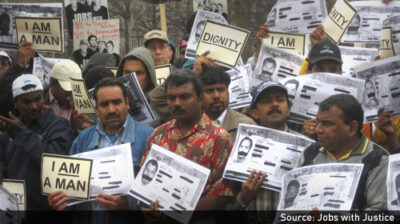
There is, unfortunately, no shortage of examples of exploitation and abuse under the program. In just one example, the ACLU and co-counsel represented men from India trafficked through the H-2B guestworker program with recruiters’ and employers’ false promises of green cards and good industrial jobs on the U.S. Gulf Coast. However, when the Indian workers arrived in late 2006 and early 2007, they found themselves living in segregated, overcrowded, guarded labor camps. Our clients were also victims of severe racial discrimination, which led in 2011 to a separate lawsuit by the Equal Employment Opportunity Commission. Sadly, their experience, while horrific, is emblematic of the broader problems with the guestworker program.
In America, one group of migrant workers faces unique forms of human rights abuses that are directly attached to their visa status: guestworkers (aka temporary workers). In the U.S. government’s H-2B guestworker program, visas tie guestworkers to a single “employer-sponsor” without the ability to change jobs. This makes the worker’s ability to obtain and retain status in the United States entirely dependent on their remaining on good terms with their employer. The program allows the employer to treat the worker as a disposable commodity, using the labor and then tossing the worker away if they complain about any aspect of their job, seek to educate other workers about their legal rights, are in any way non-compliant with the demands of the employer, or for any reason at all.
Guestworkers are generally afraid to be sent back to their home countries because they often arrive in the United States saddled with huge debts paid to recruiters for recruitment fees and travel. That debt is often multiplied by high interest rates charged by the loan sharks who workers approach to fund payment for the fees. Because recruiters often misrepresent the terms and conditions of employment opportunities in the United States, and because our government does not require these foreign recruiters to register or to even agree to follow U.S. law, fraudulent recruiters are often unaccountable for their actions. To make matters worse, the U.S. government has no oversight mechanism to ensure that guestworkers are not mistreated after they arrive in the United States or that the contracts workers sign with recruiters are honored after the workers are here and under the control of their “employer-sponsors.”
There is, unfortunately, no shortage of examples of exploitation and abuse under the program. In just one example, the ACLU and co-counsel represented men from India trafficked through the H-2B guestworker program with recruiters’ and employers’ false promises of green cards and good industrial jobs on the U.S. Gulf Coast. However, when the Indian workers arrived in late 2006 and early 2007, they found themselves living in segregated, overcrowded, guarded labor camps. Our clients were also victims of severe racial discrimination, which led in 2011 to a separate lawsuit by the Equal Employment Opportunity Commission. Sadly, their experience, while horrific, is emblematic of the broader problems with the guestworker program.