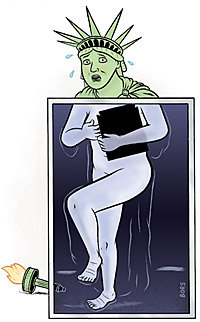
Andy Greenberg at Forbes.com reported yesterday that company representatives told him that backscatter X-rays mounted in vans that can be driven around the public streets have been sold to, and deployed by, domestic U.S. law enforcement agencies.
Backscatter X-rays are one of the technologies that are used in full body scanners at airports (over our strenuous objections). They can see through clothing and reveal the naked human form.
We don't know exactly how government purchasers of these vans are using them, but if they are in fact being used on public streets, that would be a major violation of the Constitution. In fact, it's hard to believe that any counsel at any government agency would sign off on allowing these vans to be used in that way.
Greenberg writes:
American Science & Engineering, a company based in Billerica, Massachusetts, has sold U.S. and foreign government agencies more than 500 backscatter x-ray scanners mounted in vans that can be driven past neighboring vehicles to see their contents, Joe Reiss, a vice president of marketing at the company told me in an interview. While the biggest buyer of AS&E's machines over the last seven years has been the Department of Defense operations in Afghanistan and Iraq, Reiss says law enforcement agencies have also deployed the vans to search for vehicle-based bombs in the U.S.
The use of this technology constitutes a search, and under the Fourth Amendment, a search can only be carried out with a warrant. There are exceptions to that, but none of them would apply if this technology is being used on public streets:
- The courts have ruled that motor vehicles can be searched by police officers without a warrant — but only when those officers have probable cause to believe that the vehicle contains evidence or contraband. That is the same standard required to get a warrant (the only difference is that the officer does not have to get the prior approval of a judge).
- In addition, to the extent that these devices provide scans of individuals (in vehicles or on the street), then even the motor vehicle exception would not apply.
- The courts have ruled that the government can carry out intrusive "administrative" searches on airline passengers, strictly for the narrow purpose of protecting the safety of aircraft. Clearly not applicable here.
- Searches are also conducted at government buildings and some other venues, but again those are carried out for a specific protective purpose, are usually voluntary, and are done with the knowledge and cooperation of the subject, who can therefore prepare for the search to minimize the invasion of privacy involved. Conducting such searches without full disclosure would certainly be unacceptable from a privacy standpoint.
Another major exception to the Fourth Amendment is at the nation's borders, where individuals have reduced (but not zero!) rights of privacy. Again that would not be relevant to internal use. The Department of Homeland Security is, in fact, working on deploying vehicle-scale backscatter X-ray scanners at the borders (as I learned at a briefing I received on this recently) and this may account for some of the units sold to domestic agencies (Customs & Border Patrol is part of DHS). Use of this technology on the border also raises certain concerns, but is a more complicated issue than use on the streets would be.
In addition to the privacy issues involved, it should be noted that backscatter X-ray scanners use radiation. Although the doses are said to be very low, scientists have raised questions about whether they might inadvertently deliver concentrated doses to particular spots on subjects' skin. Concerns have also arisen over the calibration and operation of these machines. Last month, the New York Times reported that more than 400 patients around the country accidentally received serious radiation overdoses from CT scan machines operated by trained medical personnel — enough to cause hair loss, rashes, memory loss, and elevated cancer risk. Do we trust that the government has the proper management and oversight mechanisms to ensure that every one of its roving scanners is working right, calibrated properly, and will not be "cranked up" by operators eager to see ever more detail in the scans they are producing?
Unless they have probable cause to search a specific vehicle, government agencies had better not be roaming U.S. streets conducting backscatter X-ray scans of vehicles and their occupants (much less pedestrians, cyclists, etc.) without their knowledge or consent. The Constitution may have taken a battering in recent years, but on this point it remains clear.
Related Issues
Related Content
-
NevadaSep 2026

Privacy & Technology
National Security
Killinger V. Jager. Explore Case.Killinger v. Jager
On September 21, 2026, the ACLU, ACLU of Nevada and the Innocence Project filed an amicus brief in the District of Nevada in support of Jason Killinger, a man wrongfully arrested after police relied on an incorrect result from facial recognition technology. -
Press ReleaseSep 2026

National Security
Human Rights
Aclu Statement Commemorating 25 Years Since September 11 Attacks. Explore Press Release.ACLU Statement Commemorating 25 Years Since September 11 Attacks
NEW YORK - In remembrance of the 25th anniversary of the September 11, 2001 attacks, Anthony D. Romero, executive director of the American Civil Liberties Union, issued the following statement: “Twenty-five years after the attacks on Sept. 11, 2001, the ACLU remembers the victims, their families, and all of those impacted. We pay particular tribute to John William Perry, a New York Police Department officer, lawyer, and longtime member of the Nassau County Chapter board of the New York Civil Liberties Union who tragically died in the rescue effort. "The lessons of the post-9/11 era apply to the abuses of power we face today. Immediately following the attacks, the ACLU urged government leaders to respond justly and in accordance with the safeguards enshrined in our Constitution. “Instead, successive presidents claimed expansive power that eroded many of our fundamental freedoms. U.S. leaders authorized torture and indefinite detention, launched illegal wars, warrantlessly surveilled Americans, and signed off on other horrific human rights violations. The Patriot Act was rubber-stamped by a Congress too afraid to ask the tough questions. And the courts all too often abdicated their role in our system of checks and balances and deferred to the executive. “Yet, thanks to the tireless work of civil liberties and civil rights organizations, human rights groups, investigative journalists, and the communities who were at the center of the harm, some of the worst abuses of that era came to light — and some of them ended. Other abuses continue to this day: Notably, key provisions within the Patriot Act are still the law of the land, and the government is still prosecuting individuals through a military commission process that has never worked and will never render true justice. "As we challenge the Trump administration's daily assault on our civil liberties and civil rights, we remain steadfast in the knowledge that our nation’s true strength lies in its people, an independent judiciary, and our commitment to due process. “The tragedy of 9/11 taught us that adherence to the rule of law is what makes this country great. Twenty-five years ago, we learned that we ought not forfeit our civil liberties in the face of government officials who are abusing their power. That lesson is doubly relevant today.” -
Press ReleaseSep 2026
National Security
Aclu Demands End To The Trump Administration’s Illegal Year-long Boat Strikes Campaign. Explore Press Release.ACLU Demands End to the Trump Administration’s Illegal Year-Long Boat Strikes Campaign
NEW YORK – Ahead of the one-year anniversary of the Trump administration’s bombing campaign of private boats in international waters, the American Civil Liberties Union is demanding immediate action from both Congress and the White House. On Sept. 2, 2025, the United States struck a small boat in the Caribbean Sea that had 11 people on board. Nine were killed in the first strike. Two survived, clinging to the wreckage for around 45 minutes before a second “double tap” strike killed them. In the year since the Trump administration launched its campaign, the United States has conducted at least 68 strikes and killed at least 227 civilians, including the family members of two ACLU clients. This tragic milestone comes right after U.S. Secretary of Defense Pete Hegseth announced plans to expand lethal military operations throughout Latin America. “For a year now, the Trump administration has engaged in a terrifying, lawless killing campaign at sea and has yet to provide the public with anything beyond the most threadbare justifications,” said Jeff Stein, staff attorney with ACLU’s National Security Project. “These strikes have devastated countless families, terrified communities, and, by the administration’s own admission, failed to achieve their purported goal of stopping drugs from entering into the United States. We urge leaders in both Congress and the executive branch to put an immediate end to these strikes before anyone else is killed.” The Trump administration has claimed, without proof, that these military strikes are targeting unnamed drug cartels. But neither domestic nor international law authorizes the use of military force against such criminal organizations. The strikes are thus premediated killings of civilians outside of armed conflict, constituting murders under domestic law and extrajudicial killings under international human rights law. Nonetheless, a secret Trump administration legal memorandum reportedly blesses the strikes as lawful and purports to immunize personnel who authorized and carried out the strikes from future criminal prosecution. Along with the Center for Constitutional Rights (“CCR”) and the New York Civil Liberties Union, the ACLU is suing for the immediate release of this memorandum. While many of the strikes’ victims remain unknown, according to investigative journalists and Senator Tim Kaine (who has reviewed classified information about the strikes), the strikes have killed ordinary people with no connection to drug trafficking. That includes Chad Joseph and Rishi Samaroo, two Trinidadian men who worked as fishermen and farmhands in Venezuela and were killed in an October 14, 2025, strike while returning home to see their loved ones. The ACLU, the ACLU of Massachusetts, and CCR represent Chad and Rishi’s family members in a lawsuit against the United States government seeking compensation for their wrongful deaths. The ACLU has also called on international human rights bodies, such as the Inter-American Commission on Human Rights, to investigate the strikes and hold the perpetrators accountable. “The international community must do everything in its power to hold the Trump administration responsible for these extrajudicial killings that are blatant violations of international law,” said Jamil Dakwar, director of ACLU’s Human Rights Program. “No other country should provide any assistance that could contribute to these unlawful U.S. government killings. We call for independent international investigation into this lawless campaign.” -
Press ReleaseAug 2026
Privacy & Technology
National Security
As Public Opposition To Flock Grows, Aclu Responds To Surveillance Company’s “new” Updates. Explore Press Release.As Public Opposition to Flock Grows, ACLU Responds to Surveillance Company’s “New” Updates
NEW YORK – Amid nationwide outcry against its automatic license plate readers, Flock Safety announced today that it will reduce its standard data retention policy and allegedly provide more control over local data searches, among other changes. However, according to American Civil Liberties Union’s new analysis, many of the proposed changes seem to be a thinly veiled PR attempt to counter communities’ genuine privacy concerns with its mass surveillance system with largely hollow security promises, rather than an earnest effort to address them. While the ACLU acknowledges one potentially positive development, most of the proposed changes stand little chance of making a positive difference for civil liberties. “Transforming an exceptionally dangerous mass surveillance system into one that is fully protective of civil rights and civil liberties is a difficult, if not impossible task. That is even more the case with a company like Flock, whose nearly $1 billion in venture capitalist funding has locked it into an operational model that seeks to trade our privacy for massive profits,” said Chad Marlow, senior policy counsel at ACLU. “Given that Flock’s latest announcement still appears more focused on addressing a PR problem than the significant privacy and other harms its products create, we will continue to analyze the company’s proposals fairly and honestly. We just won’t be holding our breath.” Flock operates more than 120,000 automatic license plate readers in at least 6,000 cities across the country, raising serious concerns around mass surveillance, data privacy, and how police and the government can use this data to go after immigrants, protestors, and others. Just this week, the Institute for Justice published a database with more than 100 incidents of ALPR abuse, including romantic stalking, wrongful stops and detentions, non-law enforcement use, and other types of misconduct. One of the changes announced is that Flock will decrease its standard data retention option to one week from 30 days. This seems positive at first blush, but as the ACLU’s breakdown explains, the devil will be in the details. For example, an exception to the data retention policy is something called “Evidence Mode, which is “when a search is tied to a case number, that data is preserved instead of aging out after 7 days.” As the ACLU notes, “If ‘Evidence Mode’ only retains hit result data that police determine may be evidence in an active investigation of a specific case, then the change may be a positive one. But if Evidence Mode triggers the retention of any ALPR data that is searched, then the new mode could indefinitely retain all the ALPR data Flock collects and shares nationally.” Another “change” the company is implementing is that local police will be able to decide what types of offenses other Flock customers can search their data for. The ACLU contends that this is not new. Flock has attempted this before, and the security measure failed because police were easily able to circumvent the system’s requirement that they input the purpose of their search. Finally, Flock announced that in response to the reports of police abuse, they will now require reasons for a search, and that they plan to universally roll out its audit assistance tool to detect police misuse. Flock’s announcement fails to note how easily users have circumvented “search reason” security measures in the past or how its new policy improves the quality of the feature. And while providing “Audit Assistance” to all departments makes sense, the ACLU notes that there is no evidence that the tool works consistently to address what the Washington Post observed is a growing pattern of police officers turning Flock into a personal stalking tool. To determine the efficacy of this tool, Flock needs to have it analyzed by an independent evaluator. Until then, the ACLU says, “we don’t know if the tool is a real security measure or just window dressing.” Dozens of communities across the country have successfully convinced their leaders to cancel Flock contracts, suspend their ALPR programs, or deactivate the cameras, with many more cities considering new legislation to rein in this mass warrantless surveillance tech. In June, the ACLU launched its “Get the Flock Out” campaign to bring together the litigation, advocacy, and legislative efforts of ACLU affiliates in each state, show how communities across the country are fighting back against the spread of Flock and other license plate readers, and lay out how lawmakers at the local, state, and federal level can best protect our rights.