Last week, in honor of International Women's Day, the ACLU hosted a roundtable discussion at the 54th Session of the United Nations Commission on the Status of Women on the importance of the Convention on the Elimination of All Forms of Discrimination Against Women (CEDAW) and the great need for the United States to ratify the global treaty. The U.S. is one of only seven countries that has yet to ratify CEDAW, and of those, is the only industrialized democracy. CEDAW celebrated its 30th anniversary in December — it's time for the U.S. to join the rest of the world in ratifying this crucial treaty, which our government was instrumental in drafting.

Please note that by playing this clip You Tube and Google will place a long-term cookie on your computer. Please see You Tube's privacy statement on their website and Google's privacy statement on theirs to learn more. To view the ACLU's privacy statement, click here.
American women can benefit from CEDAW in a plethora of ways. Contrary to some misconceptions, gender discrimination and human rights abuses occur right here at home, not only in other countries. CEDAW is a holistic treaty that would encourage improvements for women in economics, healthcare, employment, education, and gender-based violence, to name a few. For example, Radhika Balakrishnan, from the U.S. Human Rights Network, explained that CEDAW would ensure that macroeconomic policies, including the government stimulus plan and decisions about spending cuts, build in consideration for the unique concerns of women. Gouri Sadhwani, from Amnesty International USA, gave the example of maternal mortality rates: every day three to four women die during childbirth in the U.S. This is not because we don't know how to stop women from dying, it's because we lack the political will to put the necessary resources into making sure that women don't die during childbirth. CEDAW contains specific guidelines and guarantees that would push the government to address this issue.
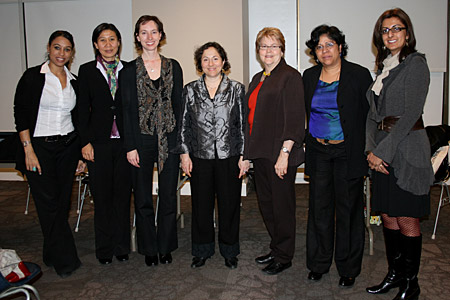
Panelists, from left to right: Karen Richardson, Zarizana Abdul Aziz, Karen Stefiszyn, Lenora Lapidus, Charlotte Bunch, Radhika Balakrishnan, Gouri Sadhwani
Zarizana Abdul Aziz, a Malaysian women's rights activist, and Karen Stefiszyn, from the United Nations Development Fund for Women, gave concrete examples of how CEDAW has produced positive results in other countries, such as legal reform in the arenas of inheritance, divorce and violence against women in countries like Kenya, Sierra Leone, and Malaysia. By holding each nation, government, and people accountable to international standards of human rights, CEDAW is instigating positive changes for women all over the world. It is an international tool with specific steps to better our world. Charlotte Bunch, from the Center for Women's Global Leadership, emphasized that, by not ratifying CEDAW, the U.S. places itself in collusion with the other nations who have not ratified CEDAW: Iran, Sudan, Somalia, Palau, Nauru, and Tonga. She noted that CEDAW has the potential to foster international dialogue and cooperation around improving women's lives, helping us all learn about good practices, new approaches and solutions to women's issues.
Karen Richardson, from the Office of the Ambassador-at-Large for Global Women's Issues in the State Department, expressed the Obama administration's commitment to women and to getting CEDAW ratified, saying that, "You really have the strongest advocates in Ambassador [Melanne] Verveer and Secretary Clinton." The panelists agreed that there is a unique political opportunity right now, in this mid-term election year, to get the 67 votes in the Senate needed to ratify CEDAW. Lenora Lapidus, from the ACLU, invited individuals and organizations to join the CEDAW Task Force, created by the Leadership Conference on Civil and Human Rights, which is leading the effort to get CEDAW ratified.
Check out video clips and a photo slideshow from the event, watch footage of the entire roundtable discussion on YouTube, and stay tuned for more ways that you can get involved.
— Stephanie Bloom and Selene Kaye
Learn More About the Issues on This Page
-
News & CommentaryMar 2026

Women's Rights
Trump Is Attacking A Crucial Fair Housing Rule That Protects Against Discrimination. Explore News & Commentary.Trump is Attacking a Crucial Fair Housing Rule that Protects Against Discrimination
The disparate impact rule is a long-held housing protection for survivors of domestic violence, women of color and other marginalized groups. The Department of Housing and Urban Development has announced plans to end the policy. -
Press ReleaseMar 2026

Women's Rights
Civil Rights Groups File Foia Request Seeking Records On Politically And Racially Motivated Child Care Funding Restrictions. Explore Press Release.Civil Rights Groups File FOIA Request Seeking Records on Politically and Racially Motivated Child Care Funding Restrictions
NEW YORK — Today, civil rights groups filed a request under the Freedom of Information Act (FOIA) seeking transparency from the U.S. Department of Health and Human Services (HHS) and its sub-agencies regarding the Trump administration’s unprecedented restrictions on federal child care and family assistance funding. The new restrictions have already caused and threaten to cause additional payment delays to child care providers, placing enormous strain on families and caregivers who depend on these programs to remain in the workforce and keep their children in safe, reliable care. The FOIA request seeks records concerning the adoption, implementation, and enforcement of the nationwide “Defend the Spend” policy and the sweeping five-state funding freeze targeting Child Care and Development Fund (CCDF), Temporary Assistance for Needy Families (TANF), and Social Services Block Grant (SSBG) dollars. In late December and early January, HHS froze access to more than $10 billion in these funds for California, Colorado, Illinois, Minnesota, and New York, while imposing new documentation and approval requirements on states nationwide. These actions jeopardize essential child care, family assistance, and social services that enable families with low incomes to work, attend school, and meet basic needs. “The administration’s new ‘Defend the Spend’ policy is a racially and politically motivated attempt to cut off access to child care programs that keep families afloat. These attacks especially harm women – and particularly women of color – who disproportionately shoulder caregiving responsibilities and are more likely to miss work because of lack of child care,” said Linda Morris, senior staff attorney at the ACLU Women’s Rights Project. “If the administration is imposing unlawful or discriminatory barriers to accessing funds, the American public has a right to know.” “Early educators and families are facing unprecedented fear and uncertainty ever since the Trump administration unleashed its torrent of attacks on the child care system,” said Whitney Pesek, senior director of federal child care policy at the National Women’s Law Center. “These attacks are not accidental: they are a targeted attempt to undermine the programs that women, and particularly women with low incomes and women of color, depend on. We are committed to holding the administration accountable for its unlawful enhanced Defend the Spend policy, which puts child care funding in a pointless administrative chokehold and delays critical funding from reaching child care programs. We urge the Department of Health and Human Services to comply with our request for information immediately.” “The Trump administration’s efforts to freeze child care funding has placed significant financial strain on low-income families already struggling to make ends meet right now,” said Saima Akhtar, senior attorney at the National Center for Law and Economic Justice. “This administration is once again using unfounded allegations of so-called ‘fraud’ to dismantle the social safety net and terrorize immigrant communities.” “Low-income families, immigrant families, and some of the children and families most in need, are the ones suffering because of the Trump administration’s attempts to cut child care funding in multiple states, including Colorado, based on the administration’s baseless claims of ‘fraud,’” said Tim Macdonald, ACLU of Colorado legal director. “The Trump administration should not be playing politics with the lives of children and families in need. Children should not be penalized over politics.” “The Trump White House regularly targets Illinois families and residents with punitive federal funding cuts, seeking to coerce leaders in our state to bend to the President’s personal and political caprices,” said Melissa Staas, senior supervising attorney at the ACLU of Illinois. “The freeze on funding for child care and family assistance in our state is the latest example. The public deserves to know if freezing child care funds to families and parents in Illinois was motivated by base politics – with no concern for the injurious impact it would have on these families.” The request filed by the American Civil Liberties Union, the ACLU of Illinois, the ACLU of Colorado, the National Women’s Law Center, and the National Center for Law and Economic Justice also seeks communications between federal officials and YouTube creator Nick Shirley, whose viral video leveled unsubstantiated fraud allegations against Somali-owned child care providers in Minnesota and was publicly amplified and credited by senior administration officials as the basis for the administration’s restrictions. The FOIA further requests communications referencing both “fraud” and “Somali,” as well as records related to statements and actions by Donald Trump and other officials that appear to scapegoat Somali and immigrant communities in justifying the funding restrictions. The groups are seeking expedited processing of the request, citing widespread public interest and the immediate harms caused by delays and uncertainty in funding. A copy of the FOIA request is available here. -
Press ReleaseJan 2026
Women's Rights
Federal Judge Grants Second Preliminary Injunction Blocking Attacks On Head Start. Explore Press Release.Federal Judge Grants Second Preliminary Injunction Blocking Attacks on Head Start
SEATTLE – A federal judge granted a preliminary injunction blocking the Trump administration’s attacks on Head Start, halting the Department of Health and Human Services’ (HHS) ban on diversity, equity, inclusion, and accessibility, as well as mass office closures and layoffs at the Office of Head Start. These administrative actions had disrupted programs nationwide and hindered their ability to fulfil their mission of providing early education and care to young children from low-income families. “This is a huge victory for kids!” said Joel Ryan, executive director of the Washington State Head Start & Early Childhood Education and Assistance Program. “When a Head Start program has their funding withheld because of their efforts to provide effective education to children with autism, serve tribal members on a reservation, or treat all families with respect, it is an attack on the fundamental promise of the Head Start program – that even children who are furthest away from opportunity should be given the early education they need to succeed in school. Today’s decision puts a stop to this attack and allows us to focus on what matters most – supporting children and families.” The ruling follows a previous preliminary injunction, which blocked a directive from the U.S. Department of Health and Human Services (HHS) to shut out some immigrant families from participating in Head Start based on their immigration status. In April, the American Civil Liberties Union’s Women’s Rights Project, the ACLU of Washington, the ACLU of Illinois, the Impact Fund and co-counsel filed a lawsuit on behalf of Parent Voices Oakland, Family Forward Oregon, and the Head Start Associations of Washington state, Illinois, Pennsylvania, and Wisconsin. The lawsuit asks the court to stop the administration from gutting Head Start, enforcing its unconstitutional ban on programs that promote diversity, equity, inclusion, and accessibility, and shutting out families and children from Head Start based on immigration status. Below are statements from plaintiffs and litigators: “No matter who they are or where they’re from, kids deserve the chance to succeed. Today’s decision ensures that Head Start providers can provide early education to children from diverse communities and backgrounds without the constant threat of being punished simply for following the requirements of the law,” said Jennie Mauer, executive director of the Wisconsin Head Start Association. “No provider should fear being shut down for providing disability-related services or language access – and no child should be deprived of critical services because of an unlawful and cruel directive.” “Head Start is essential to hundreds of thousands of low-income parents and caregivers being able to work, get an education, and provide for themselves and their families,” said Isabelle Mussard, interim executive director for Parent Voices Oakland. “The Head Start Act’s requirement to provide culturally and linguistically appropriate services means that all parents can be involved and engaged in their children’s learning. We are thrilled that today’s decision stops the administration from denying entire communities access to Head Start.” “Head Start providers work tirelessly each day to foster inclusive and supportive classrooms where every child – no matter their background – can learn, grow, and get ready for school. This decision makes clear that the Trump administration cannot continue its unlawful attacks on Head Start at the expense of children and families who rely on it most,” said Linda Morris, senior staff attorney at the ACLU’s Women’s Rights Project. “We will continue to fight for every Head Start family to ensure they have access to the education and care they need.” “This injunction protects access to education and opportunity for the most marginalized communities across the country,” said Brent Low, staff attorney at the ACLU of Washington. “It allows Head Start to continue its critical mission to serve young children and their families through programs that respond to the needs of the communities they serve.” “The vision of the Head Start Program – and the text of the legislation passed by Congress to authorize the program – specifically called on local programs to serve their entire community,” said Allison Siebeneck, director of the Women’s and Reproductive Rights Project at the ACLU of Illinois. “Congress has consistently voted to fund programs that advance equity, inclusion and accessibility to educational opportunities for people from diverse communities. The injunction issued in this case simply says that the Administration cannot wipe away this promise and specific text with their edicts.” “Congress established the Head Start program to ensure that every child has access to education during this crucial time in their lives,” said Lori Rifkin, litigation director at the Impact Fund. “In striking down these illegal actions by the Trump Administration, the Court upheld the rule of law and protected the ability of Head Start agencies to effectively provide services to hundreds of thousands of children across the country.” You can find the ruling here. -
Press ReleaseDec 2025
Disability Rights
Women's Rights
Civil Rights Groups Urge Appeals Court To Order Timely Benefits Review For Survivors Of Military Sexual Trauma. Explore Press Release.Civil Rights Groups Urge Appeals Court to Order Timely Benefits Review for Survivors of Military Sexual Trauma
WASHINGTON – Four organizations advocating for the civil rights of survivors of military sexual trauma (MST) filed a friend-of-the-court brief today urging the U.S. Court of Appeals for the Federal Circuit to reverse a lower court decision denying expedited adjudication of veterans’ benefits to people with mental health disabilities arising from sexual violence in the military. The organizations filing the amicus brief, the National Alliance to End Sexual Violence, Protect Our Defenders Foundation, Service Women’s Action Network (SWAN), and the Victim Rights Law Center, are represented by the American Civil Liberties Union. “Survivors of military sexual trauma have already endured profound harm in service to our country, it is an insult upon injury that they are being forced to endure years of bureaucratic delay to receive the benefits Congress expressly promised them,” said Josh Connolly, senior vice president of Protect Our Defenders Foundation. “Congress was unequivocal when it passed the Dignity for MST Survivors Act: claims involving military sexual trauma must be expedited. Ignoring that mandate not only defies the law, it retraumatizes survivors and further undermines trust in the system meant to protect them.” In December 2022, Congress passed legislation requiring the Department of Veterans Affairs (VA) to improve its treatment of MST survivors, including the Dignity for MST Survivors Act which mandates the VA to expedite administrative appeals involving MST. Yet the U.S. Court of Appeals for Veterans Claims ruled in a case brought by Karissa Wiggins that it would not enforce this duty. “Survivors of military sexual trauma experienced the violence while in service to our country,” said Stacy Malone, executive director of Victim Rights Law Center. “It is unconscionable that victims are being denied timely access to benefits that would help them heal and rebuild their lives.” The brief explains that timely access to benefits is critical for veterans with disabilities stemming from MST, affording survivors who require costly treatment or are unable to work the financial support they need. It also explains that expedited adjudication and appeals encourage survivors to report MST and is consistent with Congress’ intent to make compensation for survivors more readily available. “Congress passed the Dignity for MST Survivors Act nearly unanimously with a crystal-clear mandate: to improve the treatment of victims of military sexual trauma. By denying prompt review of these claims, our government is breaking the promise Congress made to care for those who have served,” said Brad Adams, senior staff attorney with the ACLU Disability Rights Program. Finally, the brief highlights that women and LGBTQ veterans are overrepresented among survivors, bearing the brunt of a dysfunctional claims process, while stigma and implicit biases infect the claims of men and Black veterans, who are more likely to have their claims denied. “Timely access to benefits can be the difference between stability and crisis for survivors of military sexual trauma. Congress recognized this reality when it required expedited review of MST claims. Failing to enforce that law undermines both survivor dignity and congressional intent,” said SWAN’s CEO and President Elisa Cardnell. The brief is available here: https://www.aclu.org/cases/karissa-wiggins-v-douglas-collins?document=Amicus-Brief