Trump’s Threat to Invoke the Insurrection Act, Explained
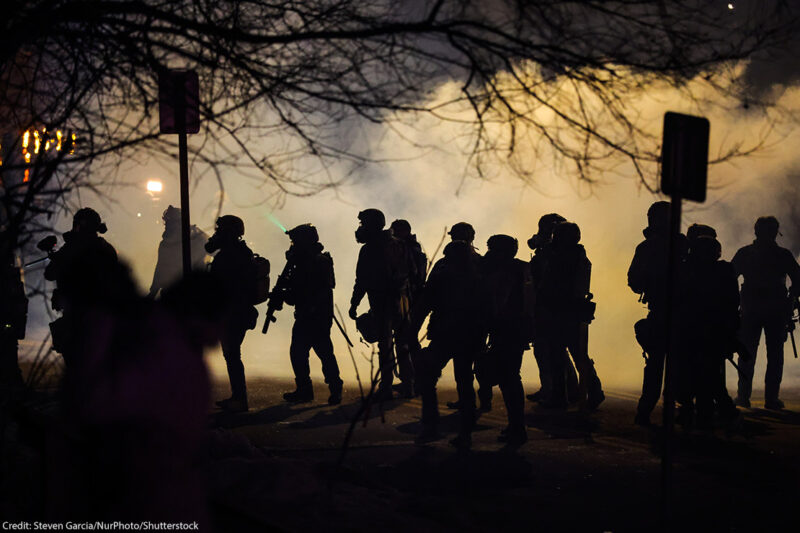
President Donald Trump threatened to invoke the Insurrection Act in Minnesota this week, continuing to stoke fear and chaos in a situation his administration created by unleashing lawless, armed federal agents against our communities.
This is not the first time the president has threatened to invoke the act, which Congress intended presidents to use only for specified and extreme emergencies, in his first or second administrations. Each time, it has been clear that President Trump’s invocation of the Insurrection Act would be unnecessary, inflammatory, and a dangerous abuse of power.
The Insurrection Act is meant to be a rarely-used exception to our foundational principle that the American military should not police the American people on domestic soil. That general rule exists for good reasons: military policing of civilians is corrosive to democracy and it puts our civil liberties and rights in peril.
Despite this, Trump renewed his threat. He did so after an Immigration and Customs Enforcement (ICE) officer killed 37-year-old mother Renee Nicole Good during a reckless and violent federal immigration enforcement operation, to which the American people have responded with overwhelmingly peaceful protests.
Stop ICE's Attack On Our Communities | American Civil Liberties Union
Stop ICE's Attack On Our Communities | American Civil Liberties Union
Federal agents’ abuses of authority and violations of constitutional rights are already brazen and cruel. President Trump’s Insurrection Act threat is contrived to escalate conflict and intimidate people exercising their First Amendment rights to speak out against injustice and observe federal agents’ activities in public spaces. The threat itself shows why the Insurrection Act is unjustified: the president would be using troops to undermine our rights, not protect them.
We’ve seen this pattern in Los Angeles, Portland, Chicago and other cities. Federal officers descend on communities to conduct violent immigration raids, instill fear, and profile residents based on race. When the American people exercise their First Amendment right to protest, federal officers respond with recklessness, injuring and maiming community members.
Below we break down what the Insurrection Act is, its long history, and how it could impact our communities if it’s invoked.
What is happening in Minnesota?
Since December, the Trump administration has deployed nearly 3,000 ICE and Border Patrol agents to Minnesota. In response to their lawless approach — characterized by masked and armed federal agents conducting violent raids, racial profiling, and violations of people’s rights, including U.S. citizens’ — overwhelmingly peaceful protests have grown in size.
These protests ballooned both in Minnesota and across the country after an ICE agent shot and killed Renee Nicole Good, a 37-year-old mother and American citizen. Yet the Trump administration doubled down on its tactics. Federal agents have continued their reckless raids and even shot three other people in Minneapolis and Portland. President Trump posted on Truth Social falsely characterizing protestors as “insurrectionists” and said he would invoke the Insurrection Act if state officials did not quell protests in Minnesota.
But “the real risk to people's safety comes from ICE and other federal agents' violence against our communities,” said Hina Shamsi, director of the ACLU National Security Project. “The killing of Renee Good starkly shows what happens when ICE operates without accountability.”
What is the Insurrection Act?
The Insurrection Act authorizes the president to use federal troops to police civilians in certain specified and extreme emergencies.
The general rule in our system is that presidents are prohibited from using the federal military for law enforcement on domestic soil. The Insurrection Act is a narrow exception and is rarely used specifically because unchecked power is a threat to liberty and can lead to tyranny.
The ACLU and others have long criticized the Insurrection Act as far too vague, but it still has important restrictions on when presidents can use it. It contains three provisions: one that authorizes the president to deploy federal or federalized National Guard troops at the request of a state, to suppress an insurrection against the state’s government. Two other provisions do not require a state governor’s request, but presidents may only invoke them to deploy federal troops to suppress insurrection, violence, or conspiracy and enforce federal law when courts or ordinary law enforcement cannot, or to protect civil rights.
Congress, the courts, and the executive branch have therefore treated invocation of the Insurrection Act as a last resort, to put down forcible state resistance to a court order, or to enforce federal rights when state authorities are entirely unable or unwilling to do so.
That’s far from the situation in Minnesota or anywhere else in the country.
Has the Insurrection Act been invoked before?
In 230 years, presidents have invoked the law only 30 times. Not only is presidential invocation of the act rare, it’s almost always controversial. The U.S. Department of Justice Office of Legal Counsel, which provides legal opinions for the president, has generally advised caution and restraint in invoking it.
The last time a president invoked the Insurrection Act without a state governor’s consent was more than 60 years ago. In keeping with the act’s constraints, in 1965, President Lyndon B. Johnson invoked it to protect civil-rights protestors after Alabama state troopers attacked peaceful activists at the Edmund Pettus Bridge on Bloody Sunday. President Trump, by contrast, appears bent on using the Insurrection Act based on falsehoods and to enable further federal deprivation of people’s rights. Under the current conditions in Minnesota, Trump’s invocation of the act would be an unprecedented and dangerous use of the military on American soil.
What happened in Trump’s previous deployments of troops?
Trump’s threat to invoke the Insurrection Act comes after months of legal defeats surrounding his previous deployments of military forces domestically.
In 2025, in spite of over state governors’ objections, President Trump forcibly federalized and deployed — or attempted to deploy — National Guard troops in Los Angeles, Portland, and Chicago. He did so after issuing a June 7th Presidential Memorandum, claiming authority under a rarely used statute to federalize and deploy National Guard members (and active-duty military troops) without geographic or temporal limitations to protect federal property and functions and enforce federal law.
California, Oregon, and Illinois filed lawsuits challenging these actions, and federal district courts in all three states ruled against the president, as did the Seventh Circuit Court of Appeals in the Illinois case.
Courts rejected the president’s arguments that he alone can decide when to deploy troops and courts have no role to play. The district court in California found that troops had violated the Posse Comitatus Act, which prohibits troops from carrying out law enforcement functions. The district court in Oregon found that the president’s determination that federal law enforcement officers could not enforce federal law in Portland was “simply untethered to the facts,” there was no “rebellion” or a “danger of rebellion” in the city, and that the forced federalization of Oregon National Guard members violated the Constitution. The district court in Illinois found that federal officials’ versions of the facts were “not reliable” and identified a “troubling trend” of government officials “equating protests with riots,” indicating “both bias and lack of objectivity.”
Finally, the Supreme Court halted Trump’s attempt to send troops into Chicago, recognizing that troop deployment to carry out federal law is “exceptional” and the Trump administration had not legally justified it. On December 31, Trump announced that he would end his deployment of National Guard troops to Chicago, Portland, and Los Angeles, and those troops have now been withdrawn. Federalized National Guard troops remain deployed in Washington, D.C., however, courts have held that because D.C. is not a state, the president exercises unique power there.
The recent threat to use the Insurrection Act is but one more attempt by Trump to circumvent the rule of law, silence dissent against his destructive policies, and further his lawless immigration agenda.
What does the Insurrection Act not do?
Despite Trump’s threat to invoke the act in response to protests, presidents may not, consistent with First Amendment principles, use the military to quell or deter lawful political protests.
Invocation of the Insurrection Act cannot and does not suspend constitutional protections. Far from it. The conduct of any troops deployed under the Insurrection Act is governed by the safeguards of our Constitution.
No matter what uniform they wear, military troops and armed federal agents must respect our constitutional rights to peaceful assembly, freedom of speech, and due process. If troops or federal agents violate these constraints, they and their leadership must be held accountable.
What will happen if President Trump invokes the Insurrection Act?
Much remains uncertain, but this much is clear: The most dangerous consequence of President Trump invoking the Insurrection Act is the harm it would cause for individual civil rights and liberties. To help protect ourselves and each other we need to know our rights.
KYR | American Civil Liberties Union
KYR | American Civil Liberties Union
President Trump would also be placing troops in legal and ethical jeopardy, and further politicizing the military in furtherance of his partisan agenda. And he would undermine the constitutional design, which prevents direct military involvement in civilian life, except in the most limited genuine crises. Images of troops patrolling city streets are more often seen under authoritarian regimes, not in our democracy.
So "what's needed now is not federal escalation, but deescalation,” said Shamsi. “Congress must demand these mass federal law enforcement forces leave Minneapolis and rein in ICE and [U.S. Customs and Border Protection] until the administration backs down.”
Related Issues
Related Content
-
Press ReleaseOct 2026

Civil Liberties
Aclu Voter Education Fund And Aclu Of Georgia Launch $250k Campaign To Educate Georgia Voters Ahead Of Midterms. Explore Press Release.ACLU Voter Education Fund and ACLU of Georgia Launch $250K Campaign to Educate Georgia Voters Ahead of Midterms
ATLANTA – The ACLU of Georgia and the ACLU Voter Education Fund are spending $250,000 in select Georgia House races to inform voters that their civil rights and liberties, including voting rights and abortion, are on the ballot this November. The ACLU Voter Education Fund will send over 225,000 mail pieces to educate voters about candidates in State House Districts 48, 53, and 105. These state races include communities like Lawrenceville, Peachtree Corners, and Sandy Springs and are highly contested. The ACLU Voter Education Fund is investing in these races because the elected candidates will influence civil rights and liberties statewide for at least two years. Their decisions will affect voting rights, reproductive rights, privacy, and other fundamental liberties. On the voter guides, residents will see candidates’ responses to questions about those issues, such as whether they would vote to repeal Georgia’s six-week abortion ban or whether they will work to prevent unnecessary restrictions on early and absentee voting. “Georgia voters have a right to know the positions that the candidates take on the rights and freedoms that shape their lives,” said Christopher Bruce, deputy executive director, ACLU of Georgia. “We’re making sure voters get the information they need to understand the issues in these elections and what the candidates would do if they had the power of the Georgia House. From reproductive freedom and voting rights to safeguarding privacy and other liberties, the choices made under the Gold Dome can have a lasting impact on our communities.” While the ACLU Voter Education Fund does not endorse or oppose any candidates, the six-figure campaign will educate voters about the candidates’ positions on key civil rights issues, including abortion, birth control, marriage equality, and voting rights for Indigenous communities, through direct mail, radio ads, and digital ads. -
Minnesota Supreme CourtOct 2026

Civil Liberties
Housing First Minn. V. City Of Corcoran And Housing First Minn. V. City Of Dayton. Explore Case.Housing First Minn. v. City of Corcoran and Housing First Minn. v. City of Dayton
When a court rules that an issue is a “political question,” that issue becomes “nonjusticiable.” In other words, courts close their doors to political questions, even when an injured plaintiff seeks relief that a court could provide. The ACLU’s State Supreme Court Initiative and the ACLU of Minnesota filed an amicus brief in the Minnesota Supreme Court arguing that the Court should narrow, or at a minimum, not expand, the political question doctrine under the Minnesota Constitution. The brief urges the Court to preserve the justiciability of legal issues and thus ensure that provisions of the state Constitution are not just words on paper but meaningful guarantees for the people of Minnesota. -
News & CommentaryOct 2026
Civil Liberties
What 'let The Record Show' Reveals About A 200-year-old Petty Paperwork Problem That Gave Courts Its Power Today. Explore News & Commentary.What 'Let the Record Show' Reveals About a 200-Year-Old Petty Paperwork Problem That Gave Courts Its Power Today
In "Let the Record Show," the ACLU's newest podcast, we discuss how office politics gave courts the power to decide if political decisions are constitutional. It's led to an array of landmark decisions that continue to protect our civil liberties today. -
Press ReleaseOct 2026
Civil Liberties
Aclu And Aclu Of North Carolina Launch Over $3.5 Million Campaign To Educate North Carolina Voters Ahead Of Midterm Elections. Explore Press Release.ACLU and ACLU of North Carolina Launch Over $3.5 Million Campaign to Educate North Carolina Voters Ahead of Midterm Elections
RALEIGH, N.C. – The American Civil Liberties Union of North Carolina and American Civil Liberties Union, Inc. today announced the launch of a joint campaign that will spend over $3.5 million to educate and engage North Carolina voters ahead of the Nov. 3 midterm elections. “For years, voters in North Carolina have watched as extreme politicians try over and over again to strip us of our rights – from our right to bodily autonomy to our right to fair representation,” said Liz Barber, ACLU of North Carolina director of policy and advocacy. “The ACLU is committed to ensuring that North Carolinians understand how state officials – like state supreme court justices and state legislators – can protect our rights, and where candidates for office this cycle stand on these important issues.” The organizations are spending $3.5 million on a series of statewide advertisements on social and digital media platforms and direct-to-voter mailers during the final weeks of the state Supreme Court race and key state legislative races. The advertisements will focus on educating voters about where candidates stand on key issues, including abortion rights and voting rights. This is the organizations’ largest electoral spend in North Carolina to date and will reach over 2.3 million voters. The spending is part of a multi-cycle strategy in North Carolina from the ACLU. In 2024, the ACLU of North Carolina and ACLU spent $750,000 on direct mail, digital ads, and grassroots outreach educating voters about issues at stake in the state Supreme Court and state legislative elections. The North Carolina Supreme Court is responsible for interpreting the state constitution and state laws. As the state’s highest court, it has the final say on many questions involving civil rights and civil liberties, and the North Carolina Constitution can provide broader protections than the U.S. Constitution. In 2022, for example, the court held that the North Carolina Constitution’s prohibition on cruel and unusual punishment can provide protections beyond those guaranteed by the Eighth Amendment. The ACLU of North Carolina, and ACLU are nonpartisan and do not support or oppose candidates for elected office. The organizations do, however, educate the voters about the issues at stake in elections and candidates’ positions and records on civil rights and civil liberties.