Why an Appeals Court Blocked a Dangerous Censorship Law in Florida’s Universities
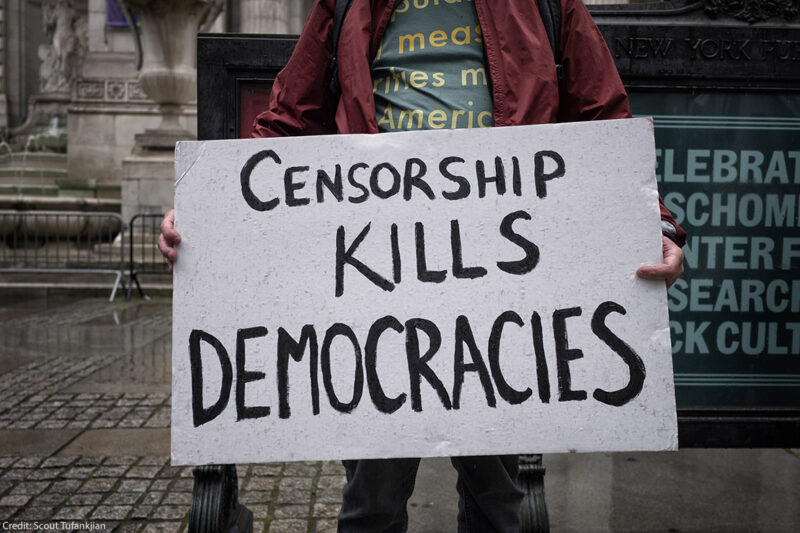
The Eleventh Circuit Court of Appeals affirmed an order in July that blocked Florida from enforcing the Stop W.O.K.E. Act in the state’s universities.
Florida is one of 24 states that has passed laws restricting instruction on race and gender in higher education since 2020. Taken together, these laws represent a nationwide backlash to progress in racial justice, but this case marks the first time an appellate court has ruled that this type of classroom censorship law is unconstitutional in higher education.

Free Speech
Racial Justice
Pernell v. Lamb
Free Speech
Racial Justice
Pernell v. Lamb
The order came in a lawsuit we filed on behalf of professors who were forced to censor their instruction on specific topics related to race and gender that are central to their academic scholarship and coursework. The Stop W.O.K.E. Act limited training and instruction on eight so-called “divisive concepts” parroted from an executive order issued by then-President Donald Trump and rescinded by then-President Joe Biden. After we sued, a federal district court described the law as “positively dystopian” and blocked enforcement of the higher education provisions of the law. Last month, the Eleventh Circuit agreed, holding that the Stop W.O.K.E. Act violated the First Amendment.
The ruling striking down the Stop W.O.K.E. Act could spread across the country as groups challenge similar laws in other states. But equally as important as the practical impact of the decision is the rationale behind it.
Viewpoint-Based Restrictions Are Especially Dangerous in Higher Education
The Stop W.O.K.E. Act imposed restrictions based on specific viewpoints — precisely the kind of law that the First Amendment was designed to prevent. Under the Act, a professor could teach the viewpoints on race and gender that the Florida legislature approved of, but could not express the disfavored viewpoint, even when it was foundational to their academic discipline. This impacted professors’ ability to teach about race and gender without running afoul of the law. In its ruling, the Eleventh Circuit emphasized viewpoint-based restrictions “designed to compel or ban a set of beliefs are dangerous in any setting, but they are especially pernicious in the classroom context.” That’s because, as the decision rightly notes, colleges and universities should be “centers of inquiry — classrooms where students are trusted to puzzle through ideas that are good and bad, easy and hard, ideally getting ever closer to the truth.”
Higher Education Instruction is Protected by the First Amendment
Academic freedom is a “special concern” of the First Amendment. This means the First Amendment protects universities’ and professors’ right to make teaching choices without government censorship targeting disfavored viewpoints. The Court was unequivocal: “If the First Amendment offers any boundary of protection at all for public university classrooms, this statute crosses it.”
Because of the nature of a professor’s job, the government’s authority to limit the speech of public employees in some circumstances without violating the First Amendment does not apply to classroom instruction in colleges and universities. The Supreme Court recognized that university professors engaged in teaching and scholarship may have “additional constitutional interests” beyond other public employees. Their academic speech is different from that of civil servants who are administering government programs, and leading a discussion or giving a lecture does not present the same workplace management concerns. According to the Supreme Court, to “impose any strait jacket” upon the leaders in colleges and universities would imperil the future of our nation.
Free Speech
LGBTQ Rights
Lessons Learned from Our Classroom Censorship Win Against Florida’s Stop W.O.K.E. Act
Free Speech
LGBTQ Rights
Lessons Learned from Our Classroom Censorship Win Against Florida’s Stop W.O.K.E. Act
In the lawsuit, Florida argued that all classroom speech was government speech, which would make it immune from the First Amendment, because professors were hired and paid by the government. But the Court squarely rejected this dangerous argument. The state doesn't control curriculum in higher education, the classroom instruction in colleges and universities doesn’t traditionally communicate ideas on behalf of the government, and the public doesn’t view it as endorsed by the government. Finally, the Court refused to extend the government speech doctrine to a ban on disfavored ideas.
Governing Higher Education Does Not Include Banning Disfavored Views
Universities may shape curricular content, such as the majors or courses offered, impose basic general education requirements for graduation, discipline teachers, and ensure competent academic instruction. However, the legislature may not ban disfavored speech. “Though the government has plenty of ways to promote its own viewpoint, puppeteering every university professor in the state is not one of them,” the Court ruled.
Instruction About Discrimination Is Not Actual Discrimination
The Court also rejected Florida’s argument that the Act prevented discrimination. This represented a strong repudiation of the Act and similar laws across the country that purport to shield students from learning about racism and sexism. However, constraining the ability to learn about discrimination does not empower students to identify or fight it—it does the opposite.
The Stop W.O.K.E. Act is one of the best-known examples of the classroom censorship laws that have pervaded state legislatures since 2020. This decision marks an important step toward a future where our classrooms are no longer political battlegrounds. With this decision, the courts agree: The First Amendment protects our right to teach, learn, and read without government interference.
Related Issues
Related Content
-
Press ReleaseSep 2026

Free Speech
Federal Appeals Court Says That Race, Gender Instruction Are Not Censored In Oklahoma Classrooms. Explore Press Release.Federal Appeals Court Says That Race, Gender Instruction Are Not Censored in Oklahoma Classrooms
DENVER — In a split opinion, the Tenth Circuit Court of Appeals yesterday held that a classroom censorship law that went into effect in Oklahoma in 2021 does not censor concepts related to race and gender in the classroom. The law, one of a rash of state-level classroom censorship laws that have pervaded the country since 2021, prohibited teachers from “making part of a course” eight concepts related to race and gender. The district court had blocked enforcement of several provisions of the law including two of the most confusingly worded concepts in 2024, while leaving the rest of the law in place. While yesterday’s ruling vacates that preliminary injunction, two judges on the three-judge panel interpreted the law so narrowly that it does not prohibit schools from presenting robust instruction on issues related to identity and discrimination. In a dissent, Judge Nancy Moritz pointed out that the majority was “attempt[ing] to rescue an obviously vague statute” and that she would have blocked enforcement of the law “in full.” “The majority’s narrow reading of the law means that H.B. 1775 is no longer a barrier to inclusive teaching and honest discussions about race and gender,” said Emerson Sykes, senior staff attorney with the ACLU’s Speech, Privacy, and Technology Project. “This decision will provide much-needed relief to students and educators across the state who can once again teach, learn, and discuss the world around them without fear of punishment under this law. We hope that this ruling constrains any Oklahoma officials tempted to use this law to censor educators.” “Oklahoma students deserve a nuanced education of race, gender, and American history,” said Megan Lambert, legal director with the ACLU of Oklahoma. “Such nuanced instruction may now return to Oklahoma classrooms. This ruling narrowed Oklahoma’s censorship law out of existence by interpreting it to only prohibit educators from affirmatively encouraging discrimination. We stand with Oklahoma educators and will continue to ensure Oklahoma classrooms are free from state censorship.” The suit was originally filed in 2021 by the ACLU, the ACLU of Oklahoma, Lawyers Committee, and McDermott, Will & Schulte LLP filed suit against HB 1775 on behalf of a broad group of public school teachers and students. “As Judge Moritz correctly relays in her dissent, 'teaching is far broader in scope than dispensing a sterile set of correct-or-incorrect facts to students—teaching involves responding to questions, leading open-ended discussions, and exploring real-world parallels to, and the legacies of, historical events,' said Michael Pillera, Director of the Educational Opportunities Project at the Lawyers’ Committee for Civil Rights Under Law. “The majority decision, while grossly misunderstanding the role of teachers and deeply underappreciating the intellectual journey students take in classrooms throughout Oklahoma, stymies a vague law's most harmful reach. The majority states that teachers only violate the law if they present an 'unqualified racist or sexist assertion' as fact, something the broad majority of teachers are clearly not doing.” For more information about the OK NAACP v. Drummond, see here. -
Press ReleaseSep 2026
Free Speech
New Filing Details Continued Intimidation Campaign Against Memphis Resident For Recording Memphis Safe Task Force Activity. Explore Press Release.New Filing Details Continued Intimidation Campaign Against Memphis Resident for Recording Memphis Safe Task Force Activity
MEMPHIS – Today, the American Civil Liberties Union, the ACLU of Tennessee, Selendy Gay PLLC, and BraunHagey Borden LLP filed a declaration on behalf of client Hunter Demster detailing the Memphis Safe Task Force’s continuing campaign of retaliation and intimidation against him for recording immigration and law enforcement activity. Memphis Safe Task Force (Task Force) agents also abused Tennessee’s Halo Law to tackle and arrest Mr. Demster while he was recording them apprehending an individual. On two occasions over five days, Task Force agents have appeared outside Mr. Demster’s home and photographed or filmed him and his home. Mr. Demster was also pinned down and arrested after Task Force agents abused the Halo Law to continue to push him back and obstruct his view of a scene while recording. The Halo Law criminalizes approaching within 25 feet of an officer after receiving an order to stop approaching or to retreat. Agents used the law as a moving wall, repeatedly issuing new stop-approaching orders as they walked toward Mr. Demster, so that standing still counted as a violation. Videos of these incidents are available here. The incidents come just weeks before a federal district court is set to hear argument on Mr. Demster and other plaintiffs’ motion for a preliminary injunction to stop the Memphis Safe Task Force from retaliating against our clients who seek to record and observe immigration and law enforcement activities. Alongside the motion, the legal team filed numerous declarations describing how multiple Memphians have been threatened with arrest, intimidated with Task Force vehicles, experienced unlawful traffic stops, and witnessed continued surveillance outside their homes after they filmed the Task Force. “The Task Force has tried to punish and intimidate me for exercising my First Amendment rights, but I will not let them chill my speech,” said Hunter Demster, plaintiff. “It is not only concerning, it is also deeply frightening how their retaliation has escalated – all because I show the world what’s going on in Memphis. I have every right to record and observe what goes on in my own neighborhood, and I will not be intimidated into surrendering my free speech.” The filing details three incidents. The first incident occurred on August 26, 2026, when Mr. Demster observed a group of Task Force agents and proceeded to record the agents’ activities on the sidewalk. Despite not interfering with or impeding Task Force activity, several agents pointed at him and yelled “25 feet.” While he was retreating, two agents continually approached him while repeatedly invoking the Halo Law. When Mr. Demster asserted that he was considerably more than 25 feet back from the scene and exercising his First Amendment right to record, an agent responded, “You’ve gotta be 25 feet back from me because I’ve extended the scene.” Shortly after, agents surrounded Mr. Demster, tackled him to the ground, pinned him down, restrained his legs, and handcuffed him. Videos of Mr. Demster's arrest are available here, here, and here. While Mr. Demster was under arrest, Lucas Cameron-Vaughn, legal director of the ACLU of Tennessee and co-counsel in this litigation, arrived at the scene. Despite identifying himself as Mr. Demster’s attorney and attempting to speak with Mr. Demster, Mr. Cameron-Vaughn was also ordered to retreat 25 feet and threatened with arrest. Mr. Demster was eventually released at the scene. Video of invocation of the Halo Law against Mr. Cameron-Vaughn is available here. The second incident occurred on August 30, 2026, four days after Mr. Demster was arrested. Mr. Demster was at home when a group of Task Force agents amassed across the street from his home. When Mr. Demster approached the group of agents, one of the agents called Mr. Demster by his name. The agents departed in unmarked vehicles approximately ten minutes later, and, as they left, an agent wearing a U.S. Marshals vest photographed or filmed Mr. Demster and his house. Video of the agents across the street from Mr. Demster’s house is available here. The third incident occurred on September 3, 2026. When Mr. Demster arrived at his home, he saw a Memphis Safe Task Force vehicle parked immediately outside his home. Mr. Demster approached the vehicle and asked why agents were outside his house and if he could help them. One of the agents said no. While Mr. Demster was filming the vehicle, an individual inside the SUV extended his phone out the window and photographed or filmed Mr. Demster. Video of the agents parked outside Mr. Demster’s home and photographing or filming Mr. Demster is available here and here. "Task Force agents should not be staking out our clients' homes simply for recording their activities in public,” said Scarlet Kim, senior staff attorney with the ACLU's Speech, Privacy, and Technology Project. "Nor should they abuse the Halo Law to interfere with our clients’ First Amendment right to record. The Task Force’s unrelenting campaign of harassment against Mr. Demster and our other clients for simply documenting their activities is terrifying and a gross violation of their constitutional rights. The court must step in to protect them.” Since September 2025, thousands of federal, state, and local agents have flooded the streets of Memphis as part of the Memphis Safe Task Force, a 31-agency Task Force that has aggressively patrolled the city at the invitation of Governor Bill Lee and President Donald Trump. Agents and officers working with the Memphis Safe Task Force have terrorized local communities, conducting mass traffic stops and large-scale immigration arrests, primarily in communities of color. With Task Force abuses upending daily life in Memphis — a city already rocked by historic and pervasive law enforcement violence — ordinary Memphians have taken to the streets to observe and record their activities. “Task Force agents used Tennessee’s Halo Law as a moving barrier to push Mr. Demster farther and farther from the scene he was documenting,” said Lucas Cameron-Vaughn, legal director with the ACLU of Tennessee. “When I identified myself as his attorney and tried to speak with him after his arrest, agents threatened me with arrest too. No one should face intimidation, surveillance, or arrest for peacefully recording law enforcement activity in their own community. The court must act to protect our clients’ First Amendment right to observe and document what public officials do in public.” A hearing for the legal team’s motion for a preliminary injunction will be held on September 23, 2026, in Memphis. The lawsuit was filed in mid-May by the American Civil Liberties Union Foundation, the ACLU Foundation of Tennessee, Selendy Gay PLLC, and BraunHagey & Borden LLP in the United States District Court for the Western District of Tennessee. The named defendants include Acting Attorney General Todd Blanche and the heads of DHS, ICE, CBP, the U.S. Marshals, and the Tennessee Highway Patrol. -
Press ReleaseSep 2026
Free Speech
Privacy & Technology
Aclu, Aclu Of D.c., And National Press Photographers Association Tell Court That Blocking Drone Photography Of Dhs Operations Violates First Amendment. Explore Press Release.ACLU, ACLU of D.C., and National Press Photographers Association Tell Court that Blocking Drone Photography of DHS Operations Violates First Amendment
WASHINGTON – Today, the American Civil Liberties Union (ACLU), the ACLU of D.C., and the National Press Photographers Association filed an amicus brief in support of a Minnesota photojournalist’s lawsuit challenging the Federal Aviation Administration's (FAA) Temporary Flight Restrictions (TFR). Earlier this year, as ICE was carrying out brutal immigration raids across the country, the FAA dramatically expanded restrictions on drone flights, banning such flights over any Department of Homeland Security (DHS) facility or “mobile asset,” which included any DHS vehicle. As the amicus explains, the TFR made it functionally impossible for journalists to use drones to gather news in any area where immigration enforcement agents were deployed, violating the First Amendment right to record public officials performing their duties in public. “The FAA’s restriction forced journalists reporting on immigration enforcement activity to ground their drones or risk criminal charges. This choice is unacceptable, unconstitutional, and runs roughshod over the First Amendment right to gather news,” said Scarlet Kim, senior staff attorney with ACLU’s Speech, Privacy, and Technology Project. The brief explains that the FAA’s restriction was not about public safety or national security. Journalists were previously already advised and generally adhered to avoiding airspace around sensitive locations, such as active military bases, airports, and aircraft carriers. Moreover, press drones weren’t interfering with official activity or putting anyone at risk by capturing immigration enforcement activity unfolding in public. "Under Trump, even the Federal Aviation Administration has become a political censor,” said Arthur Spitzer, senior counsel at ACLU-D.C. “The agency should be protecting the safety of the flying public, not protecting ICE from unfavorable news coverage.” The brief further explains that journalists were effectively being censored beyond their DHS coverage, since the unpredictability of where any DHS vehicle may be traveling made it functionally impossible for journalists to use drones for any newsgathering in areas where immigration enforcement agents were deployed without putting themselves at risk of severe legal and financial penalties. “Drones have become essential, safe, and economical tools for documenting government activity and other matters of public concern. By creating an unpredictable moving exclusion zone around DHS assets, the FAA forced visual journalists to choose between abandoning lawful newsgathering and risking severe penalties,” said Mickey H. Osterreicher, general counsel for the National Press Photographers Association. “Safety restrictions must be narrowly tailored and consistent with the First Amendment, especially when they limit the public’s ability to observe government officials performing their duties.” -
Washington, D.C.Sep 2026

Free Speech
Levine V. Faa. Explore Case.Levine v. FAA
On September 4, 2026, the ACLU, ACLU of D.C. and the National Press Photographers Association filed an amicus brief to urge the court to block airspace restrictions on drone flights, banning such flights over any Department of Homeland Security (DHS) facility or “mobile asset,” which includes any DHS vehicle.