Trump's Muslim Ban Flies in the Face of International Law and Treaties the US Has Ratified
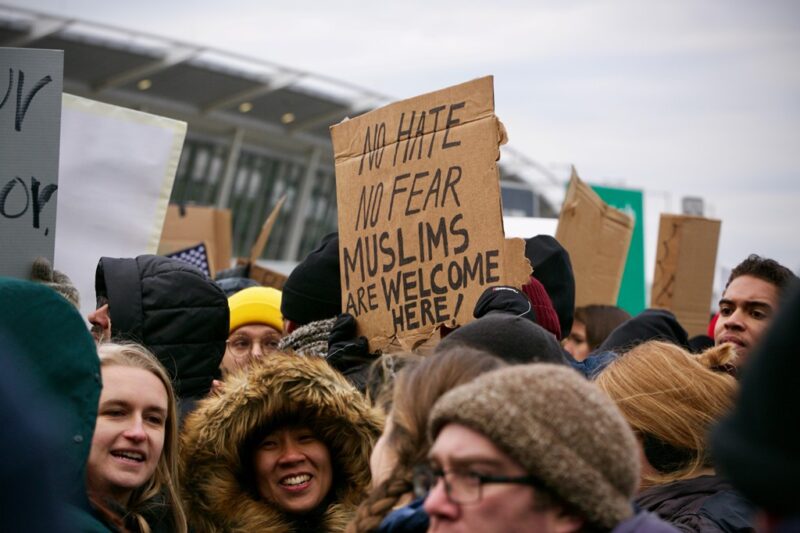
This piece originally ran at Al Jazeera English.
The day after US President Donald Trump signed his now notorious Muslim ban, he spoke with Germany’s Chancellor Angela Merkel. Over the phone, she reportedly “explained” to Trump the United States’ obligations under international refugee law, which requires the international community to take in war refugees on humanitarian grounds.
It’s hardly surprising that President Trump had to learn about the United States’ responsibilities towards refugees from a foreign head of state. But it’s clear that after only a week in office his administration’s lack of familiarity with and respect for refugee and human rights law is already charting a dangerous course for the country and the world.
While the exact scope and meaning of the executive order continues to be deciphered, on its face and as applied to date, Trump’s order appears to violate several international treaties ratified by the US, some provisions of which have been incorporated into US law and cited as binding by the US Supreme Court.
In particular, the order seems to fly in the face of the 1967 Protocol Relating to the Status of Refugees which updated the post-World War II Refugee Convention of 1951, and other international human rights law that prohibits discrimination on the basis of race, religion, or national origin.
To continue reading the piece, click here.
Related Issues
Related Content
-
Press ReleaseOct 2026

National Security
Human Rights
Families Of Trinidadian Men Killed One Year Ago By Trump Administration Call For Justice. Explore Press Release.Families of Trinidadian Men Killed One Year Ago by Trump Administration Call for Justice
NEW YORK – On the one-year anniversary of the Trump administration’s murder of two Trinidadian men killed in a U.S. missile strike last October, their family members are demanding justice and accountability. At least 239 people have been killed in these strikes since September 2025. On Oct.14, 2025, Chad Joseph and Rishi Samaroo were returning from Venezuela, where they were working on farms and as fishermen, to their homes in Las Cuevas, Trinidad and Tobago, when a missile struck their boat. Four other people also died in the strike. The ACLU, Center for Constitutional Rights, and other partners are representing Lenore Burnley, Mr. Joseph’s mother, and Sallycar Korasingh, Mr. Samaroo’s sister, in their wrongful death suit. The families are suing under a federal statute called the Death on the High Seas Act, a law that allows family members to sue for wrongful deaths occurring in international waters. “The last year has been devastating without Chad in our lives. Chad was the heart of our family. He was loving, generous and caring, and always there for us. We all miss him terribly,” said Mr. Joseph’s mother, Lenore Burnley. “A year later, we are still grieving and seeking justice for his death. We will always mourn losing Chad but hope that this lawsuit will be a step towards justice for him and the family.” Prior to his murder, 26-year-old Mr. Joseph lived with his wife and their three children in Las Cuevas, Trinidad. To support his family, he often traveled the 20 nautical miles from his home to Venezuela for work on a farm, fishing, and other odd jobs. On October 12, he called his wife to let her know that he had found a boat ride home from Venezuela and would see her in a couple of days. On October 14, his wife and mother saw social media reports of a boat strike; fearing that the boat was his, they repeatedly called him but got no reply. His family never heard from him again. Mr. Samaroo was born in El Socorro, Trinidad, where his elderly father, eight younger siblings, and two of his three sons still reside. His elderly mother lives nearby in San Juan. In 2024, he was released early from prison after serving a 15-year sentence. After paying his debt to society, Mr. Samaroo worked hard to make an honest living. In August 2025, he began working on a farm in Venezuela, taking care of goats and cows and making cheese. He would call his family almost every day when he was in Venezuela, and in an Oct. 12 call with Ms. Korasingh, he told her he’d be home soon to help her take care of their ailing mother. Just like Mr. Joseph, that was the last time Ms. Korasingh or anyone else in the family heard from him. “Not a day goes by when our family doesn’t think about our brother Rishi,” said Sallycar Korasingh, Mr. Samaroo’s youngest sister. “Rishi was a good person, loved by his family and community. The last year without him in our lives has been heartbreaking. My brother and family deserve justice. We will continue fighting for answers and the accountability we deserve.” The Trump administration has claimed, without proof, that these military strikes are targeting unnamed drug cartels. However, even if these boats did carry drugs, neither domestic nor international law authorizes the use of military force against criminal organizations. The strikes are thus premediated killings of civilians outside of armed conflict, constituting murders under domestic law and extrajudicial killings under international human rights law. “For a year now, our clients have had to live without their loved ones and without justice in the name of President Trump’s lawless killing campaign,” said Jeff Stein, staff attorney with ACLU’s National Security Project. “These illegal strikes at sea have devastated countless families, terrified communities, and made us all less safe. We won’t stop fighting for accountability. We urge leaders in both Congress and the executive branch to finally end this illegal campaign before anyone else is killed.” The ACLU and Center for Constitutional Rights are also suing for a secret Trump administration legal memorandum that reportedly blesses the strikes as lawful and purports to immunize personnel who authorized and carried out the strikes from future criminal prosecution. However, just this month, a federal court rejected several of the Trump administration’s key rationales for withholding this memo and ordered the government to provide additional details about who has seen the memo and how it has been used. The judge also ordered the government to privately give him the memo, so he can determine whether it should be released publicly. The government was given until today, Oct. 14, to comply with his order. While the Trump administration agreed to turn the memo over to the judge for his private review today, it asked the judge to reconsider the other aspects of his order. On Friday, Oct. 16, the ACLU and the Center for Constitutional Rights will file a brief opposing the government’s attempt to avoid compliance with the judge’s order. “Even as one year has gone by, and despite so many intervening Trump administration atrocities, we must not forget the administration’s unprecedented campaign of serial murders of civilians on the seas,” said Baher Azmy, Legal Director of the Center for Constitutional Rights. “This lawless campaign has left so many families broken, and, in their names, accountability under law for individuals responsible for murder will someday come.” The ACLU and Center for Constitutional Rights have also called on international human rights bodies, such as the Inter-American Commission on Human Rights, to investigate the strikes and hold the perpetrators accountable. -
Press ReleaseOct 2026
Human Rights
Aclu Congratulates Navanethem ‘navi’ Pillay For Winning Nobel Peace Prize. Explore Press Release.ACLU Congratulates Navanethem ‘Navi’ Pillay for Winning Nobel Peace Prize
NEW YORK – Today, the American Civil Liberties Union applauded the Norwegian Nobel Committee’s decision to award Navanethem, ‘Navi’, Pillay the Nobel Peace Prize for 2026 for her tireless championing and enforcement of international law. The Norwegian Nobel Committee designated this year’s laureate in acknowledgement of her impact on international law. Ms. Pillay has served as a judge on the High Court in South Africa, the International Criminal Tribunal for Rwanda, and the International Criminal Court (ICC). Previously, she was the United Nations (UN) High Commissioner for Human Rights and, until recently, chaired the UN Independent International Commission of Inquiry on the Occupied Palestinian Territory. Today, Navi Pillay is a judge on the International Court of Justice. “At a time of rising authoritarianism at home and abroad, it is more important to recognize the heroes who are protecting human rights and upholding international law,” said Anthony D. Romero, executive director of the ACLU. “Ms. Pillay’s commitment to the rule of law and pursuit of justice, and the impact of her work in the United States and across the globe, make her uniquely qualified for the Nobel Peace Prize.” The acknowledgement of Ms. Pillay’s human rights work comes at a time when the Trump administration has pursued efforts to erode pathways of international accountability and justice, including sanctions against the International Criminal Court. The celebration of her work underscores the importance of preserving and recognizing global justice and human rights accountability bodies. “The decision to recognize and honor Ms. Pillay comes at a time when the United States under the Trump administration continues to flout international law and is attempting to dismantle global justice institutions that provide accountability for human rights violations,” said Jamil Dakwar, director of the ACLU’s Human Rights Program. “We greatly welcome this recognition of Ms. Pilay and hope her extraordinary career and work for justice serves as an example for leaders in the United States and around the world to uphold their human rights obligations and pursue justice for all.” -
Press ReleaseOct 2026
Human Rights
Aclu Statement On President Trump’s Latest Attack On The International Criminal Court. Explore Press Release.ACLU Statement on President Trump’s Latest Attack on the International Criminal Court
NEW YORK – Today, the Trump administration announced sanctions on the entire International Criminal Court, only hours after one of the court’s former judges won the Nobel Peace Prize. Previously, the United States had sanctioned specific ICC officials, a UN human rights expert, and three Palestinian human rights groups. The international community, including the United States, established the ICC in 1998 to help maintain international peace and security. The ICC investigates and prosecutes atrocity crimes when domestic legal systems are unwilling or unable to do so. 125 countries have joined the international treaty creating the ICC, known as the “Rome Statute.” While the United States has not ratified the Rome Statute, it has supported the ICC’s critical work on a wide range of matters under both Democratic and Republican administrations. “The Trump administration’s continued attempts to dismantle the International Criminal Court are disastrous for global justice and human rights accountability,” said Jamil Dakwar, director of the ACLU’s Human Rights Program. “We condemn the latest sanctions, which could undercut the ICC’s ability to investigate and prosecute atrocities such as genocide, crimes against humanity, and war crimes, and make it even harder for survivors to get justice. We cannot move backwards and let the Trump administration take the world further down a path of impunity and injustice.” The ACLU represents two U.S. human rights advocates in a federal lawsuit challenging President Trump’s initial sanctions targeting the ICC on Feb. 6, 2025. As the lawsuit explains, the sanctions violate the First Amendment by prohibiting the advocates, and other Americans like them, from communicating with the ICC, including by providing legal advice, expert analysis, and evidence. In August, the ACLU and 10 other civil liberties and human rights organizations belonging to the International Network of Civil Liberties Organizations (INCLO) called on the European Commission to protect individuals and organizations targeted by U.S. ICC sanctions from their extra-territorial reach by immediately activating the Council of Europe Regulation (EC) No 2271/96 (‘the Blocking Statute’). -
Press ReleaseOct 2026
Immigrants' Rights
+3 Issues
New Aclu Report Sounds The Alarm On How Trump Administration’s Mass Deportation Agenda Is Eroding Democracy. Explore Press Release.New ACLU Report Sounds the Alarm on How Trump Administration’s Mass Deportation Agenda is Eroding Democracy
WASHINGTON — The American Civil Liberties Union today released a new report, 76 Ways Mass Deportation is Breaking Our Democracy, detailing how the Trump administration is using mass deportation as the pretext and mechanism to attack civil liberties and structural democratic safeguards at an unparalleled scale and speed. The report comes as Immigration and Customs Enforcement (ICE) arrests have hit a record high, as the Trump administration has shifted its approach from mass raids to more discrete arrests following widespread outrage. From the deployment of federal agents and military troops for immigration enforcement in U.S. cities, to the mass revocation of visas and other forms of lawful status, and the targeting of immigrants’ rights protesters, the Trump administration has repeatedly used immigration policy as a trojan horse for attacks on core pillars of U.S. democracy. Notably, the report categorizes the dizzying array of abuses into three major categories, which often overlap: Attacks on civil rights and liberties, as the Trump administration has used mass deportations as both a pretext and distraction for its assault on myriad constitutional rights – including the rights to free speech and freedom of assembly and due process – impacting citizens and noncitizens alike. Attacks on democratic checks and balances, as the administration expands its federal deportation police and executive power, eviscerating due process for immigrants and normalizing ICE’s violence, while evading and even defying court orders. Attacks on multiracial, pluralistic democracy, as the administration continues to gut existing legal protections and introduce new policies targeting people who are immigrants – including through visa and entry bans and efforts to end birthright citizenship and Temporary Protected Status (TPS) – in what appears to be a calculated attempt to change the racial makeup of the U.S. now and into the future. “For the past year and a half, the ACLU and advocates have warned that the Trump administration’s mass deportation agenda pulls straight from an authoritarian playbook – and now, we’re seeing the devasting impacts of those policies, with citizens and noncitizens alike paying the price and the state of our democracy in crisis,” said Naureen Shah, director of immigration policy and government affairs at the ACLU. “This report is a clarion call to members of Congress to strengthen and repair our pluralistic, multiracial democracy by passing meaningful immigration reforms. That must include creating a broad path to citizenship for immigrants who contribute to our communities and our economy.” Within the report, the ACLU also calls on members of Congress to restore and defend democratic rights and norms through transformative immigration reform, including by creating a broad path to citizenship and modernization of border processing and policies. It also calls on lawmakers to build stronger accountability, transparency and oversight measures to effectively compel the executive branch to uphold civil rights and civil liberties. “From the cancellation of Congressionally mandated protections like TPS to the arrest of noncitizen students for exercising their First Amendment rights, the Trump administration has repeatedly violated bedrock democratic principles under the guise of immigration enforcement,” said Sarah Mehta, deputy director of immigration policy and government affairs at the ACLU. “As this administration has shown, no one is safe from its extreme mass deportation agenda. Our elected officials – and the state of our democracy – cannot afford to allow this lawlessness to continue. The time to act is now.” This report is the fourth in the ACLU’s affirmative immigration vision series, in which policy and legal experts explore how the Trump administration’s immigration agenda has harmed communities nationwide, undermined our democracy, and wreaked havoc on key industries and weakened the American workforce. The series will also outline steps that members of Congress, as well as state and local policymakers, can take to reform the U.S. immigration system and inoculate against future attacks on core rights and safety. You can read the full report here: https://www.aclu.org/publications/76-ways-mass-deportation-is-breaking-our-democracy