We’ve Filed More Than 50 Legal Claims Over Abuse by Federal Immigration Agents. Here's Why.

In April, ICE held one mother, who was five months pregnant, with her husband and four children, including her 11-month-old baby, in a cell with no sunlight and little access to running water for nearly a month. The mother lost consciousness twice from the heat before anyone took her seriously.
“My children were confused and scared about why they were trapped in this cell, why they could not go outside, and why they had no toys to play with,” said the mother, who is unnamed here due to her immigration status.
On July 29, ACLU affiliates announced the filing of 54 federal tort claims against the federal government on behalf of people and families harmed by federal immigration agents across 17 states and Washington, D.C. Like the story of the pregnant mother, each claim reveals the story of someone whose rights were violated by federal law enforcement since President Donald Trump took office again. Some were seriously injured, while others were unlawfully detained, denied medical care, or targeted simply for speaking out or recording what they saw. Together, their experiences reveal a dangerous and widespread pattern of abuse that threatens the rights and safety of us all.

Immigrants' Rights
+2 Issues
The People v. Agents of Chaos and Cruelty
Immigrants' Rights
+2 Issues
The People v. Agents of Chaos and Cruelty
Since President Trump took office again, immigration agents have terrorized communities in workplaces, schools and neighborhoods across the country. Masked agents have smashed car windows and dragged people from their vehicles, separated parents from their children, ignored documents proving lawful immigration status, and detained people in dangerous facilities without urgently needed medical care. U.S. citizens and noncitizens alike have been detained, and in some cases, assaulted based on nothing more than how they look or sound. The Trump administration has also targeted U.S. citizens for simply exercising their First Amendment rights and speaking out against federal agents’ abuses.
The consequences of this violence and abuse have been devastating. Many people have suffered serious injuries and property damage, and some have lost their lives. In January, ICE shot and killed Renee Good and Alex Pretti in Minneapolis. Months later, federal agents shot and killed two men in July: Lorenzo Salgado Araujo in Texas and Joan Sebastián Durán Guerrero in Maine. More than 50 people have also died in ICE detention since the start of President Trump’s mass deportation campaign.
What's a Federal Tort Claim?
Such abuses are widespread and systemic, reflecting a coordinated effort to intimidate and control our communities. They require a coordinated response. That’s why the ACLU and our affiliates are taking legal action under the Federal Tort Claims Act (FTCA).
The Federal Tort Claims Act allows a person to seek financial compensation from the federal government if a federal employee hurts them while on the job. Filing a claim is the first step people need to take before they can have their day in court. Without the FTCA, the government would be almost entirely shielded from lawsuits for monetary damages. It is one of the few paths available for someone harmed by a federal agent to hold the government financially accountable, even when the individual officer is never identified or disciplined. We’re using the FTCA to seek accountability and compensation for the abuse our clients experienced at the government’s hands.
The People Behind Our Campaign Against Federal Immigration Abuses
The 54 stories at the center of this campaign paint a horrifying picture of the terror that federal agents have inflicted on our communities.
In one case, armed, masked agents surrounded Willy Wender Aceituno, a U.S. citizen from North Carolina, outside a restaurant and forced to prove his citizenship. After Aceituno showed the officers identification confirming his citizenship, the officers walked away — only to return minutes later to smash his car window and throw him onto broken glass. They handcuffed Aceituno, placed him in an unmarked SUV, and eventually left him bleeding on the side of the road, miles from his car.
Immigrants' Rights
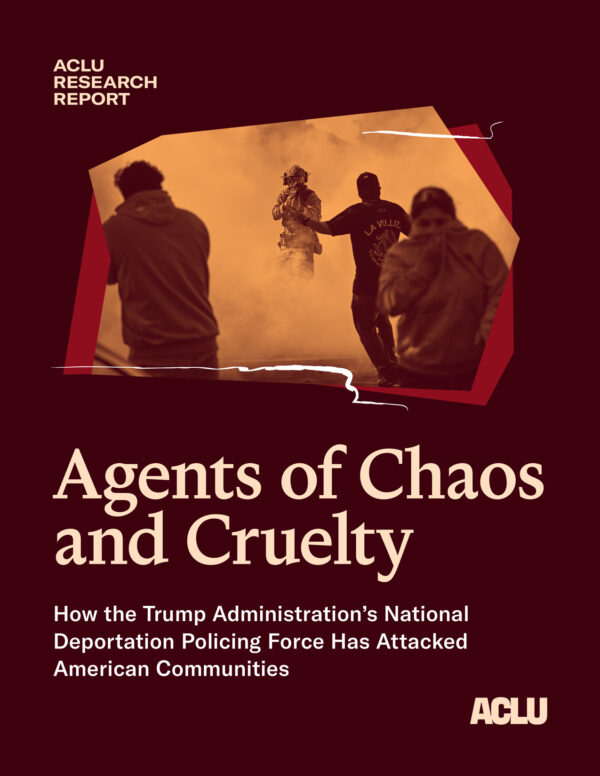
Agents of Chaos and Cruelty: How the Trump Administration's National Deportation Policing Force Has Attacked American Communities
Immigrants' Rights
Agents of Chaos and Cruelty: How the Trump Administration's National Deportation Policing Force Has Attacked American Communities
In another case in Vermont, ICE agents broke into José Estrada Jerez’s home in search of a man who was not there and whom Estrada Jerez did not know. The agents violently handcuffed and pointed loaded firearms at him — a U.S. citizen who was only 18 years old at the time.
Together, these stories show that no one is safe from the violence of this administration’s lawless agenda — regardless of immigration status or U.S. citizenship.
What We're Fighting For
Filing these claims won't undo the harm and trauma that our affiliates' clients endured. No settlement or court judgment can erase what it felt like to be thrown to the ground, separated from your children, or locked in a cell without access to the outside world. But these claims can bring a measure of justice to the people and families affected and help hold the federal government financially accountable for the harm caused.
We're not stopping there. We need additional pathways to accountability so that justice is accessible to the tens of thousands of people with stories just like those of our claimants. While we’re fighting in court, we’re also asking Congress to address barriers that allow federal agents to evade responsibility: such as, the near-total lack of a clear path to sue federal agents directly, and, when such a claim is available, qualified immunity, a legal doctrine that can shield officers from liability. We're also supporting legislation that would bring independent oversight to detention facilities and end family detention.
This is a fight we intend to win. We will use every legal and legislative tool at our disposal to end this abuse, defend people’s rights, and hold the federal government accountable under the law. Learn more about the clients ACLU affiliates are representing.
Related Issues
Related Content
-
Press ReleaseSep 2026

Immigrants' Rights
New Aclu And Afl-cio Report Shows Deportations Lower Wages And Raise Costs For America’s Workers. Explore Press Release.New ACLU and AFL-CIO Report Shows Deportations Lower Wages and Raise Costs for America’s Workers
WASHINGTON — The American Civil Liberties Union and the American Federation of Labor and Congress of Industrial Organizations (AFL-CIO) today released a new report, Citizenship and the Affordability Agenda: A Path to Better Jobs, Higher Wages, and Prosperity for All, detailing how the mass deportation agenda is exacerbating the affordability crisis by disrupting critical industries, eliminating jobs, weakening workplace protections, and driving up costs for working families. The findings come as communities continue to suffer the impact of mass de-legalization, record levels of immigration arrests and rebound from the economic toll of militarized enforcement operations like Minnesota’s “Operation Metro Surge." The report finds that a broad path to citizenship would stabilize jobs and prices across the construction, hospitality, and care industries that families depend on while raising wages for all American workers. It also examines how Congress has committed at least $240 billion to immigration enforcement, while cutting funding for programs that help families afford food and health care, including SNAP, Medicaid, and Affordable Care Act subsidies — and in some cases allowing them to expire. “Deportations make workers poorer and more vulnerable to exploitation by employers,” said Naureen Shah, director of government affairs, equality division at the ACLU. “When ICE continuously raids a community, everyone pays for it – in lost jobs higher prices and damaged businesses. The only immigration agenda that actually improves affordability is one that creates a broad path to citizenship.” “Working people are paying the price for an immigration system that is destabilizing entire industries and communities and making it easier to exploit workers,” said AFL-CIO President Liz Shuler. “As this report demonstrates, a broad pathway to citizenship for all would raise wages, create more and better jobs, and strengthen our economy in ways that help all of us. It’s past time to give millions of working people and their families the stability they deserve, and we call on Congress to make citizenship a top priority. Working people know that it’s not an immigrant that stands between them and a good job—it’s the billionaires—and it’s time our laws reflect that. Among the report’s key findings: Immigration enforcement enables workplace exploitation. The federal government now spends 91 times more on immigration enforcement than on labor-standards enforcement, which leaves workplaces more dangerous and enables employers to violate wage, safety, and overtime laws while crushing worker organizing. More than a quarter of workers in low-wage industries report minimum-wage violations. While these abuses are highest among immigrant workers, they are widespread enough to suppress pay and standards for all workers in those industries, regardless of immigration status. Immigration raids stunt business activity and revenue creation. Immigration raids and enforcement surges have terrified people from going to work, shopping, dining out, and participating in their communities. The report cites an estimated 8.1 billion fewer visits to businesses and between $3 billion and $14 billion in lost annual spending. For example, Minnesota businesses lost $10–$20 million a week during and after “Operation Metro Surge.” Mass deportation eliminates jobs held by U.S. citizens. The Economic Policy Institute projects continued pursuit of the administration’s deportation agenda could eliminate nearly 6 million jobs, almost half of which are currently held by U.S. citizens. Stripping workers’ legal immigration status is worsening the affordability crisis. The Trump administration’s mass “de-documentation” campaign has stopped work authorization from nearly 2 million people, disrupting key industries like construction and hospitality. A broad path to citizenship would create jobs and raise wages. Creating a path to citizenship would create hundreds of thousands of new jobs and substantially raise wages for every American worker= by removing immigration status as a tool employers use to suppress pay and silence workers. This report, published in partnership with the AFL-CIO, is the third in the ACLU’s affirmative vision series, in which policy and legal experts explore how the Trump administration’s immigration agenda has harmed communities nationwide, undermined our democracy, and wreaked havoc on key industries and weakened the American workforce. The series will also outline steps that members of Congress, as well as state and local policymakers, can take to reform the U.S. immigration system and inoculate against future attacks on our rights and safety. You can read the full report here: https://www.aclu.org/publications/citizenship-and-the-affordability-agenda-a-path-to-better-jobs-higher-wages-and-prosperity-for-all -
News & CommentarySep 2026
Immigrants' Rights
The Trump Administration Is Disappearing Immigrants And Asylum Seekers In Growing Third Country Removal Campaign. Explore News & Commentary.The Trump Administration Is Disappearing Immigrants and Asylum Seekers in Growing Third Country Removal Campaign
Through shadowy deportation agreements, the Trump administration is sending detained individuals to countries where they have no ties — and may face persecution. -
Press ReleaseSep 2026
Immigrants' Rights
Parties File Joint Request To Dismiss Supreme Court Immigration Detention Case. Explore Press Release.Parties File Joint Request to Dismiss Supreme Court Immigration Detention Case
WASHINGTON — Today, both parties in Genalo v. G.M. filed a joint stipulation asking the U.S. Supreme Court to dismiss the case as moot following a pardon granted by New York Governor Hochul that eliminated the basis for Mr. G.M.’s deportation and detention. At the request of both sides, the Supreme Court dismissed the case, thereby cancelling upcoming arguments. The Second Circuit ruling requiring due process protections for prolonged detention will remain in place. Mr. G.M. is a lawful permanent resident who was held in ICE detention for 21 months without a bond hearing. His now-moot case challenged his prolonged immigration detention without meaningful due process. The American Civil Liberties Union, New York Civil Liberties Union, MacArthur Justice Center, and Hecker Fink LLP are co-counsel in this case. “This is a great outcome for our client who no longer faces the threat of deportation and future immigration detention,” said Cecillia Wang, national legal director of the ACLU. “The Second Circuit reached the correct decision in recognizing that prolonged immigration detention cannot continue without due process, and that decision will remain in place. We will continue to defend our Constitution’s limits on immigration detention and will keep up the fight against Trump administration’s extreme, unprecedented, and lawless positions.” "We are heartened that our client will not be separated from his family," said Amy Belsher, supervising attorney at the New York Civil Liberties Union. "The Second Circuit made abundantly clear that immigrants are entitled to due process, and we're gratified that their ruling will protect all those in the Second Circuit from prolonged detention." "Mr. G.M. spent 21 months locked away by ICE, separated from his family and community, without any consideration of whether he actually posed a danger or a flight risk. The Second Circuit saw that for what it was: a violation of due process," said Amit Jain, Counsel for the Supreme Court and Appellate Program at the MacArthur Justice Center. "This is a victory for Mr. G.M., and we will continue to fight alongside anyone, regardless of immigration status, who experiences such grave violations of due process." The administration’s position in Genalo v. G.M. drew cross-ideological opposition with 11 amicus briefs filed in total, including from former Republican senior government officials, members of Congress, and a former federal judge. In an amicus brief supporting G.M., they wrote that in their prior government roles they had “never asserted, nor ever heard the Government argue to this Court,” that a noncitizen detained under this law has no fundamental liberty interest. Although Genalo v. G.M will no longer proceed before the Supreme Court, the Trump administration’s efforts to expand mandatory detention and deny bond hearings to people who are immigrants, including longtime residents with deep ties to their families and communities, continues. Similar cases could make their way to the Supreme Court and will be met with forceful defense of due process. The joint stipulation is available here. -
Press ReleaseSep 2026
Immigrants' Rights
Federal Appeals Court Rules Against Trump Mandatory Detention Policy. Explore Press Release.Federal Appeals Court Rules Against Trump Mandatory Detention Policy
RICHMOND, Va.— Another federal appeals court has rejected the Trump administration’s new policy subjecting millions of immigrants to mandatory detention without access to bond hearings. The Fourth Circuit is now the ninth federal appeals courts to find the policy unlawful, along with hundreds of district courts. The ruling arose from habeas corpus petitions filed on behalf of Oscar Lopez Garcia and Juan Jose Rivera by their respective immigration counsel, Benach Pitney Reilly LLP and Ceartas Solutions. The American Civil Liberties Union, the ACLU of Virginia, and Murray Osorio PLLC joined the legal team representing petitioners in the government’s consolidated appeal. The case is Lopez Garcia v. Guadian. Last year, the Trump administration adopted a new radical reinterpretation of longstanding immigration laws and declared that anyone who entered the country without inspection must be detained without access to bond. For decades prior, people in removal proceedings who were detained by the government have generally had the right to seek release by an immigration judge. Among those who have been affected by the administration’s radical reinterpretation are people eligible for legal status, even those with long-pending immigration applications who have been waiting years due to administrative backlogs. The following is reaction to today’s ruling: “The courts have resoundingly rejected the administration’s cruel policy and its blatant disrespect for the rule of law,” said My Khanh Ngo, senior staff attorney with the ACLU’s Immigrants’ Rights Project. “We are thrilled for our clients and their families.” “The government cannot rewrite immigration law to serve this administration's anti-immigrant agenda by detaining people en masse, and today’s ruling again makes that crystal clear,” said Sophia Gregg, senior immigrants’ rights attorney with the ACLU of Virginia. “The Fourth Circuit’s decision is an important victory for both Virginians and for our civil rights and civil liberties nationwide.” “The Court has it right: ‘Mass detention of marginalized individuals without due process harkens back to some of the darkest moments in our country’s history... Those shameful and abhorrent past detentions were limited in scope in comparison to’ what the Government asked for in this case. We are thrilled that the Court declined to expand mandatory detention to millions of people,” said Sarah Pitney, partner at Benach Pitney Reilly LLP and counsel for Mr. Lopez Garcia. “I have seen over and over again the devastating impact that the detention of a mother or father has on their children, many of whom are U.S. citizens,” said Sarnata Reynolds, founding attorney at Ceartas Solutions. “Today’s decision restores a basic safeguard: the government cannot imprison members of our communities throughout their immigration cases without giving them a meaningful chance to seek release.” The ruling is here.