Trump Administration Playbook Takes Tactics from Lavender Scare of the Cold War


A defining feature of the mid-20th century was the government-wide panic over communism, anarchism, and other leftist beliefs known as the Red Scare. However what many don’t know is that an estimated 5,000 to 10,000 government employees were fired or forced to resign during that same time period, solely because they were suspected or confirmed to be queer. This purge of queer people from government jobs further instilled distrust of the LGBTQ community by the general public under the guise of protecting national security. It’s called the Lavender Scare.
The tactics of the Lavender Scare mirrored and contributed to the Red Scare, a broader cultural firestorm that famously led to Senator Joseph McCarthy’s Senate hearings against alleged communists. But as efforts to actually reveal communists in the State Department stalled, McCarthy and his allies increasingly linked “suspected communist behavior” to homosexuality, claiming that gay state employees were more susceptible to blackmail by communists and therefore posed a pernicious threat to the nation’s security.
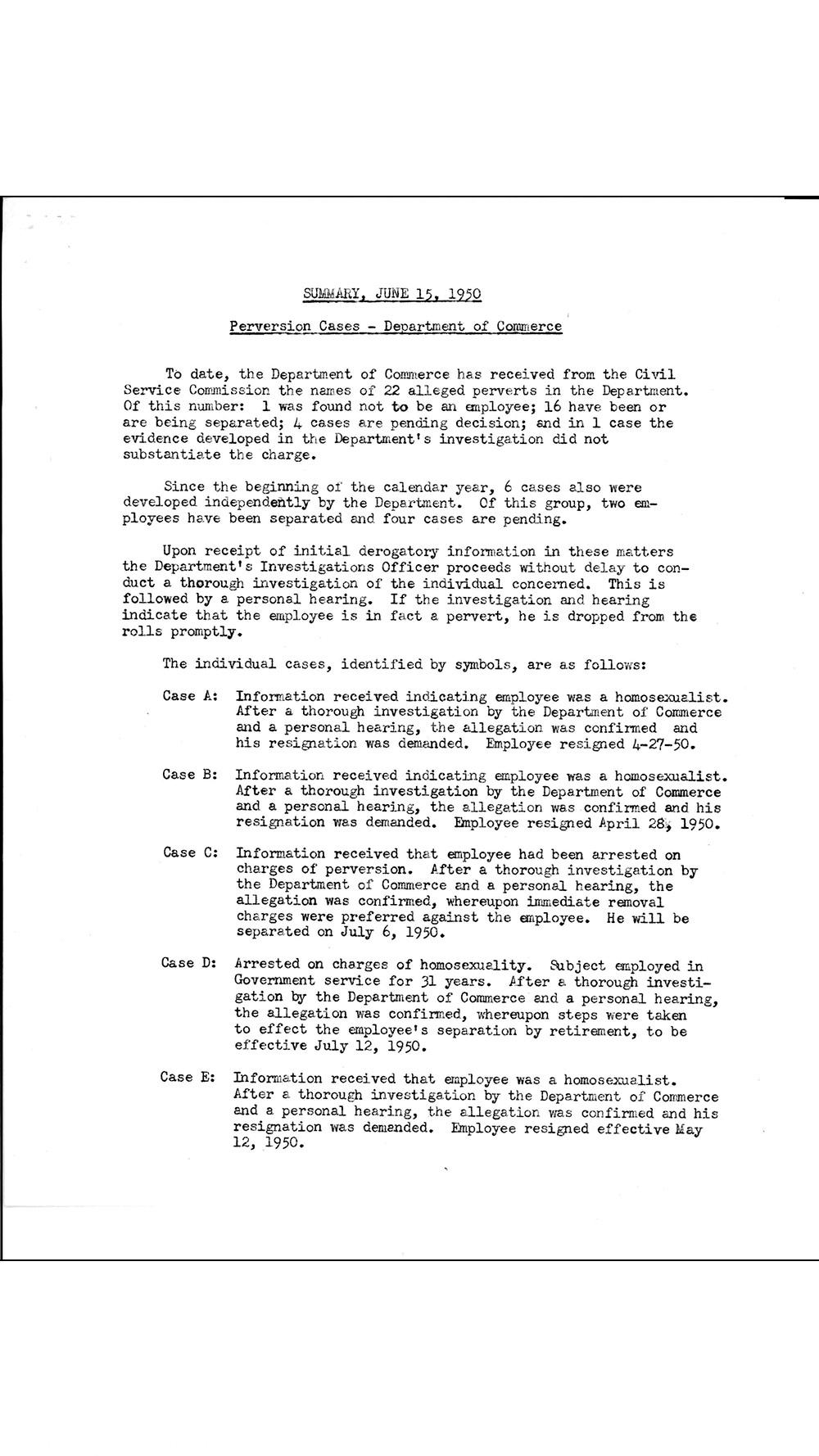
Whereas most people know about the Red Scare and learned about it in school, the harms of the Lavender Scare remain widely undiscussed in history classes or popular culture at large. The playbook the government used to classify queer people as a threat to national security was in the works long before the mass firings came to a head — and it's a playbook we see the Trump administration using today to attack the LGBTQ community at large.
Government Encouraged Reporting 'Homosexual Behavior'
Government officials encouraging everyday people to report others who displayed “homosexual behavior” was an especially insidious element of the Lavender Scare, and was a directive that stretched far beyond just the federal government. In Florida, for example, politicians launched a watchdog group known as the Johns Committee to “preserve Southern customs and weed out subversives.” Led by Senator Charley E. Johns, the committee honed in on schools in particular and encouraged educators, students, administrators, and everyday people to report Black activists, leftists, LGBTQ people, and other populations displaying what they perceived as communist tendencies. The ACLU of Florida formed in 1955 to combat these targeted crusades on the rise.
Taking a page from the Johns Committee playbook 70 years later, the FBI opened a tip line in June 2025 and requested people report teachers who “promote gender ideology” and providers of gender-affirming care. And just last month, the Department of Justice attempted to force health care providers to hand over the identities and sensitive information of transgender youth who have received gender-affirming care. This is a blatant violation of the trans youth and their families’ right to privacy. The ACLU is suing the Trump administration to block this effort in court.
These directives have far-reaching effects: They turn neighbor against neighbor, incentivize people to surveil children, and normalize the restriction of safe and critical health care. States across the country support this agenda by introducing laws that criminalize or push health care out of reach for many trans kids. Along with our affiliates, the ACLU is fighting these attacks.

U.S. Military Ousted Tens of Thousands of Service Members
Throughout the mid-20th century, countless service members were interrogated by military officials to confess homosexual ideation or identity. Service members were even asked the question “do you have homosexual tendencies?” on the day of their induction into the Army. The narrative of the time was that queer service members were more susceptible to blackmail, morally weak, and therefore unfit to serve. Tens of thousands of service members were forced to leave the military with less than honorable discharges, a vestige of the country that rejected them solely for who they were and who they loved.
President Trump has similarly made it a priority to weed queer people out of Armed Services. Just one week after taking office again, Trump issued an executive order claiming trans people were incapable of the "honorable, truthful, and disciplined lifestyle" necessitated by military service. The president claims that the acceptance of trans service members is detrimental to the “cohesion” of the military, which is a lie that has been weaponized against every minority group that has joined or tried to join the military throughout history, including Black people, women, and other members of the LGBTQ community. Though Trump’s campaign against the small portion of the military that are transgender (less than half of 1%) continues, an appeals court partially blocked the order banning trans service members at the beginning of this month after the Supreme Court reinstated the order in May 2025.

Harmful Portrayal of LGBTQ Community as a Threat to Families
A cornerstone of the Lavender Scare was to convince the public that members of the LGBTQ community were a threat to children and traditional American family values. A report from the Hoey Committee, for example, best exemplified this effort. Senator Clyde R. Hoey established this Senate subcommittee to determine the extent to which homosexuality was present in the government workforce through an investigation. The report, titled “Employment of Homosexuals and Other Sex Perverts in Government,” ultimately concluded that homosexuals were "unsuitable for employment in the federal government.” It served as the precursor to an executive order from President Eisenhower in 1953 that effectively prohibited queer people from working for the federal government altogether. The report itself includes testimony from officials across the federal government declaring that queer people are morally unfit and perverted, without any valid evidence. This misrepresentation only further fed the prejudice against LGBTQ people across the nation.
Today, the Trump administration consistently suggests “gender ideology” is a threat to children and his idealized vision of the nuclear family, claiming “the evil and backwards lies of gender insanity are robbing our children of their happiness, health, and freedom, while imposing unimaginable heartbreak on parents and families.” They’ve censored doctors, researchers, educators, artists, and government workers from even mentioning the existence of transgender people, all while restricting the freedom of families with transgender youth. It is not a particularly new or novel strategy to disguise fear of LGBTQ people as coming from a need to “protect children,” often bolstered by dangerous lies about the LGBTQ community.
![Scanned, yellowed cover of a U.S. Senate document with a thin black border and the header “[CONFIDENTIAL COMMITTEE PRINT].” At top left it reads “81st Congress, 2d Session,” centered “SENATE,” and at top right “DOCUMENT No. —.” The title in large all-caps says “EMPLOYMENT OF HOMOSEXUALS AND OTHER SEX PERVERTS IN GOVERNMENT.” Below, centered text reads “INTERIM REPORT” and “SUBMITTED TO THE COMMITTEE ON EXPENDITURES IN THE EXECUTIVE DEPARTMENTS BY ITS SUBCOMMITTEE ON INVESTIGATIONS,” followed by “PURSUANT TO S. Res. 280 (81st Congress)” and a line about a resolution authorizing the committee to carry out certain duties. Near the bottom is a U.S. eagle emblem and the publication line “1950—Ordered to be printed,” with “UNITED STATES GOVERNMENT PRINTING OFFICE, WASHINGTON: 1950.” The page also shows faint library/date stamp markings and a blue rectangular stamp along the right edge.](https://assets.aclu.org/live/uploads/2026/06/employment-of-homosexuals-and-other-sex-perverts-in-governments-m.jpg)
Queerness as a Medical Illness Justified Arrest and Violent Conversion Therapy
Until the 1970s, homosexuality was classified as a mental illness by the medical establishment and the public at large. The Diagnostic and Statistical Manual of Mental Disorders (DSM) in 1952 labeled homosexuals as having a “sociopathic personality disturbance,” and psychiatrists were called to testify on the matter in Congressional hearings. This harmful diagnosis gave further rise to violent forms of conversion therapy, which often included electroshock treatments, sleep deprivation, and induced vomiting designed to make LGBTQ people fear their own sexual desires, identities, or partners. Elected officials used this classification of queerness as a mental disorder to justify these extreme injustices.
This often fell hardest on Black queer people and Black trans people in particular, for whom the violent oppression of the Jim Crow era converged with the Lavender Scare. One case that embodies this plight is that of Ava Betty Brown, a Black trans woman who was arrested in 1957 for cross-dressing, which was then considered to be a psychiatric disorder. Brown was arrested, forced by the police to undress, and ultimately found guilty at trial. She would go on to be repeatedly arrested and even beaten by law enforcement officers, all because of how she dressed. By the time the DSM removed the classification of mental illness in 1973, an entire population was already outlawed from public acceptance.
This stigmatization laid the groundwork for anti-LGBTQ politicians of today to push their agenda against the queer community. The Trump administration has strongly implied that being transgender is a mental disorder, and has used this rhetoric to support efforts to restrict gender-affirming care. Through executive orders and other rules, the administration has tried to coerce doctors who affirm transgender youth’s identities into dropping their transgender patients. The administration has also pathologized queerness as a means to force transgender people out of government jobs, including efforts to prevent trans federal workers from using the correct bathroom or access the health care they need. Activists close to the administration have made clear they see transgender youth as “low-hanging fruit” and that their actual goal is to outlaw access to gender-affirming care for transgender people regardless of age, and push transgender people out of public life entirely.
Liberation Movement Launched in Response to Lavender Scare

State-sanctioned discrimination against the LGBTQ community didn’t start in the 1950s with the Lavender Scare, and it didn’t end there, either. For years and even decades after the final trials of the Lavender Scare, government workers who were forced out of their jobs remained in a shadow of exclusion, cast out from the life they knew without any recompense or justice. Countless people were rejected from their families and communities due to allegations of queerness that came from these unjust firings. Some even died by suicide as a result of the persecution.
The Lavender Scare was a scorched-earth approach to rid the government of queer people and intimidate queer people in the general population, too. But it was in response to this oppression that the Gay Rights Movement took shape. For the first time in American history, LGBTQ people were effectively pushed out of the closet en masse. As much as there was immense danger in this loss of anonymity, there was also liberation inherent in it.
Years before the Stonewall uprising of 1969, widely understood to be the start of the modern gay rights movement, many people of the LGBTQ community moved through the anguish of their ostracization by building toward a better world. In fact, the Mattachine Society, the first sustained gay rights organization in the nation, was formed in 1950 as the Lavender Scare was in full swing. If there’s one thing the queer community knows how to do, it’s survive oppression and do so with joy and resistance. As the ACLU fights attacks on LGBTQ rights in courts and state houses across the nation, we’re reminded that we as a community have been here before, and we have overcome.
Related Issues
Related Content
-
Press ReleaseAug 2026

LGBTQ Rights
Appeals Court Rejects Trump Administration’s Latest Effort To Seize Private Medical Records Of Transgender New Yorkers. Explore Press Release.Appeals Court Rejects Trump Administration’s Latest Effort to Seize Private Medical Records of Transgender New Yorkers
NEW YORK - In a victory for transgender young people and their families, a panel of the Second Circuit Court of Appeals has rejected the Department of Justice’s attempt to stay a lower court win that protected the medical records of transgender youth from serial attempts by the Trump administration to seize them. “This is a tremendous relief to New York families who have to navigate the fear of their private medical information being seized by a federal government hostile to their children,” said Chase Strangio, Co-Director of the ACLU’s LGBTQ & HIV Rights Project. These subpoenas are an unwarranted effort to violate the hallowed relationship between a parent and their child’s doctor in a transparent effort to end medical care for transgender young people and target transgender people for discrimination. We will continue to oppose this effort by the administration and we will always stand up for the privacy and autonomy rights of those who are targeted for discrimination by the government.” “Today’s order by the court of appeals preserves the district court’s order prohibiting the government from seeking the identities and sensitive health information of transgender young people and their families who sought care in New York City. The government cannot weaponize the legal system and the use of subpoenas, whether through a grand jury or otherwise, to collect the most private medical information of transgender young people and their families, in violation of the right to privacy guaranteed by our Constitution,” said Omar Gonzalez-Pagan, Senior Counsel and Health Care Strategist at Lambda Legal. “Every family should be able to make healthcare decisions without fear of political interference or exposure. While this fight is far from over, we are grateful for today’s decision and will continue fighting for the rights and privacy of transgender people and their families.” “This is another victory for the fundamental privacy rights of every New Yorker, and an immense relief to transgender youth and their families,” said Bobby Hodgson, deputy legal director at the New York Civil Liberties Union. “The Trump administration’s attempts to weaponize and manipulate the criminal legal system to bully young people, scare their families, and intimidate healthcare providers are unconstitutional—and we’re thankful the Second Circuit left in place the well-reasoned order blocking those tactics. Our laws recognize that everyone deserves basic privacy protections for their sensitive medical information, and we will continue to fight for the rights of transgender New Yorkers and their families.” In May 2026, NYU Langone Hospitals received a subpoena purportedly under the authority of a federal grand jury in Fort Worth, Texas, which demanded that they turn over the identities and sensitive health information of any patient who had received medical treatment for gender dysphoria while they were under 18 years old from NYU Langone, from January 2020 through May 2026. Other healthcare institutions in New York City, including Mount Sinai Health System, have received similar subpoenas, though the nature of these is unclear. The grand jury subpoenas followed a year-long effort by the Department of Justice to obtain this same information from hospitals across the country through administrative subpoenas—efforts that were repeatedly blocked by at least eight federal district courts. One court dismissed the government’s reasoning as a “smokescreen,” while another concluded that DOJ “issued the subpoena first and searched for a justification second.” In June 2026, a lawsuit was filed in the United States District Court for the Southern District of New York by the American Civil Liberties Union, the New York Civil Liberties Union, and Lambda Legal on behalf of three families with transgender youth and two transgender young adults who were minors when they began care. All plaintiffs have filed under pseudonyms to maintain their privacy and anonymity, and the court provisionally certified a class of similarly situated transgender patients who accessed gender-affirming medical care as a minor from any New York City-area medical institution. Soon after, the district court judge granted the families’ requests for a preliminary injunction, blocking DOJ from violating the patients’ constitutional privacy rights by obtaining the identifying and sensitive health information as part of their purported investigation into unspecified health offenses through the subpoena to NYU Langone and any other similar subpoenas to healthcare institutions in New York City, including Mt. Sinai, that provide or have provided gender-affirming medical care to transgender minors. The plaintiffs argue that the Department of Justice’s demands to access this identifying and sensitive health information violate their Fourth and Fifth Amendment rights to privacy and to be free from unreasonable search and seizure. The plaintiffs also sued NYU Langone to prevent its release of information protected by doctor-patient privilege under New York state law. Today’s order from the Second Circuit can be found here. Click here for more on Coe et al v. Blanche -
Oregon Supreme CourtAug 2026

LGBTQ Rights
Prisoners' Rights
Zyst V. Miller. Explore Case.Zyst v. Miller
Following the Oregon Department of Corrections’ unconstitutional treatment of a transgender prisoner, a habeas court ordered her removal from segregated housing, an individualized gender-affirming care assessment, a psychiatric evaluation, and identification of an appropriate cellmate. However, the Oregon Court of Appeals reversed the psychiatric-evaluation and cellmate orders, finding them “too attenuated” to qualify as habeas relief. The ACLU’s State Supreme Court Initiative, alongside the ACLU of Oregon, joined an amicus brief by the law firm Sugerman Dahab arguing that habeas courts have broad discretion to remedy violations and resulting harms. The brief explains that the Court of Appeals’ “close connection” test unduly constricts habeas relief, and which should be construed to encompass not only the need to halt ongoing constitutional violations, but also the need to mitigate various harms that may arise from those violations. -
Press ReleaseAug 2026
LGBTQ Rights
Joint Statement From Legal Organizations In Response To Texas Supreme Court Ruling In Doe V. Abbot And Pflag V. Abbot. Explore Press Release.Joint Statement from Legal Organizations In Response to Texas Supreme Court Ruling in Doe v. Abbot and PFLAG v. Abbot
AUSTIN, Texas — The Texas Supreme Court today issued a ruling in Doe v. Abbott and PFLAG v. Abbott, challenging the Texas Department of Family and Protective Services’ mandate to investigate families with transgender children. Lambda Legal, the American Civil Liberties Union, the ACLU of Texas, and PFLAG issued the following statement: “For more than four years, we successfully blocked DFPS from investigating Texas families based on allegations that they were providing gender affirming medical care to their transgender adolescents. Today, the Texas Supreme Court issued a purely procedural ruling vacating those injunctions—not because DFPS’s rule requiring these investigations is lawful but because the individual plaintiffs who brought these cases no longer need the injunctions. The Court held that their claims are moot either because DFPS has closed their investigations and has testified that they will not reopen them or because the young people involved are no longer minors and thus DFPS no longer has the authority to investigate their parents. “DFPS argued to the Court that, given that gender affirming medical care is no longer lawfully provided to minors in Texas, there is no reason for DFPS to conduct future investigations. We will hold them to that. Any family that is contacted by DFPS related to gender affirming medical care should contact the Lambda Legal Help Desk.” -
Court CaseSep 2026
LGBTQ Rights
Jackson-edney V. Labrador. Explore Case.Jackson-Edney v. Labrador
Six transgender residents of Idaho filed a lawsuit in federal court challenging HB 752, a 2026 state law that criminalizes their use of sex-designated public restrooms consistent with their gender identity.