Kansas Town Uses License Plate Readers to Go After Man Who Wrote Op-Ed
Subscribe to the Free Future Newsletter
Free Future home
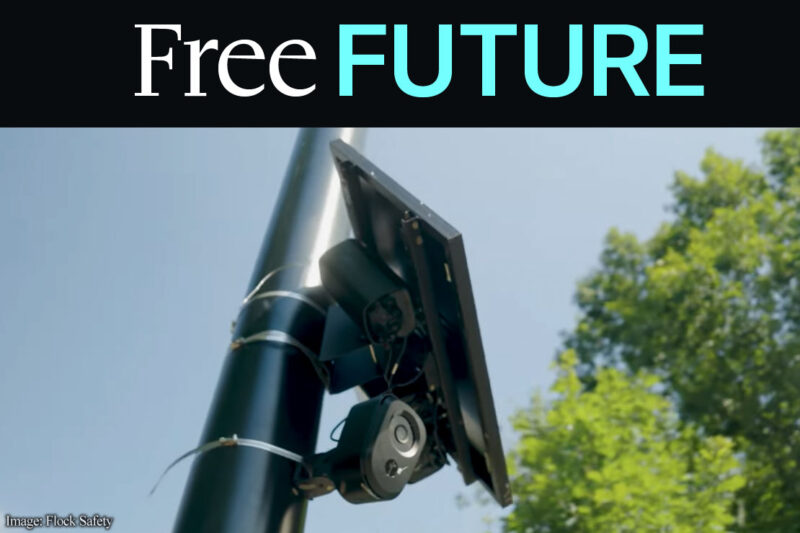
Police in Lenexa, Kansas used automated license plate reader (ALPR) technology to pursue a man who wrote a critical op-ed about the police department, according to reporting by Kansas public radio station KCUR. This is a rare public example of exactly the kind of abuse that we’ve long warned against when it comes to mass-surveillance systems like license plate readers. It also comes on the heels of reports about apparent misuse of license plate databases by ICE agents in Minnesota not for legitimate law enforcement purposes but to intimidate observers and protesters, and of a woman who was falsely accused of theft based on data from license plate readers.
The op-ed published by the Kansas man, Canyen Ashworth, was critical of local ICE operations and the role of Lenexa police in them. The same day that piece ran, Lenexa police began to investigate Ashworth, according to internal emails obtained by KCUR. They quickly tied him to an unidentified suspect the police were looking for who had several days earlier put four posters up around town showing a picture of an ICE agent and the words “remember when we killed fascists.” The police alleged that the unidentified “Paper Hanger” had violated an unspecified city ordinance, and the posters were removed.
The Paper Hanger’s arguably aggressive message was nonetheless speech protected by the First Amendment. And while government officials may regulate constitutionally protected speech through “time, place, and manner” restrictions, they can't do so selectively based on the content of the messages. KCUR reports that in Lenexa, “Posters about lost pets and community events were generally not removed.”
In fact, the town’s mayor later told KCUR that the town had no formal policy regarding posters on city property.
City and police officials claimed that they were targeting the Paper Hanger because the glue he used had the potential to damage city property. On the basis of this great crime, the police began using license plate readers to track Ashworth’s movements around town, and several weeks after his op-ed, the police chief emailed patrol officers to announce that “A suspect has been developed in the case of the City Center Posters” and announce a “be on the lookout for” (BOLO) alert for Ashworth.
Perhaps most ominously, when issuing the BOLO the chief declared “This is MYOC,” meaning “make your own case” — which in turn meant essentially, “there is no arrest warrant for him so look for any reason to stop him” and, as the deputy police chief at the time put it, “You need to build your own probable cause, your own reasonable suspicion.”
As my ACLU colleague and head of the Kansas ACLU Micah Kubic put it, issuing a BOLO on someone for putting up posters is “both a rejection of the First Amendment, and a really ridiculous misuse of resources.”
Compared to the blatant targeting of people for their speech and/or political opposition that we’ve been seeing lately from the Trump Administration, this case may look small. But it was scary enough for Ashworth. And it's a particularly clear example of the abusive dynamic that mass-surveillance systems always end up falling into:
- Target someone who the authorities dislike but have no evidence has done anything wrong.
- Fire up powerful surveillance technologies that have been sold to the public as a way to stop serious, dramatic crimes and keep the public safe.
- Use those technologies to watch the disfavored person in the hopes of drumming up something that they can be charged with, even to the point of scraping the bottom of the barrel and going after something like “damaging glue use.”
We’ve seen plenty of this “show me the man, I’ll find you the crime” kind of abuse at the hands of the Trump Administration. But this story is a reminder that such abuse can rear its head in towns across the nation — small, medium, or large. And when it does, license plate reading programs are a natural tool for the authorities to turn to.
Related Issues
Related Content
-
Press ReleaseSep 2026

Privacy & Technology
Aclu Privacy Expert To Testify At Bipartisan Senate Hearing On Flock And Other Automatic License Plate Readers. Explore Press Release.ACLU Privacy Expert to Testify at Bipartisan Senate Hearing on Flock and Other Automatic License Plate Readers
WHAT: The Senate Judiciary Subcommittee on Crime and Counterterrorism will hold a hearing on Wednesday entitled, “Always Watching: Flock’s Nationwide AI Surveillance Network.” Testifying at this hearing will be privacy and surveillance expert Chad Marlow, a senior policy counsel at the American Civil Liberties Union. Marlow will detail how automatic license plate readers (ALPRs) like Flock are used to violate our rights, discuss the growing bipartisan movement against these creepy cameras, and underscore that the best privacy protection is to ban ALPRs altogether. Marlow’s testimony comes as people across the country come together to oppose these cameras and urge their elected officials to get rid of them. The Institute for Justice has cataloged more than 200 incidents of ALPR abuse, including stalking, wrongful stops and detentions, non-law enforcement use, and other types of misconduct. Since the beginning of 2026, over 200 cities have terminated their contracts with Flock and other ALPR companies and that number keeps growing. In August, cities terminated their contracts at a rate of more than three per day. WHEN: Wednesday, September 23, 2026 at 2:30 p.m. ET WHO: Chad Marlow, Senior Policy Counsel, ACLU Benn Jordan, Cybersecurity Engineer Lindsey Isaacs, Wrongfully Accused Driver Alasdair Whitney, Legislative Counsel, Institute for Justice The Honorable Ross Teeple, Sheriff for Pinal County WHERE: Dirksen Senate Office Building Room 562 *Livestream can be found here. Chad will be available for questions and interviews following the hearing. Please reach out to Allegra Harpootlian with any requests. -
Oregon Supreme CourtAug 2026

Privacy & Technology
State V. Lane. Explore Case.State v. Lane
Oregon law enforcement, without a warrant, installed surveillance cameras on two telephone poles near Petitioner’s home and recorded activity there for a month. The State argues that police can continuously surveil our most private spaces—our homes—without judicial oversight. The ACLU's Speech, Privacy, and Technology Project and State Supreme Court Initiative, alongside the ACLU of Oregon and the Oregon Criminal Defense Lawyers Association, filed an amicus brief arguing that police were required to obtain a warrant before conducting the extensive pole-camera surveillance at issue this case. -
Press ReleaseSep 2026
Privacy & Technology
Aclu Urges Senate To Block Ai Experimentation Provision In Crypto Bill. Explore Press Release.ACLU Urges Senate to Block AI Experimentation Provision in Crypto Bill
WASHINGTON — The Senate will take a procedural vote on the Clarity Act today, which includes a provision that would give companies a free pass to experiment on “AI test projects” without transparency or oversight. The American Civil Liberties Union argues that this is unneeded both because of how fast artificial intelligence is already growing, and also because of the harm it could cause to individuals’ rights. “Companies have plenty of freedom to do basic research on AI. But they shouldn’t have the freedom to use the American people as guinea pigs by subjecting them to harmful experiments that violate existing laws meant to protect people,” said Jina John, senior policy counsel on AI at the ACLU. “At the very moment that AI leaders are warning of catastrophic risks and urging Congress to regulate AI, Congress must not pass any law that would endanger people’s rights and liberties for the sake of AI experimentation.” Section 509 of the bill would establish a scheme for companies to seek waivers from any regulation from a financial regulator, including those related to privacy, security, consumer protection, and civil rights. That means companies could conduct AI experiments that risk exposing consumers’ financial data or be used to develop products that make decisions about lending, housing, and other important areas without providing notice about adverse actions or considering the potential for discrimination, all without oversight. The ACLU and a coalition of other rights groups recently sent a letter to Congress outlining the dangers of this provision for privacy rights and the right to be free from discrimination in key economic transactions. -
Press ReleaseSep 2026
Free Speech
Privacy & Technology
Aclu, Aclu Of D.c., And National Press Photographers Association Tell Court That Blocking Drone Photography Of Dhs Operations Violates First Amendment. Explore Press Release.ACLU, ACLU of D.C., and National Press Photographers Association Tell Court that Blocking Drone Photography of DHS Operations Violates First Amendment
WASHINGTON – Today, the American Civil Liberties Union (ACLU), the ACLU of D.C., and the National Press Photographers Association filed an amicus brief in support of a Minnesota photojournalist’s lawsuit challenging the Federal Aviation Administration's (FAA) Temporary Flight Restrictions (TFR). Earlier this year, as ICE was carrying out brutal immigration raids across the country, the FAA dramatically expanded restrictions on drone flights, banning such flights over any Department of Homeland Security (DHS) facility or “mobile asset,” which included any DHS vehicle. As the amicus explains, the TFR made it functionally impossible for journalists to use drones to gather news in any area where immigration enforcement agents were deployed, violating the First Amendment right to record public officials performing their duties in public. “The FAA’s restriction forced journalists reporting on immigration enforcement activity to ground their drones or risk criminal charges. This choice is unacceptable, unconstitutional, and runs roughshod over the First Amendment right to gather news,” said Scarlet Kim, senior staff attorney with ACLU’s Speech, Privacy, and Technology Project. The brief explains that the FAA’s restriction was not about public safety or national security. Journalists were previously already advised and generally adhered to avoiding airspace around sensitive locations, such as active military bases, airports, and aircraft carriers. Moreover, press drones weren’t interfering with official activity or putting anyone at risk by capturing immigration enforcement activity unfolding in public. "Under Trump, even the Federal Aviation Administration has become a political censor,” said Arthur Spitzer, senior counsel at ACLU-D.C. “The agency should be protecting the safety of the flying public, not protecting ICE from unfavorable news coverage.” The brief further explains that journalists were effectively being censored beyond their DHS coverage, since the unpredictability of where any DHS vehicle may be traveling made it functionally impossible for journalists to use drones for any newsgathering in areas where immigration enforcement agents were deployed without putting themselves at risk of severe legal and financial penalties. “Drones have become essential, safe, and economical tools for documenting government activity and other matters of public concern. By creating an unpredictable moving exclusion zone around DHS assets, the FAA forced visual journalists to choose between abandoning lawful newsgathering and risking severe penalties,” said Mickey H. Osterreicher, general counsel for the National Press Photographers Association. “Safety restrictions must be narrowly tailored and consistent with the First Amendment, especially when they limit the public’s ability to observe government officials performing their duties.”