Drones for Intimidation
Subscribe to the Free Future Newsletter
Free Future home
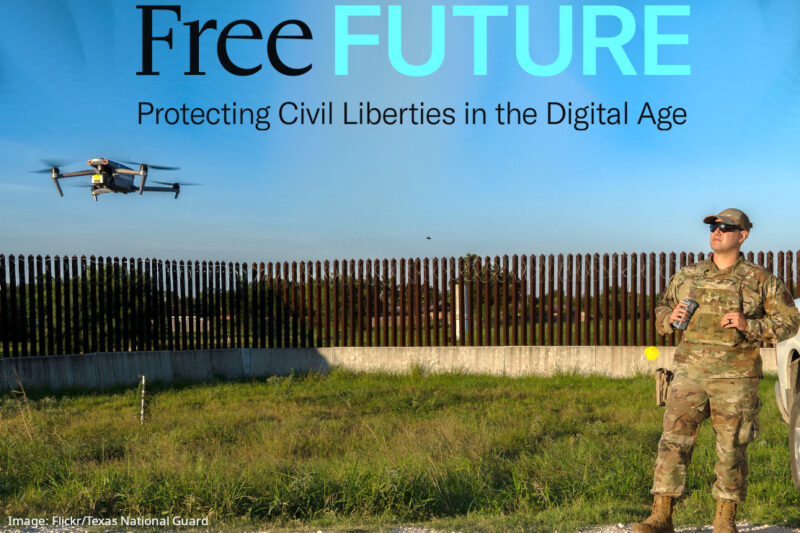
Minnesota Public Radio Friday published an investigation into drone sightings in Minneapolis during President Trump’s recent surge of undisciplined paramilitary immigration agents into that city — including reports that suggest the use of drones for intimidation.
One activist told MPR she was woken up by a drone hovering in her backyard outside her second-story bedroom window. She subsequently recorded at least 16 possible drone sightings; before the surge, she had never seen one. She and others shared video and still photographs of many drone sightings with MPR.
A south Minneapolis woman interviewed by MPR said neighborhood residents were seeing drones all over. “People keep track in the neighborhood chats, ‘Ope, the drones are back tonight,’” she said. Another city resident said they saw a drone hovering 20 feet over a house being used to distribute groceries to people hiding from ICE, while another reported seeing multiple drones flying complex patterns over her neighborhood in January.
A lack of transparency
Unfortunately, the FAA has not built a system that allows ordinary people to identify the operator of drones they see flying over their homes and communities. And it's not clear that the feds are complying with the limited system the FAA has built, called Remote ID. That means that it can be hard to know for sure who is operating a particular drone. But while secrecy makes it hard to confirm, it sure looks like ICE or other federal agencies are using drone technology the same way they’re using other surveillance technologies: to intimidate protesters and observers.
Minneapolis police and Minnesota state police said the drone sightings did not comport with how they use drones and were not theirs, MPR reported. And DHS refused to comment on the drone sightings. The Washington Post reported in January, however, that “ICE has been using small drones to monitor some protests over the past year.”
And of course these flights come in a larger context of other abuses of technology by agencies like ICE and the Border Patrol. As my ACLU-Minnesota colleague Alicia Granse (who is part of the ACLU team suing DHS over its treatment of observers) has summarized it, that includes examples of observers and protesters:
- Being led to their own homes by federal agents.
- Having themselves, their vehicles, or their homes conspicuously photographed.
- Seeing vehicles identified as belonging to a federal agency parked outside their home.
- Being told they would be entered into a domestic terrorist watchlist.
- Having their Global Entry status revoked.
- Having their phones confiscated and being told that they’ve been cloned.
Intimidation by drone, it seems, needs to be added to the list. We have ourselves received reports from observers in another city of a drone flying low in front of people’s faces after an ICE protest, in what seemed to be a clear effort to intimidate. Veteran protesters also report drones swooping low over other protests in similar apparent intimidation attempts.
Surveillance, dominance, and control
In a 2024 white paper, we called for strict limits on the use of drones over protests to ensure that not only are they not used for intimidation, but that they not record protesters except where there is criminal behavior. As we pointed out then:
Sometimes police attend protests not to keep the peace but to intimidate and surveil. These kinds of abuses are especially likely to happen around protests among historically marginalized groups, or groups protesting the police themselves, or expressing other viewpoints that the police don’t like.
In addition, drones are often perceived as alien and hostile and frequently elicit a visceral response…. And by virtue of their position in the sky, they signify surveillance, dominance, and control. Human rights activists have pointed to the way drones have functioned as an intimidating and oppressive “technology of domination” in countries such as Afghanistan, Pakistan, China, and the Palestinian occupied territories.
Perhaps the most striking example of aircraft used to intimidate protesters was at the racial justice protests outside the White House in June 2020, when the Trump Administration deployed a military Blackhawk helicopter to disperse peaceful protesters by hovering low over a street, creating wind gusts strong enough to snap tree limbs. As we noted at the time, experts call this tactic a “show of force” and say it’s a common military tactic to “intimidate and remind potential enemies of your armed presence.” A Blackhawk helicopter is a whole other level compared to a small drone, but it dramatizes the intentions some in law enforcement can bring to a protest.
I hear a lot about "drones for good" from boosters, and drones do have a lot of good uses, but they should never be used for surveillance, let alone intimidation, of peaceful protesters in our country. Yet just such intimidation is emerging as a distinct “use case” for some in law enforcement, and policymakers need to respond accordingly.
Related Issues
Related Content
-
NevadaSep 2026

Privacy & Technology
National Security
Killinger V. Jager. Explore Case.Killinger v. Jager
On September 21, 2026, the ACLU, ACLU of Nevada and the Innocence Project filed an amicus brief in the District of Nevada in support of Jason Killinger, a man wrongfully arrested after police relied on an incorrect result from facial recognition technology. -
Press ReleaseSep 2026

Privacy & Technology
Aclu Privacy Expert To Testify At Bipartisan Senate Hearing On Flock And Other Automatic License Plate Readers. Explore Press Release.ACLU Privacy Expert to Testify at Bipartisan Senate Hearing on Flock and Other Automatic License Plate Readers
WHAT: The Senate Judiciary Subcommittee on Crime and Counterterrorism will hold a hearing on Wednesday entitled, “Always Watching: Flock’s Nationwide AI Surveillance Network.” Testifying at this hearing will be privacy and surveillance expert Chad Marlow, a senior policy counsel at the American Civil Liberties Union. Marlow will detail how automatic license plate readers (ALPRs) like Flock are used to violate our rights, discuss the growing bipartisan movement against these creepy cameras, and underscore that the best privacy protection is to ban ALPRs altogether. Marlow’s testimony comes as people across the country come together to oppose these cameras and urge their elected officials to get rid of them. The Institute for Justice has cataloged more than 200 incidents of ALPR abuse, including stalking, wrongful stops and detentions, non-law enforcement use, and other types of misconduct. Since the beginning of 2026, over 200 cities have terminated their contracts with Flock and other ALPR companies and that number keeps growing. In August, cities terminated their contracts at a rate of more than three per day. WHEN: Wednesday, September 23, 2026 at 2:30 p.m. ET WHO: Chad Marlow, Senior Policy Counsel, ACLU Benn Jordan, Cybersecurity Engineer Lindsey Isaacs, Wrongfully Accused Driver Alasdair Whitney, Legislative Counsel, Institute for Justice The Honorable Ross Teeple, Sheriff for Pinal County WHERE: Dirksen Senate Office Building Room 562 *Livestream can be found here. Chad will be available for questions and interviews following the hearing. Please reach out to Allegra Harpootlian with any requests. -
Oregon Supreme CourtAug 2026
Privacy & Technology
State V. Lane. Explore Case.State v. Lane
Oregon law enforcement, without a warrant, installed surveillance cameras on two telephone poles near Petitioner’s home and recorded activity there for a month. The State argues that police can continuously surveil our most private spaces—our homes—without judicial oversight. The ACLU's Speech, Privacy, and Technology Project and State Supreme Court Initiative, alongside the ACLU of Oregon and the Oregon Criminal Defense Lawyers Association, filed an amicus brief arguing that police were required to obtain a warrant before conducting the extensive pole-camera surveillance at issue this case. -
Press ReleaseSep 2026
Privacy & Technology
Aclu Urges Senate To Block Ai Experimentation Provision In Crypto Bill. Explore Press Release.ACLU Urges Senate to Block AI Experimentation Provision in Crypto Bill
WASHINGTON — The Senate will take a procedural vote on the Clarity Act today, which includes a provision that would give companies a free pass to experiment on “AI test projects” without transparency or oversight. The American Civil Liberties Union argues that this is unneeded both because of how fast artificial intelligence is already growing, and also because of the harm it could cause to individuals’ rights. “Companies have plenty of freedom to do basic research on AI. But they shouldn’t have the freedom to use the American people as guinea pigs by subjecting them to harmful experiments that violate existing laws meant to protect people,” said Jina John, senior policy counsel on AI at the ACLU. “At the very moment that AI leaders are warning of catastrophic risks and urging Congress to regulate AI, Congress must not pass any law that would endanger people’s rights and liberties for the sake of AI experimentation.” Section 509 of the bill would establish a scheme for companies to seek waivers from any regulation from a financial regulator, including those related to privacy, security, consumer protection, and civil rights. That means companies could conduct AI experiments that risk exposing consumers’ financial data or be used to develop products that make decisions about lending, housing, and other important areas without providing notice about adverse actions or considering the potential for discrimination, all without oversight. The ACLU and a coalition of other rights groups recently sent a letter to Congress outlining the dangers of this provision for privacy rights and the right to be free from discrimination in key economic transactions.