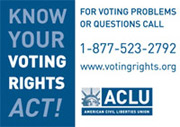
Regular readers of this blog will know that we at the Blog of Rights are all about empowering voters and getting out the vote (or "GOTV" for you wonky types). We’ve just posted printer-friendly versions of our voter empowerment cards. Covering 32 states from Alaska to Wyoming, these cards inform voters of their rights on Election Day and offer tips for avoiding problems when going to the polls.
And if you haven't voted already (would that we all could vote early), Steven Rosenfeld of Alternet has a great guide, filled with tons of handy links, that will ensure that things go smoothly tomorrow.
(I learned from one of these links, VerifiedVoting.org, that New York is still using the really old mechanical lever voting machines tomorrow. They make a very satisfying "ka-chunk!" noise when you cast your ballot.)
And if there's one phone number to have on-hand when you head for your polling place, it's the ACLU's voting rights complaint hotline: (877) 523-2792. Give that number a call to report any problems or any suspicious shenanigans going down at the polls.
We'll see you at the polls!
Related Issues
Related Content
-
Press ReleaseSep 2026

Voting Rights
U.s. Supreme Court, For A Third Time, Declines To Overturn Lawful Missouri Congressional Map. Explore Press Release.U.S. Supreme Court, for a Third Time, Declines to Overturn Lawful Missouri Congressional Map
WASHINGTON — Today, the U.S. Supreme Court has, for a third time, declined to allow an unlawful congressional map to be used in the 2026 midterm elections in Missouri. Less than two months before Election Day, two congressional candidates and two voters attempted to force the state once again to use the 2025 map that was a result of mid-decade redistricting, even though it had already been ruled unlawful by the Missouri Supreme Court, a ruling twice left in place by the U.S. Supreme Court. Campaign Legal Center, the ACLU of Missouri and ACLU Voting Rights Project filed amicus briefs at the Missouri Supreme Court, the Eighth Circuit Court of Appeals, and three times at the U.S. Supreme Court, most recently on September 22, 2026, urging the Court to stay a rogue decision of the Eighth Circuit and a federal district court attempting to resurrect the 2025 map. Today the Supreme Court stayed those lower court decisions, definitively confirming that the 2026 election must take place under the lawful 2022 map. “The gerrymandered map passed in 2025 in Missouri was never law, and yet self-interested, partisan politicians, and now two lower federal courts, have repeatedly attempted to impose it on voters for the 2026 midterms,” said Mark Gaber, senior director of redistricting at Campaign Legal Center. “This case should never have reached the Supreme Court three times, but we’re glad that the final outcome of these cases is Missourians having the opportunity to vote under a lawful map this fall.” “Politicians and elected officials have unleashed unnecessary but intentional chaos on Missouri voters, not for the benefit of their constituents but for themselves and the state actors in D.C. who designed and demanded these maps solely for partisan power grab," said Gillian Wilcox, director of litigation and policy for the ACLU of Missouri. "Voting has already begun and today's decision closes the door on the politicians’ shenanigans." "The people of Missouri have the right to go to the polls and reject the State's attempt to gerrymander their congressional districts, and the Supreme Court has now confirmed, for the third time in as many weeks, that the State's unlawful districts cannot be used this November,” said Ming Cheung, senior staff attorney with the ACLU’s Voting Rights Project. “Voting has already begun, and all efforts to cause confusion and chaos must cease. This saga began in 2025 when politicians tried to rig the map and take away representation from Kansas City residents, but the courts have now made clear that voters — not politicians — decide who represents them.” Background: In September 2025, the Missouri General Assembly passed House Bill 1 (H.B. 1) which created a new, mid-decade, gerrymandered congressional map. In response, the people of Missouri exercised their rights under the Missouri Constitution by collecting signatures for a referendum petition on H.B. 1. On December 9, 2025, Missourians submitted over 300,000 signatures in support of the referendum. Under the Missouri Constitution, this should have suspended the implementation of the new map until voters had an opportunity to either approve or disapprove of it in the next election. However, Missouri Secretary of State Denny Hoskins refused to certify the referendum petition and attempted to force voters to vote under the unlawful map. Secretary Hoskins’ actions were met with swift legal action, and after moving through multiple lawsuits, the U.S. Supreme Court denied multiple efforts by him and other political actors to retain the unlawful 2025 map in the upcoming midterms. This latest decision from the Supreme Court comes after an appeal of an Eighth Circuit ruling that the unlawful map must be used. -
Press ReleaseSep 2026
Voting Rights
Nightmare Over For Crystal Mason, Highest Criminal Court In Texas Dismisses State’s Petition For Review . Explore Press Release.Nightmare Over for Crystal Mason, Highest Criminal Court in Texas Dismisses State’s Petition for Review
AUSTIN, Texas — The Court of Criminal Appeals today let stand a lower court's ruling that acquitted Crystal Mason of illegal voting by dismissing the state’s petition for review as improvidently granted. The lower court’s decision vacates Mason’s conviction in Crystal Mason v. State of Texas and should mark the end to a nearly decade-long legal battle to defend her innocence. The lower court’s decision found there was insufficient evidence to show that Mason knew she was ineligible to vote. She had faced up to five years in prison. “In all these years, I never lost my faith that justice would be done,” said Crystal Mason. “I am so happy my nightmare is over and I can move on. I hope people who hear my story are encouraged to make their voices heard and to get out and vote. If the right to vote weren’t so important, they wouldn’t be trying to take it away.” Mason, a Black mother of three from Fort Worth, was convicted of illegal voting for submitting a provisional ballot in 2016 that was never counted as a vote. She believed she was fulfilling her civic duty and had no idea the state considered her ineligible to vote. The Texas Second Court of Appeals reversed Crystal Mason’s conviction, and the Court of Criminal Appeals upheld that decision. Mason was represented by the American Civil Liberties Union of Texas, the national ACLU, and the Texas Civil Rights Project, along with criminal defense attorney Alison Grinter and civil rights attorney Kim T. Cole. The following quotes can be attributed to members of her legal team: Sophia Lin Lakin, director of the ACLU’s Voting Rights Project: “Crystal Mason has fought this injustice for nearly a decade, and we are thrilled that the Court of Criminal Appeals has finally put an end to this case. No one should face prison for casting a ballot when they had no idea they were ineligible to vote. During a time where politicians are sowing chaos and confusion into our elections, today’s decision is a long-overdue recognition that voting requirements should be transparent, and that we should never criminalize voters over honest mistakes.” Tommy Buser-Clancy, senior staff attorney of the ACLU of Texas: “Civic participation without fear of imprisonment is a cherished right that is critical to our system of democracy. The highest criminal court in Texas affirmed that right by letting the lower court’s acquittal stand. Ms. Mason has spent nearly a decade defending her rights in Texas and today we see that her efforts have been successful not only in defending her own freedom, but also in protecting the ability of Texans across the state to participate in our democracy without fear." Zachary Dolling, litigation director for the Texas Civil Rights Project: “Ms. Mason should never have been prosecuted in the first place, and although she’ll never get back the years of her life she spent fighting against this unjust prosecution, she can at least move on. This decision allows us to celebrate Ms. Mason’s bravery and courage over the past six years.” Alison Grinter, criminal defense attorney: “This is a momentous day for voting rights in Texas. For nearly 10 years, Ms. Mason had to wake up each morning knowing the state was threatening to imprison her for simply doing her civic duty. Tomorrow, she’ll wake up with that burden lifted, knowing that her effort to participate in our democracy should never have been criminalized and that she can continue to do the voter empowerment work that she has been championing for all of these years.” Kim T. Cole, civil attorney for Mason: “We are grateful that the Court allowed Crystal Mason’s acquittal to stand and finally brought this nearly decade-long injustice to an end. For years, while Crystal lived with the agonizing threat of having her freedom ripped away, she turned her pain into purpose—educating and registering voters and fighting to protect the very right that led to her prosecution. However, justice does not end with an acquittal. Crystal suffered through years of legal battles against a prosecution which we have always maintained was politically motivated and never should have happened.” Access the Court of Criminal Appeals brief here. More background here. -
Press ReleaseSep 2026
Voting Rights
Aclu And Aclu Voter Education Fund Invest $2.3 Million In Michigan House And Senate Races, And The Michigan Supreme Court Race. Explore Press Release.ACLU and ACLU Voter Education Fund Invest $2.3 Million in Michigan House and Senate Races, and the Michigan Supreme Court Race
DETROIT – The ACLU of Michigan, the American Civil Liberties Union, and the ACLU Voter Education Fund are spending $2.3 million in select Michigan House and Senate races, and the Michigan Supreme Court race. The commitment is part of the ACLU’s effort to inform voters that their civil rights and liberties, including voting rights and abortion, are on the ballot this November election. Voter guides and paid advertising will be utilized to educate voters about the candidates in these races. The ACLU Voter Education Fund is spending about $400,000 in the Michigan Supreme Court race, and the ACLU is spending about $1.9 million in select legislative races. State lawmakers shape civil rights and liberties, as does the Michigan Supreme Court. Their decisions impact the expansion or restriction of voting rights, reproductive rights, privacy rights, and other civil rights and liberties. The ACLU of Michigan and national American Civil Liberties Union, have invested in four Senate and House races, including Senate Districts 4, 9, 13 and 30, and House Districts 27, 44, 46, 109. The senate and House District races are highly contested. There are two open seats on the Michigan Supreme Court, and voters will choose two candidates out of six who are running. Though state parties nominate Michigan Supreme Court candidates, each will appear in the nonpartisan section of the November 3 election ballot. The ACLU and ACLU Voter Education Fund will reach voters through mailer guides and digital advertising. "Michigan voters overwhelmingly support reproductive freedom, including abortion, as they made clear when voting to amend our state constitution to include these protections," said Merissa Kovach, ACLU of Michigan political director. "Our aim is to ensure we preserve and expand upon the gains we have made in Michigan. It is imperative that voters are aware of each candidate’s record on reproductive freedom, voting rights, and other civil rights and liberties before casting their votes.” Click here to learn more about the Michigan Supreme Court race. -
News & CommentarySep 2026
Voting Rights
Let’s Make Your Voting Plan!. Explore News & Commentary.Let’s Make Your Voting Plan!
Are you prepared to cast your ballot? Make a voting plan with us ahead of Election Day!