ACLU Women's Rights Advocate Honors Gloria Steinem's Legacy

Reeling from the crushing results of the presidential election in 2016, I wrote Gloria Steinem a letter. I detailed my plans to attend law school to pursue gender justice work, and I included a small request. Although she coined so many legendary phrases, the simplicity of one has always resonated with me: “The truth will set you free, but first it will piss you off.” I asked her to write that pivotal quote down so I could have her words tattooed in her handwriting. Two months later, I received a manila envelope in the mail with a piece of paper that had the quote and her signature. I promptly got both tattooed on my rib as a physical embodiment of her enduring and indefatigable spirit.
When I first learned that Steinem had died, I couldn’t imagine a world without her. In fact, I can’t recall a time when I didn’t know who Steinem was. She has been a figure so ingrained in the fabric of our culture for over 60 years as one of the architects of the feminist movement. She saw women’s lives in all their complexity and refused to accept the world as it was, fighting for structural, legal, and political change so that women could live their most authentic lives. The feminist movement is larger than any one person, and she would be the first to admit that. Yet, it’s difficult to imagine the movement being where it is today without Steinem.
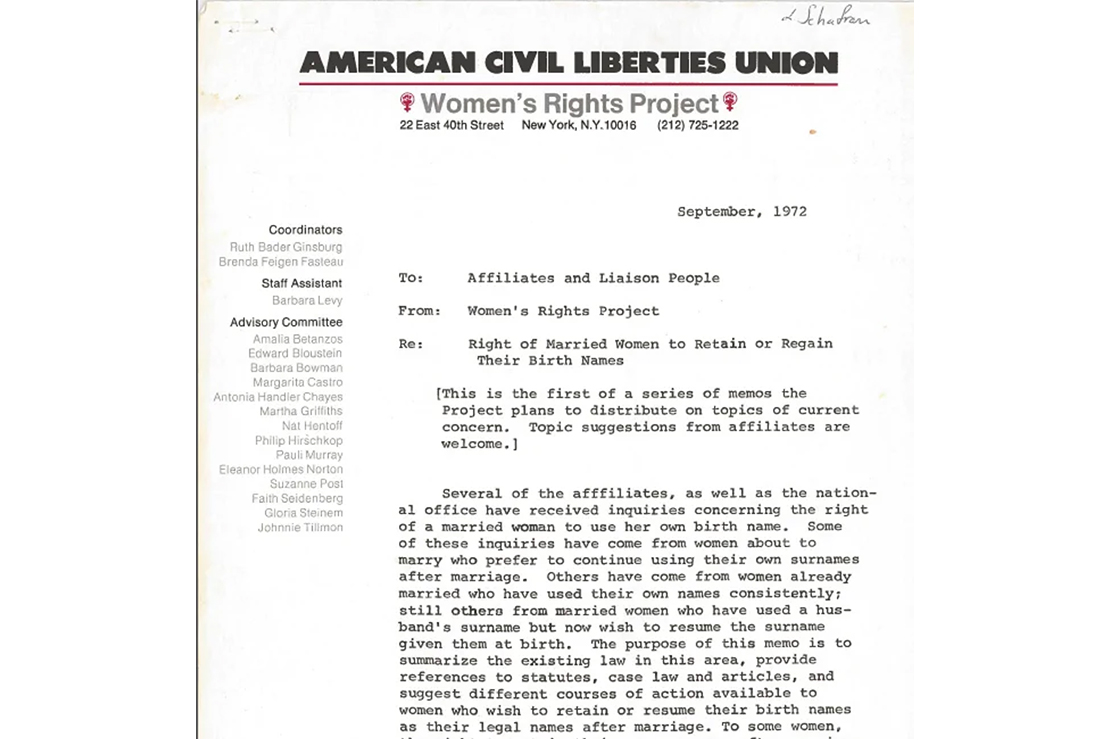
It feels especially devastating to lose Steinem as the Trump administration’s unrelenting attack on women’s rights threatens her life’s work. With reproductive rights, childbearing, and gender roles at the center of our cultural discourse, the fights of the future remain the fights of the past as we work to defend our progress. And while it’s easy to feel despondent about the current rollback of so many civil rights we hold dear, we must remember that Steinem, who knew the work was never finished, remained an eternal optimist. She would often say, “Hope is a form of planning.” The ACLU Women’s Rights Project, of which Steinem served on an advisory committee that guided our early work, shares Steinem’s vision of imagining the world as it can be — one of full equality — and will continue to work tirelessly to make that vision a reality.
Gloria Steinem's Fight Against Traditional Gender Roles Persists Today
Steinem challenged systems of power through trailblazing journalism and co-founded Ms. Magazine in 1971, creating one of the first national platforms dedicated to feminist voices. As an organizer, she founded the National Women’s Political Caucus to elect women to office. Steinem also founded the Women’s Action Alliance, which created a network of feminist activists that helped open the first domestic violence shelters among other accomplishments. She also founded the Women’s Media Center, which addressed issues of women’s representation in media. Steinem knew that real change begins when we recognize our collective power, and she put that into practice each day.
Steinem rose to prominence in the 1960s in an ecosystem that cast a white woman as the face of the feminist movement. However, she used her visibility to uplift all women, adopting the mantra, “We are linked, not ranked.” Steinem traveled across the country on speaking tours with Black activists, Dorothy Pitman Hughes, and Flo Kennedy. Mainstream media continuously tried to paint Steinem as the singular embodiment of the feminist movement, but she would time and again acknowledge the sources behind her politics, and used her standing to redistribute the access, power, and authority she held.
The right to reproductive freedom brought Steinem into the feminist movement in 1969 as a journalist covering a speak-out of women discussing the illegal abortions they had. Steinem dedicated her 2015 memoir, “My Life on the Road”, to a doctor in London who performed an abortion she had when she was 22 years old. Steinem’s foundational belief that reproductive autonomy was essential for women’s equal citizenship informed her work. For Steinem, feminism does not mean women should reject marriage or parenthood, but that they should have the freedom to decide for themselves. Steinem herself chose not to have children, a decision she publicly stated she never regretted. “Everybody with a womb doesn’t have to have a child any more than everybody with vocal cords has to be an opera singer,” she said in a 2011 interview with comedian Chelsea Handler on her show “Chelsea Lately.” Steinem’s candor feels particularly relevant today with the rise of tradwife influencers, who advocate for a return to traditional gender roles and the wave of pro-natalist policies at the federal level.
A Legacy That Guides and Empowers
I had the privilege of seeing Steinem in person this past July, just two months before her death. I became overwhelmed seeing her frailty in person at 92 years old. Steinem had been such a guiding light in my life and that of so many others that I thought she would live on forever.
I took gender studies classes in college that expanded my understanding of Steinem’s work and inspired me to first pursue a career in film, recognizing the power of media to shift social consciousness. After several years, the interminably slow pace of reform in the industry made me want to have a more tangible and immediate impact, influencing my decision to attend law school. As a staff attorney in the Women’s Rights Project, I push for change and systemic reform in institutions that perpetuate discrimination against women and girls. Steinem’s wisdom has been at the core of all the work I’ve done and all the work I’ve yet to do.
“People often ask me if I’m ‘passing the torch,’” Steinem said in a speech to the National Press Club in 2013. “I explain that I’m keeping my torch, thank you very much. And I’m using it to light the torches of others.” Steinem’s monumental legacy carries on in the countless number of people whose authentic lives were made possible because she made it so.
My torch has been lit, and for that, I will be forever grateful. May her memory be a blessing and may she rest in power.
Related Issues
Related Content
-
Press ReleaseAug 2026

Women's Rights
Foia Request Seeks Records Related To Pentagon Review Of Women In Ground Combat Roles. Explore Press Release.FOIA Request Seeks Records Related to Pentagon Review of Women in Ground Combat Roles
NEW YORK – Today, the American Civil Liberties Union’s Women’s Rights Project (WRP), the National Women’s Law Center (NWLC), and the Service Women’s Action Network (SWAN) filed a request under the Freedom of Information Act (FOIA) seeking records from the Department of Defense (DoD) regarding its decision to undertake formal review of the “effectiveness” of women in ground combat roles. The request comes as DoD and Secretary Pete Hegseth have provided no meaningful explanation for why the review was ordered, what it will examine, or what its findings could mean for women’s continued ability to serve in ground combat roles. In December 2025, DoD launched a six-month review of women’s integration into ground combat units, a decade after lifting the remaining restrictions for women to compete for those roles, in which roughly 5,000 women have served. DoD directed the Army and Marine Corps to provide data on the “operational effectiveness” of those units, including internal studies about women’s integration, to the Institute for Defense Analyses (IDA), a nonprofit organization. DoD did not announce the formal review, which became public only after it was reported by a news outlet. In April 2026, DoD reassigned the review to Johns Hopkins University Applied Physics Laboratory (JHU/APL) and extended the study’s duration to one year. “During his tenure, Secretary Hegseth has repeatedly questioned women’s ability to serve in ground combat, including by misleadingly claiming that occupational standards have been lowered to accommodate women. Such standards have been gender-neutral, by statute, for over 30 years,” said Gillian Thomas, senior counsel, ACLU’s Women’s Rights Project. “This formal review raises serious concerns that the Department of Defense is laying the groundwork to once again restrict qualified women from serving in combat. The public has a right to know why DoD ordered the review, its intended scope, and whether women’s exclusion from combat jobs is on the table as a potential outcome.” “Excluding qualified women from ground combat would make our military weaker, not stronger,” said Elisa Cardnell, chief executive officer, SWAN. “Women have always served with distinction on the front lines. Since formally being integrated into combat jobs, they have excelled in some of the military’s most demanding roles, brought critical operational experience and capabilities to missions around the world, and strengthened recruitment and retention. Every qualified servicemember should have the opportunity to earn their place and serve.” “Investigating women’s effectiveness in the military is baseless, sexist, and offensive,” said Lauren Khouri, senior director of workplace justice at NWLC. “Hegseth has been explicit about his intentions to push women out of the military and today we’re filing to find out the extent and intention of this review. This is an attack on our servicemembers and the public deserves transparency.” Women have always been on the frontlines of our nation’s defense and have served in every major U.S. conflict. For decades, however, restrictions barred women from thousands of combat positions. Those restrictions were gradually dismantled as women proved themselves in increasingly demanding assignments, including during the wars in Iraq and Afghanistan, where women were killed, wounded, and decorated for valor. In 2016, all remaining ground combat roles were open to women following a lawsuit by WRP on behalf of SWAN and four servicewomen challenging the Pentagon’s policy barring women from serving in those positions. Today, this progress is at risk following a series of actions by Secretary Hegseth that have raised concerns about women’s ability to serve in the military on equal terms. In addition to questioning women’s ability to serve in ground combat positions, Secretary Hegseth has repeatedly denigrated women servicemembers and veterans and taken unprecedented action to fire women leaders – along with Black officers – and purge them from promotion lists. He has also initiated changes to physical eligibility criteria for combat jobs across the military branches, based on an asserted belief that women have been held to lower fitness standards. These actions raise concerns that the formal review serves as a prelude to restrict women’s continued service in ground combat roles. Earlier this year the top enlisted leaders of each of the military branches testified before the Senate Armed Services Committee that women’s integration into combat occupations has not compromised performance standards or operational readiness. Even under questioning from congressional leaders, Secretary Hegseth has not offered any evidence calling women’s combat “effectiveness” into question, let alone supporting the need for further study. The FOIA request seeks records related to the formal review assigned to the Institute for Defense Analyses and later reassigned to the Johns Hopkins University Applied Physics Laboratory, including records describing the scope, purpose, methodology, and anticipated use of the review. It also seeks records related to an earlier DoD review of combat jobs’ occupational standards. A copy of the FOIA request is available here. -
News & CommentaryAug 2026

Women's Rights
Veterans Share Why The Military Is Stronger When Women Can Serve In Ground Combat Roles. Explore News & Commentary.Veterans Share Why the Military Is Stronger When Women Can Serve in Ground Combat Roles
Veterans reflect on their military service, the requirements of ground combat occupations, and the decade-long integration of women into those roles. -
News & CommentaryAug 2026

Criminal Law Reform
+2 Issues
States Are Punishing Women Who Survive Violence With Incarceration. They Deserve Clemency.. Explore News & Commentary.States are Punishing Women Who Survive Violence with Incarceration. They Deserve Clemency.
One woman violently forced into assisting a murder seeks clemency in Michigan. Author and journalist Justine van der Leun calls for states to enact laws protecting criminalized survivors. -
News & CommentaryJul 2026

Racial Justice
+3 Issues
Federal Funding Should Support Communities, Not Political Agendas. Explore News & Commentary.Federal Funding Should Support Communities, Not Political Agendas
Congressional investments should reach the communities they were intended to serve.