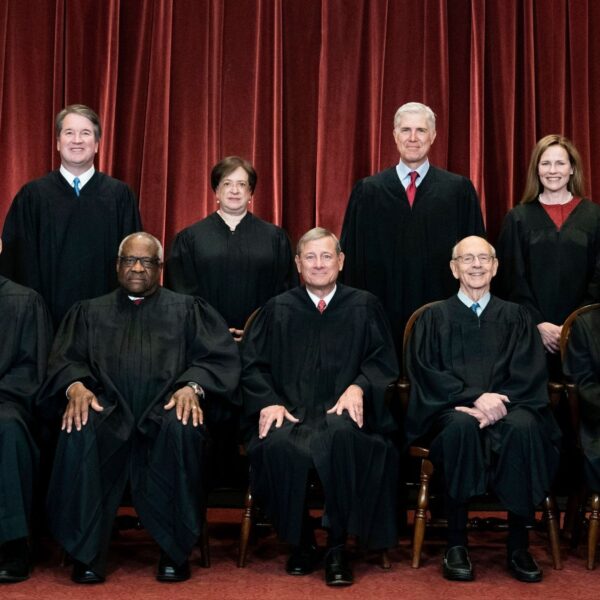
Black Women Take the Supreme Court
February 17, 2022
Just weeks ago, Justice Steven Breyer announced his retirement from the Supreme Court, opening the door for President Biden to nominate a new judge to the bench. Keeping his campaign promise, Biden confirmed that he will be nominating a Black woman to replace Breyer, a historic move for a field that has not always welcomed Black women with open arms.
Joining us to discuss the impact of this future nomination is Ria Tabacco Mar, Director of the ACLU’s Women’s Rights Project and one of At Liberty’s most frequent guests. Ria leads the project that was founded and led by Justice Ruth Bader Ginsburg.
It should be noted before we begin this conversation that as a matter of policy, the ACLU does not endorse or oppose particular candidates for the Supreme Court, except in extraordinary circumstances.
In this episode
Elizabeth Watson


This Episode Covers the Following Issues
Related Content
-
News & CommentaryOct 2026

Women's Rights
Family Separation Causes Real And Lasting Harm For Children And Parents. Explore News & Commentary.Family Separation Causes Real and Lasting Harm for Children and Parents
The ACLU is standing up for families torn apart by the government, especially those with the least resources to challenge in court. -
Press ReleaseOct 2026

Women's Rights
Civil Rights Groups File Lawsuit Against Dod For Withholding Records On Study Of Women In Ground Combat Roles. Explore Press Release.Civil Rights Groups File Lawsuit Against DOD for Withholding Records on Study of Women in Ground Combat Roles
NEW YORK – Today, the American Civil Liberties Union’s Women’s Rights Project (WRP), the National Women’s Law Center (NWLC), and the Service Women’s Action Network (SWAN) filed a lawsuit against the U.S. Department of Defense (DOD) for failing to respond to a Freedom of Information Act (FOIA) request seeking information about the Pentagon’s decision to launch a study of the “effectiveness” of women in ground combat roles. The request seeks records concerning why the study was ordered, its scope, and what its findings could mean for women’s continued ability to serve in ground combat jobs, which they integrated ten years ago. “Secretary of Defense Pete Hegseth has repeatedly, without evidence, questioned women’s ability to serve in ground combat, even though senior military leaders from every branch have attested to women’s success,” said Gillian Thomas, senior counsel, ACLU’s Women’s Rights Project. “Now, without explanation, he has commissioned a study of women’s performance and assigned it to a researcher with a record of criticizing women’s combat readiness. The public has a right to know why, and what he plans to do with the results.” “If Hegseth wants to push women out of the military, he cannot hide from the public,” said Lauren Khouri, senior director of workplace justice at NWLC. “We’re suing today to hold Hegseth accountable for his baseless, sexist, and offensive attacks on women servicemembers. These attacks undermine the law and our national security and must end." “Servicewomen in combat roles have consistently proven their capability by meeting the exact same unchanged, rigorous standards as their male peers. Re-examining these settled integration standards in secret distracts from military readiness and undermines the thousands of women serving with distinction,” said Elisa Cardnell, chief executive officer, SWAN. “The Department of Defense owes servicewomen and the public full transparency about why this study was ordered and how its findings will be used." In August, the groups submitted a FOIA request seeking records related to DOD’s review, which was launched in December 2025, a decade after DOD lifted all restrictions on women serving in ground combat roles. Since then, roughly 5,000 women have served in those jobs. DOD did not announce the review, which became public only after it was reported by a news outlet. In April, DOD reassigned the study from the Institute for Defense Analyses (IDA) to the Johns Hopkins University Applied Physics Laboratory (JHU/APL) and extended its duration from six months to one year. The lead researcher at JHU/APL authored a 2015 study, commissioned by the Marines, that was critical of women’s combat performance. The study was widely criticized for its methodology and other flaws, but Secretary of Defense Pete Hegseth has cited it favorably. Despite the current review’s apparent wide-ranging scope and potential negative consequences for thousands of women serving in combat jobs, DOD and Secretary Pete Hegseth have provided no meaningful explanation for why it was initiated, its methodology, or how its findings may be used. Women have always been on the frontlines of our nation’s defense and have served in every major U.S. conflict, beginning with the Revolutionary War. For decades, however, restrictions barred women from thousands of combat positions. Those restrictions were largely rolled back for women in the Navy and Air Force in the early 1990s, but the ground combat ban remained in place — barring women from serving in more than 200,000 jobs in infantry, armor, artillery, and related fields. With the wars in Iraq and Afghanistan, where the lines between “combat zone” and “combat support” routinely were erased, and where women were killed, wounded, and decorated for valor, the formal exclusion of women from ground combat jobs became impossible for the Pentagon to defend. In 2016, following a lawsuit by WRP on behalf of SWAN and four servicewomen challenging the Pentagon’s combat exclusion policy, all remaining ground combat roles were opened to women. The formal review of women’s combat “effectiveness,” a decade after they began serving in those jobs, comes amid a series of actions by Secretary Hegseth reflecting hostility to all servicewomen. In addition to questioning women’s ability to perform in ground combat positions, Secretary Hegseth has repeatedly denigrated women servicemembers and veterans and taken unprecedented action to fire senior women leaders — along with senior Black officers — and remove them from promotion lists. Secretary Hegseth has also put forth rhetoric and policies emphasizing a hyper-masculine conception of physical strength as the leading predictor of job combat performance. These include his recently announcing mandatory testosterone testing and changing physical eligibility criteria for combat jobs across the military branches based on an asserted notion that existing standards held women to lower fitness requirements. These actions have raised concerns that the formal review currently underway could serve as a pretext for reinstating the ground combat ban, in whole or in part. Given that Secretary Hegseth and other senior leaders have refused to provide substantive answers to questions about the review — even from members of Congress — the need for transparency is urgent. The lawsuit seeks a court order requiring DOD to promptly process the FOIA request and release all responsive records. The request seeks records related to the formal review describing the scope, purpose, methodology, and anticipated use. It also seeks records related to an earlier DOD review of occupational standards for combat jobs. A copy of the complaint is available here. A copy of the FOIA request is available here. -
Press ReleaseOct 2026
Women's Rights
Civil Rights Groups Oppose Proposed Changes That Would Illegally Dismantle The Head Start Program. Explore Press Release.Civil Rights Groups Oppose Proposed Changes That Would Illegally Dismantle the Head Start Program
WASHINGTON — Today, civil right groups filed a public comment in opposition to a rule proposed by the U.S. Department of Health and Human Services’ Administration for Children and Families, urging the agency to withdraw its proposed changes to the Head Start Program Performance Standards. The proposal would remove many of the standards that have made Head Start one of the nation’s most successful investments in young children and families and would make it harder for local programs to provide the high-quality services children deserve. Head Start’s performance standards establish minimum protections to ensure children receive high-quality education, developmental screenings, qualified teachers, and comprehensive support regardless of where they live. Removing those protections would create uncertainty for families and weaken accountability for taxpayers. “These proposed changes are unlawful. Congress requires HHS to protect the quality, scope, and type of services Head Start provides, and to ensure Head Start programs provide linguistically and culturally relevant comprehensive services. The administration cannot simply disregard those directives. This proposal would weaken standards that families have relied on for generations and undermine a program Congress specifically acted to protect,” said Jennesa Calvo-Friedman, senior staff attorney at the ACLU Women’s Rights Project. “By making Head Start programs less accessible, this proposed rule threatens women’s economic and social freedom and risks pushing them out of the workforce and back into the home.” “Head Start serves thousands of children and families across Illinois, providing a critical boost for success and creating opportunity in our state,” said Allison N. Siebeneck, director of the Women’s and Reproductive Rights Project at the ACLU of Illinois. “The Administration has been determined to undermine – indeed dismantle – Head Start since taking office last year. They failed legislatively to achieve this goal and are attempting to accomplish the same end via these rule changes. We are proud to stand with our colleagues and partners in opposing this destructive and harmful effort.” “Head Start is a critically important support for children, families, and entire communities facing barriers that arise from systemic racism and inequality – a purpose Congress specifically created it for. As the Administration continues its attempt to unravel Head Start, this time through rulemaking, we continue our fight to stop any attempt to restrict meaningful access to this vital program,” said La Rond Baker, ACLU of Washington legal director. “Head Start exists to make sure every child in the United States has access to comprehensive education. The proposed Rule undercuts that purpose,” said Lori Rifkin, Impact Fund litigation director. “It erases crucial access requirements for the children most likely to be left behind, including children with disabilities, children in rural communities, children in foster care, and Black and brown children. The Administration's attacks on Head Start have been rejected by Congress and the federal courts, and we will continue to stand with Head Start programs and families to fight these illegal acts.” For more than 60 years, Head Start has combined early learning with health care, developmental screenings, nutrition, family support, disability services, and parent engagement. Decades of research show that this comprehensive approach improves school readiness, as well as health, educational attainment, and long-term outcomes for children and families. Rather than providing meaningful flexibility, the proposal removes safeguards that protect children while providing no additional funding to address rising costs for staffing, food, transportation, insurance, and facilities. Programs would be left with fewer resources and fewer protections to maintain high-quality services. The comment was submitted by the American Civil Liberties Union’s Women’s Rights Project, the ACLU of Washington, ACLU of Illinois, and Impact Fund. The group also represents a coalition of Head Start parents and providers that successfully halted previous attempts from the Trump administration to gut the Head Start program. Those attempts included a sprawling “DEIA” ban, restrictions of eligibility for many immigrant families, and cuts to more than half of the staff at the Office of Head Start, that likewise sought to fundamentally alter what Head Start providers could teach and the communities they could serve. The full public comment is available here. -
News & CommentarySep 2026

Women's Rights
Aclu Women's Rights Advocate Honors Gloria Steinem's Legacy. Explore News & Commentary.ACLU Women's Rights Advocate Honors Gloria Steinem's Legacy
Attorney Ashley Johnson reflects how Gloria Steinem shares the work of the ACLU and how it lit the way for her own future in advocacy.