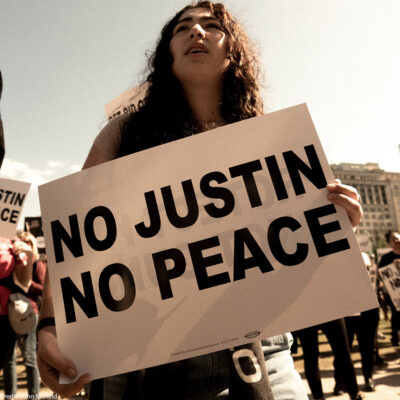
What Happens In Tennessee Won't Stay in Tennessee
April 13, 2023
On Friday, April 7, the Tennessee state legislature voted to expel two out of the three state representatives, Reps. Justin Pearson and Justin Jones, who protested on the chamber floor in the wake of a mass shooting that killed six people, including three 9-year-old children. Their expulsion was an unprecedented move, completely disregarding the norms of democracy and the will of voters. No Tennessee House member has ever been removed from elected office for simply violating decorum rules.
This week, Reps. Pearson and Jones were both reinstated to their elected seats in the State House, but the damage has been done.
Here to unpack all that has happened in Tennessee this week is Jeff Preptit, a staff attorney at the ACLU of Tennessee.
In this episode
Kendall Ciesemier

This Episode Covers the Following Issues
Related Content
-
Press ReleaseSep 2026

Voting Rights
U.s. Supreme Court Blocks Postal Service From Restricting Mail Ballots. Explore Press Release.U.S. Supreme Court Blocks Postal Service From Restricting Mail Ballots
WASHINGTON – In a major win for voting rights, election integrity, and democracy, the U.S. Supreme Court today left in place a preliminary injunction that blocks the U.S. Postal Service (USPS) from enforcing key parts of a new rule that would have significantly restricted mail voting and disenfranchised voters who rely on mail ballots. The preliminary injunction will remain in place through the Nov. 3 election. The decision means that all 50 states can continue to use their existing processes for mail voting, which have proven for decades to be safe, secure, and reliable. Hundreds of thousands of mail ballots are already being delivered to eligible voters, with millions more to follow this month. Many Americans rely on mail voting because disability, distance, or work or caregiving schedules make it difficult or impossible to get to their polling site in person. With the injunction in place, USPS cannot refuse to deliver mail ballots for the November election. Nor can it require states to upload personal voter information into its new and untested online portal. The USPS rule that has been blocked by the courts would have operationalized President Trump’s March 31 executive order to restrict mail voting. The injunction stems from a lawsuit filed by a coalition of nonpartisan voter service and civic organizations: the League of Women Voters of Massachusetts, League of Women Voters, Association of Americans Resident Overseas, U.S. Vote Foundation, OCA - Asian Pacific American Advocates, and Delta Sigma Theta Sorority, Inc. They are represented by the American Civil Liberties Union, ACLU of Massachusetts, Brennan Center for Justice at NYU Law, Legal Defense Fund (LDF), Asian Americans Advancing Justice – AAJC (Advancing Justice – AAJC), and LatinoJustice PRLDEF. Attorneys for the plaintiffs released the following statement: “This ruling is a critical step to ensuring free and fair elections this November by maintaining access to mail voting for millions of eligible voters across the United States and lifting the dire threat that the Postal Service would disenfranchise them. Mail voting is safe, secure, and reliable — and the Trump administration has presented no evidence to the contrary, as the courts have repeatedly recognized. We will remain vigilant in countering threats to free and fair elections and ensuring that every eligible voter is able to cast a ballot and have it count.” Read the Supreme Court’s order here: https://assets.aclu.org/live/uploads/2026/09/26A305_3756.pdf -
U.S. Supreme CourtSep 2026

Voting Rights
People Not Politicians V. Onder (amicus). Explore Case.People Not Politicians v. Onder (Amicus)
Whether congressional elections in Missouri for the November 2026 midterms will be held using districts that never lawfully took effect because they have not been subject to a vote by the people via the referendum process. -
U.S. Supreme CourtSep 2026
Voting Rights
Hoskins V. Von Glahn (amicus). Explore Case.Hoskins v. von Glahn (Amicus)
Whether congressional elections in Missouri for the November 2026 midterms will be held using districts that never lawfully took effect because they have not been subject to a vote by the people via the referendum process. -
Press ReleaseSep 2026
Voting Rights
U.s. Postal Service Still Blocked From Enforcing Key Parts Of New Rule To Restrict Mail Ballots. Explore Press Release.U.S. Postal Service Still Blocked from Enforcing Key Parts of New Rule to Restrict Mail Ballots
BOSTON – The First Circuit Court of Appeals today kept in place through the Nov. 3 election a preliminary injunction blocking the U.S. Postal Service (USPS) from enforcing key parts of a new rule that would significantly interfere with mail voting if implemented.The Trump administration has also asked the U.S. Supreme Court to stay the injunction. A ruling is expected soon. In issuing the injunction, the U.S. District Court in Boston found that the USPS rule was likely unconstitutional and unlawful — and that enforcing it would make voter disenfranchisement “practically inevitable.” The First Circuit Court of Appeals reinforced the District Court’s findings, writing: “[T]he district court made detailed findings about the chaos and widespread disenfranchisement that would occur between now and November 3 should the [USPS] Rule take immediate effect, including the fact that it would be impossible for some States to reprint compliant envelopes; the likely delays in the required USPS envelope review process; the lack of a presently operative portal; and the herculean task that would confront the USPS in scanning tens of millions of ballot envelopes and reviewing for a match with information in the presently non-operative portal." The injunction stems from a lawsuit filed by a coalition of nonpartisan voter service and civic organizations: the League of Women Voters of Massachusetts, League of Women Voters, Association of Americans Resident Overseas, U.S. Vote Foundation, OCA - Asian Pacific American Advocates, and Delta Sigma Theta Sorority, Inc. They are represented by the American Civil Liberties Union, ACLU of Massachusetts, Brennan Center for Justice at NYU Law, Legal Defense Fund (LDF), Asian Americans Advancing Justice – AAJC (Advancing Justice – AAJC), and LatinoJustice PRLDEF. Plaintiffs and counsel jointly issued the following statement: “The U.S. Postal Service is not the gatekeeper for mail ballots. It does not have that authority. And it cannot usurp election authority from the states and Congress. This decision rightly keeps in place an order blocking USPS from enforcing its disruptive and disenfranchising rule through the November election and preserves the current system, which has worked safely, securely, and reliably for decades.”