NYCLU on NYS Passing Legislation to Restore Voting Rights to People on Parole
ALBANY, N.Y. – The New York State Assembly joined the Senate by passing legislation to permanently and automatically restore the right of people on parole to vote in all elections.
In response, the New York Civil Liberties Union issued the following statement from senior staff attorney Perry Grossman:
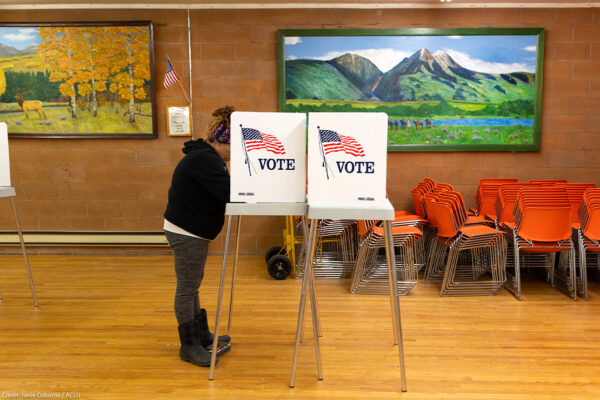
“The NYCLU applauds the Assembly for passing A4448, which will automatically restore the voting rights of people on parole once they return home to their communities.
“With today’s vote, the legislature brings New York one step closer to replacing voting restrictions rooted in racism with evidence-based policymaking. Civic engagement after re-entry correlates with lower recidivism, better outcomes for people on parole, and greater community stability. We urge Governor Cuomo to make the automatic restoration of voting rights for New York’s returning citizens permanent without delay.”
Related Issues
Related Content
-
Press ReleaseAug 2026

Voting Rights
Federal Court Rejects Effort To Block Desoto County’s Majority-black Judicial District. Explore Press Release.Federal Court Rejects Effort to Block DeSoto County’s Majority-Black Judicial District
JACKSON, Miss. – A federal court denied an effort to block DeSoto County’s majority-Black judicial subdistrict from being used in the November election, preserving the only judicial district in the county that gives Black voters a meaningful opportunity to elect candidates of their choice. Following a four-day preliminary injunction hearing last week, U.S. District Judge Sharion Aycock of the Northern District of Mississippi ruled that the plaintiffs “wholly failed to carry their burden” to obtain preliminary relief and could not overcome the Supreme Court’s Purcell v. Gonzalez decision, which cautions courts against making disruptive changes to election rules close to an election. The American Civil Liberties Union, ACLU of Mississippi, Legal Defense Fund (LDF), and NAACP represented the DeSoto County NAACP and Delta Sigma Theta Sorority, Inc. to intervene in the case last month to defend the majority-Black judicial subdistrict. The groups intervened to stop the plaintiffs who sought to eliminate the district. “The court’s decision protects DeSoto County voters from this unfounded, last-minute attempt to take away their only meaningful opportunity to participate in judicial elections,” said Ming Cheung, senior staff attorney with the ACLU’s Voting Rights Project. “Callais is not a license for politicians to disempower Black voters.” “Today's ruling protected DeSoto county voters' constitutional right to fair judicial representation for this year's elections,” said Brenda Wright, Special Counsel at the Legal Defense Fund. “Those voters deserve nothing less than free and fair elections, and it was unfortunate that the opponents of these districts would try to change the rules so late in the process.” “In one of the fastest growing counties in Mississippi, where black residents make up over 30% of the county and have largely driven the population increase, black DeSoto Countians deserve like all voters a chance to elect candidates of their choice including to the Circuit and Chancery Courts,” said Joshua Tom, legal director at ACLU of Mississippi. The ruling comes as DeSoto County prepares for the November midterm elections. Black residents make up approximately 36% of the county’s population, and the county has a longstanding pattern of racially polarized voting. Most judgeships in DeSoto County are elected countywide, meaning that without the majority-Black judicial subdistrict, Black voters would lack a meaningful opportunity to elect their preferred candidates to the circuit and chancery courts. While the court’s ruling addresses the request for preliminary relief, the underlying litigation remains ongoing. The civil rights groups will continue defending the judicial district and the voting rights of DeSoto County residents. -
Press ReleaseAug 2026
Voting Rights
Federal Court Blocks U.s. Postal Service From Implementing Executive Order Restricting Mail Voting. Explore Press Release.Federal Court Blocks U.S. Postal Service from Implementing Executive Order Restricting Mail Voting
BOSTON – A federal court today issued a preliminary injunction blocking the U.S. Postal Service (USPS) from implementing President Trump’s 2026 executive order restricting mail voting, in a case brought by a coalition of nonpartisan voting rights groups. “The court saw what we've said from the beginning: this executive order is causing real harm right now," said Sophia Lin Lakin, director of the ACLU's Voting Rights Project. "Today's ruling sends another necessary message to an administration that continues to weaponize portions of the government to sow chaos into our elections at the expense of eligible voters. The president does not get to rewrite the rules of voting, and he certainly does not get to treat voters as collateral damage in his campaign to control state-run elections. Every last-minute disruption, every manufactured obstacle, and every attempt to seize control of election administration puts real voters in the crosshairs. But this ruling protects voters as we head into the November midterms." Today’s ruling blocks USPS from implementing Section 3 of the executive order for the November 3 midterm elections and any earlier federal election. The court held unequivocally that “the executive branch has no authority to regulate elections” and recognized that the executive order is currently causing "irreparable harm” to both voting rights groups and voters by creating confusion about the mail ballots that millions of voters rely on. In June, the same District Court ruled in a separate case brought by 23 states and the District of Columbia that key parts of the executive order were unconstitutional and legally void. In that ruling, the court barred both federal agencies and USPS from using the executive order to interfere with voter rolls or mail ballots in the plaintiff states and D.C. The Trump administration has made an emergency request to the U.S. Supreme Court to lift that injunction; that request is pending. The suit from voting rights groups was filed by the League of Women Voters of Massachusetts, the League of Women Voters, Association of Americans Resident Overseas (AARO), U.S. Vote Foundation, OCA - Asian Pacific American Advocates (OCA), and Delta Sigma Theta Sorority, Inc. They are represented by the American Civil Liberties Union (ACLU), ACLU of Massachusetts, Brennan Center for Justice, Legal Defense Fund (LDF), Asian Americans Advancing Justice (Advancing Justice-AAJC), and LatinoJustice PRLDEF. Plaintiffs and counsel in the case issued the following statements: Attorneys representing the plaintiffs: “This ruling reinforces the clear language of our Constitution: The president plays no role in our elections and he cannot turn the U.S. Postal Service into a tool for disenfranchising voters. Millions of citizens rely on mail voting, and USPS has no authority to determine which of them should receive ballots. Voting rights groups and state and local officials are already deep into preparation for ongoing primaries and the November 2026 midterms, and the president’s executive order has created chaos and harm. We welcome this ruling as an important step to preserve free and fair elections. We will continue to vigorously defend the fundamental right to vote and protect the integrity of our elections.” Celia Canavan, Executive Director, League of Women Voters of Massachusetts: “The League of Women Voters of Massachusetts commends the court for upholding one of our most sacred constitutional rights: the right to vote. We are pleased to see this ruling and are committed to remaining in the fight to protect voting rights – not just for the Bay Staters who rely on mail voting, but for every American who utilizes this safe, secure, and trusted tool.” Marcia Johnson, chief of activation and justice, League of Women Voters: “This ruling is a victory for voters and for the Constitution. Neither the president nor the U.S. Postal Service has the authority to rewrite election rules. Millions of Americans, including seniors, military voters, voters with disabilities, rural voters, and citizens living overseas, rely on voting by mail to participate in our democracy. Today’s decision reaffirms that the rules governing our democracy must be set by the Constitution and the law, not by executive overreach. The League of Women Voters will continue fighting to ensure that every voter can cast a ballot and have that ballot counted.” Doris Speer, president of the Association of Americans Resident Overseas: “AARO is extremely pleased with this decision. The executive order threatened chaos, confusion, and disenfranchisement of Americans living overseas. The president cannot make rules for federal elections, and certainly should not place new obstacles in the way of exercising the most fundamental right and responsibility of citizenship — the right to vote. We are gratified that this order has been stopped.” Susan Dzieduszycka-Suinat, President and CEO, U.S. Vote Foundation: “We are relieved that the courts have halted this executive order and reaffirmed the roles of states and Congress in setting election rules. Absentee and mail voting have long provided a secure and reliable way for eligible voters, including military and overseas citizens, to participate in elections. We remain committed to protecting access to these proven voting processes.” Thu Nguyen, Executive Director, OCA – Asian Pacific American Advocates: “Asian American voters often rely on translators to help comfortably cast an informed ballot. And voting by mail is an indispensable tool that allows us to better access translators of choice using various communication tools like the phone. Without it, we’d be reliant on translators who are available to go to the polls with us or hope to find one there. We applaud the court decision enjoining the USPS because this means our communities will have fewer hurdles to overcome in the upcoming primaries and the November general election.” Cheryl W. Turner, international president of Delta Sigma Theta Sorority, Inc.: “Today’s ruling affirms a foundational promise of our democracy: Every eligible voter must be able to participate freely, fairly, and without unnecessary barriers. Delta Sigma Theta will continue to stand against any effort that threatens access to the ballot and undermines the rights of voters, particularly in communities that have too often been excluded from full democratic participation.” Read the order here. Find more information about League of Women Voters of Massachusetts v. Trump here. -
Press ReleaseAug 2026
Voting Rights
South Carolina Veterans' Groups Fight Back Against Partisan Bid To Exclude Voters From Primary Elections. Explore Press Release.South Carolina Veterans' Groups Fight Back Against Partisan Bid to Exclude Voters from Primary Elections
COLUMBIA – Two groups representing military veterans are seeking to keep South Carolina’s primary elections open to all registered voters. As the new motion to intervene highlights, a large share of military veterans identify as politically independent. Forcing party registration to vote in primaries could lock many independent voters, including veterans, out of a key part of the election process. Veterans for All Voters and The Chamberlain Network, nonpartisan groups representing some of South Carolina’s 400,000 military veterans, have filed a motion to intervene on the side of the state defendants in the ongoing federal lawsuit South Carolina Republican Party v. Bolchoz. The veterans are represented by the American Civil Liberties Union and the ACLU of South Carolina. South Carolina’s semi-open primaries are publicly funded and administered by state and county election officials. Under the current system, any registered voter may choose to vote in one major party’s primary or another during an election cycle, but not both. On July 6, after failing to close primaries via Statehouse legislation, the South Carolina Republican Party sued State Election Commission Chairman Robert Bolchoz and other election officials in federal court. The state GOP, which holds a supermajority in both chambers of the Statehouse, is asking the court to grant the party control over who is allowed to vote in taxpayer-funded primary elections. “Elections belong to the people,” said Allen Chaney, Legal Director of the American Civil Liberties Union of South Carolina. “Granting private political parties the power to exclude eligible voters from decisive, state-run elections is unfair and undemocratic.” “Once again, we’re witnessing politicians attempt to choose who gets to participate in our democracy,” said Adriel Cepeda Derieux, Deputy Director for the ACLU's Voting Rights Project. “In South Carolina, where deeply gerrymandered districts means many races are effectively decided in the primary, closing those state-run elections would silence hundreds of thousands of independent voters.” “My first duty station was in South Carolina, and I called the state home for my first two years on active duty. This case is about whether eligible voters can continue participating in publicly funded primaries without giving up their political independence,” said Alberto Ramos, Chief Executive Officer of Veterans for All Voters. “My brothers and sisters in arms who call South Carolina home today deserve a meaningful voice in the elections that often decide who represents them. South Carolina’s elections belong to South Carolina voters, and we are stepping into court to defend their voice.” "More than half of post-9/11 veterans do not identify with either party,” said Peter Lucier, Research and Advocacy Manager of The Chamberlain Network. “Those independent veterans deserve a voice in the democracy they served to defend." Thanks to a pattern of extreme gerrymandering that has made most Congressional and Statehouse districts politically non-competitive in the general election, primary elections are often the decisive contests in South Carolina elections. If the state Republican Party gets its way in court, independent voters who do not register with a party will be robbed of the opportunity to cast a meaningful ballot. In some races, the primary election is the only chance to vote. In the 2026 election cycle, for example, data from the South Carolina Election Commission identifies 56 elections where the primary is the only contested election. In those races, exclusion from the primary means complete disenfranchisement. Open primaries are especially important to veterans, who are more likely than the general population to identify as political independents. For example, in a 2024 survey of veterans conducted by Iraq and Afghanistan Veterans of America, 55% of veterans said they did not identify with either the Democratic or Republican party. The South Carolina Republican Party has tried suing the state to exclude voters from state-run primaries before. In 2011, the state party was a plaintiff in the case Greenville County Republican Party Executive Committee v. South Carolina. But the party eventually abandoned the case after a federal court upheld the facial constitutionality of the state’s primary laws. In the 2025-2026 legislative session, lawmakers considered bills to amend the semi-open primary system (including H. 3310 and H. 3396, H. 5183, S. 109, and S. 113). Despite the Republican Party holding a supermajority in both chambers of the state legislature, none of these bills passed. As noted in today’s legal filing, a similar case unfolding in Texas may give South Carolinians a preview of what the South Carolina Republican Party will try next. After proposing legislation to close primaries and then amending party rules, the Republican Party of Texas sued the state in Hunt v. Texas, filed in September 2025. Texas Attorney General Ken Paxton, representing the state as a defendant in the lawsuit, made no defense and instead sided with his own political party attempting to overturn the state’s open primary system. South Carolina Republicans have followed a similar path so far. South Carolina Attorney General Alan Wilson, who may be called on to defend the State Election Commission in this case, has already appeared at a press conference alongside his party’s leaders aiming to close primaries. If the attorney general is not interested in defending voters’ rights, then South Carolinians will mount their own defense. -
South CarolinaAug 2026
Voting Rights
South Carolina Republican Party V. Bolchoz. Explore Case.South Carolina Republican Party v. Bolchoz
The South Carolina Republican Party has sued state election officials seeking to close South Carolina’s primary elections, excluding independent and unaffiliated voters from participating in what are often the only meaningful elections in their communities. Veterans for All Voters and The Chamberlain Network, two nonpartisan veterans’ organizations, have moved to intervene as defendants to protect their members’ right to vote in the primary of their choice and to ensure the State does not settle the case in a way that extinguishes those rights.