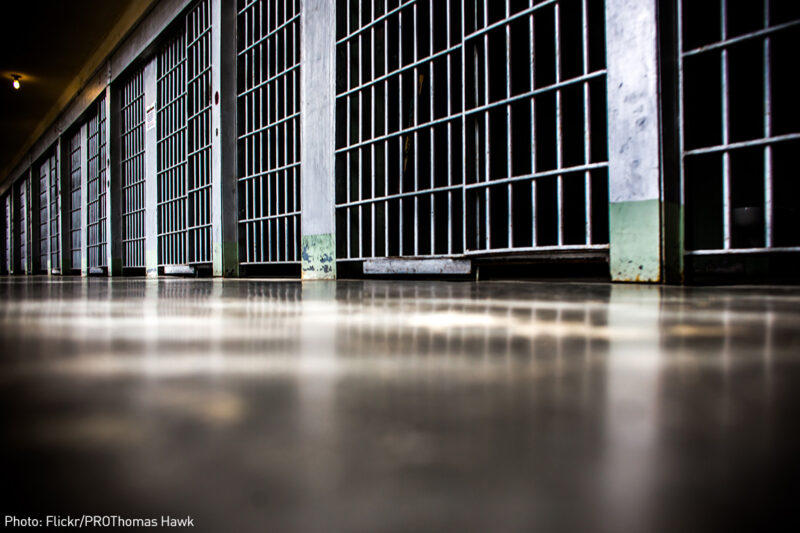
Today, the U.S. has the highest incarceration rate of any country in the world. With over 2.3 million men and women living behind bars, our imprisonment rate is the highest it’s ever been in U.S. history. And yet, our criminal justice system has failed on every count: public safety, fairness and cost-effectiveness. Across the country, the criminal justice reform conversation is heating up. Each week, we feature our some of the most exciting and relevant news in overincarceration discourse that we’ve spotted from the previous week. Check back weekly for our top picks.
Fighting Private Prisons
The efforts of the ACLU and other private prisons opponents were rewarded in Florida, where the state senate voted 21-19 against a bill to privatize every prison in Southern Florida. In rejecting privatization, Florida has an opportunity to pass smart criminal justice reforms to save the state money.
• Meanwhile, the Corrections Corporation of America, the largest private prison company in the nation, sent a letter last month to 48 state governors offering to buy state-run prisons on the condition that those prisons remain full for 20 years. The ACLU and 26 other organizations, including faith groups, sent letters to those governors urging them to decline CCA’s offer.
• USA Today ran two articles examining the ethical concerns raised by the proposal. Read them here and here.
• Join us in taking action: go here to urge your governor to reject CCA’s offer, and please share widely with your networks.
States Move Toward Sentencing Reform
Last month, the ACLU released a report highlighting recent bipartisan state-level reforms. The ACLU has been pushing for more progress by successfully advancing bills in several states that would reduce prison populations, including:
• California: The ACLU worked to introduce a bill that would change simple possession of drugs from a felony to a misdemeanor.
• Hawaii: The ACLU supported reform bills changing drug and parole laws that just passed the House and moved on to the state Senate.
• Louisiana: A bill with bipartisan support was introduced to grant parole to nonviolent offenders serving life without parole.
• Maryland: The ACLU has championed several bills, including one that would reduce pre-trial detention for misdemeanors and others that would reform parole, marijuana and juvenile justice laws.
• Washington: The ACLU is helping direct policy for the state’s newly-operational LEAD program, a first-of-its-kind that diverts low-level offenders into services immediately after arrest and before booking. Other members of this coordinating group include law enforcement, elected officials, and community stakeholders. The program will be rigorously evaluated, and we hope expanded into other states. Washington will also consider a ballot initiative to legalize marijuana use this fall.
• West Virginia: An omnibus reform bill designed to save money by reducing the prison and jail populations has cleared the state Senate and is moving to the House floor. The ACLU contributed to a new report by the West Virginia Center on Budget and Policy that makes the fiscal case for these reforms.
Fiscal Note Reform
The ACLU and the American Legislative Exchange Council (ALEC) align on the need for rigorous budget accounting of new criminal justice laws. ALEC is calling for states to implement recommendations similar to those of a report released last month by the ACLU and the Center for Budget and Policy Priorities. Over a dozen states are considering fiscal note reforms this year, including Maryland and West Virginia, where efforts have focused on criminal justice bills.
ACLU in the Media
The past month saw a number of highlights in the media, including: Inimai Chettiar in The Huffington Post on mass incarceration as the new Jim Crow; David Shapiro’s op-ed in the Palm Beach Post on the pitfalls of private prisons; David Fathi in USA Today on music as a tool for inmate reintegration; and Jason Williamson in USA Today on the danger of drug-testing for welfare recipients.
Demanding Humane Prison Conditions
No matter what their crime, prisoners have a constitutional right to humane conditions. The ACLU is working to improve conditions in:
• Mississippi: A lawsuit brought by the ACLU and the Southern Poverty Law Center will soon result in a groundbreaking consent decree banning solitary confinement for kids convicted as adults. The decision is also an indictment of private prisons: the decree will require juveniles to be transferred out of a hyper-violent GEO Group-run facility.
• Arizona: This week the ACLU filed a lawsuit on behalf of Arizona prisoners denied adequate health care and held in cruel forms of solitary confinement, as reported by the Associated Press.
• Pennsylvania: The ACLU released a report last month documenting the failure of state prisons to provide adequate reproductive health care for female prisoners.
Learn more about overincarceration: Sign up for breaking news alerts, follow us on Twitter, and like us on Facebook.
Related Issues
Related Content
-
Press ReleaseSep 2026

Criminal Law Reform
+2 Issues
Federal Court Rules Washington, D.c. Parole And Supervised Release System Discriminates Against People With Disabilities. Explore Press Release.Federal Court Rules Washington, D.C. Parole and Supervised Release System Discriminates Against People with Disabilities
WASHINGTON – A federal court ruled last week that the federal agencies responsible for parole and supervised release in Washington, D.C. violated federal disability law by systematically failing to meaningfully consider and accommodate people with disabilities. The class action lawsuit was brought by two D.C. residents with disabilities, represented by the American Civil Liberties Union, ACLU of D.C., Public Defender Service for the District of Columbia, and Latham & Watkins LLP. Plaintiffs challenged the federal government’s post-conviction supervision system in Washington, D.C. for ignoring the needs of people with disabilities, thereby putting them at constant risk of sanctions, including incarceration. The court’s decision granted plaintiffs’ motion for summary judgment on liability. “This decision makes clear that failing to provide people with all types of disabilities the accommodations they need to comply with supervision is discrimination, plain and simple,” said Allison Frankel, senior staff attorney at the ACLU’s Criminal Law Reform Project. “People with disabilities should have a fair chance to comply with the myriad supervision rules and remain in their communities, instead of being set up to fail from the start. We are celebrating this victory for our clients, and we are committed to continue fighting to ensure that people with disabilities on supervision across the country receive the accommodations they are legally entitled to.” For D.C. residents, a criminal sentence can extend for years beyond their time behind bars through parole or supervised release, which requires people to comply with myriad and onerous conditions. Failing to follow conditions, like missing a single appointment, can land a person back in jail or prison, even when no new criminal conduct is alleged. In 2021 and 2022, 10 percent of all individuals under supervision in D.C. faced violation proceedings solely for technical violations of release conditions. Among people with disabilities, the percentage was nearly twice as high (18 percent). People with disabilities are over-represented among the supervision population and face heightened barriers to meeting supervision requirements. “Discrimination against people with disabilities is incompatible with justice,” said Laura Follansbee, staff attorney at the ACLU of D.C. “This ruling is an important victory for equal access, and it affirms that people with disabilities must have a genuine opportunity to succeed on parole and supervised release in D.C.” The ACLU has documented similar barriers that people with disabilities under supervision face across the country. In 2024, the organization released a report providing guidance for people with disabilities seeking accommodations, as well as tools for advocates working to challenge systemic barriers. “For years, the government has failed to accommodate individuals with disabilities on parole and supervised release in D.C., as required by law,” said Christine Smith, associate at Latham & Watkins, who argued the motion. “This ruling is a significant step toward securing lasting institutional reform and ensuring that all people have an equal opportunity to succeed on supervision.” The decision is here: https://www.aclu.org/cases/mathis-v-united-states-parole-commission?document=Memorandum-Opinion-Granting-Summary-Judgment-on-Liability -
Press ReleaseDec 2025
Criminal Law Reform
Smart Justice
Aclu Responds To President Trump’s Announcement Rescheduling Marijuana. Explore Press Release.ACLU Responds to President Trump’s Announcement Rescheduling Marijuana
WASHINGTON – President Trump announced today that he will direct executive agencies to reclassify marijuana from Schedule I to Schedule III under federal law, recognizing that marijuana has accepted medical uses and a lower potential for dependence. Marijuana is currently classified alongside substances such as heroin, and rescheduling would instead place it alongside medications like Tylenol with codeine. The announcement follows years of advocacy directed at many administrations, expanding scientific research, and widespread state-level reforms. “Today’s announcement is a significant step toward aligning federal marijuana policy with science, evidence, and the realities on the ground in states across the country,” said Nina Patel, senior policy counsel at the ACLU. “Congress must now pass the Cannabis Administration and Opportunity Act and the Marijuana Opportunity Reinvestment and Expungement Act (MORE Act) to ensure justice for the people and communities harmed by the war on drugs. These federal bills would remove federal criminal penalties for marijuana, provide criminal history record clearing, and necessary investments in communities disproportionately targeted for criminalization. The ACLU will continue the fight to end unjust and punitive drug polices for everyone and the creation of a more perfect union for all.” -
Press ReleaseAug 2025
Smart Justice
Aclu And Partners Reach A Landmark Settlement Agreement To End Wealth-based Detention In Oklahoma. Explore Press Release.ACLU and Partners Reach a Landmark Settlement Agreement to End Wealth-Based Detention in Oklahoma
OKLAHOMA CITY – The American Civil Liberties Union, ACLU of Oklahoma, and Covington & Burling LLP announced a landmark agreement today with court leadership in Canadian County, Oklahoma that, if approved by the federal judge presiding over the case, would put an end to the unconstitutional practice of jailing people simply because they cannot afford bail. Under the agreement, judges in Canadian County must determine a person’s ability to pay before imposing cash bail. The agreement also prohibits conditioning release on paying cash bail unless the court finds that doing so is necessary because nonfinancial conditions will not adequately ensure future court appearance or protect the public. This marks a major step toward ending wealth-based detention in Oklahoma. “This agreement marks a major step toward ending a two-tiered justice system in Oklahoma where wealth determined who stayed in jail and who walked free,” said Brandon Buskey, director of the ACLU’s Criminal Law Reform Project. “For far too long, people who are presumed innocent have been languishing in jail when they could have otherwise been safely in their communities. The procedures we have implemented are critical to building a more just and equitable pretrial system for all.” If approved, the settlement would resolve a federal class action lawsuit, White v. Hesse, brought in 2019 on behalf of people detained pretrial in Canadian County. Plaintiffs challenged the unconstitutional use of a preprinted bail schedule and the policy and practice of imposing cash bail without individualized hearings or ability to pay assessments. As a result, people were routinely held in jail for weeks without receiving a meaningful hearing. “Spending even a few days in jail can upend a person’s entire life,” said Megan Lambert, legal director at the ACLU of Oklahoma. “People risk losing their jobs, their housing, and even custody of their children, making it more difficult to rebuild their lives upon release. Cash bail traps people in a cycle of discrimination, poverty, and incarceration. Today’s agreement interrupts that cycle to better ensure that no one is locked up simply because they cannot afford to pay for their freedom.” The full agreement is here: https://www.aclu.org/cases/white-et-al-v-hesse-et-al?document=Consent-Decree -
Press ReleaseAug 2025
Smart Justice
Aclu Condemns Trump Executive Orders Targeting Cash Bail Reform In Washington, D.c.. Explore Press Release.ACLU Condemns Trump Executive Orders Targeting Cash Bail Reform in Washington, D.C.
WASHINGTON – President Trump signed two executive orders today attempting to end Washington, D.C.’s cash bail reforms and threatening to withhold federal funds from cities with similar policies. Below is a statement from Cynthia Roseberry, director of policy and government affairs with the American Civil Liberties Union’s Justice Division, in response to the orders: “To further his dangerous, performative abuse of power in D.C., President Trump today took another step to make people in our nation’s capital less safe by targeting common sense bail reforms. These executive orders are another blatant power grab by the Trump administration that will only serve to benefit the predatory bail industry. But the people who will be most impacted are those with the fewest resources. Whether we can afford to pay should never determine our freedom.” “The President’s attempt to end cash bail risks increasing pretrial detention, which is not a real solution to preventing crime in D.C. It can actually have a negative effect on public safety, by separating people from their support networks, jobs, and housing,” said Alicia Yass, supervisory policy counsel at ACLU of the District of Columbia. “Even short periods of unnecessary detention increase a person's risk of re-arrest, and cash bail has been associated with a 6 to 9 percent increase in reoffending or committing another crime. Cash bail has long punished people living below the poverty line — especially Black and Brown communities. It is our constitutional right to be presumed innocent until proven guilty. Pretrial detention does just the opposite — it treats certain people as guilty until proven innocent.”