The Bush administration has long defended its prison at Guantánamo by claiming that the Constitution did not apply there because it was located outside the United States. But newly disclosed government documents obtained by Yale Law School's Lowenstein International Human Rights Clinic and the ACLU under the Freedom of Information Act reveal that the administration was secretly trying to extend Guantánamo's lawless system to this country.
The documents concern the three individuals held as "enemy combatants" within the United States: Yaser Hamdi, Jose Padilla, and Ali al-Marri. Two of those detainees—Padilla and al-Marri—were arrested in this country. Al-Marri, who is represented by the ACLU, remains at the Navy brig in South Carolina and is seeking review of his continued detention in the U.S. Supreme Court.
The President's claim that he can order the military to seize people off the streets of the United States and imprison them forever without charge or trial by labeling them "enemy combatants" defies centuries of precedent and legal tradition. The new documents illustrate the dirty underbelly of this dangerous power grab.
The documents clearly show that the standard operating procedure developed for Guantánamo governed every aspect of these detentions inside the United States. That procedure gave interrogators carte blanche to engage in tactics that bordered on if not amounted to torture. They demonstrate that the abuse inflicted on Padilla and al-Marri—which included prolonged isolation, painful stress position, extreme sensory deprivation, and threats of violence and death—was the direct consequence of the Bush administration's decision to apply the Guantánamo rules to the United States.
The documents also show that the servicemen and women tasked with implementing these policies questioned mistreating detainees and expressed concern for the detainees' safety, only to be overruled by higher-ups in the chain of command. By shedding light on the administration's secret plan to create a miniature Guantánamo at home, the documents mark an important step forward in repairing the damage the administration has caused to America's Constitution and values.
Learn More About the Issues on This Page
-
Press ReleaseJun 2026

Privacy & Technology
National Security
Florida Man Sues Police Over Wrongful Arrest Due To False Facial Recognition Match. Explore Press Release.Florida Man Sues Police Over Wrongful Arrest Due to False Facial Recognition Match
JACKSONVILLE, Fla. — Robert Dillon is suing the Jacksonville Beach Police Department, as well as the Jacksonville and Pinellas County Sheriff’s Offices, after he was wrongfully arrested due to a faulty facial recognition match. The police relied on an incorrect result from facial recognition technology to get an arrest warrant, while concealing evidence that showed he could not have committed the crime he was being accused of. He is one of 15 known people to have this happen to them in the United States. “The night I spent in jail after they arrested me for a crime I did not commit still haunts me to this day. I will never get over how terrified and worried I was, wondering if I’d ever go home to my wife and daughter again,” said Robert Dillon. “Over a year later, I’m still picking up the pieces of my life, all because the police relied on this dangerous technology instead of doing their jobs and actually investigating. Florida police must implement safeguards and ensure this never happens to anyone else, because until they do, nobody is safe.” Fifty-two-year-old Robert Dillon lives in Fort Myers, Florida with his wife and daughter. His life was irreparably changed in August 2024, when police arrested him for a crime he never committed. Mr. Dillon was accused of trying to lure a child at a fast-food restaurant in Jacksonville Beach, more than 300 miles away from his home, after a Jacksonville Sheriff’s Office employee ran grainy surveillance photos of the suspect through an AI-assisted facial recognition program, which identified Dillon as a possible match. Using only that, and the statement of a restaurant employee who picked his photo out of a lineup, Jacksonville Beach police got an arrest warrant. As the lawsuit explains, the photo lineup was unreliable because when facial recognition technology generates a false match, it will often be to someone who looks similar to the suspect, thus misleading witnesses who are asked to choose between that innocent lookalike and a set of random filler photos. What police didn’t tell the court is that a McDonald’s employee said the suspect was a “regular” at the Jacksonville Beach restaurant, but that Mr. Dillon lived five hours away and had told police he had never even been to Jacksonville Beach in his life, and that an automatic license plate reader search showed no hits on his car anywhere near the Jacksonville Beach McDonald’s in the days surrounding the crime. The prosecutor has since dropped the charges against Mr. Dillon, and the record of his arrest has been wiped; however, the trauma remains. He was forced to borrow money and pledge the title to his truck to post bond, he lost income while he was subjected to months of criminal prosecution, he was publicly branded with a mugshot that remains accessible online, long after the charges were dropped, and community members still approach him in public to ask about the case. No law enforcement agency has ever apologized. “No one should lose their freedom or be scared to leave their house because an algorithm got it wrong,” said Nate Freed Wessler, deputy director of the ACLU’s Speech, Privacy, and Technology Project. “These Florida police departments owe it to Mr. Dillon to make amends and to take serious steps to make sure this doesn’t happen to anyone else. Police across the country are on notice: Unreliable face recognition technology is hurting people, and we will keep fighting to hold them accountable for these abuses.” Mr. Dillon is suing the Jacksonville Beach Police Department, Jacksonville Sheriff’s Office, Pinellas County Sheriff’s Office, and responsible police officers for damages. He is also demanding serious policy changes be instituted immediately. The Pinellas County Sheriff’s Office operates the statewide facial recognition technology system that was used to misidentify Mr. Dillon. A second wrongful arrest by Florida police due to reliance on the Pinellas County system was reported earlier this year. And just last week, reporting revealed that the Jacksonville Sheriff’s Office wrongfully arrested a North Carolina resident after relying on an incorrect result from facial recognition technology. That man spent three months in jail, losing his job, his home, and custody of his children, before charges were dropped. “One wrongful arrest is one too many — this should have never happened to Mr. Dillon,” said Nicholas Warren, staff attorney at the ACLU of Florida. “Florida’s growing reliance on facial recognition technology threatens us all. We must stop this dangerous pattern before it traps more innocent people. No one should have their freedom taken away because the police rely on faulty technology." The technology frequently gets it wrong, and testing has repeatedly shown that facial recognition systems exhibit higher rates of false matches when used on people of color, women, older people, and young people. To date, police in Maryland, Michigan, Missouri, Louisiana, Nevada, New Jersey, New York, North Dakota, Florida, and Arizona are publicly known to have wrongfully arrested people due to reliance on this technology. “Robert’s case illustrates the stakes when police deploy AI-assisted identification tools without adequate safeguards. Digital information can be a powerful tool for law enforcement, but its proliferation, supercharged by the AI boom, carries profound Fourth Amendment implications,” said Steve Silverberg, counsel at Hoguet Newman Regal & Kenney, LLP. “We are proud to stand with Robert and the ACLU in holding these agencies accountable, and in making clear that technological advancements, however enticing, do not suspend constitutional obligations.” Mr. Dillon is represented by the American Civil Liberties Union, ACLU of Florida, and Hoguet Newman Regal & Kenney, LLP. -
News & CommentaryMar 2026
Privacy & Technology
+2 Issues
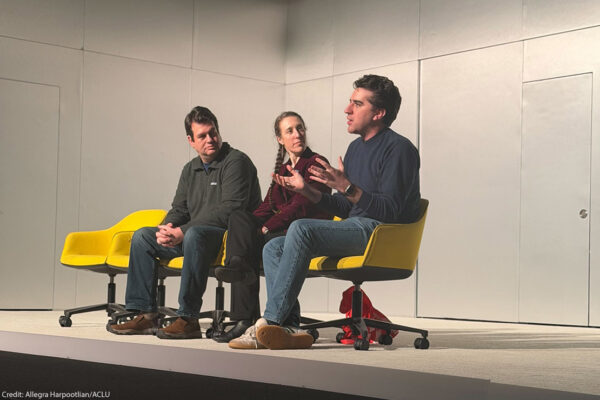
How One Playwright Is Using Theatre To Expose The Surveillance State. Explore News & Commentary.How One Playwright is Using Theatre to Expose the Surveillance State
As the ACLU fights to protect people’s privacy, playwright Matthew Libby discusses his play about the private companies fueling the government’s surveillance of immigrants. -
Press ReleaseMar 2026
National Security
Privacy & Technology
Aclu And Cdt Urge Court To Stop Government From Punishing Anthropic For Important Advocacy On Ai Guardrails. Explore Press Release.ACLU and CDT Urge Court to Stop Government from Punishing Anthropic for Important Advocacy on AI Guardrails
WASHINGTON — Today, the American Civil Liberties Union (ACLU) and the Center for Democracy & Technology (CDT) filed an amicus brief in Anthropic’s lawsuit in the D.C. Circuit Court of Appeals challenging the company’s designation as a “supply-chain risk” by the Department of Defense. The designation purports to prohibit anyone from using Anthropic’s tools in connection with Defense Department work. Anthropic’s lawsuit argues that this designation was in retaliation for the company’s First Amendment-protected advocacy related to AI safety, including the urgent need for artificial intelligence (AI) guardrails that prohibit the U.S. military from using these powerful new tools for fully autonomous weapons and mass domestic surveillance. “AI-powered surveillance poses immense dangers to our democracy. Anthropic’s public advocacy for AI guardrails is laudable and protected by the First Amendment — not something the Pentagon should be punishing,” said Patrick Toomey, deputy director of the ACLU’s National Security Project. “Our privacy laws are lagging decades behind the government’s ability to capture and exploit our data using AI tools, which can easily reveal the most intimate details of our lives. Anthropic has been right to speak out, but Congress also must step up to protect us from mass spying.” The brief explains why Anthropic’s advocacy for AI guardrails is vitally important and describes the dangers posed by AI tools when applied to immense datasets containing sensitive information — including how these tools can invade privacy, chill speech, and facilitate discriminatory profiling. The groups also explain how existing U.S. privacy laws are inadequate to protect people in the United States, especially in light of loopholes the government has long exploited to justify sweeping surveillance. And it emphasizes why, as a result, Anthropic’s advocacy for strict limitations on the government’s use of AI is critical to protecting the public’s privacy interests. “AI can enable surveillance that is unprecedented in its detail, scope, and scale, and that poses a profound threat to the freedoms our democracy depends on. The right to privacy, freedom of speech, and freedom of association are fundamental to our country and to our Constitution,” said Samir Jain, vice president of policy at CDT. “By exploiting the data broker loophole, the government has access to unprecedented data on our lives, our routines, and our relationships. Combining that data with the power of AI would expand the Pentagon’s surveillance powers exponentially, and companies like Anthropic are well within their rights to push back on that outcome.” As the amicus brief shows, while Anthropic has rightly advocated for AI guardrails, people in the U.S. deserve a lasting legislative solution to protect their privacy. The ACLU and CDT have been vocal supporters of the bipartisan Fourth Amendment Is Not For Sale Act, a commonsense reform bill that would ban the government from buying data it would otherwise need a warrant to obtain. -
Press ReleaseMar 2026
National Security
Human Rights
Legal Experts Underscore Illegality Of U.s. Boat Strikes At Inter-american Commission On Human Rights Hearing. Explore Press Release.Legal Experts Underscore Illegality of U.S. Boat Strikes at Inter-American Commission on Human Rights Hearing
GUATEMALA CITY — On Friday, the Inter-American Commission on Human Rights held the first hearing of its kind on the legality of U.S. boat strikes in the Caribbean and the harm they are causing communities across Latin America. The ACLU, Center for Constitutional Rights, International Crisis Group and UN human rights experts presented to the commission on how the United States’ lethal-strike policy violates both domestic and international law. U.S. representatives were in attendance, and decried the attempt to hold them accountable. “We are doing everything in our power to hold the Trump administration responsible for its egregious violations of both U.S. and international law, and that includes asking the widely respected Inter-American Commission on Human Rights to investigate these heinous killings,” said Jamil Dakwar, director of the ACLU’s Human Rights Program. “The administration can act as outraged and indignant as they want, but Friday’s hearing was a vital first step for establishing international accountability for the lawless policy that claimed the lives of at least 156 people and created another dangerous example of state-sanctioned violence with impunity. The fact that the Trump administration is lashing out at the ACLU and at the Commission is just another preposterous attempt to evade accountability and deflect attention from the government’s crimes.” At the convening, the human rights experts highlighted that under both U.S. and international law, it is flagrantly illegal to use the military to kill civilians suspected only of crimes. The United States is not in an armed conflict with anyone in Latin America. That means the people on these boats are civilians. Civilians, including those suspected of smuggling drugs, are not lawful targets. The Commission also heard arguments on the U.S. government’s duty under international treaties to investigate these extrajudicial killings and hold officials accountable for the murders of at least 156 people. Ben Saul, the U.N. special rapporteur for protecting fundamental freedoms while countering terrorism, accused the U.S. of “responding with lawless violence that flagrantly violates human rights, in its phony war on so-called narco-terrorism.” The special rapporteur also made clear that “drug trafficking is a crime, not war,” and that the portrayal of suspected drug traffickers as being responsible for “speculative drug overdoses” did not constitute a “permissible law enforcement action in personal self-defense or the defense of others.” In addition, the groups outlined the illegal nature of these strikes and how they violate the UN charter and human rights obligations that bind the United States The groups’ called on the commission to declare the U.S. boat strike policy in violation of international law, to conduct an investigation into the policy, and to convene a special meeting with OAS member states affected by the U.S. policy, and make recommendations on how to refrain from aiding or abetting or otherwise being complicit in the U.S. government’s violations of international law. “These extrajudicial killings were poorly veiled cover to justify the illegal overthrow of the Venezuelan government, as admitted by White House Chief of Staff Susie Wiles,” said Angelo Guisado, senior staff attorney at the Center for Constitutional Rights. “The administration’s desire to play imperial superpower in the region cannot be a reason to completely displace the foundations of international law.” Reps. Joaquin Castro (D-TX) and Sara Jacobs (D-CA) also sent a letter to the commission urging them to “scrutinize this administration’s policy and help advance accountability in the international arena.” Last week’s hearing was one of many legal avenues the ACLU and Center for Constitutional Rights are taking to hold the Trump administration accountable for these strikes. They also represent two of the victims’ families in their efforts to seek redress and separately are suing for the release of the Trump administration’s legal memo justifying these strikes. Video of the hearing is available here