How One Playwright is Using Theatre to Expose the Surveillance State
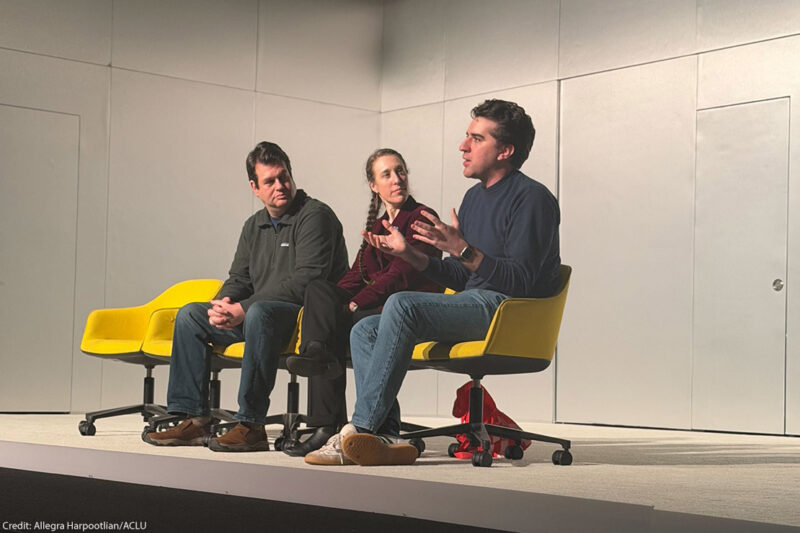
Today it is easier than ever for the U.S. government to spy on us and access our private data. Whether it’s using license plate readers to track protestors’ movements, faulty facial recognition software to check people’s immigration status, or buying our data in bulk to avoid getting a warrant, federal, state, and local government are repeatedly violating our rights in an effort to scoop up as much information about us as possible.

Privacy & Technology
Kansas Town Uses License Plate Readers to Go After Man Who Wrote Op-Ed
Privacy & Technology
Kansas Town Uses License Plate Readers to Go After Man Who Wrote Op-Ed
Without safeguards, federal agencies will continue to exploit their partnerships with tech companies to sow fear and violate our rights, which is why the ACLU is advocating for Congress to pass legislation that would protect our privacy in the digital age. These bills include the ICE Out of Our Faces Act, which would ban ICE and other immigration agencies from buying, acquiring, or using facial recognition software and the Fourth Amendment Is Not For Sale Act, a bipartisan bill that would ban the government from buying our data from Palantir and other companies without a warrant.
To pull this dystopian Big Brother act off, the U.S. government needs us to feel powerless. But we can all push back against this unjust surveillance in the streets, the courtroom, city hall, and our art.
Matthew Libby, the creator of a new off-Broadway play called “DATA,” is using theater to fight against the surveillance state. He became inspired to write the play after seeing how Big Tech companies are used to supercharge President Trump’s deportation agenda. Below, we discuss how “DATA” pushes back against public-private surveillance partnerships, and how we should all speak out against this obscene government overreach.
Allegra Harpootlian: How did this play come about? What made you want to focus on privacy and surveillance?
Matthew Libby: The play grew out of my desire to use my experience and voice to make sense of what I have seen in the news and firsthand as a professional. Art is a powerful way to connect with other people and talk about issues that matter to me, and nothing could be more important to me than advocating for stronger protections against invasive surveillance. Ten years ago, if you told me I would be a playwright, I wouldn’t have believed you, but I found it to be the best way for me to speak up.
In the fall of 2015 as a junior at Stanford University studying cognitive science, I drove down University Avenue in Palo Alto to interview for a technical writer internship.That’s how I spent an afternoon inside the offices of Palantir Technologies.
Abandoning all suspense: I didn’t get the internship, never worked at Palantir, and soon after cast aside the idea of working in tech at all.
In 2017, when I learned about Palantir’s involvement with the first Trump administration’s deportation agenda, it affected me. I felt anger at their overt complicity, and often active participation, in the U.S. government’s disregard for basic human rights. But I also started thinking, uneasily, about a parallel reality in which I had gotten that internship. Would I have felt differently? What would I have believed? Who would I have been? These questions sparked my desire to use art to speak out, becoming the concept of what is now DATA.
Allegra: What’s “DATA” about? Why is it important for people who care about privacy to see?
Matthew: The story is set in a Palantir-esque data-mining company called Athena Technologies. It follows a brilliant, conflicted entry-level programmer who gets pulled into a secret project to build AI software for the Department of Homeland Security. This new software was to be used to make decisions about whether someone should be allowed into this country. “DATA” is a thriller about morality, coming of age in Silicon Valley, and the rising specter of AI authoritarianism. It explores how technocrats use the threat of a technological arms race to justify building increasingly repressive software at home. In short, it’s a story about the ethical dilemma of what happens when you’re the one building Big Brother for the government.
Allegra: The ACLU has long fought to ban the government from relying on facial recognition technology, license plate readers, and other tech that can be used to violate our rights. What made you want to take the topic of public-private surveillance partnerships on?
Matthew: When I first started writing the play in 2018, I envisioned it as the softest possible form of science fiction: not fifty years in the future, or even five years, but more like five minutes. Of course, the tech industry moves significantly faster than the theatre industry. As emboldened as Palantir and other Big Tech companies were during Trump’s first administration,, the company has now fully embraced this partnership, reporting $1.855 billion in revenue from government contracts alone in 2025. And Palantir’s stock soared in the wake of President Trump’s illegal war on Iran, as investors anticipated the company playing a major role in the ongoing war.
Notably, Palantir has been successful under both Democratic and Republican administrations for two decades, and is by no means alone among tech giants in publicly demonstrating loyalty to Donald Trump. In fact, the public’s growing awareness of just how entwined the tech industry has become with the government is changing how audiences interact with the play. While early drafts were written in the shadow of Trump’s 2017 Muslim ban and photographs of children in cages at the southern border, eight years later, our run has coincided with draconian ICE raids in Minneapolis, the killings of Renee Good and Alex Pretti, and the drama between Anthropic, OpenAI, and the Pentagon, driven by the government’s desire to strip away the already limited guardrails on AI systems used for mass warrantless surveillance.
Allegra: Mass surveillance can make people feel pretty powerless. What gives you hope?
Matthew: As the world offstage has become more terrifying than anything I could’ve written, audiences have been audibly reacting in recognition to events in the play. This gives me hope. Artificial intelligence, data mining, and machine learning techniques will continue to improve in ways that won’t be immediately visible in our consumer products. That means it’s even more vital to shine a light on how advanced tools are supplied to those in power and then deployed in the world. “DATA” makes the argument that in a world where innovation will always outpace regulation, it is the responsibility of the rank-and-file employees inside of tech companies to think about speaking up, whether that is inside the company, writing to Congress, or exercising their free expression rights at protests or through the arts. For the rest of us, we must also look for opportunities to identify and push back on the intimate bonds between AI companies and the U.S. government. One way we can do that is by taking action with organizations like the ACLU, who are working to rein in the surveillance state and protect all of us from this unconstitutional government overreach.
“As the world offstage has become more terrifying than anything I could’ve written, audiences have been audibly reacting in recognition to events in the play. This gives me hope.”
After more than a decade, I still don’t know who I would’ve become if I had gotten that internship at Palantir. But the search made it clear to me that the current status quo — the black box of advanced AI software feeding directly into the black box of governmental bureaucracy — can only ever result in moral compromise. When we accept a worldview that reduces everyone and everything to data points, we not only dehumanize each other, we also dehumanize ourselves. Perhaps theatre, the most ancient and analog of dramatic art forms, can be one tool among many in helping people return to their inherent humanity.
Related Issues
Related Content
-
News & CommentaryOct 2026
Privacy & Technology
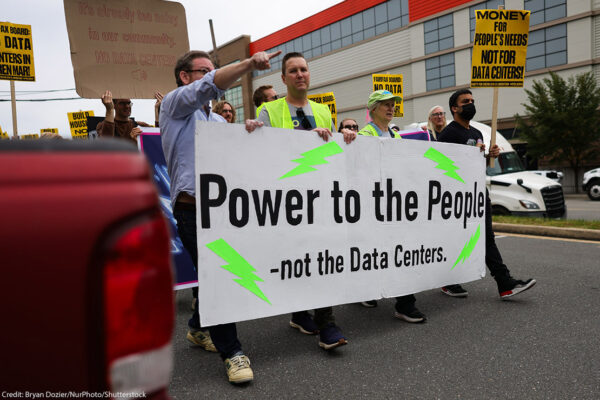
Your Questions Answered: How Data Centers Erode Civil Rights And Civil Liberties. Explore News & Commentary.Your Questions Answered: How Data Centers Erode Civil Rights and Civil Liberties
ACLU experts break down how data centers negatively impact communities, violate civil liberties, and how we can respond. -
News & CommentaryOct 2026

Privacy & Technology
How Technologies Move From Empowering To Imprisoning. Explore News & Commentary.How Technologies Move From Empowering to Imprisoning
Transportation expert’s warning on self-driving cars captures the way technologies move from empowering options to disempowering requirements -
News & CommentaryOct 2026
Privacy & Technology
How Technologies Move From Empowering To Imprisoning. Explore News & Commentary.How Technologies Move From Empowering to Imprisoning
Transportation expert’s warning on self-driving cars captures the way technologies like Digital IDs, Face recognition, AI, and digital payments move from empowering options to disempowering requirements -
News & CommentaryOct 2026
Privacy & Technology
$100 Million Ice “intelligence” Program Is A Domestic Secret Police Agency In The Making. Explore News & Commentary.$100 Million ICE “Intelligence” Program is a Domestic Secret Police Agency in the Making
Administration that has ordered agencies to target activists and nonprofits would hire “intelligence” agents within ICE to identify “threats” and investigate “relationships”