Valle del Sol v. Whiting et al.
What's at Stake
(Formerly Friendly House et al. v. Whiting).
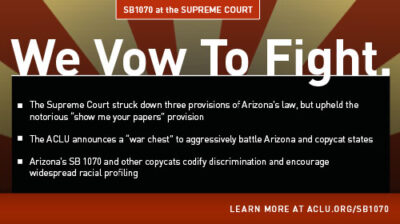
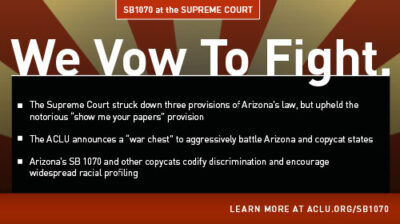
The U.S. Supreme Court has upheld the most hotly disputed part of Arizona's anti-immigrant law, S.B. 1070, which requires police to determine the immigration status of someone arrested or detained when there is "reasonable suspicion" they are not in the U.S. legally. The ACLU, along with a coalition of civil rights organizations, will continue to challenge the Arizona law on other constitutional grounds.
Summary
<!--
-->
The ACLU will continue to challenge that the Arizona law invites racial profiling against people of color by law enforcement in violation of the equal protection guarantee and prohibition on unreasonable seizures under the 14th and Fourth Amendments, and infringes on the free speech rights of day laborers and others in Arizona.
Jim Shee, a plaintiff, is a U.S.-born 70-year-old American citizen of Spanish and Chinese descent. Shee asserts that he will be vulnerable to racial profiling under the law. Although the law has not yet gone into effect, he has already been stopped twice by local law enforcement officers in Arizona and asked to produce his "papers."
Another plaintiff, Jesus Cuauhtémoc Villa, is a resident of the state of New Mexico who is currently attending Arizona State University. The state of New Mexico does not require proof of U.S. citizenship or immigration status to obtain a driver's license. Villa does not have a U.S. passport and does not want to risk losing his birth certificate by carrying it with him. He worries about traveling in Arizona without a valid form of identification that would prove his citizenship to police if he is pulled over. If he cannot supply proof upon demand, Arizona law enforcement would be required to arrest and detain him.
Several prominent law enforcement groups, including the Arizona Association of Chiefs of Police, oppose the law because it diverts limited resources from law enforcement's primary responsibility of providing protection and promoting public safety in the community and undermines trust and cooperation between local police and immigrant communities.
The Department of Justice also filed a lawsuit challenging S.B. 1070 shortly after the ACLU. In July, 2010, a federal court in Phoenix blocked key provisions of the law from going into effect, including the requirement that law enforcement demand "papers" from people they stop whom they suspect are "unlawfully present." The state then appealed the decision to The United States Court of Appeals for the Ninth Circuit, which upheld the lower court's ruling last April.
Know Your Rights: Supreme Court Rules on Arizona Immigration Law
This link will serve content from youtube.com.
Conozca Sus Derechos: SB1070 Y El Tribunal Supremo
Legal Documents
-
07/09/2018
Friendly House et al. v. Whiting - Complaint
Date Filed: 07/09/2018
Affiliate: Arizona
Download Document-
09/15/2016
Valle del Sol et al. v. Whiting et al. - Joint Agreement
Date Filed: 09/15/2016
Affiliate: Arizona
Download Document-
05/20/2014
ACLU-South Tucson Police Department Settlement Agreement
Date Filed: 05/20/2014
Affiliate: Arizona
Download Document-
10/08/2013
Valle del Sol v. Whiting et al. - 9th Circuit Court of Appeals Ruling
Date Filed: 10/08/2013
Affiliate: Arizona
Download Document-
03/04/2013
Valle del Sol v. Whiting et al. - 9th Circuit Court of Appeals Opinion
Date Filed: 03/04/2013
Affiliate: Arizona
Download Document-
08/17/2012
Valle del Sol v. Whiting et al. – Plaintiffs’ Proposed Motion for Preliminary Injunction and Memorandum of Points and Authorities in Support
Date Filed: 08/17/2012
Affiliate: Arizona
Download Document-
07/20/2012
Request for Public Records re: Arizona Senate Bill 1070
Date Filed: 07/20/2012
Affiliate: Arizona
Download Document-
06/28/2012
Letter to Counsel of Defendants in Friendly House v. Whiting Re: 2B
Date Filed: 06/28/2012
Affiliate: Arizona
Download Document-
06/25/2012
Arizona et al. v. United States - Supreme Court Opinion
Date Filed: 06/25/2012
Affiliate: Arizona
Download Document-
03/23/2012
Arizona v. U.S. - Amicus Brief of the ACLU
Date Filed: 03/23/2012
Affiliate: Arizona
Download Document-
02/29/2012
Valle del Sol v. Whiting et al. - Order Granting Plaintiffs' Renewed Motion for Preliminary Injunction of A.R.S. § 13-2928 (A) and (B)
Date Filed: 02/29/2012
Affiliate: Arizona
Download Document-
01/07/2011
Friendly House, et al. v. Whiting, et al. - Plaintiffs' Motion For Preliminary Injunction
Date Filed: 01/07/2011
Affiliate: Arizona
Download Document-
07/13/2010
Friendly House, et al. v. Whiting, et al. - Intervenor Defendants' Response To Plaintiffs' Motion For Preliminary Injunction
Date Filed: 07/13/2010
Affiliate: Arizona
Download Document-
06/29/2010
Friendly House et al. v. Whiting et al. - Amicus Brief of the National Council of La Raza
Date Filed: 06/29/2010
Affiliate: Arizona
Download Document-
06/29/2010
Friendly House et al. v. Whiting et al. - Amicus Brief of the American Immigration Lawyers Association
Date Filed: 06/29/2010
Affiliate: Arizona
Download Document-
06/29/2010
Friendly House et al. v. Whiting et al. - Amicus Brief of the Asian American Institute
Date Filed: 06/29/2010
Affiliate: Arizona
Download Document-
06/29/2010
Friendly House et al. v. Whiting et al. - Amicus Brief of the Arizona Association for Criminal Justice
Date Filed: 06/29/2010
Affiliate: Arizona
Download Document-
06/29/2010
Friendly House et al. v. Whiting et al. - Amicus Brief of the United Mexican States
Date Filed: 06/29/2010
Affiliate: Arizona
Download Document-
06/29/2010
Friendly House et al. v. Whiting et al. - Amicus Brief of the Santa Clara County
Date Filed: 06/29/2010
Affiliate: Arizona
Download Document-
06/29/2010
Friendly House et al. v. Whiting et al. - Amicus Brief of the Legal Momentum
Date Filed: 06/29/2010
Affiliate: Arizona
Download Document-
06/29/2010
Friendly House et al. v. Whiting et al. - Amicus Brief of the Lawyers Committee for Civil Rights Under Law
Date Filed: 06/29/2010
Affiliate: Arizona
Download Document-
06/29/2010
Friendly House et al. v. Whiting et al. - Amicus Brief of the International Longshore and Warehouse Union
Date Filed: 06/29/2010
Affiliate: Arizona
Download Document-
06/29/2010
Friendly House et al. v. Whiting et al. - Amicus Brief of the Anti-Defamation League
Date Filed: 06/29/2010
Affiliate: Arizona
Download Document-
06/21/2010
Friendly House, et al. v. Whiting, et al. - Plaintiffs' Motion For Preliminary Injunction And Memorandum In Support
Date Filed: 06/21/2010
Affiliate: Arizona
Download Document-
06/04/2010
Friendly House et al. v. Whiting et al. - Motion for Extra Pages
Date Filed: 06/04/2010
Affiliate: Arizona
Download Document-
06/04/2010
Friendly House et al. v. Whiting et al. - Proposed Brief in Support of a Preliminary Injunction
Date Filed: 06/04/2010
Affiliate: Arizona
Download DocumentPress Releases
Arizona Attorney General Issues Opinion Establishing Constitutional Standards for Enforcement of Key SB 1070 Provisions, Ending Lawsuit
South Tucson Officials Agree to Important Revision of Police Practices Related to SB 1070
Federal Court Deals New Blow to Arizona’s Anti-Immigrant SB 1070
Federal Appeals Court Blocks Anti-Day Laborer, Anti-Speech Ordinance
Appeals Court Asked to Block Show-Me-Your-Papers Provision of Arizona Anti-Immigrant Law
Supreme Court Reinstates Arizona “Show Me Your Papers” Law, but Strikes Down Three Other Provisions of Anti-Immigrant Measure