VICTORY! Supreme Court Finds Drunk-Driving Laws Can Be Strictly Enforced without Abandoning Constitutional Rights
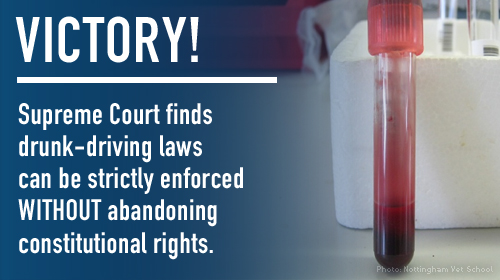
The ACLU welcomes today’s Supreme Court’s decision in Missouri v. McNeely. Writing for the majority, Justice Sonia Sotomayor upheld the 4th Amendment’s privacy protections by rejecting the proposition that states may routinely compel drivers to submit to a blood test in drunk-driving cases without consent and without a warrant.
We know from experience that drunk-driving laws can be strictly enforced without abandoning constitutional rights. Today’s decision appropriately recognizes what half the states have already demonstrated – that maintaining highway safety does not require sacrificing personal privacy.
Learn more about policing and other civil liberty issues: Sign up for breaking news alerts, follow us on Twitter, and like us on Facebook.
Related Issues
Related Content
-
Press ReleaseNov 2026

Criminal Law Reform
Aclu Urges Colorado Supreme Court To Require State To Address Cases Tainted By Officials’ Misconduct. Explore Press Release.ACLU Urges Colorado Supreme Court to Require State to Address Cases Tainted by Officials’ Misconduct
DENVER — The American Civil Liberties Union, the ACLU of Colorado, and the Exoneration Project have submitted an amicus brief urging the Colorado Supreme Court to order systemic remedies for thousands of defendants harmed by egregious misconduct and a long-running cover-up in a state DNA lab. During her 29-year tenure as a DNA analyst for the Colorado Bureau of Investigation (CBI), Yvonne “Missy” Woods worked on tens of thousands of criminal cases. She manipulated data and tampered with evidence in many of those cases. Although Woods’s coworkers flagged her misconduct in 2014 and 2018, CBI supervisors covered it up. That cover-up withheld exculpatory evidence from criminal defendants, and Woods’s misconduct continued until 2023. Once the CBI belatedly investigated Woods in 2023, it found that she had altered or deleted data in at least 1,045 cases. However, the lab’s decade-long cover-up meant that a significant amount of instrument data had been lost, making it impossible for many other defendants to prove that Woods committed misconduct in their cases. Woods was sentenced to 10 years in prison for her fraud. Under the U.S. and Colorado Constitutions and Colorado law, CBI is part of the prosecution team in every case in which it provides DNA evidence and therefore had a duty to disclose Woods’ misconduct. It failed that duty here. “Missy Woods’ repeated mishandling of critical forensic evidence and CBI’s subsequent cover-up was a profound disgrace. Colorado’s failure to notify defense teams of this fraud left thousands of accused people without access to potentially exculpatory evidence,” said Emma Mclean-Riggs, ACLU of Colorado senior staff attorney. “The Colorado Supreme Court should take forceful, systemic, and proactive action to protect the fairness of Colorado courts and address the harms this fraud caused.” The ACLU and Exoneration Project brief argues that the systemic nature of the government’s misconduct warrants systemic remedies. In particular, the brief asks the Colorado Supreme Court to put the burden of remedying the state’s misconduct on the state, rather than on the defendants harmed by the misconduct. This means requiring the state to affirmatively prove in every Woods-involved case that she did not commit misconduct. “For almost 10 years, the CBI knowingly allowed Missy Woods’ fraud to go unchecked. This is more than just one rogue analyst; this is a lab-wide cover-up that tainted over 10,000 cases. Government misconduct of this magnitude undermines the integrity of the entire justice system. It is the state’s responsibility to right its wrongs and rebuild the public’s trust, and the court should order the state to do just that,” said Terry Ding, Senior Staff Attorney with the ACLU’s State Supreme Court Initiative. Contrary to the state’s insistence that it should not have to do anything outside the 1,045 cases involving confirmed misconduct, the brief also explains that the loss of older data means many more cases were likely affected, even if definitive proof is no longer available. Citing other cases in which state supreme courts have addressed similar government misconduct in their states, the brief asks the Colorado Supreme Court to provide proper relief and deter future misconduct. -
Colorado Supreme CourtNov 2026

Civil Liberties
Criminal Law Reform
People V. Eatinger. Explore Case.People v. Eatinger
In 2023, the State of Colorado admitted to the public that a state DNA analyst, Missy Woods, had manipulated data and tampered with evidence in potentially thousands of criminal cases. But the State did not learn of Woods’s malfeasance in 2023. In fact, Woods’s supervisors had been aware of it since 2014. Instead of investigating her fraud and disclosing it to defendants in affected cases, however, the supervisors covered it up and allowed her to continue working on cases—including Daniel Eatinger’s case here—for another decade. The ACLU’s State Supreme Court Initiative, the ACLU of Colorado, and the Exoneration Project filed an amicus brief with the Colorado Supreme Court arguing that Woods and her supervisors violated their constitutional duty to disclose her misconduct, and that the Court should order systemic remedies for the thousands of defendants who have been harmed. -
Colorado Supreme CourtOct 2026
Civil Liberties
Criminal Law Reform
Daves V. Mosley. Explore Case.Daves v. Mosley
Section 131 of the newly enacted Enhance Law Enforcement Integrity Act gives Coloradans a cause of action to seek damages or equitable relief when state or local police officers violate the Colorado Constitution. In 2022, Christopher Mosley sued Officer Brendan Daves for conducting a warrantless search of his car, which Daves argued was lawful under the federal protective sweep doctrine. After Mosley prevailed at trial and the court of appeals affirmed, Daves appealed to the Colorado Supreme Court. The ACLU’s State Supreme Court Initiative and the ACLU of Colorado filed an amicus brief agreeing with Mosley’s argument that Daves has misapprehended the federal doctrine whilst focusing on a separate point: the Court’s interpretation of Section 131 is not bound by federal law. -
Michigan Supreme CourtOct 2026
Civil Liberties
Criminal Law Reform
People V. Taylor. Explore Case.People v. Taylor
In 2013, Michigan passed the Michigan Indigent Defense Commission Act (MIDCA) to ensure that indigent criminal defendants—that is, those who cannot afford to pay for counsel themselves—received constitutionally adequate counsel, paid for by the state. This case concerns whether and under what circumstances trial courts can, consistent with MIDCA, order indigent criminal defendants to pay the state back for their attorneys. The ACLU’s State Supreme Court Initiative, the ACLU of Michigan, and the Michigan State Planning Body filed an amicus brief in the Michigan Supreme Court arguing that MIDCA, properly construed, partially abrogated a different statute authorizing trial courts to assess attorney fees against indigent defendants and explaining that allowing such orders would undermine Michiganders’ right to counsel.