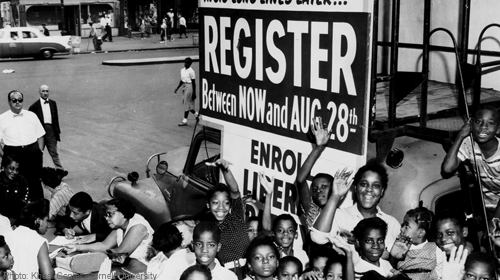
Today marks the opening of the health insurance exchanges created under the Affordable Care Act. An estimated seven million uninsured Americans are expected to apply for coverage during this first round of open enrollment; the Congressional Budget Office estimates that by 2016, 25 million Americans will register for health insurance through the exchanges. In addition to expanding access to affordable healthcare, the opening of the health exchanges also has the opportunity to dramatically expand access to the ballot.
You see, one-third of uninsured Americans are also not registered to vote. And under the 1993 National Voter Registration Act (NVRA)—also called the "motor voter law"—agencies that provide public assistance, like the new health insurance exchanges, must also provide voter registration services. Because of this law, both the Department of Health and Human Services and the White House have acknowledged that the health insurance exchanges operated by, or in partnership with the federal government must offer voter registration services.
This important law also applies to the 14 states that are operating their own exchanges independent of the federal government. Among these states, California, New York, Vermont, Maryland, Connecticut and Rhode Island have all acknowledged their obligation under the NVRA to provide voter registration services through the health insurance exchanges. With over 10 million uninsured Americans living in these five states, this is a tremendous opportunity to expand ballot access. Unfortunately, nine states—Colorado, the District of Columbia, Hawaii, Kentucky, Massachusetts, Nevada, Oregon and Washington—have yet to officially announce plans to comply with the NVRA. We will continue to press ahead and urge more states to comply with federal law so that all Americans can have an opportunity to exercise the most fundamental right in our democracy.
Learn more about the Voting Rights Act and other civil liberty issues: Sign up for breaking news alerts, follow us on Twitter, and like us on Facebook.
Related Issues
Related Content
-
Press ReleaseSep 2026

Voting Rights
Nightmare Over For Crystal Mason, Highest Criminal Court In Texas Dismisses State’s Petition For Review . Explore Press Release.Nightmare Over for Crystal Mason, Highest Criminal Court in Texas Dismisses State’s Petition for Review
AUSTIN, Texas — The Court of Criminal Appeals today let stand a lower court's ruling that acquitted Crystal Mason of illegal voting by dismissing the state’s petition for review as improvidently granted. The lower court’s decision vacates Mason’s conviction in Crystal Mason v. State of Texas and should mark the end to a nearly decade-long legal battle to defend her innocence. The lower court’s decision found there was insufficient evidence to show that Mason knew she was ineligible to vote. She had faced up to five years in prison. “In all these years, I never lost my faith that justice would be done,” said Crystal Mason. “I am so happy my nightmare is over and I can move on. I hope people who hear my story are encouraged to make their voices heard and to get out and vote. If the right to vote weren’t so important, they wouldn’t be trying to take it away.” Mason, a Black mother of three from Fort Worth, was convicted of illegal voting for submitting a provisional ballot in 2016 that was never counted as a vote. She believed she was fulfilling her civic duty and had no idea the state considered her ineligible to vote. The Texas Second Court of Appeals reversed Crystal Mason’s conviction, and the Court of Criminal Appeals upheld that decision. Mason was represented by the American Civil Liberties Union of Texas, the national ACLU, and the Texas Civil Rights Project, along with criminal defense attorney Alison Grinter and civil rights attorney Kim T. Cole. The following quotes can be attributed to members of her legal team: Sophia Lin Lakin, director of the ACLU’s Voting Rights Project: “Crystal Mason has fought this injustice for nearly a decade, and we are thrilled that the Court of Criminal Appeals has finally put an end to this case. No one should face prison for casting a ballot when they had no idea they were ineligible to vote. During a time where politicians are sowing chaos and confusion into our elections, today’s decision is a long-overdue recognition that voting requirements should be transparent, and that we should never criminalize voters over honest mistakes.” Tommy Buser-Clancy, senior staff attorney of the ACLU of Texas: “Civic participation without fear of imprisonment is a cherished right that is critical to our system of democracy. The highest criminal court in Texas affirmed that right by letting the lower court’s acquittal stand. Ms. Mason has spent nearly a decade defending her rights in Texas and today we see that her efforts have been successful not only in defending her own freedom, but also in protecting the ability of Texans across the state to participate in our democracy without fear." Zachary Dolling, litigation director for the Texas Civil Rights Project: “Ms. Mason should never have been prosecuted in the first place, and although she’ll never get back the years of her life she spent fighting against this unjust prosecution, she can at least move on. This decision allows us to celebrate Ms. Mason’s bravery and courage over the past six years.” Alison Grinter, criminal defense attorney: “This is a momentous day for voting rights in Texas. For nearly 10 years, Ms. Mason had to wake up each morning knowing the state was threatening to imprison her for simply doing her civic duty. Tomorrow, she’ll wake up with that burden lifted, knowing that her effort to participate in our democracy should never have been criminalized and that she can continue to do the voter empowerment work that she has been championing for all of these years.” Kim T. Cole, civil attorney for Mason: “We are grateful that the Court allowed Crystal Mason’s acquittal to stand and finally brought this nearly decade-long injustice to an end. For years, while Crystal lived with the agonizing threat of having her freedom ripped away, she turned her pain into purpose—educating and registering voters and fighting to protect the very right that led to her prosecution. However, justice does not end with an acquittal. Crystal suffered through years of legal battles against a prosecution which we have always maintained was politically motivated and never should have happened.” Access the Court of Criminal Appeals brief here. More background here. -
Press ReleaseSep 2026
Voting Rights
Aclu And Aclu Voter Education Fund Invest $2.3 Million In Michigan House And Senate Races, And The Michigan Supreme Court Race. Explore Press Release.ACLU and ACLU Voter Education Fund Invest $2.3 Million in Michigan House and Senate Races, and the Michigan Supreme Court Race
DETROIT – The ACLU of Michigan, the American Civil Liberties Union, and the ACLU Voter Education Fund are spending $2.3 million in select Michigan House and Senate races, and the Michigan Supreme Court race. The commitment is part of the ACLU’s effort to inform voters that their civil rights and liberties, including voting rights and abortion, are on the ballot this November election. Voter guides and paid advertising will be utilized to educate voters about the candidates in these races. The ACLU Voter Education Fund is spending about $400,000 in the Michigan Supreme Court race, and the ACLU is spending about $1.9 million in select legislative races. State lawmakers shape civil rights and liberties, as does the Michigan Supreme Court. Their decisions impact the expansion or restriction of voting rights, reproductive rights, privacy rights, and other civil rights and liberties. The ACLU of Michigan and national American Civil Liberties Union, have invested in four Senate and House races, including Senate Districts 4, 9, 13 and 30, and House Districts 27, 44, 46, 109. The senate and House District races are highly contested. There are two open seats on the Michigan Supreme Court, and voters will choose two candidates out of six who are running. Though state parties nominate Michigan Supreme Court candidates, each will appear in the nonpartisan section of the November 3 election ballot. The ACLU and ACLU Voter Education Fund will reach voters through mailer guides and digital advertising. "Michigan voters overwhelmingly support reproductive freedom, including abortion, as they made clear when voting to amend our state constitution to include these protections," said Merissa Kovach, ACLU of Michigan political director. "Our aim is to ensure we preserve and expand upon the gains we have made in Michigan. It is imperative that voters are aware of each candidate’s record on reproductive freedom, voting rights, and other civil rights and liberties before casting their votes.” Click here to learn more about the Michigan Supreme Court race. -
News & CommentarySep 2026
Voting Rights
Let’s Make Your Voting Plan!. Explore News & Commentary.Let’s Make Your Voting Plan!
Are you prepared to cast your ballot? Make a voting plan with us ahead of Election Day! -
News & CommentarySep 2026
Voting Rights
Quiz Yourself: Can You Spot Voting Misinformation?. Explore News & Commentary.Quiz Yourself: Can You Spot Voting Misinformation?
Make sure you're well equipped against voting misinformation.