Campaigns & Initiatives
Learn more about and support the ACLU's work to defend civil liberties and civil rights in every corner of the country.
Featured
Campaign
Jan 2026

Free Speech
+2 Issues
Defeat, Delay, Dilute: ACLU Versus President Trump
One year ago, President Donald Trump was sworn in for a second term. His administration has created chaos, trampled on our rights, and harmed so many of us. But the ACLU has been fighting back — and winning. Now, we're telling the story of the first year of our fight against the Trump administration’s second term, our lessons learned, and our path forward.
We were prepared for this fight from day one.
Before President Trump was elected, we examined his campaign promises — including those outlined in Project 2025 — and outlined a plan for how we would fight to protect the rights and liberties of all people. We spent months plotting out our litigation and advocacy strategy across the country, building a plan to ensure that cities and states would be a Firewall for Freedom — a shield defending against a federal government attacking civil rights and civil liberties.
Within hours of President Trump's inauguration, it was clear that he and his administration would, once again, test the Constitution and the willingness of our nation’s institutions and people to defend it. But we were ready. The ACLU mobilized our lawyers, advocates, organizers, storytellers, and supporters to delay unconstitutional policies before they took effect, dilute their reach when full blockage wasn’t immediately possible, and defeat them through courts, public pressure, and sustained organizing. In 2025, we took over 230 legal actions against the Trump administration, with remarkable success: 64% of our lawsuits have delayed, diluted, or defeated the Trump administration’s agenda.
But despite everything we’ve accomplished so far, we cannot underestimate the continued speed and ferocity of this assault on civil rights and civil liberties or the impact it will continue to have on us all. And as we enter 2026, the stakes feel as high as ever.
That’s why the ACLU is releasing a report about the first year of the Trump administration, highlighting key lessons learned and laying out our roadmap for the years to come. You can download the full report here: Defeat, Delay, Dilute: ACLU Versus President Trump
What the ACLU does over the next three years and how well we do it will play a role in shaping the course of American history. Because democracy doesn’t defend itself – people do. And together, we will keep showing up.
Campaign
Jan 2026

LGBTQ Rights
More Than A Game
This year, SCOTUS will determine whether states can ban transgender students from youth sports — but the ACLU and women’s sports stars are teaming up in support of trans youth, their families, and their right to be themselves.
Campaign
May 2025

LGBTQ Rights
Freedom To Be: Joy, Family, & Transgender Rights
The Freedom To Be Monument is a powerful, living testament to trans resilience, community, and joy. Explore the monument, witness these powerful stories, and join us in the fight to defend trans freedom.
This installation took over the National Mall in Washington, D.C., on May 17 as a bold act of resistance to transphobia, trans erasure, and anti-trans legislation. It stands as a declaration that trans people deserve the freedom to be—loved, safe, and in control of our own health care decisions.
Inspired by the legacy of the AIDS Memorial Quilt, this installation combats erasure and ensures that trans voices, stories, and existence are seen and honored. It directly challenges those who seek to strip away trans rights, boldly affirming that trans lives are here to stay.
Spelling out the words “Freedom To Be,” the monument consists of 250 panels—each 6 feet by 6 feet—created by hundreds of trans folks and allies across the country. Every panel is a response to the question: What does freedom to be mean to me? Over the past year, in partnership with the ACLU, trans storytellers and allies have poured their hopes, fears, and dreams into this collective work of art.
All Campaigns & Initiatives
Initiative
Jan 2026
Civil Liberties
State Supreme Court Initiative
The U.S. Supreme Court is increasingly not an option to protect, let alone expand, civil liberties and civil rights. Last year’s Supreme Court term was the most conservative in a century, as President Trump’s three nominees exercised their newfound power to rule against liberty and shrink our constitutional rights.
But state supreme courts offer promise in the face of a hostile federal judiciary. That’s why we’re taking the fight to the states – we want to show up with as many resources and tools as we have available. The ACLU is launching a dedicated effort, called the State Supreme Court Initiative, to fight for the expansion of rights through state supreme courts, both through litigation and advocacy work.
The State Supreme Court Initiative will build on the organization’s existing work in state supreme courts and will expand the organization’s litigating capacity. With lawyers in every state in the country, the ACLU is uniquely situated to do this important work and to develop cross-state expertise on state constitutional litigation.
Explore initiative
Initiative
Jan 2026
Civil Liberties
State Supreme Court Initiative
The U.S. Supreme Court is increasingly not an option to protect, let alone expand, civil liberties and civil rights. Last year’s Supreme Court term was the most conservative in a century, as President Trump’s three nominees exercised their newfound power to rule against liberty and shrink our constitutional rights.
But state supreme courts offer promise in the face of a hostile federal judiciary. That’s why we’re taking the fight to the states – we want to show up with as many resources and tools as we have available. The ACLU is launching a dedicated effort, called the State Supreme Court Initiative, to fight for the expansion of rights through state supreme courts, both through litigation and advocacy work.
The State Supreme Court Initiative will build on the organization’s existing work in state supreme courts and will expand the organization’s litigating capacity. With lawyers in every state in the country, the ACLU is uniquely situated to do this important work and to develop cross-state expertise on state constitutional litigation.
Campaign
Jan 2026
Civil Liberties
Firewall For Freedom: States Must Safeguard Our Rights
States are the frontlines of our freedom — communities expect state and local officials to protect us from Trump’s assault on our rights. Donald Trump began to make good on his promises as soon as he was inaugurated in January.
Explore campaign
Campaign
Jan 2026
Civil Liberties
Firewall For Freedom: States Must Safeguard Our Rights
States are the frontlines of our freedom — communities expect state and local officials to protect us from Trump’s assault on our rights. Donald Trump began to make good on his promises as soon as he was inaugurated in January.

Campaign
Nov 2025
Immigrants' Rights
Border Humanity Project: Letters to America
Throughout its history, our country has been a beacon of hope and freedom for people seeking better lives for themselves and their families, including those fleeing violence and seeking a better life. As a result, people who are immigrants have always been integral to our communities, economy, and the very fabric of our nation.
Explore campaign
Campaign
Nov 2025
Immigrants' Rights
Border Humanity Project: Letters to America
Throughout its history, our country has been a beacon of hope and freedom for people seeking better lives for themselves and their families, including those fleeing violence and seeking a better life. As a result, people who are immigrants have always been integral to our communities, economy, and the very fabric of our nation.
Campaign
Oct 2025
Free Speech
Stand with Standing Rock
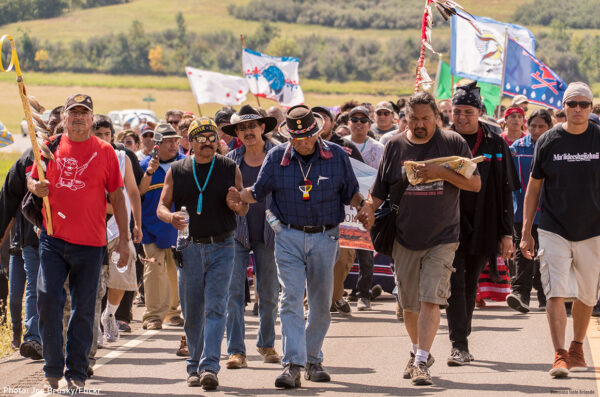
In January 2016, with the aim of creating a direct route to transport crude oil from the North Dakota Bakken region through South Dakota, and Iowa and into Illinois, the Dakota Access Pipeline was unanimously approved for construction. The controversial pipeline could destroy ancestral burial grounds and poison the water supply for a sovereign nation, as well as millions of Americans downstream who rely on the Missouri River.
All eyes were on Standing Rock as unwarranted armored vehicles rolled in. Law enforcement used automatic rifles, sound cannons, and concussion grenades against water protectors. An estimated 300 protesters were injured when police in riot gear used water cannons for hours in subfreezing weather to disperse them.
National Guard troops, personnel and equipment pouring in from over 75 law enforcement agencies from around the country created a battlefield-like atmosphere at Standing Rock. Escalated police militarization was used to intimidate and silence water protectors’ free speech and their right to protest a pipeline which passes near sovereign territory.
Thousands from across the globe joined in solidarity with the Standing Rock Sioux Tribe to stop the construction of the Dakota Access pipeline. The protest has brought together at least 200 tribes that had not united for more than 150 years.
In June 2025, the Standing Rock Sioux Tribe appealed a federal judge’s dismissal of its latest lawsuit against the U.S. Army Corps of Engineers, continuing its years-long fight to protect tribal sovereignty and water rights threatened by the Dakota Access Pipeline. The tribe argues the pipeline still lacks a valid federal easement to cross under Lake Oahe, a reservoir along the Missouri River that provides water for the reservation, and that keeping it open violates federal law.
Since Standing Rock’s historic mobilization, states across the country have advanced or passed anti-protest laws that criminalize resistance to fossil fuel projects. These laws target Indigenous-led movements and environmental defenders who continue to speak out against the destruction of sacred lands and waters. As these restrictive laws spread, it is more important than ever for advocates to understand and defend their constitutional rights to free speech and peaceful assembly. Knowing your rights and standing together in solidarity remains essential to ensuring that the struggle for clean water, sacred lands, and tribal sovereignty is not silenced by fear or repression.
Explore campaign
Campaign
Oct 2025
Free Speech
Stand with Standing Rock
In January 2016, with the aim of creating a direct route to transport crude oil from the North Dakota Bakken region through South Dakota, and Iowa and into Illinois, the Dakota Access Pipeline was unanimously approved for construction. The controversial pipeline could destroy ancestral burial grounds and poison the water supply for a sovereign nation, as well as millions of Americans downstream who rely on the Missouri River.
All eyes were on Standing Rock as unwarranted armored vehicles rolled in. Law enforcement used automatic rifles, sound cannons, and concussion grenades against water protectors. An estimated 300 protesters were injured when police in riot gear used water cannons for hours in subfreezing weather to disperse them.
National Guard troops, personnel and equipment pouring in from over 75 law enforcement agencies from around the country created a battlefield-like atmosphere at Standing Rock. Escalated police militarization was used to intimidate and silence water protectors’ free speech and their right to protest a pipeline which passes near sovereign territory.
Thousands from across the globe joined in solidarity with the Standing Rock Sioux Tribe to stop the construction of the Dakota Access pipeline. The protest has brought together at least 200 tribes that had not united for more than 150 years.
In June 2025, the Standing Rock Sioux Tribe appealed a federal judge’s dismissal of its latest lawsuit against the U.S. Army Corps of Engineers, continuing its years-long fight to protect tribal sovereignty and water rights threatened by the Dakota Access Pipeline. The tribe argues the pipeline still lacks a valid federal easement to cross under Lake Oahe, a reservoir along the Missouri River that provides water for the reservation, and that keeping it open violates federal law.
Since Standing Rock’s historic mobilization, states across the country have advanced or passed anti-protest laws that criminalize resistance to fossil fuel projects. These laws target Indigenous-led movements and environmental defenders who continue to speak out against the destruction of sacred lands and waters. As these restrictive laws spread, it is more important than ever for advocates to understand and defend their constitutional rights to free speech and peaceful assembly. Knowing your rights and standing together in solidarity remains essential to ensuring that the struggle for clean water, sacred lands, and tribal sovereignty is not silenced by fear or repression.
Campaign
Oct 2025
Free Speech
Banned Books Week 2025
Find an event or learn more about your First Amendment freedoms.
Explore campaign
Campaign
Oct 2025
Free Speech
Banned Books Week 2025
Find an event or learn more about your First Amendment freedoms.