Voting Rights
United States v. Alaska
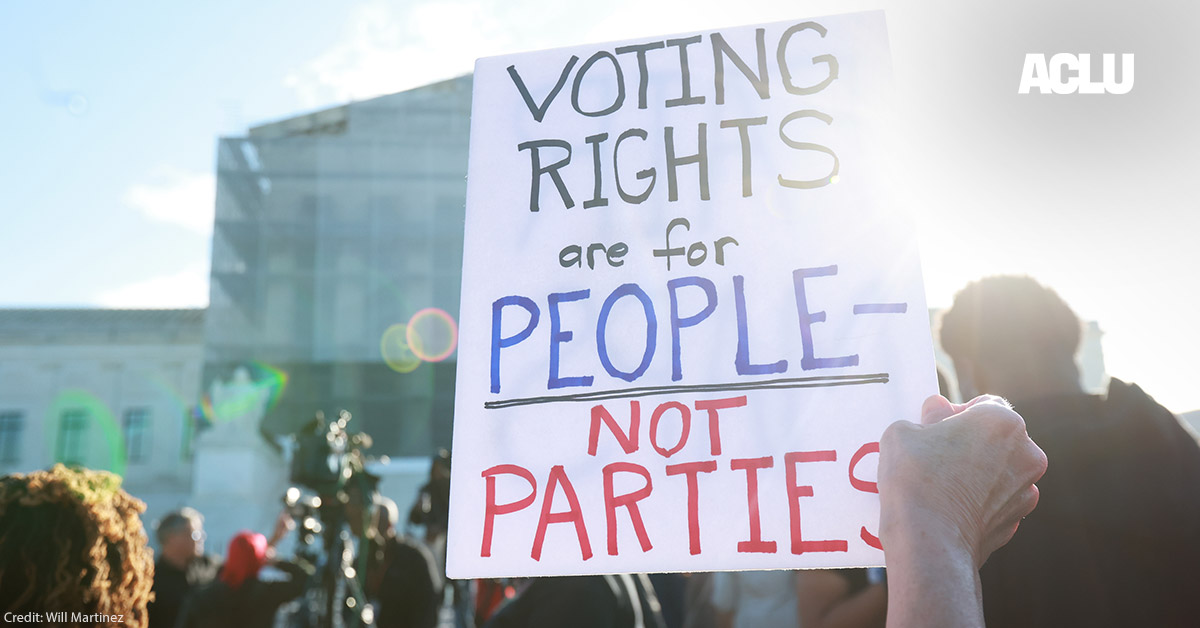
Representing two Alaska voters, the League of Women Voters of Alaska, and Common Cause, the American Civil Liberties Union and ACLU of Alaska moved to intervene in United States v. Alaska, a frivolous lawsuit seeking to prevent from the State of Alaska from certifying its election results if the incumbent U.S. Senator does not win the election. The lawless suit asserts a single claim based on the purpose language of the National Voter Registration Act (NVRA), that has no basis in any case, legal principle, or arguably tenable reading of the NVRA.
We are seeking dismissal of this suit that aims to deprive Alaskans of their right to vote and right to representation.
Status: Ongoing
View Case
Learn About Voting Rights
Featured
Washington, D.C.
Oct 2026

Voting Rights
Common Cause v. U.S. Department of Justice
The U.S. Department of Justice has launched an unprecedented and unlawful effort to invade the privacy of millions of American voters and threaten their right to vote. It has demanded that every state and the District of Columbia turn over their entire voter database, including Social Security Numbers, political party affiliation, and voter participation history. And at least a dozen states have complied, submitting their voters’ information for federal review. But the Department of Justice has no authority to dictate when a voter registration should be cancelled, and we are suing to stop the federal government’s overreach and ensure that voters’ information remains secure and free from unlawful interference.
Massachusetts
Sep 2026
Voting Rights
League of Women Voters of Massachusetts v. Trump
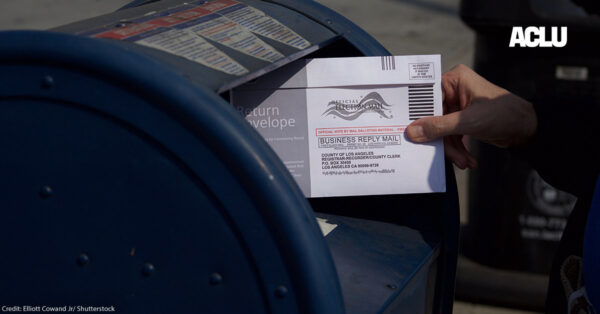
On March 31, 2026, President Trump issued a sweeping Executive Order titled “Ensuring Citizen Verification and Integrity in Federal Elections,” seeking once again to seize control of election administration from Congress and the states. The Order directs federal agencies to compile lists of U.S. citizens and transmit them to states before every election, directs the U.S. Postal Service — an independent agency established by Congress — to create a list of “approved” mail voters, and instructs USPS to refuse to deliver ballots from voters not on that federally created list. If implemented, the Order would threaten the ability of millions of eligible citizens to cast their ballots, particularly military members, overseas citizens, the elderly, recently naturalized citizens, and voters with disabilities who rely on mail voting.
U.S. Supreme Court
May 2026
Voting Rights
Racial Justice
Allen v. Milligan
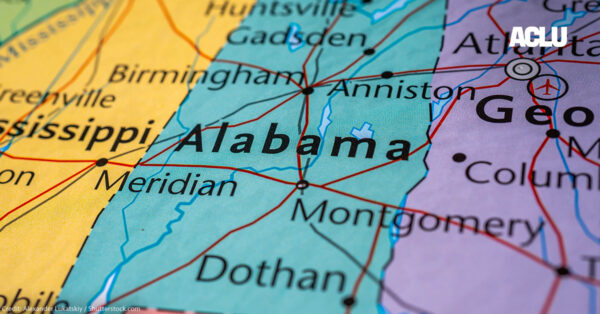
Whether Alabama’s congressional districts violate Section 2 of the Voting Rights Act because they discriminate against Black voters. We succeeded in winning a new map for 2024 elections which, for the first time, has two congressional district that provide Black voters a fair opportunity to elect candidates of their choosing despite multiple attempts by Alabama to stop us at the Supreme Court. Despite this win, Alabama is still defending its discriminatory map, and a trial was held in February 2025 to determine the map for the rest of the decade.
In May 2025, a federal court ruled that Alabama’s 2023 congressional map both violates Section 2 of the Voting Rights Act and was enacted by the Alabama Legislature with racially discriminatory intent.
U.S. Supreme Court
Apr 2026
Voting Rights
Louisiana v. Callais (Callais v. Landry)
Whether the congressional map Louisiana adopted to cure a Voting Rights Act violation in Robinson v. Ardoin is itself unlawful as a gerrymander.
Mississippi
Dec 2025
Voting Rights
White v. Mississippi State Board of Elections
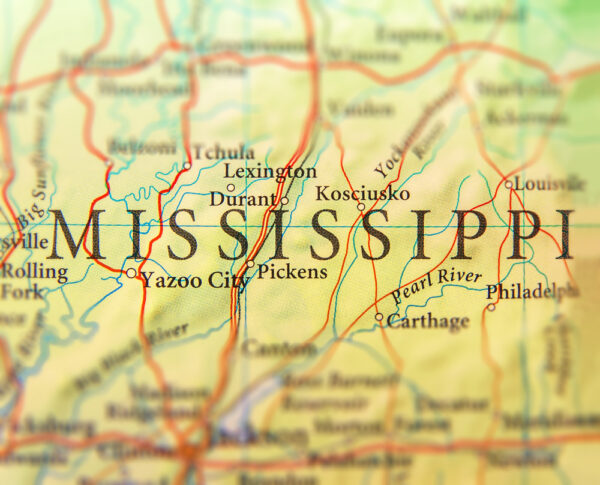
District lines used to elect Mississippi’s Supreme Court have gone unchanged for more than 35 years. We’re suing because the current lines crack the Mississippi Delta and dilute the voting strength of Black Mississippians in state Supreme Court elections, in violation of the Voting Rights Act.
Washington, D.C.
Oct 2025
Voting Rights
League of Women Voters Education Fund v. Trump
On March 25, 2025, in a sweeping and unprecedented Executive Order, President Trump attempted to usurp the power to regulate federal elections from Congress and the States. Among other things, the Executive Order directs the Election Assistance Commission—an agency that Congress specifically established to be bipartisan and independent—to require voters to show a passport or other citizenship documentation in order to register to vote in federal elections. If implemented, the Executive Order would threaten the ability of millions of eligible Americans to register and vote and upend the administration of federal elections.
On behalf of leading voter registration organizations and advocacy organizations, the ACLU and co-counsel filed a lawsuit to block the Executive Order as an unconstitutional power grab.
All Cases
210 Voting Rights Cases
Maryland
Oct 2026
Voting Rights
United States v. DeMarinis
The Department of Justice (“DOJ”) sued Maryland demanding the release of its full, unredacted voter file, which includes the highly sensitive and personal data of every voter in the state. This suit appears to be part of DOJ’s effort to build a national voter database without congressional authorization, improperly question the validity of state voter rolls, and intimidate eligible voters in Maryland and around the country.
Explore case
Maryland
Oct 2026
Voting Rights
United States v. DeMarinis
The Department of Justice (“DOJ”) sued Maryland demanding the release of its full, unredacted voter file, which includes the highly sensitive and personal data of every voter in the state. This suit appears to be part of DOJ’s effort to build a national voter database without congressional authorization, improperly question the validity of state voter rolls, and intimidate eligible voters in Maryland and around the country.
South Carolina
Sep 2026
Voting Rights
NAACP South Carolina State Conference v. Wilson
All voters with disabilities have the right to receive assistance voting from a person of their choice. South Carolina prohibits some voters with disabilities from receiving assistance and limits who voters can rely on for assistance. Voters with disabilities and the NAACP South Carolina State Conference sued to challenge those laws under Section 208 of the Voting Rights Act and protect disabled voters’ right to assistance.
Explore case
South Carolina
Sep 2026
Voting Rights
NAACP South Carolina State Conference v. Wilson
All voters with disabilities have the right to receive assistance voting from a person of their choice. South Carolina prohibits some voters with disabilities from receiving assistance and limits who voters can rely on for assistance. Voters with disabilities and the NAACP South Carolina State Conference sued to challenge those laws under Section 208 of the Voting Rights Act and protect disabled voters’ right to assistance.

Texas
Sep 2026
Voting Rights
Crystal Mason v. State of Texas
Crystal Mason thought she was performing her civic duty by filling out a provisional ballot in the 2016 election. She didn’t know it would land her a five-year prison sentence, upending her family and the life she had built. At the time, Ms. Mason was on federal supervised release, a preliminary period of freedom for individuals who have served their full time of incarceration in federal prison. Ms. Mason didn’t know, and nobody told her, that the state considered her ineligible to vote while on supervised release. Because her name didn’t appear on voter rolls, she filed a provisional ballot, consistent with federal law. The state never counted her ballot but has still sought to send her to prison for an innocent mistake.
Explore case
Texas
Sep 2026
Voting Rights
Crystal Mason v. State of Texas
Crystal Mason thought she was performing her civic duty by filling out a provisional ballot in the 2016 election. She didn’t know it would land her a five-year prison sentence, upending her family and the life she had built. At the time, Ms. Mason was on federal supervised release, a preliminary period of freedom for individuals who have served their full time of incarceration in federal prison. Ms. Mason didn’t know, and nobody told her, that the state considered her ineligible to vote while on supervised release. Because her name didn’t appear on voter rolls, she filed a provisional ballot, consistent with federal law. The state never counted her ballot but has still sought to send her to prison for an innocent mistake.
U.S. Supreme Court
Sep 2026
Voting Rights
People Not Politicians v. Onder (Amicus)
Whether congressional elections in Missouri for the November 2026 midterms will be held using districts that never lawfully took effect because they have not been subject to a vote by the people via the referendum process.
Explore case
U.S. Supreme Court
Sep 2026
Voting Rights
People Not Politicians v. Onder (Amicus)
Whether congressional elections in Missouri for the November 2026 midterms will be held using districts that never lawfully took effect because they have not been subject to a vote by the people via the referendum process.

U.S. Supreme Court
Sep 2026
Voting Rights
Hoskins v. von Glahn (Amicus)
Whether congressional elections in Missouri for the November 2026 midterms will be held using districts that never lawfully took effect because they have not been subject to a vote by the people via the referendum process.
Explore case
U.S. Supreme Court
Sep 2026
Voting Rights
Hoskins v. von Glahn (Amicus)
Whether congressional elections in Missouri for the November 2026 midterms will be held using districts that never lawfully took effect because they have not been subject to a vote by the people via the referendum process.