Jesselyn McCurdy, legislative counsel for our Washington Legislative Office, blogged on HuffingtonPost.com on racial profiling:
By allowing racial and religious bias to decide who is detained by law enforcement, we betray that fundamental promise of equal protection under the law.
You can help end racial profiling by telling your Congresspersons to co-sponsor Senator Russ Feingold (D-WI) and Representative John Conyers' (D-MI) End Racial Profiling Act of 2007 (ERPA), which is expected to be introduced next week on June 21.
Related Issues
Related Content
-
Press ReleaseOct 2026

Civil Liberties
Aclu Voter Education Fund And Aclu Of Georgia Launch $250k Campaign To Educate Georgia Voters Ahead Of Midterms. Explore Press Release.ACLU Voter Education Fund and ACLU of Georgia Launch $250K Campaign to Educate Georgia Voters Ahead of Midterms
ATLANTA – The ACLU of Georgia and the ACLU Voter Education Fund are spending $250,000 in select Georgia House races to inform voters that their civil rights and liberties, including voting rights and abortion, are on the ballot this November. The ACLU Voter Education Fund will send over 225,000 mail pieces to educate voters about candidates in State House Districts 48, 53, and 105. These state races include communities like Lawrenceville, Peachtree Corners, and Sandy Springs and are highly contested. The ACLU Voter Education Fund is investing in these races because the elected candidates will influence civil rights and liberties statewide for at least two years. Their decisions will affect voting rights, reproductive rights, privacy, and other fundamental liberties. On the voter guides, residents will see candidates’ responses to questions about those issues, such as whether they would vote to repeal Georgia’s six-week abortion ban or whether they will work to prevent unnecessary restrictions on early and absentee voting. “Georgia voters have a right to know the positions that the candidates take on the rights and freedoms that shape their lives,” said Christopher Bruce, deputy executive director, ACLU of Georgia. “We’re making sure voters get the information they need to understand the issues in these elections and what the candidates would do if they had the power of the Georgia House. From reproductive freedom and voting rights to safeguarding privacy and other liberties, the choices made under the Gold Dome can have a lasting impact on our communities.” While the ACLU Voter Education Fund does not endorse or oppose any candidates, the six-figure campaign will educate voters about the candidates’ positions on key civil rights issues, including abortion, birth control, marriage equality, and voting rights for Indigenous communities, through direct mail, radio ads, and digital ads. -
Minnesota Supreme CourtOct 2026

Civil Liberties
Housing First Minn. V. City Of Corcoran And Housing First Minn. V. City Of Dayton. Explore Case.Housing First Minn. v. City of Corcoran and Housing First Minn. v. City of Dayton
When a court rules that an issue is a “political question,” that issue becomes “nonjusticiable.” In other words, courts close their doors to political questions, even when an injured plaintiff seeks relief that a court could provide. The ACLU’s State Supreme Court Initiative and the ACLU of Minnesota filed an amicus brief in the Minnesota Supreme Court arguing that the Court should narrow, or at a minimum, not expand, the political question doctrine under the Minnesota Constitution. The brief urges the Court to preserve the justiciability of legal issues and thus ensure that provisions of the state Constitution are not just words on paper but meaningful guarantees for the people of Minnesota. -
News & CommentaryOct 2026
Civil Liberties
What 'let The Record Show' Reveals About A 200-year-old Petty Paperwork Problem That Gave Courts Its Power Today. Explore News & Commentary.What 'Let the Record Show' Reveals About a 200-Year-Old Petty Paperwork Problem That Gave Courts Its Power Today
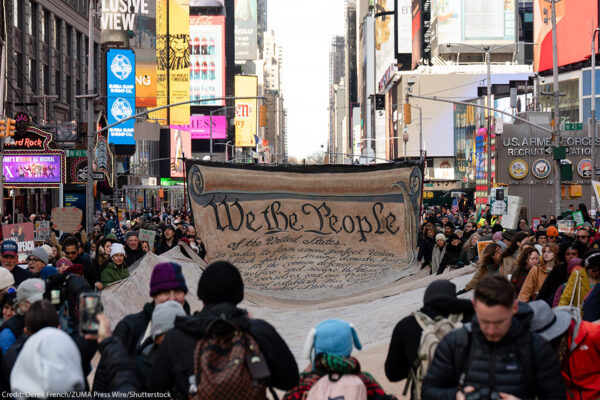
In "Let the Record Show," the ACLU's newest podcast, we discuss how office politics gave courts the power to decide if political decisions are constitutional. It's led to an array of landmark decisions that continue to protect our civil liberties today. -
Press ReleaseOct 2026
Civil Liberties
Aclu And Aclu Of North Carolina Launch Over $3.5 Million Campaign To Educate North Carolina Voters Ahead Of Midterm Elections. Explore Press Release.ACLU and ACLU of North Carolina Launch Over $3.5 Million Campaign to Educate North Carolina Voters Ahead of Midterm Elections
RALEIGH, N.C. – The American Civil Liberties Union of North Carolina and American Civil Liberties Union, Inc. today announced the launch of a joint campaign that will spend over $3.5 million to educate and engage North Carolina voters ahead of the Nov. 3 midterm elections. “For years, voters in North Carolina have watched as extreme politicians try over and over again to strip us of our rights – from our right to bodily autonomy to our right to fair representation,” said Liz Barber, ACLU of North Carolina director of policy and advocacy. “The ACLU is committed to ensuring that North Carolinians understand how state officials – like state supreme court justices and state legislators – can protect our rights, and where candidates for office this cycle stand on these important issues.” The organizations are spending $3.5 million on a series of statewide advertisements on social and digital media platforms and direct-to-voter mailers during the final weeks of the state Supreme Court race and key state legislative races. The advertisements will focus on educating voters about where candidates stand on key issues, including abortion rights and voting rights. This is the organizations’ largest electoral spend in North Carolina to date and will reach over 2.3 million voters. The spending is part of a multi-cycle strategy in North Carolina from the ACLU. In 2024, the ACLU of North Carolina and ACLU spent $750,000 on direct mail, digital ads, and grassroots outreach educating voters about issues at stake in the state Supreme Court and state legislative elections. The North Carolina Supreme Court is responsible for interpreting the state constitution and state laws. As the state’s highest court, it has the final say on many questions involving civil rights and civil liberties, and the North Carolina Constitution can provide broader protections than the U.S. Constitution. In 2022, for example, the court held that the North Carolina Constitution’s prohibition on cruel and unusual punishment can provide protections beyond those guaranteed by the Eighth Amendment. The ACLU of North Carolina, and ACLU are nonpartisan and do not support or oppose candidates for elected office. The organizations do, however, educate the voters about the issues at stake in elections and candidates’ positions and records on civil rights and civil liberties.