Tony Winner Ali Stroker Reframes Disability Representation and Identity
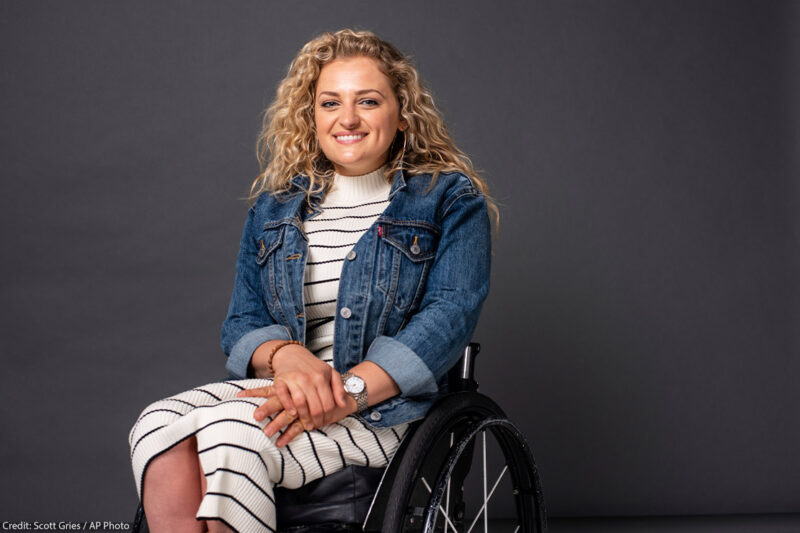
Over the past several years, we have witnessed a heightened demand for marginalized communities to be better represented in the media, in boardrooms, and every sector of society. While some progress has been made, representation of people with disabilities often takes a backseat in the conversation.
In fact, it was only in 2015 that actress and singer Ali Stroker made history when she became the first person using a wheelchair to perform on a Broadway stage — immediately breaking barriers for people with disabilities. Four years later, she did it again, becoming the first person using a wheelchair to win a Tony award.
“This award is for every kid watching tonight who has a disability, who has a limitation or challenge, who has been waiting to see themselves represented in this arena,” she said while accepting the award.
Stroker’s representation is undoubtedly historic, but there is still so much more work to be done. Although there are around 133 million Americans who live with visible or invisible disabilities, their representation in media and entertainment remains bleak and in many cases, nonexistent. Across the top 100 movies of 2019 only 2.3 percent of all speaking characters had a disability. Even more alarming, when a character with a disability is portrayed, they often aren’t even played by someone with a disability. In fact, one study found that in the top 10 TV shows during 2018, only 12 percent of disabled characters were depicted by actors with the same diagnoses in real life. That’s why disability representation is more important than ever, as we strive to create a more equitable and inclusive world.
Since her historic broadway debut, Stroker has blazed the trail for more disabled representation, on and off the stage. This week, she sat down for a conversation with us on our podcast to discuss the importance of not just representation, but the celebration of disabilities in the entertainment industry and beyond.
Listen to Episode 166 of ACLU's "At Liberty" Podcast Below:
In this episode, we continue our celebration of Disability Pride Month with a conversation about representation.
In this episode, we continue our celebration of Disability Pride Month with a conversation about representation.

Related Issues
Related Content
-
North CarolinaSep 2026

Disability Rights
Edwards V. Witherspoon. Explore Case.Edwards v. Witherspoon
-
Press ReleaseSep 2026

Disability Rights
Federal Appeals Court Allows Case Defending Incarcerated People’s Right To Medication For Opioid Use Disorder To Proceed. Explore Press Release.Federal Appeals Court Allows Case Defending Incarcerated People’s Right to Medication for Opioid Use Disorder to Proceed
RICHMOND, Va. – The Fourth Circuit Court of Appeals today reversed a lower court and ruled that a woman who is suing North Carolina prison officials for violating her rights under the Eighth Amendment and federal disability rights laws can bring her claims to trial. She is seeking damages for being shackled by prison officials shortly before, during, and after childbirth, and being denied her access to medication for opioid use disorder after giving birth. The woman, Tracey Edwards, was incarcerated in the North Carolina Correctional Institution for Women (NCCIW). Prison officials abruptly cut off Ms. Edwards' medication for opioid use disorder (MOUD) after she gave birth, causing an extremely painful, dangerous, and unnecessary withdrawal. They also kept Ms. Edwards shackled shortly before, and at times during and after giving birth – in direct violation of the prison system’s own policy – causing severe pain and interfering with Ms. Edwards’ ability to bond with her newborn child. Ms. Edwards brought claims for damages under the Eighth Amendment’s prohibition on cruel and unusual punishment and federal disability rights laws, including the Americans with Disabilities Act and Section 504 of the Rehabilitation Act. Her claims were thrown out by the district court, but today’s ruling from the Fourth Circuit reverses that decision and remands the case to the district court for further proceedings. “More than half a decade after Ms. Edwards faced horrific treatment behind bars, she’s still fighting for accountability for what happened to her. In the midst of a deadly overdose crisis, we need to use every tool at our disposal to save lives, including medication for opioid use disorder,” said Joseph Longley, staff attorney with the ACLU Disability Rights Program. “Instead of banning care, jails and prisons should be providing the basic health care that incarcerated people need to survive.” In the opinion written by the three-judge panel, the court recognizes the “growing recognition that substance use and [opioid use disorder] are disabilities.” The judges also write that a reasonable jury could conclude that Ms. Edwards’ shackling during childbirth and the denial of MOUD was “far from constitutionally adequate treatment.” “Ms. Edwards should have never been shackled or denied MOUD. These actions not only had severe impacts on her health and well-being, but gravely violated her civil rights and the prison's own policies. We're grateful the court will allow Ms. Edwards to bring her case to trial,” said Hassan Zavareei, managing partner at Tycko & Zavareei LLP. The court also writes that it is “clearly established” that there is a “constitutional right to receive adequate medical care and to be free from officials’ deliberate indifference to their known medical needs.” “This is a refreshing win that furthers what we already know: denial of MOUD violates the law and courts are willing to demand accountability,” said Amelia Caramadre, attorney at Kaplan & Grady. “Prison officials broke their own rules to shackle Ms. Edwards during labor and childbirth, then invoked their own rules to abruptly cut off her medication, throwing her into withdrawal and leaving her in pain she described as worse than the pain of giving birth,” said Samuel Weiss, Executive Director of Rights Behind Bars. “We should not tolerate this kind of treatment in our prisons any more than we would tolerate it anywhere else.” Ms. Edwards was represented in the appeal by the American Civil Liberties Union, ACLU of North Carolina, Rights Behind Bars, Tycko & Zavareei LLP, and Kaplan & Grady LLC. -
Press ReleaseSep 2026
Disability Rights
Statement Of National Disability Organizations On The Department Of Justice’s Proposed Resolution Of Texas V. Kennedy. Explore Press Release.Statement of National Disability Organizations on the Department of Justice’s Proposed Resolution of Texas v. Kennedy
WASHINGTON – On Aug. 31, 2026, the Department of Justice (DOJ), on behalf of the Department of Health and Human Services (HHS), along with Texas, Florida and Alaska filed a proposed resolution of Texas v. Kennedy. These states challenged the HHS 2024 regulations implementing Section 504 of the Rehabilitation Act, which prohibits discrimination on the basis of disability by recipients of federal funds. The lawsuit focuses on the regulations’ provisions regarding community integration for people with disabilities. The resolution asks the court to enter an order vacating references to community integration throughout the Section 504 regulations, including the entirety of the integration provision. The resolution does not impact other portions of the 2024 HHS Section 504 Rule. We strongly and unequivocally condemn the actions of DOJ and HHS. This resolution continues the federal government’s abandonment of its duty to enforce the right of people with disabilities to live in their own homes and communities. The resolution relies on the June 18, 2026 memo from the DOJ’s Office of Legal Counsel. That memo reflects the federal government’s reversal of its longstanding interpretation of the law and of its own authority. The federal government’s Section 504 regulations have included integration provisions since 1977. To be clear, this resolution does not and cannot change longstanding legal precedent interpreting the requirements of Section 504 or the Americans with Disabilities Act (ADA). Nor does it change the ADA or Section 504 themselves. Only Congress can change the law. DOJ’s new interpretation of the Supreme Court’s decision in Olmstead v. L.C., the ADA, and Section 504 is simply wrong and inconsistent with 50 years of law. DOJ itself admits that its interpretation is “out of step” with the interpretation of the law by courts across the country. The disability community opposes any effort to turn back the clock on disability rights and community integration or to strip disabled people of their dignity and autonomy. We join together against discrimination and segregation of people with disabilities. This statement was created by The Arc of the United States, Bazelon Center for Mental Health Law, Center for Public Representation, Disability Rights Education & Defense Fund, Justice in Aging, the National Health Law Program, and American Civil Liberties Union, with contributions by Alison Barkoff, Hirsh Health Law and Policy Associate Professor, George Washington University. -
Press ReleaseAug 2026
Disability Rights
Challenge To West Virginia Methadone Clinic Moratorium Proceeds. Explore Press Release.Challenge to West Virginia Methadone Clinic Moratorium Proceeds
CHARLESTON, W.Va. – A federal judge in West Virginia today declined the state’s request to dismiss a lawsuit brought by West Virginia’s largest overdose prevention group, Solutions Oriented Addiction Response of West Virginia, which is suing to overturn the state’s nearly two-decades-old moratorium on new methadone clinics. The ruling allows the case to proceed. “As we are packing thousands of doses of naloxone and care packages for Save a Life Day 2026, we are reminded that access matters,” said Sarah Stone, co-director of Solutions Oriented Addiction Response of West Virginia (SOAR-WV). “Whether it’s naloxone, methadone or any other evidence-based care, people shouldn’t have to overcome stigma and unnecessary barriers to get the care they need. Dignity, autonomy and equitable access should not be extras. They are a baseline.” Access to methadone is critical for people living with opioid use disorder, allowing people who use drugs like fentanyl to begin recovery treatment without dangerous withdrawal. Over the last two decades, more than 12,000 people have died from an opioid overdose in West Virginia. Yet, a statewide moratorium and state zoning restrictions limit methadone clinics to just nine clinics across the state, leaving large parts of the population a very long distance from the nearest clinic. “[A]s SOAR-WV has alleged the lack of methadone treatment centers has made it more difficult and time consuming to connect individual users to treatment, it necessarily follows that it is spending more of its resources on each individual referral. Therefore, the Court has little difficulty finding that SOAR-WV has sufficiently alleged a direct connection between the moratorium and zoning restrictions and injury to its mission,” wrote U.S. District Judge Robert C. Chambers in his order today. The lawsuit is being brought by the American Civil Liberties Union, ACLU of West Virginia, and Kaplan & Grady. It argues that the moratorium violates the American with Disabilities Act and Section 504 of the Rehabilitation Act, because people with opioid use disorder – a recognized disability under federal law – are unable to receive the essential rehabilitation services they need. “West Virginia’s moratorium is denying people with opioid use disorder the ability to receive lifesaving healthcare. This isn’t just dangerous and inhumane, it’s discriminatory and illegal,” said Joseph Longley, staff attorney with the ACLU Disability Rights Program. “We look forward to proving that in court.” “This ruling is a critical step toward ending West Virginia’s discriminatory barriers to addiction treatment,” said David Howard Sinkman of Kaplan & Grady. “Methadone is essential for treating opioid use disorder and particularly important in the fentanyl era. People need access to treatment, not government restrictions that put their lives at risk.” The order denying the motion to dismiss is available here: https://www.aclu.org/cases/solutions-oriented-addiction-response-west-virginia-v-state-of-west-virginia?document=Order-Denying-Motion-to-Dismiss