'I Have No Rights': Minnesota Residents Sue Trump Administration for Racial Profiling, Stops Without Suspicion, and Warrantless Arrests
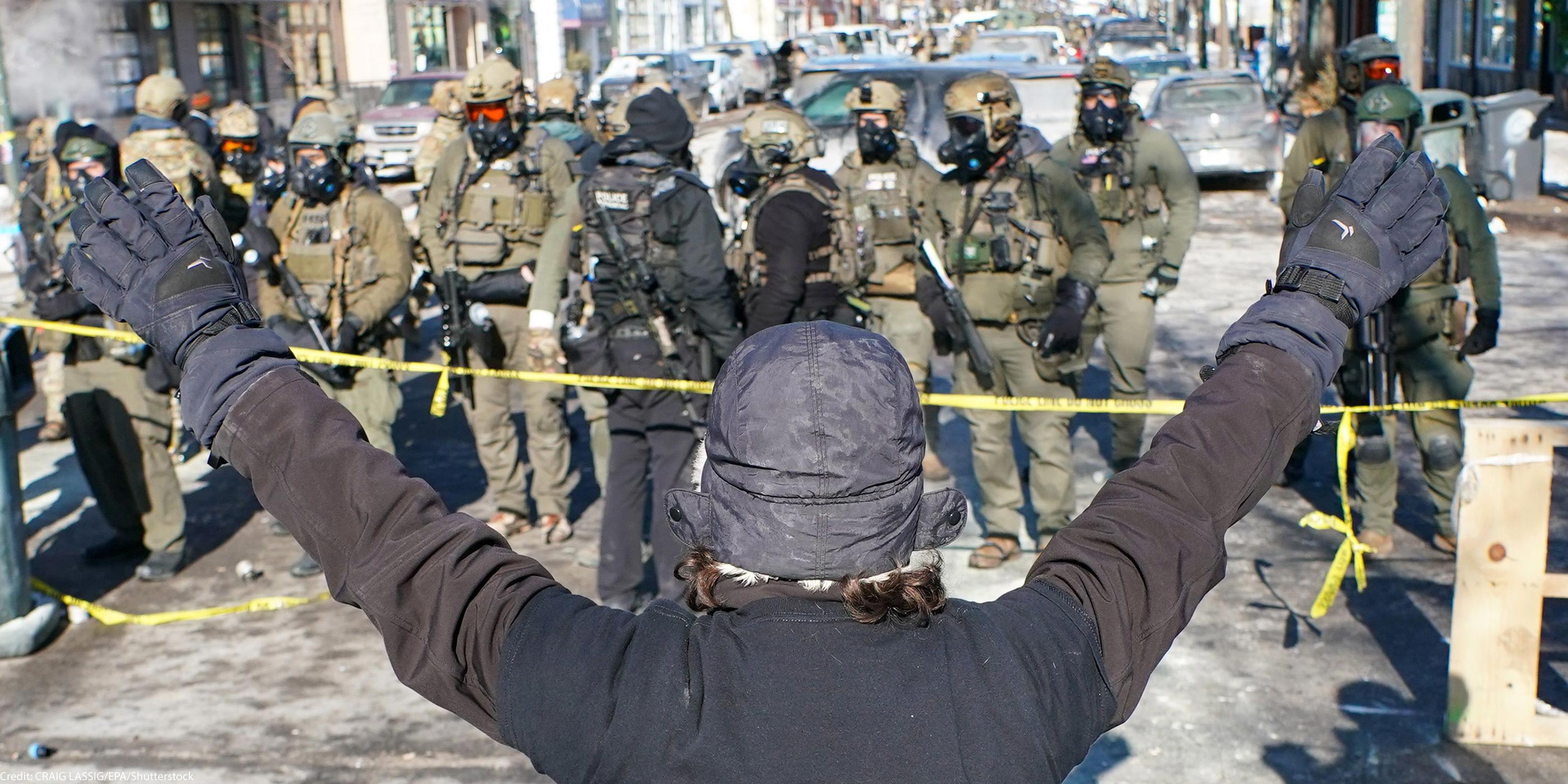
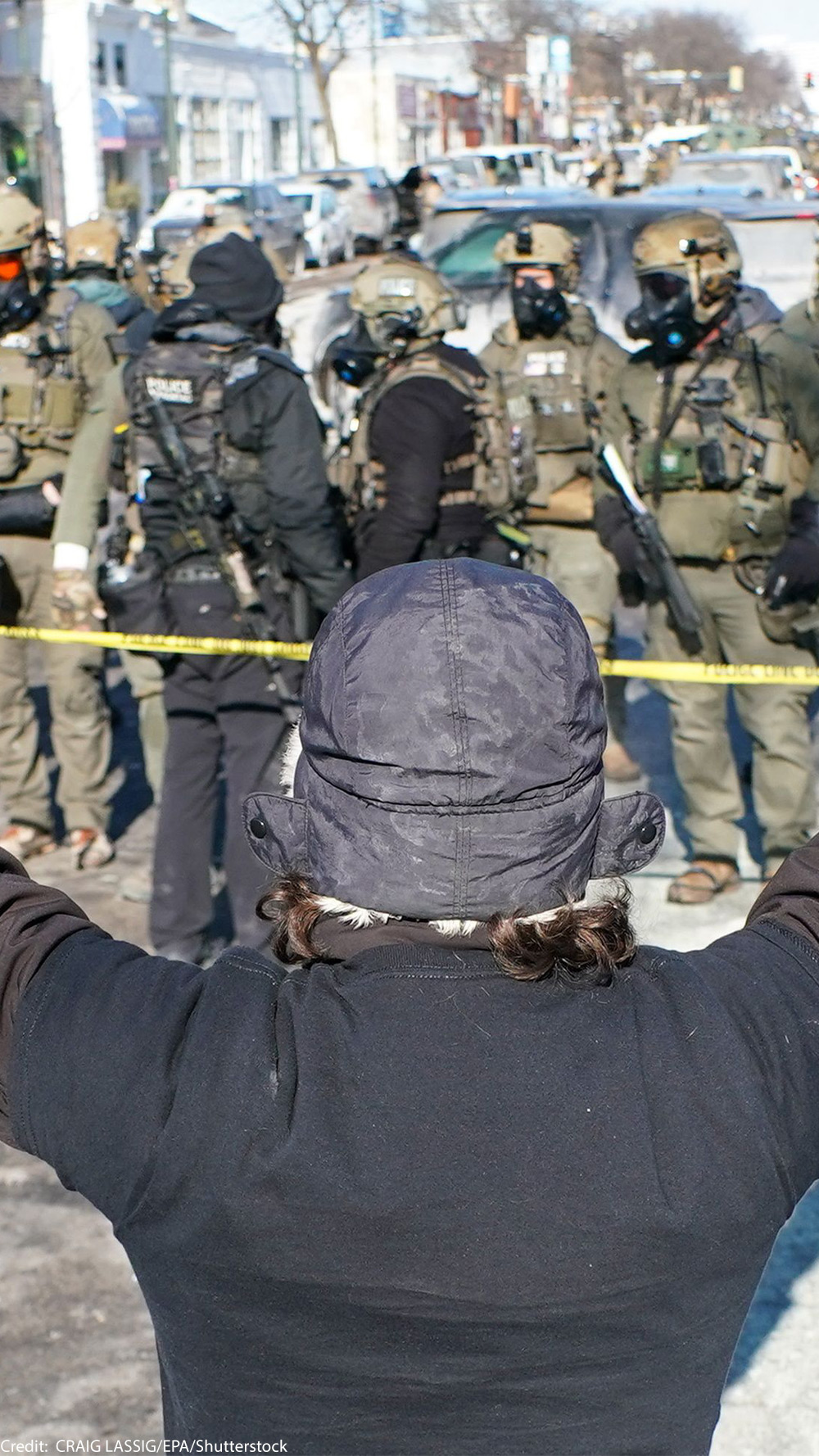
As immigration agents patrolled the Twin Cities in January, 30-year-old R.M. and his family insisted on staying home in the suburbs of Minneapolis. That was, until his 5-year-old daughter really wanted ice cream. “I’m brave,” she said. “I can go.” So they grabbed their passport cards and left for the ice cream shop. When they returned, U.S. Immigration and Customs Enforcement (ICE) agents were parked blocking his driveway.
R.M. is a citizen and Latino, and he is identified by his initials for fear of retaliation. He testified in court in February detailing a harrowing incident with ICE as part of an ACLU lawsuit where Minnesotans allege racial profiling, unlawful seizure and arrest at the hands of Department of Homeland Security agents. At that moment, he said he felt like, “I have no rights.”
The American Civil Liberties Union, ACLU of Minnesota, Covington & Burling LLP, Greene Espel PLLP, and Robins Kaplan LLP filed a class-action lawsuit against the Trump administration on behalf of three community members — and a class of similarly situated people — whose constitutional rights were violated by federal agents, including Immigration and Customs Enforcement (ICE) and Customs and Border Protection (CBP). The court recently held that we had made a clear showing that ICE and CBP adopted unlawful and unconstitutional policies authorizing stops based on race or ethnicity and without reasonable suspicion of an immigration violation, as well as making arrests without probable cause. The court denied our request for a preliminary injunction, which would have halted the practices while the case proceeded. This is due to a finding that the plaintiffs are not at immediate risk, largely due to the drawdown in federal agents. However, ICE and CBP presence persists throughout rural areas of Minnesota as well as areas of the Twin Cities. The decision is nevertheless an important affirmation of the rights of Somali and Latino Minnesota residents, and we are continuing to fight for our clients’ rights.
Minnesotans have lived in fear ever since the Trump administration announced a focus on Minnesota in immigration arrests and increased its deployment of federal forces by the thousands. Neighborhood watch groups organized to protect their immigrant neighbors, armed simply with whistles to alert others of ICE presence. Keeping passports on hand while going to work or running errands has become normal. Hundreds have marched in freezing temperatures calling for ICE to leave the city. Children have watched their fellow students being taken. ICE agents have violently retaliated against Minnesotans who have filmed them, leading to the tragic killing of U.S. citizens Renee Good and Alex Pretti.
Masked federal agents in military gear have continuously ignored basic human rights in their enforcement activity against Minnesotans, especially targeting Somali and Latino communities. And the ongoing effects continue to leave communities — citizens and immigrants alike — traumatized.
ICE Has Racially Profiled and Unlawfully Arrested Citizens
The Trump administration has been clear in its targeting of the Somali and Latino communities in Minnesota. President Trump has called people from Somalia “garbage,” has said “we don’t want them in our country,” and has told them to “go back to where they came from.” Following Trump’s comments, ICE and CBP agents have indiscriminately arrested — without warrants or probable cause — Minnesotans solely because the agents perceived them to be Somali or Latino.
Such was the case for R.M. As he drove up towards his home, he rolled down his window to tell the agents that he needed to get into his driveway. Streets were snowy across the Twin Cities after a recent storm, and homeowners like R.M. knew they couldn’t park on the street to allow snow plows to clean the roads. The ICE agents refused to move as they were attempting to apprehend another individual. R.M.’s daughter began crying and yelling after seeing the masked agents. So he temporarily parked along the street, brought his daughter to safety inside with her mother, and came back out to record what was happening.
One agent walked towards him onto his private property, asking where he was from and for his identification. At the time, R.M. refused to show his identification, saying he was a citizen and that he was not required to show his documentation. R.M. asked the agent why he needed his documents. As R.M. testified (ICE declined to appear in court), the ICE agent responded saying “because of your accent.” R.M. told the agent he had a similar accent too, to which the agent got aggravated, handcuffed him, pulled him outside of his home’s fence, and dragged him to a van.
At this point, he told the agent he had his passport card in his wallet. Eventually, the agent let R.M. go. He recalled the agent saying to him in Spanish, “I don’t care if you’re a citizen, next time I’m going to take you. I don’t care if I have to do extra paperwork.”
The court found that R.M. and 22 other declarants were stopped and detained based solely on their race or ethnicity. As R.M. explained, his other neighbors who were white were outside yelling at the agents in his defense. But, “I was the only one picked that day.”
His daughter has been living in fear since. She doesn’t want to go outside and is constantly scanning for cars with tinted windows. Another time they went to get ice cream, she begged her father to take her home.
One day as they were driving, they witnessed 5-year-old Liam Conejo Ramos getting detained by ICE. She asked her dad, “They can take kids too?” When they returned, she closed the curtains in the house and used her family’s shoes to block the front door. That same day, they saw ICE agents four other times, constantly hearing whistles in the background.
Video Evidence Shows a Somali Citizen Brutally Arrested by ICE
Video evidence and testimony from 20-year-old M.H., who is Somali, detailed a two-hour interaction with ICE where he was unlawfully stopped and violently taken in December. “Every night when I go to sleep,” he said. “it replays in my head.” M.H. is also identified by his initials for fear of retaliation.
M.H. works in a predominantly Somali neighborhood of Minneapolis. The plaintiffs’ attorneys showed a video inside a back entrance stairwell to a Somali restaurant just outside of M.H.’s office that showed agents pushing him into metal fencing. He kept saying he’s a U.S. citizen to which an agent responded: “That don’t matter.”
The video showed agents push M.H. into the wall and handcuff him. Videos also showed an agent pulling him into a headlock outside and down to the ground in the falling snow.“I felt like I couldn’t breathe,” he said.
Agents pulled M.H. into an unmarked vehicle. Witnesses chased after the car on foot. His employer heard what was going on, came outside with a printed copy of his passport card from his employment records, and attempted to show the agents through the window of the car as they drove away.
In the SUV, the agents turned off M.H.’s phone. They tried to scan his face, he said. They didn’t ask any further questions and never showed any warrant. They never even asked for his identification, signalling there was no indication that they actually knew he was.
They took M.H. to the now infamous Bishop Henry Whipple Federal Building in St. Paul, the first stop for detained immigrants in Minnesota. When they stopped outside of the gate, they forced him outside, scanned his face again, and went back inside the vehicle. Then, they went inside the federal building. At this point, a government employee finally looked at M.H.’s identification. They also took his photo and fingerprints. Once they searched his name in a database, they let M.H. go.
“I’m worried about being stopped again just because of how I’m perceived,” he said. He used to walk to stores in the area, including for groceries. Every morning he used to stop at the popular Somali shopping joint Karmel Mall for a Somali-style coffee to take to work. Now, he avoids the mall entirely.
Life in Minnesota Remains Upended by DHS’s Abuses
Daily life in Minnesota remains upended by DHS’s unlawful, abusive immigration stop and arrest tactics. There are still federal agents in the Twin Cities, and they have spread throughout rural Minnesota. Communities have been arranging funds for rent assistance and groceries for people who have been sheltering at home to avoid ICE.
“Our lawsuits against the federal government for their egregious violations of the U.S. Constitution continue,” said the ACLU of MN. “There has been no indication that DHS plans to end the unlawful policies that they have used to violate the rights of thousands of Minnesotans.”
If your arrest, detention, stop, or questioning, appeared to be the result of targeting and profiling based on your race or national origin, or if you have been arrested, detained, or stopped by federal immigration agents where the federal agents did not have a warrant or they had a warrant that did not apply to you please complete this form.
Related Issues
Related Content
-
News & CommentaryOct 2026
Immigrants' Rights
New Aclu Documentary Reveals Stories Of Families At Idaho Immigration Raid. Explore News & Commentary.New ACLU Documentary Reveals Stories of Families at Idaho Immigration Raid
“Wilder Raids,” the ACLU’s latest short documentary features the harrowing stories of families caught in a violent immigration raid at a horse race in Wilder, Idaho last year. -
Press ReleaseOct 2026

Immigrants' Rights
Criminal Law Reform
New Aclu Film Exposes Human Toll Of Immigration Raid In Wilder, Idaho As Families’ Lawsuit Moves Forward. Explore Press Release.New ACLU Film Exposes Human Toll of Immigration Raid in Wilder, Idaho as Families’ Lawsuit Moves Forward
NEW YORK – The American Civil Liberties Union premiered Wilder Raids, an original short film telling the story of two families whose lives were upended by a violent immigration raid at a horse-racing event in Wilder, Idaho, one year ago today. The film follows the families as they reckon with the lasting trauma of the raid and details the ongoing lawsuit brought by the ACLU, ACLU of Idaho, Cooley LLP, and Stoel Rives LLP seeking accountability. One year ago today, more than 200 federal, state, and local law enforcement officers descended on an otherwise peaceful family event at a horse-racing track in Wilder, Idaho. Law enforcement arrived in armored trucks and a helicopter with flashbang grenades and guns drawn and detained approximately 400 spectators – including U.S. citizens and children – for four hours in inhumane conditions before subjecting everyone to suspicionless immigration interrogations. Through interviews with the families and an inside look at the ongoing legal fight, Wilder Raids explores the lasting impact of the raid on those who experienced it and the broader Wilder community. Juana Rodriguez, one of the lead plaintiffs and featured storyteller in the film, is a U.S. citizen who was at the event with her 3-year-old son. After being violently rounded up with hundreds of other families, Rodriguez was placed in zip ties and detained for several hours without food or water. Law enforcement instructed her toddler to hold onto her pocket while Rodriguez remained zip tied and unable to comfort her son. “I was like, why? I have my son with me. I have to take care of him. I was scared. If I overreacted, I felt like they were going to hurt me,” Rodriguez said. “For the longest time, my son begged me for food. He begged me for water … I wish I could have done more in the moment, but I couldn’t. I think that’s what really gets to me till this day.” The families featured in the film filed a lawsuit last February that argues that federal, state, and local law enforcement used criminal warrants as a pretext for a sweeping immigration dragnet at an event where they knew attendees would be predominantly Latino. The complaint further alleges that the agencies conspired to deprive those detained of their Fourth Amendment rights against unreasonable seizures and their right to equal protection regardless of ethnicity. The lawsuit invokes federal civil rights laws enacted after the Civil War to protect people from racialized government violence and provides a potential avenue for holding federal actors accountable for constitutional violations. “Defendants continue to characterize what happened in Wilder as an ordinary warrant execution, but there was nothing routine about the terror they inflicted on hundreds of people trying to spend a Sunday with their families,” said Jenn Rolnick Borchetta, deputy director on policing at the ACLU. “This film makes it impossible to ignore what our clients and their families experienced that day and puts a human face on the reckless violence and cruelty inflicted on the community. One year later, we will not let the government rewrite what happened in Wilder and we will continue fighting to hold those responsible accountable.” “The violent raid in Wilder has had significant ripple effects across many communities in Idaho, which can still be felt today, a year later,” said Leo Morales, executive director of the ACLU of Idaho. “The film reminds us of how critical it is for every American to rise to the challenge of protecting civil liberties. It also highlights how personal and fragile our rights can be if left unprotected from government action. Families cannot simply shake off and ignore the abuse; it is our collective responsibility to seek justice, take action, and make things whole.” The lawsuit is ongoing as the families await a decision on the defendants’ motions to dismiss. On Sept. 8, 2026, plaintiffs filed an opposition brief urging the federal court to allow the lawsuit to proceed. Additional statements from co-counsel are below. Jade Ford, an attorney at Cooley LLP: “This film sends a clear message: the Wilder community will not stand idly by in the face of constitutional violations. Every person in this country is entitled to freedom from unlawful seizure and freedom from discriminatory targeting. Those are not hollow promises—they are vital constitutional guarantees, and the Wilder community intends to see them enforced.” Wendy Olsen, an attorney at Stoel Rives LLP: “All Idaho families should be able to enjoy community and cultural events without fear that their rights will be violated, that their children will be traumatized or that they will be targeted based on their perceived color or national origin. This film bravely tells that story on behalf of the Wilder community.” -
Press ReleaseOct 2026
Immigrants' Rights
Legal Organizations Urge Federal Court To End Abuse And Deadly Conditions And Protect People Detained At Camp East Montana . Explore Press Release.Legal Organizations Urge Federal Court to End Abuse and Deadly Conditions and Protect People Detained at Camp East Montana
EL PASO, Texas – Legal organizations filed a motion for preliminary injunction demanding ICE provide adequate healthcare and improve conditions for people detained at Camp East Montana, the nation’s largest immigration detention facility located on the Fort Bliss military base in El Paso, Texas. The motion comes as ICE is on track to have its deadliest fiscal year on record, as deaths in detention have nearly doubled since last fall, including three deaths at Camp East Montana alone. The motion, which was supported by more than 40 declarations from people currently or formerly detained at Camp East Montana, loved ones of people who have died, and correctional and medical experts, describes the government’s systemic failure to provide adequate medical care and humane living conditions. The conditions reported include medical neglect, unsanitary and unsafe conditions, confinement to windowless tents for 23 to 24 hours a day, barriers to legal counsel, and such little food that people experience substantial weight loss and other serious medical conditions. People detained at the facility also describe being physically beaten by guards and confined in extreme isolation as punishment for seeking help. “The conditions reported in those declarations shock the conscience,” Dean Williams, a former state prison director who evaluated the conditions in Camp East Montana, wrote in support of the motion. “People describe degrading, unsafe, and unsanitary conditions, abuse by guards, and extreme restrictions and harsh treatment far beyond those of the most secure prisons I have overseen.” In May of 2026, the American Civil Liberties Union, ACLU of Texas, Texas Civil Rights Project, and Farella Braun + Martel LLP filed their lawsuit against ICE after the federal government began detaining thousands of people in a tent encampment on the Fort Bliss military base in the El Paso desert. The facility has repeatedly come under fire since its opening in August 2025 following rampant reports of abusive, inhumane, and deadly conditions. Quotes from named plaintiffs in the lawsuit are as follows: “Urgent protection is desperately needed at Camp East Montana,” said named plaintiff Gerald Akari Angye. “Today, people are still being detained in this windowless camp with inadequate food, water, medicine, and recreation. People with health issues do not receive the care they need. This case remains important to me because I am a voice for those harmed by this regime. I will never be the same after the violence I experienced by guards at Camp East Montana. Many others are still being held in those horrible conditions. The United States preaches democracy and human rights, but it is separating families and torturing people who are seeking safety. The world is watching. The inhumane conditions at Camp East Montana seem to be getting worse. No one of good conscience can support what is happening there. I plead with the court to give relief to people held in the horrible Camp East Montana.” “It’s hard for outside observers to understand what people go through at Camp East Montana,” said named plaintiff Navdeep. “That’s why we are sharing our stories. I don’t want people to continue suffering and experiencing the terrible conditions I experienced there. We need the court to take action to immediately improve conditions at Camp East Montana and to prevent additional suffering.” “Camp East Montana is not built to accommodate the basic needs of people,” said named plaintiff ZOR. “If the court fails to intervene, things may get even worse. If nothing is done, I worry it will be a signal that it is okay that for the law to continue being ignored at Camp East Montana. I believe the conditions at Camp East Montana are meant to break people down emotionally and to punish them so they become desperate to leave. It is unbearable to be mistreated every day and trapped in a dirty room with up to 72 people. Many of us are only able to endure it because of the strength we get from the thought of our families.” Additional quotes from co-counsel are as follows: “We cannot wait any longer,” said Rita Lomio, Senior Counsel at the ACLU’s National Prison Project. “ICE and the Department of Defense have long known of the cruel and deadly conditions at the tent encampment on the Fort Bliss military base. They have demonstrated time and again that they cannot or will not act to end the abuse. Former prison and jail directors have found that conditions at Camp East Montana are unprecedented and make all who live and work at the encampment unsafe. While litigation continues, a preliminary injunction is needed to end the most egregious abuses before more people needlessly suffer and die.” “The need for court-ordered relief is urgent,” said Savannah Kumar, staff attorney at the ACLU of Texas. “For the past year, the government has disappeared thousands of people into its desert camp that has been the site of beatings by guards, death, disease, and hunger. The situation has continued to deteriorate. People held inside tents describe the denial of desperately needed medical care, environmental hazards, and filthy conditions. These unbearable conditions violate U.S. law and erode the moral fabric of our country. A preliminary injunction is necessary to prevent additional death and abuses at the largest immigration detention camp in the country. All of us, no matter where we were born, are created equal and are entitled to dignity that is being systematically denied at this horrific tent camp.” “State-sanctioned violence is occurring in and outside of facilities like Camp East Montana, and the blatant disregard for human life and access to basic health care should shock the conscience of every American,” said Rochelle Garza, President of the Texas Civil Rights Project. “If we, as a society, say nothing and go along with the notion that certain lives matter less than others, the government’s abuse and neglect will continue to be normalized. Our preliminary injunction is an effort to stop ICE, and the harm that has seeped into the walls of their detention facilities, from going unchecked.” “Detention does not strip individuals of their fundamental rights to safety, dignity, and necessary medical care,” said Cynthia Castillo, partner at Farella Braun + Martel LLP. “The record in this case shows deeply troubling medical neglect, dangerous living conditions, and mistreatment that demand immediate action. A preliminary injunction is essential to prevent further irreparable harm and to ensure that individuals detained at Camp East Montana are treated humanely while their legal claims are heard.” More information on the lawsuit is available here: https://www.aclu.org/cases/akari-angye-et-al-v-ice -
News & CommentaryOct 2026
Immigrants' Rights
A Congressman Questioned Reports Of Deadly Conditions At An Ice Detention Center. Then Two More People Died.. Explore News & Commentary.A Congressman Questioned Reports of Deadly Conditions at an ICE Detention Center. Then Two More People Died.
Nearly 60 people have died in detention, as calls against medical neglect, inedible food, and unsanitary conditions continue. Congress must establish standards of care and accountability.