Trans Rights Are Women's Rights
*This blog was updated in March, 2026.
March is Women’s History Month, which means I’m often asked to name the most pressing issue facing women in America. Answers spring to mind, sometimes faster than I can form the words. I think about the White House’s attacks on childcare at the expense of kids and families who need it most. The fall of Roe and the rise of abortion bans and restrictions coupled with the dangers of being pregnant in America, particularly for Black women. The Trump administration’s open contempt for women who serve our country — and for the word “women” also comes to mind. The list goes on.
None of these ills, however, is the subject of a presidential action “Defending Women from Gender Ideology Extremism and Restoring Biological Truth to the Federal Government.” Instead, this executive order creates a legal definition of womanhood based on the capacity to produce ova, or human eggs. This definition of “woman,” which is gerrymandered to exclude trans women and girls, then applies throughout federal law — and threatens trans people’s freedom to live openly at work, at school, or anywhere in the places they call home.
That should set off alarm bells for all of us, not just those engaged directly in the struggle for LGBTQ rights. The executive order is only a sliver of the cruel campaign to deny basic rights to trans people currently underway. And despite its misleading “Defending Women” label, it shares a through-line with a long and ugly history of gender-based subjugation in the name of “biology.” For centuries, laws and policies premised on women’s biological capacities and “delicate” nature were used to shut women out of educational, economic, and civic opportunities. On these grounds, the U.S. Supreme Court upheld laws barring women from becoming attorneys — or bartenders. Similar “biological” arguments were used to exclude Black women from “the fairer sex” in order to justify extraction of Black women’s labor under the institution of slavery and beyond.
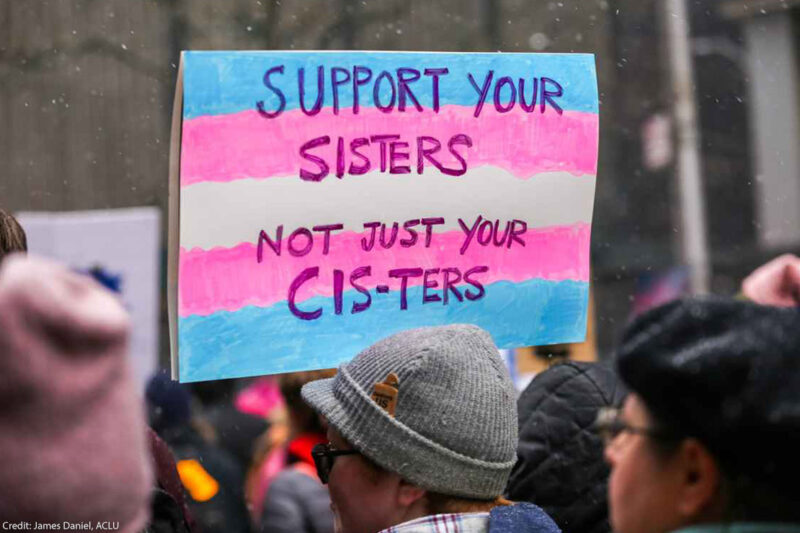
As feminists, we reject efforts to appropriate the rhetoric of “women’s rights” to inflict life-threatening harm on trans people, men or women. Attacking trans people does nothing to address the real problems women face. To the contrary, limiting freedom for trans people worsens conditions for all women by re-entrenching the very gender stereotypes that have underpinned centuries of women’s oppression and that the ACLU Women’s Rights Project has worked for more than half a century to dismantle. After all, the very notion that a person should identify with the sex they were assigned at birth for their entire life is a stereotype, as the more than 1.5 million trans people living in the United States attest to every day.
Formed in 1972, the Women’s Rights Project’s earliest cases focused on establishing rigorous judicial review of laws that classified people on gender lines, often based on long-held stereotypes about men’s and women’s capacities and without regard to individual abilities, needs, and wants. That work, led by Ruth Bader Ginsburg for the ACLU, included challenging a probate rule that preferred men to women based on the stereotype that any man is more capable of settling an estate than every woman; a housing allowance offered to servicemen, but not servicewomen, based on the stereotype that men should be primary breadwinners; and an income tax deduction available to women, but not men, based on the stereotype that only women should be caregivers.
The plaintiffs in these cases included men as well as women. What they had in common was that each defied gender stereotypes, out of desire or necessity. And all fought to live fully and authentically, without laws and policies that constrained them based on gender or their ability to bear children. To live openly as transgender is to seek that same freedom.
Not only is there no conflict between demanding rights for women and for all transgender people, advances in trans rights hold a specific promise for women’s liberation. By tearing down laws and policies based on gender stereotypes, we can create the opportunity for each of us to determine our own life story. That’s why the Women’s Rights Project strives to represent people of all genders who face barriers based on their sex.
Today’s avalanche of attacks on trans people, with over 492 anti-LGBTQ bills we’re tracking in 2026 so far, makes plain that the gender discrimination of the past is all too present today. Defending trans people is not only a moral duty for the feminist movement; it is central to it.
Learn More About the Issues on This Page
-
Press ReleaseMar 2026

LGBTQ Rights
Kansas State Court Denies Temporary Restraining Order Against State Law Invalidating Ids And Restricting Bathroom Access For Transgender People. Explore Press Release.Kansas State Court Denies Temporary Restraining Order Against State Law Invalidating IDs and Restricting Bathroom Access for Transgender People
Lawrence, K.S. - A judge for the District Court of Douglas County rejected a request for a temporary restraining order blocking enforcement of SB 244, a Kansas state law that immediately invalidated the driver’s licenses of transgender people across the state and which authorizes anyone to sue anybody they suspect of being transgender for using the “wrong” restroom in government buildings. “This is a devastating, but hopefully temporary, setback for our clients and transgender people across the state of Kansas,” said Harper Seldin, Senior Staff Attorney for the ACLU’s LGBTQ & HIV Rights Project. “The harm of this law has already had sweeping impacts on the lives of transgender people like our clients, threatening their ability to hold a job, go to school, or go about their daily lives. We all deserve the freedom to be ourselves without politicians interfering in our lives, and we will keep fighting SB 244 until it is erased from state law entirely. We look forward to demonstrating at a temporary injunction hearing that this law is unconstitutional and deeply harmful and should be enjoined.” SB 244, passed into law by the state legislature over Governor Laura Kelly’s veto, prohibits transgender people from using public restrooms that align with their gender identity on government property. It also establishes a private right of action that allows anyone who suspects someone is transgender and in violation of the law to sue that person for “damages” totaling $1,000. The law also invalidates Kansas-issued driver’s licenses with updated gender markers that reflect the carrier’s gender identity. Last week, transgender people across the state received letters from the state Department of Revenue’s Division of Vehicles informing them that their driver’s licenses “will no longer be valid,” effective immediately. The law also prohibits transgender Kansans – or those born in Kansas - from updating the gender marker on state-issued birth certificates and driver’s licenses in the future. Doe v. State of Kansas was filed in the District Court of Douglas County on behalf of anonymous Plaintiffs Daniel Doe and Matthew Moe by the American Civil Liberties Union, the ACLU of Kansas, and Ballard Spahr LLP. The lawsuit charges that SB 244 violates the Kansas Constitution’s protections for personal autonomy, privacy, equality under the law, due process, and freedom of speech. Today’s order from the court can be found here. -
KansasMar 2026
LGBTQ Rights
Doe V. State Of Kansas. Explore Case.Doe v. State of Kansas
Two transgender residents of Kansas filed a lawsuit in state court challenging SB 244, a state law enacted in 2026 that immediately invalidated the driver’s licenses of transgender people across the state and which authorizes anyone to sue anybody they suspect of being transgender for using the “wrong” restroom in government buildings. -
News & CommentaryMar 2026
LGBTQ Rights
Bans Against Trans Athletes Will Not “save Women’s Sports”. Explore News & Commentary.Bans Against Trans Athletes Will Not “Save Women’s Sports”
Rather than advance equality and inclusion in athletics for all women and girls, politicians attack transgender athletes, and undercut what women are capable of achieving. -
Press ReleaseFeb 2026
LGBTQ Rights
Transgender Kansans Challenge State Law Invalidating Their Driver’s Licenses And Allowing Them To Be Sued For Using Public Restrooms. Explore Press Release.Transgender Kansans Challenge State Law Invalidating Their Driver’s Licenses and Allowing Them to Be Sued for Using Public Restrooms
Topeka, KS – Two transgender residents of Kansas have filed a lawsuit in state court challenging a new state law that immediately invalidated their driver’s licenses, and which authorizes anyone to sue anybody they suspect of being transgender for using the “wrong” restroom in government buildings. SB 244, passed into law by the state legislature over Governor Laura Kelly’s veto, prohibits transgender people from using public restrooms on government property that align with their gender identity. It also establishes a private right of action that allows anyone who suspects someone is transgender and in violation of the law to sue that person for “damages” totaling $1,000. The law also invalidates state-issued driver’s licenses with updated gender markers that reflect the carrier’s gender identity. This week, transgender people across the state received letters from the state Department of Revenue’s Division of Vehicles informing them that their driver’s licenses “will no longer be valid,” effective immediately. The law also prohibits transgender Kansans – or those born in Kansas - from updating the gender marker on state-issued birth certificates and driver’s licenses in the future. Today’s lawsuit challenging SB 244 was filed in the District Court of Douglas County on behalf of anonymous Plaintiffs Daniel Doe and Matthew Moe by the American Civil Liberties Union, the ACLU of Kansas, and Ballard Spahr LLP. The lawsuit charges that SB 244 violates the Kansas Constitution’s protections for personal autonomy, privacy, equality under the law, due process, and freedom of speech. “This legislation is a direct attack on the dignity and humanity of transgender Kansans,” said Monica Bennett, Legal Director of the ACLU of Kansas. “It undermines our state’s strong constitutional protections against government overreach and persecution.” “SB 244 is a cruel and craven threat to public safety all in the name of fostering fear, division, and paranoia,” said Harper Seldin, Senior Staff Attorney for the ACLU’s LGBTQ & HIV Rights Project. “The invalidation of state-issued IDs threatens to out transgender people against their will every time they apply for a job, rent an apartment, or interact with police. Taken as a whole, SB 244 is a transparent attempt to deny transgender people autonomy over their own identities and push them out of public life altogether.” “SB 244 presents a state-sanctioned attack on transgender people aimed at silencing, dehumanizing, and alienating Kansans whose gender identity does not conform to the state legislature’s preferences,” said Heather St.Clair, a Ballard Spahr litigator working on the case. “Ballard Spahr is committed to standing with the ACLU and the plaintiffs in fighting on behalf of transgender Kansans for a remedy against the injustices presented by SB 244, and is dedicated to protecting the constitutional rights jeopardized by this new law.”