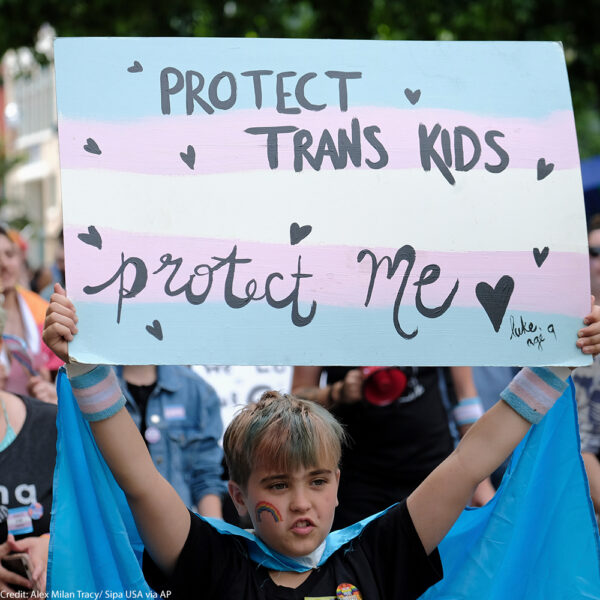
Let Trans Kids Speak for Themselves
June 8, 2023
As legislatures across the country enact anti-LGBTQ bills, one group has taken center stage in our national conversation: trans youth. Of the 491 anti-LGBTQ bills that we are tracking in this legislative session, 118 are bills seeking to restrict or ban gender-affirming care for trans kids. In the midst of all of this we are losing sight of the big picture. Trans kids are simply kids. And they’d like everyone else to let them be that. They don’t want to have to grow up fast, or be thrust into the spotlight. They want to manage their cheer team, build robots in their bedrooms, and go to homecoming with their friends.
So today, we’re passing them the mic, because well, the adults are talking too much and need to sit down and listen.
In this episode
Kendall Ciesemier

This Episode Covers the Following Issues
Related Content
-
Press ReleaseAug 2026

LGBTQ Rights
Appeals Court Rejects Trump Administration’s Latest Effort To Seize Private Medical Records Of Transgender New Yorkers. Explore Press Release.Appeals Court Rejects Trump Administration’s Latest Effort to Seize Private Medical Records of Transgender New Yorkers
NEW YORK - In a victory for transgender young people and their families, a panel of the Second Circuit Court of Appeals has rejected the Department of Justice’s attempt to stay a lower court win that protected the medical records of transgender youth from serial attempts by the Trump administration to seize them. “This is a tremendous relief to New York families who have to navigate the fear of their private medical information being seized by a federal government hostile to their children,” said Chase Strangio, Co-Director of the ACLU’s LGBTQ & HIV Rights Project. These subpoenas are an unwarranted effort to violate the hallowed relationship between a parent and their child’s doctor in a transparent effort to end medical care for transgender young people and target transgender people for discrimination. We will continue to oppose this effort by the administration and we will always stand up for the privacy and autonomy rights of those who are targeted for discrimination by the government.” “Today’s order by the court of appeals preserves the district court’s order prohibiting the government from seeking the identities and sensitive health information of transgender young people and their families who sought care in New York City. The government cannot weaponize the legal system and the use of subpoenas, whether through a grand jury or otherwise, to collect the most private medical information of transgender young people and their families, in violation of the right to privacy guaranteed by our Constitution,” said Omar Gonzalez-Pagan, Senior Counsel and Health Care Strategist at Lambda Legal. “Every family should be able to make healthcare decisions without fear of political interference or exposure. While this fight is far from over, we are grateful for today’s decision and will continue fighting for the rights and privacy of transgender people and their families.” “This is another victory for the fundamental privacy rights of every New Yorker, and an immense relief to transgender youth and their families,” said Bobby Hodgson, deputy legal director at the New York Civil Liberties Union. “The Trump administration’s attempts to weaponize and manipulate the criminal legal system to bully young people, scare their families, and intimidate healthcare providers are unconstitutional—and we’re thankful the Second Circuit left in place the well-reasoned order blocking those tactics. Our laws recognize that everyone deserves basic privacy protections for their sensitive medical information, and we will continue to fight for the rights of transgender New Yorkers and their families.” In May 2026, NYU Langone Hospitals received a subpoena purportedly under the authority of a federal grand jury in Fort Worth, Texas, which demanded that they turn over the identities and sensitive health information of any patient who had received medical treatment for gender dysphoria while they were under 18 years old from NYU Langone, from January 2020 through May 2026. Other healthcare institutions in New York City, including Mount Sinai Health System, have received similar subpoenas, though the nature of these is unclear. The grand jury subpoenas followed a year-long effort by the Department of Justice to obtain this same information from hospitals across the country through administrative subpoenas—efforts that were repeatedly blocked by at least eight federal district courts. One court dismissed the government’s reasoning as a “smokescreen,” while another concluded that DOJ “issued the subpoena first and searched for a justification second.” In June 2026, a lawsuit was filed in the United States District Court for the Southern District of New York by the American Civil Liberties Union, the New York Civil Liberties Union, and Lambda Legal on behalf of three families with transgender youth and two transgender young adults who were minors when they began care. All plaintiffs have filed under pseudonyms to maintain their privacy and anonymity, and the court provisionally certified a class of similarly situated transgender patients who accessed gender-affirming medical care as a minor from any New York City-area medical institution. Soon after, the district court judge granted the families’ requests for a preliminary injunction, blocking DOJ from violating the patients’ constitutional privacy rights by obtaining the identifying and sensitive health information as part of their purported investigation into unspecified health offenses through the subpoena to NYU Langone and any other similar subpoenas to healthcare institutions in New York City, including Mt. Sinai, that provide or have provided gender-affirming medical care to transgender minors. The plaintiffs argue that the Department of Justice’s demands to access this identifying and sensitive health information violate their Fourth and Fifth Amendment rights to privacy and to be free from unreasonable search and seizure. The plaintiffs also sued NYU Langone to prevent its release of information protected by doctor-patient privilege under New York state law. Today’s order from the Second Circuit can be found here. Click here for more on Coe et al v. Blanche -
Oregon Supreme CourtAug 2026

LGBTQ Rights
Prisoners' Rights
Zyst V. Miller. Explore Case.Zyst v. Miller
Following the Oregon Department of Corrections’ unconstitutional treatment of a transgender prisoner, a habeas court ordered her removal from segregated housing, an individualized gender-affirming care assessment, a psychiatric evaluation, and identification of an appropriate cellmate. However, the Oregon Court of Appeals reversed the psychiatric-evaluation and cellmate orders, finding them “too attenuated” to qualify as habeas relief. The ACLU’s State Supreme Court Initiative, alongside the ACLU of Oregon, joined an amicus brief by the law firm Sugerman Dahab arguing that habeas courts have broad discretion to remedy violations and resulting harms. The brief explains that the Court of Appeals’ “close connection” test unduly constricts habeas relief, and which should be construed to encompass not only the need to halt ongoing constitutional violations, but also the need to mitigate various harms that may arise from those violations. -
Press ReleaseAug 2026
LGBTQ Rights
Joint Statement From Legal Organizations In Response To Texas Supreme Court Ruling In Doe V. Abbot And Pflag V. Abbot. Explore Press Release.Joint Statement from Legal Organizations In Response to Texas Supreme Court Ruling in Doe v. Abbot and PFLAG v. Abbot
AUSTIN, Texas — The Texas Supreme Court today issued a ruling in Doe v. Abbott and PFLAG v. Abbott, challenging the Texas Department of Family and Protective Services’ mandate to investigate families with transgender children. Lambda Legal, the American Civil Liberties Union, the ACLU of Texas, and PFLAG issued the following statement: “For more than four years, we successfully blocked DFPS from investigating Texas families based on allegations that they were providing gender affirming medical care to their transgender adolescents. Today, the Texas Supreme Court issued a purely procedural ruling vacating those injunctions—not because DFPS’s rule requiring these investigations is lawful but because the individual plaintiffs who brought these cases no longer need the injunctions. The Court held that their claims are moot either because DFPS has closed their investigations and has testified that they will not reopen them or because the young people involved are no longer minors and thus DFPS no longer has the authority to investigate their parents. “DFPS argued to the Court that, given that gender affirming medical care is no longer lawfully provided to minors in Texas, there is no reason for DFPS to conduct future investigations. We will hold them to that. Any family that is contacted by DFPS related to gender affirming medical care should contact the Lambda Legal Help Desk.” -
IdahoSep 2026

LGBTQ Rights
Jackson-edney V. Labrador. Explore Case.Jackson-Edney v. Labrador
Six transgender residents of Idaho filed a lawsuit in federal court challenging HB 752, a 2026 state law that criminalizes their use of sex-designated public restrooms consistent with their gender identity.