HIV/AIDS

  • 1
  • 2
  • Next Page

It Is Time to Modernize Discriminatory HIV/AIDS Laws

By Ian S. Thompson, ACLU Washington Legislative Office & Steven Waddy, Legislative Assistant, ACLU at 4:55pm

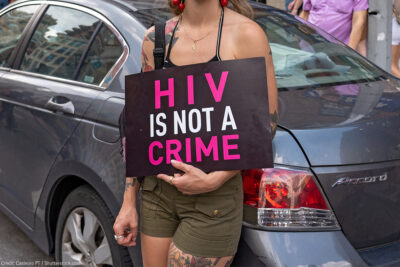
While science has vastly advanced since the early days of the HIV/AIDS epidemic more than 30 years ago, the ways in which many criminal laws treat people living with HIV look like throwbacks to the dark days of the past when fear and misinformation about HIV and how it is transmitted were rampant.

There are presently 32 states that have criminal laws that punish people for exposing another person to HIV, even in the absence of actual HIV transmission or even a meaningful risk that transmission could occur.

Living with HIV in an Alabama Prison

By Albert Knox at 10:14am

In 2011, the ACLU and the ACLU of Alabama sued the Alabama Department of Corrections for discrimination against inmates living with HIV. Alabama is one of only two states, along with South Carolina, that continue to segregate inmates living with HIV in separate housing units and otherwise restrict their access to prison programs.  We are awaiting a decision. You can read more about it here.

There is so Much More to us Than Just Being HIV-Positive

By Dana Harley at 12:54pm

I entered a system that stated in its mission statement that I would be rehabilitated and prepared for society upon my return. That is so far from the truth. I have been subjected to a system that belittled me and literally made fun of me and my illness. There were times when I felt less than human.

I am hopeful that Judge Thompson’s decision will dramatically change the misconceptions about HIV. We are human beings and we deserve to be treated as such. It is true that I am a convicted felon and I have been sentenced to do my time, but being HIV-positive in the Alabama Department of Corrections (ADOC) system has convicted me twice.

VICTORY! Henderson et al. v. Thomas et al.

By Margaret Winter, National Prison Project at 3:01pm

Today a federal judge in Montgomery, Alabama entered a historic decision in the quarter-century-old fight for equality for prisoners living with HIV.   It’s the culmination of a month-long trial in a class-action lawsuit by the ACLU that put Alabama’s discriminatory and dehumanizing treatment of prisoners with HIV under a national spotlight.

Driven by stubborn prejudice and willful ignorance, Alabama has been categorically excluding prisoners with HIV from a host of rehabilitative, educational, trade skills and vocational programs—even barring those with serious mental health needs and substance abuse problems from critically important treatment programs.  Alabama houses them in HIV-only dormitories, and forces all male prisoners with HIV to wear a white wrist-band night and day—a latter-day yellow star.

"Y'all Will Not Walk My Halls and Spread HIV."

By Steve Gosset, ACLU at 10:09am

For 25 years, the ACLU has been a forceful advocate to end discrimination against prisoners living with HIV. We've worked to end their segregation from the rest of the prison population and ensure they are afforded access to vital services and programs.

A Policy of Shame: the Fight to End HIV Segregation in Prison Continues

By Margaret Winter, National Prison Project at 10:01am

Alabama segregates all prisoners with HIV, and houses them separately from all other prisoners – it’s an HIV ghetto.  As soon as you walk into Limestone Correctional Facility, the prison where Alabama houses all male prisoners with HIV, you know who has the virus:  they are forced to wear a white armband day and night.  

PBS' "Perpetuating Stigma" Highlights HIV Criminalization

By Allison Neal, ACLU of Alabama & Carl Takei, ACLU National Prison Project & Rose Saxe, AIDS Project at 3:17pm

Earlier this week, PBS aired the documentary Perpetuating Stigma about the ongoing criminalization of women with HIV. Through the stories of several women impacted by HIV criminalization — the use of criminal law to target people diagnosed with HIV for prosecutions and imprisonment — the documentary movingly illustrates how such laws dehumanize and stigmatize women living with HIV. But because of the opposition of the Alabama Department of Corrections, the producers of “Perpetuating Stigma” never got to tell the story of Dana Harley.

Blood Donation Ban for Gay and Bisexual Men Under Review by HHS

By Ian S. Thompson, ACLU Washington Legislative Office at 6:54am

Late last week, the U.S. Department of Health and Human Services (HHS) provided an important status update about ongoing research studies examining the lifetime ban on blood donations from men who have ever had sex with other men since 1977.

Gay and bisexual men, intravenous drug users, people who have had sex for money and people who have tested positive for HIV disease are currently the only groups of people banned from donating blood. Gay and bisexual men are excluded regardless of their individual sexual histories or HIV risk. Despite the lifetime ban on blood donations from gay and bisexual men, other individuals who are also at increased risk for HIV disease, including people who have heterosexual sex with someone who they know to be living with HIV or people who have had sex with a commercial sex worker, are prevented from donating blood for only one year.

A Step Forward in the Fight Against AIDS

By Anne Morrison, Women's Rights Project at 3:39pm

Yesterday, organizations combating HIV/AIDS received support to continue and strengthen their work with one of the populations most vulnerable to infection. The 2nd Circuit Court of Appeals struck down the "anti-prostitution pledge," a part of the U.S. Leadership Against HIV/AIDS, Tuberculosis, and Malaria Act. The law required nongovernmental organizations receiving U.S. funding for HIV/AIDS work to declare — or pledge — that they opposed prostitution. Most alarmingly, the pledge extended to all parts of an organization's work, even parts that didn't use U.S. money.

AIDS Conference 2012 – ACLU Continues Fighting to “Turn the Tide Together”

By Patrick DePoy, ACLU Washington Legislative Office at 10:16am

This week, Washington will host the 2012 International AIDS Conference.  This is the first time since 1990 that the U.S. will host the major international gathering on the AIDS epidemic.  The reason for this is that in 1987, Congress passed legislation prohibiting people living with HIV from traveling into the United States.  Under the ban, those living with HIV were listed as having a “communicable disease of public health significance.”  Rooted in the fear and prejudice that was an ever-present reality in those days, the ban imposed an unfair burden on tourists, short-term visitors, and foreigners seeking to live in the U.S.   In 2009, President Obama finally lifted the travel ban, following a 2008 statutory repeal vote in Congress, correctly pointing out that if the U.S. wants to be a world leader in the fight against HIV/AIDS, “we need to act like it.”  

  • 1
  • 2
  • Next Page
Statistics image