The 1970s
Share
1970
ACLU Pamphlet "We Don't Enter Popularity Contests" on the Details and Range of our Civil Rights Work
This pamphlet written by Daniel St. Albin Greene, a journalist at The National Observer, documents the ACLU’s history and its work in the 1970s to protect civil rights and civil liberties, including taking cases that might be politically unpopular.
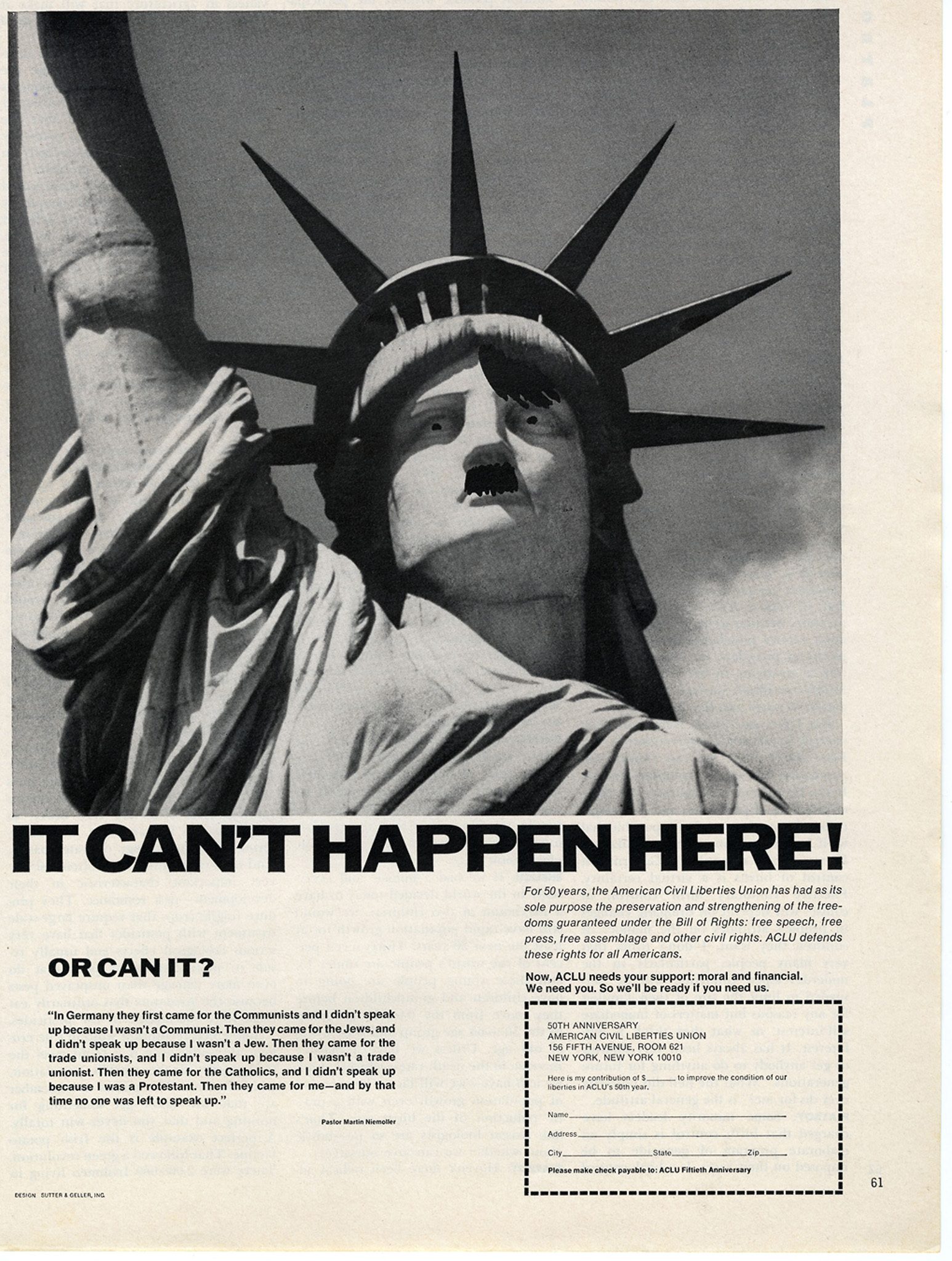
ACLU Advertisement Featuring "First They Came" Poem in Playboy Magazine
This 1970 advertisement for the ACLU appeared in Playboy Magazine to promote the organization by showing it represents everyone. It features the famous "First They Came" poem written by Pastor Martin Niemöller in the aftermath of World War II.
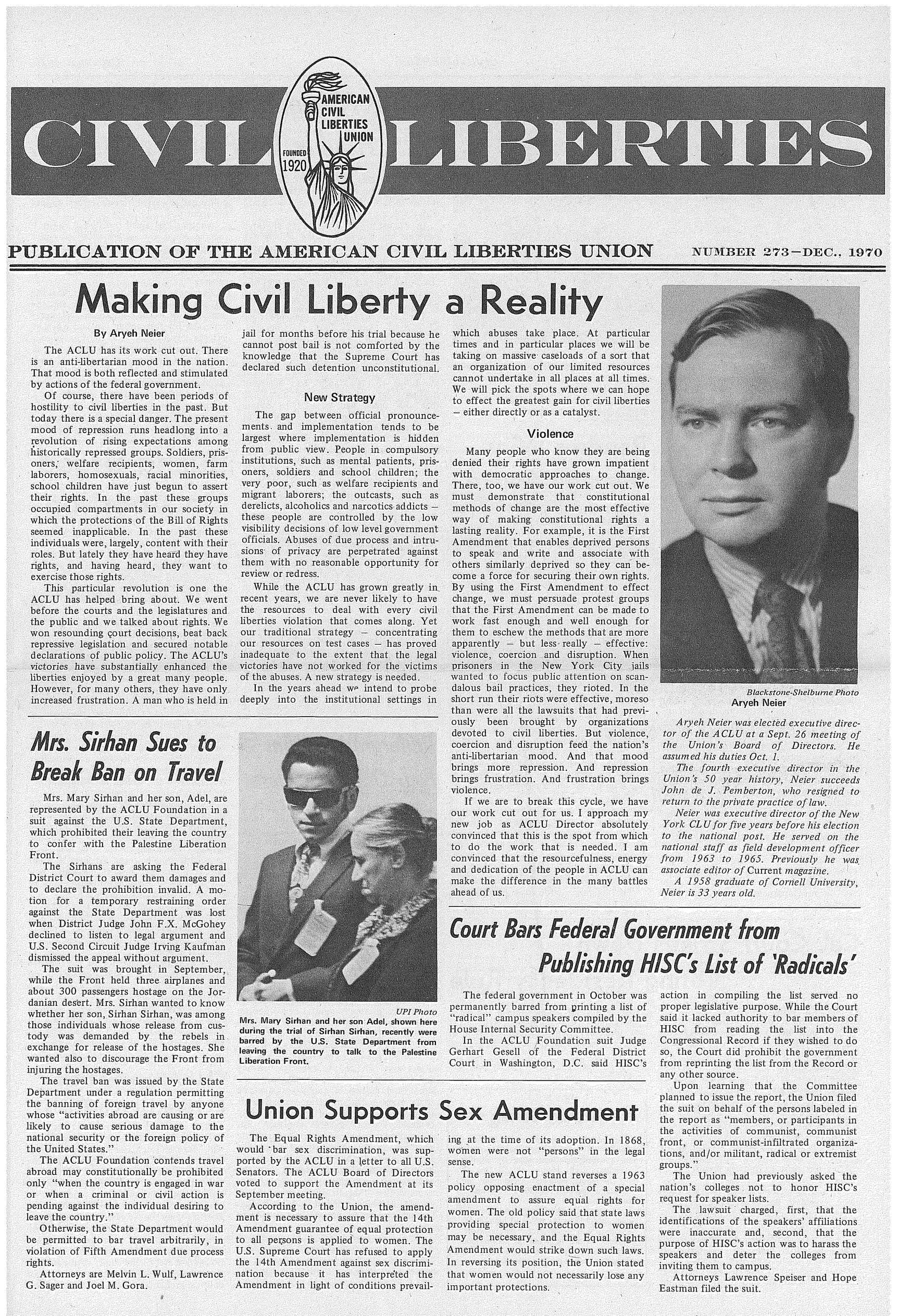
ACLU Civil Liberties Newsletter "Making Civil Liberty a Reality"
In this December 1970 issue of the ACLU's newsletter, Aryeh Neier, who had been recently elected as our executive director and would serve in that role until 1978, introduces himself to ACLU members and outlines his priorities and agenda.
1971
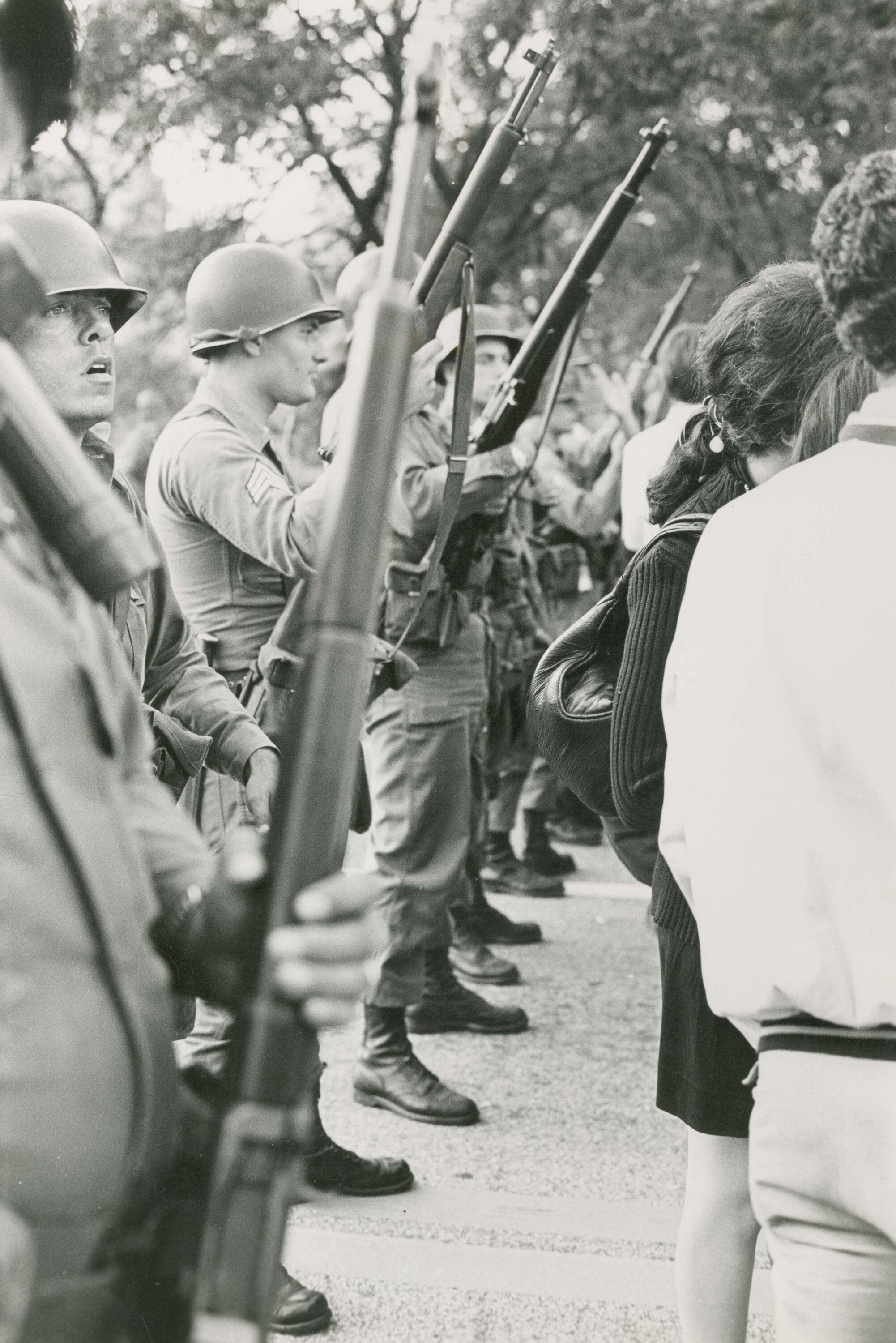
National Guardsman Sent to Quell Protest Standing Before Civilians
This photograph from the 1970s shows a line of National Guard members standing armed behind American civilians. Over fifty years later, the ACLU and our affiliates again challenged unlawful federal deployments of National Guard troops and federal agents to intimidate civilians.
Audio Clip of ACLU Attorney Allen R. Derr Successfully Arguing Women's Rights Case in front of the Supreme Court
In this audio clip, ACLU attorney Allen R. Derr successfully argues the women's rights case, Reed v. Reed, in front of the Supreme Court. The case struck down a state law that gave automatic preference to men over women as administrators of decedents' estates. This was the Supreme Court's first ruling that sex-based classifications violated the Equal Protection Clause of the Fourteenth Amendment.
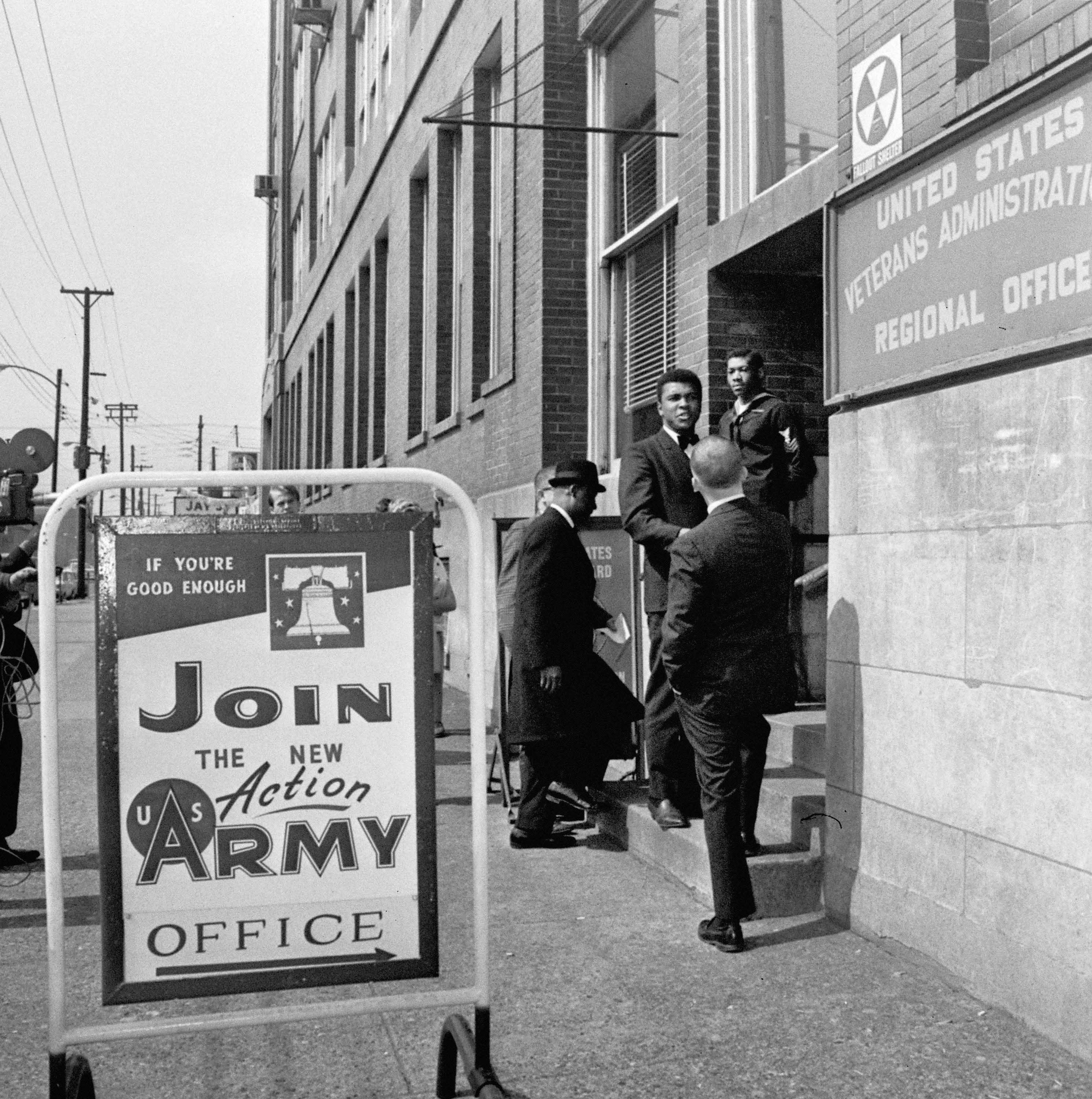
Boxing Champion and ACLU Client Muhammad Ali at a Veterans Administration Office to Oppose Draft
In this March 17, 1966 photo, Muhammad Ali arrives at a Veterans Administration office in Louisville, Kentucky to appeal his Vietnam War draft call-up. Ali was drafted after becoming a heavyweight boxing champion and announcing to the world that he was Muslim. He applied for classification as a conscientious objector on religious grounds, but the draft board denied his exemption, and he was found guilty of avoiding the draft. Along with partners, ACLU attorneys represented Ali in 1971 in Clay v. United States all the way to the Supreme Court, where his conviction was reversed.
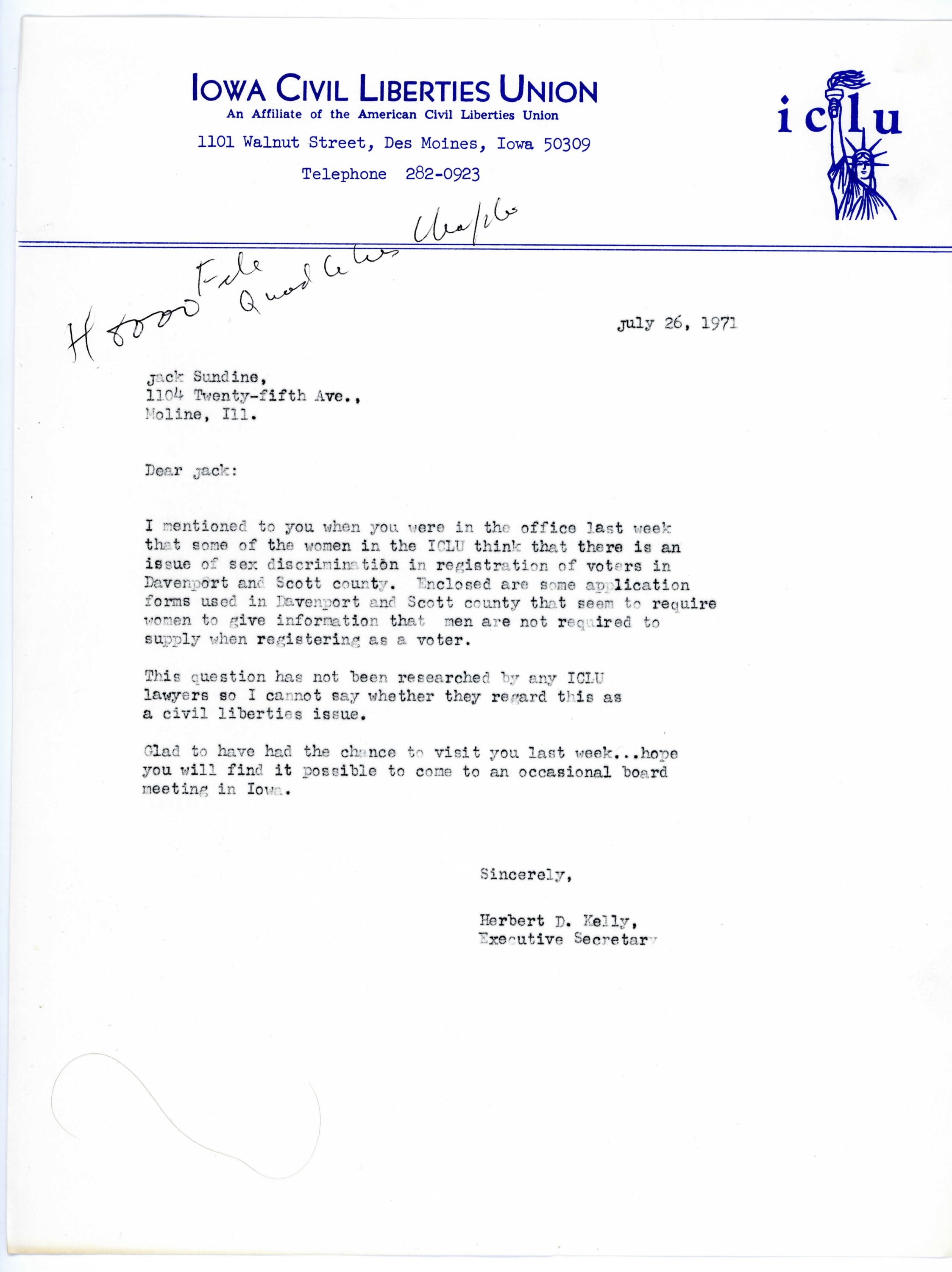
ACLU of Iowa Memo on Discrimination Against Women Voters
In 1971, women in Davenport, Iowa, were required to list a parent or husband to in order to register to vote. In this memo, ACLU of Iowa Executive Secretary Herbert Kelly first brings this to the attention of Board President Jack Sundine. Eventually, ACLU lawyers worked with election officials to get the discriminatory practice ended.
1972
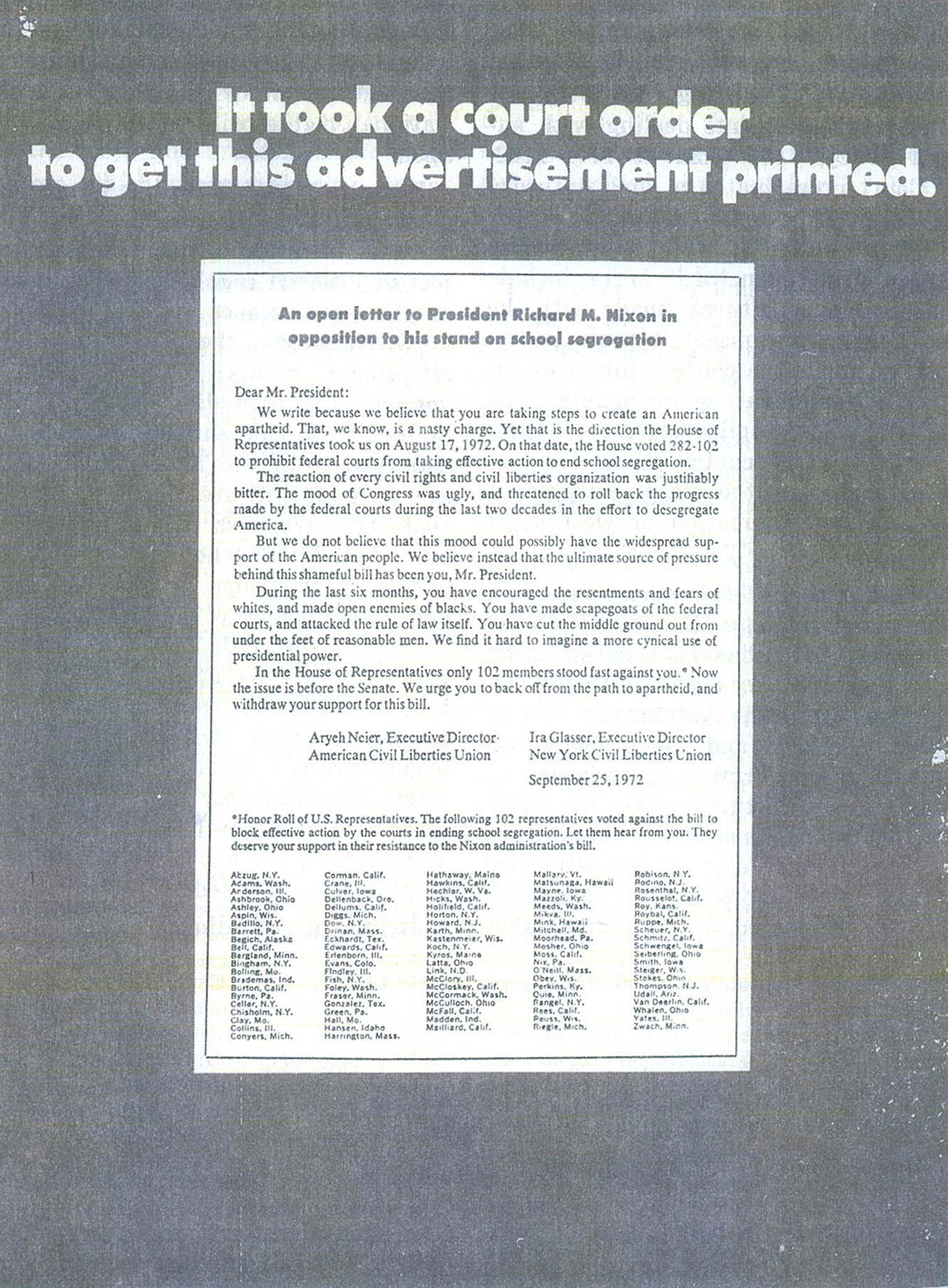
ACLU's Open Letter Advertisement to President Richard Nixon in The New Republic Opposing his Stance on School Segregation
In 1972, the Nixon administration silenced critics and threatened the New York Times with criminal prosecution if it ran an ACLU full-page advertisement criticizing the president’s stance on desegregating schools. The ACLU sued and won. This is a reproduction of that ad from a later publication.
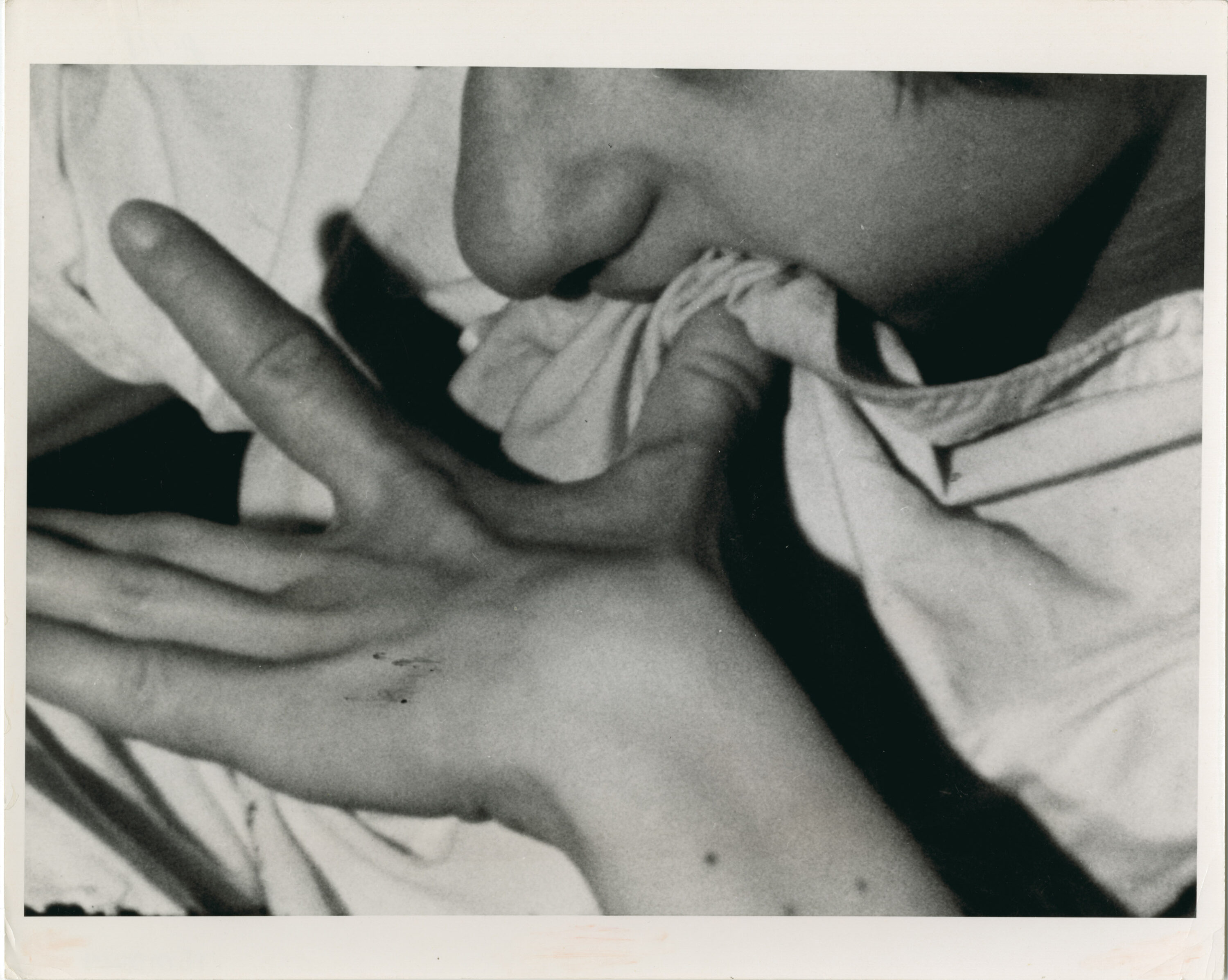
Patient at Willowbrook State School
In 1972, the New York Civil Liberties Union and the Legal Aid Society led a historic civil rights lawsuit challenging the inhumane conditions for children and adults with disabilities held at Willowbrook State School in Staten Island. This photograph shows one of the individuals institutionalized at Willowbrook.
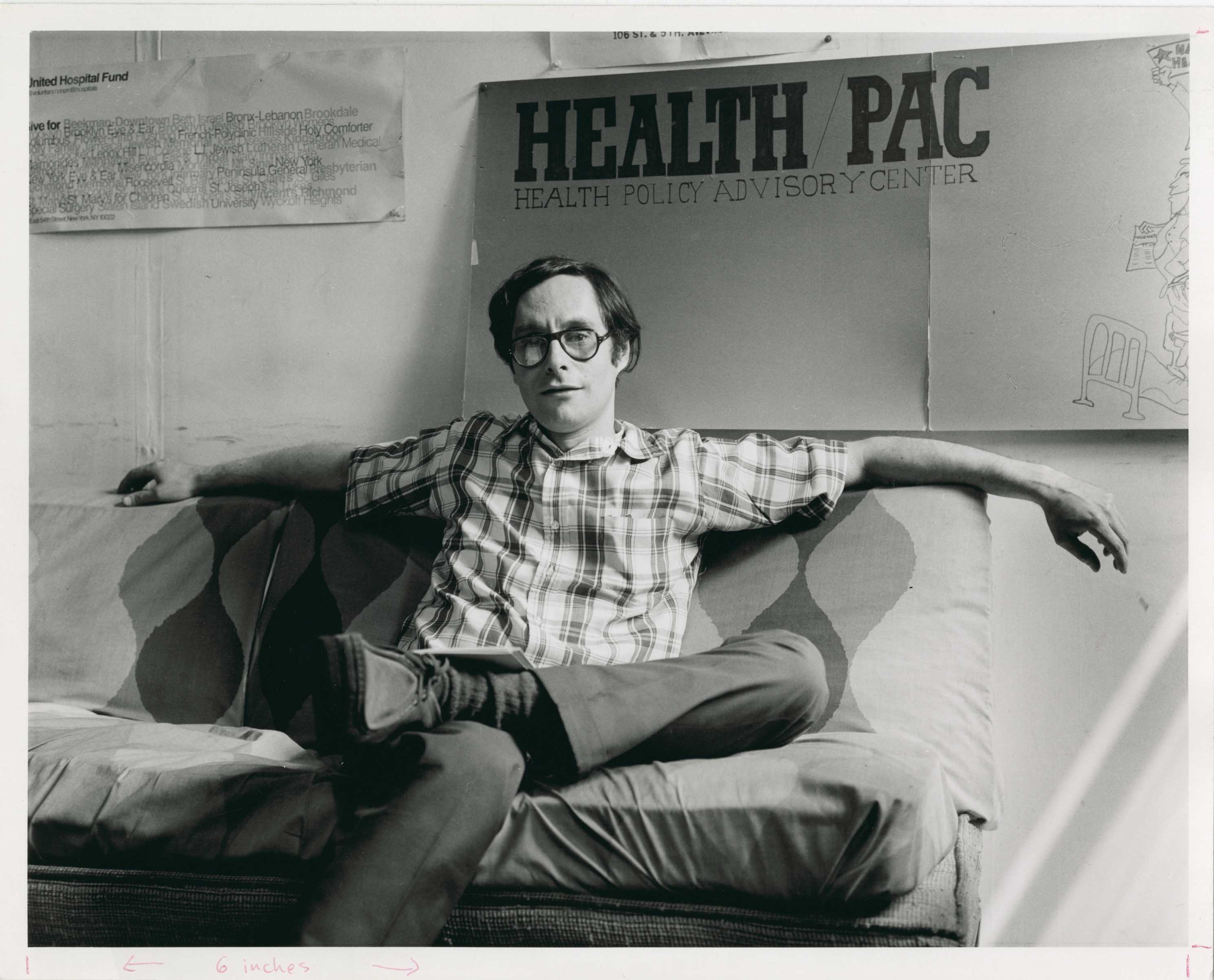
Photograph of ACLU Client Dr. Howard Levy
Dr. Howard Levy, a doctor stationed at Fort Jackson, South Carolina, was court-martialed for refusing to train Green Beret medics during the Vietnam War. ACLU attorney Charles Morgan represented him in Levy v. Parker and Levy v. Resor. Although the ACLU did not succeed, the case did advance the question of freedom of speech for soldiers in uniform.
1973
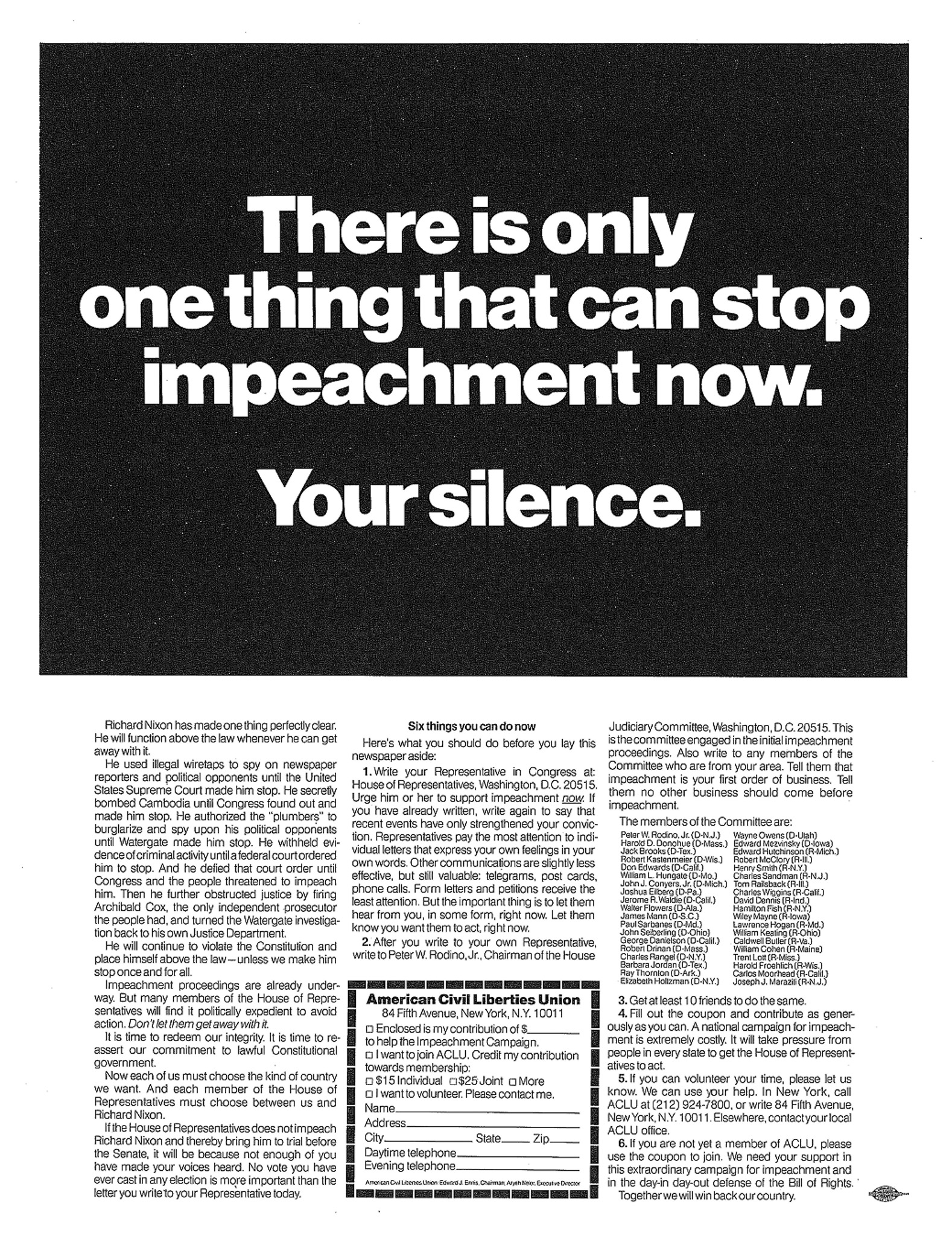
ACLU's Full-Page Advertisement Calling for President Richard Nixon's Impeachment
In 1973, the ACLU Board of Directors called for the impeachment of President Richard Nixon. This full-page advertisement was part of a series of advertisements the ACLU took out to share why we were calling for his impeachment and to ask the American public to join us. Nixon resigned in 1974 to avoid impeachment.
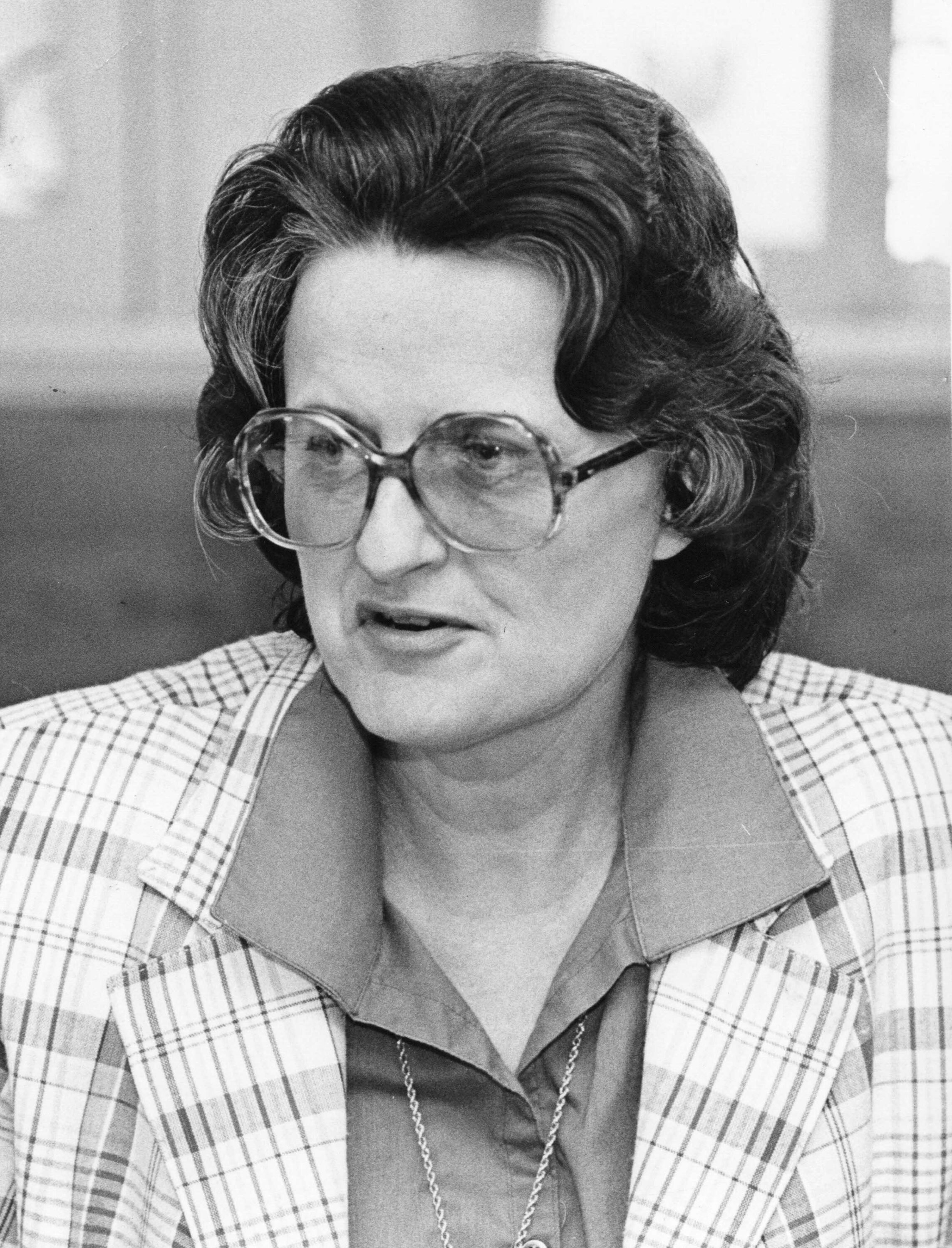
Photograph of Civil Rights Lawyer Margie Pitts Hames
In 1970, the ACLU and Atlanta Legal Aid Society hired Atlanta civil rights lawyer Margie Pitts Hames to contest a 1968 abortion law in Georgia. In the resulting 1973 Supreme Court case, Doe v. Bolton, a companion case to Roe v. Wade, the Court held that physicians should be entrusted to judge whether an abortion is “necessary” based on all factors relevant to a woman’s well-being.
1974
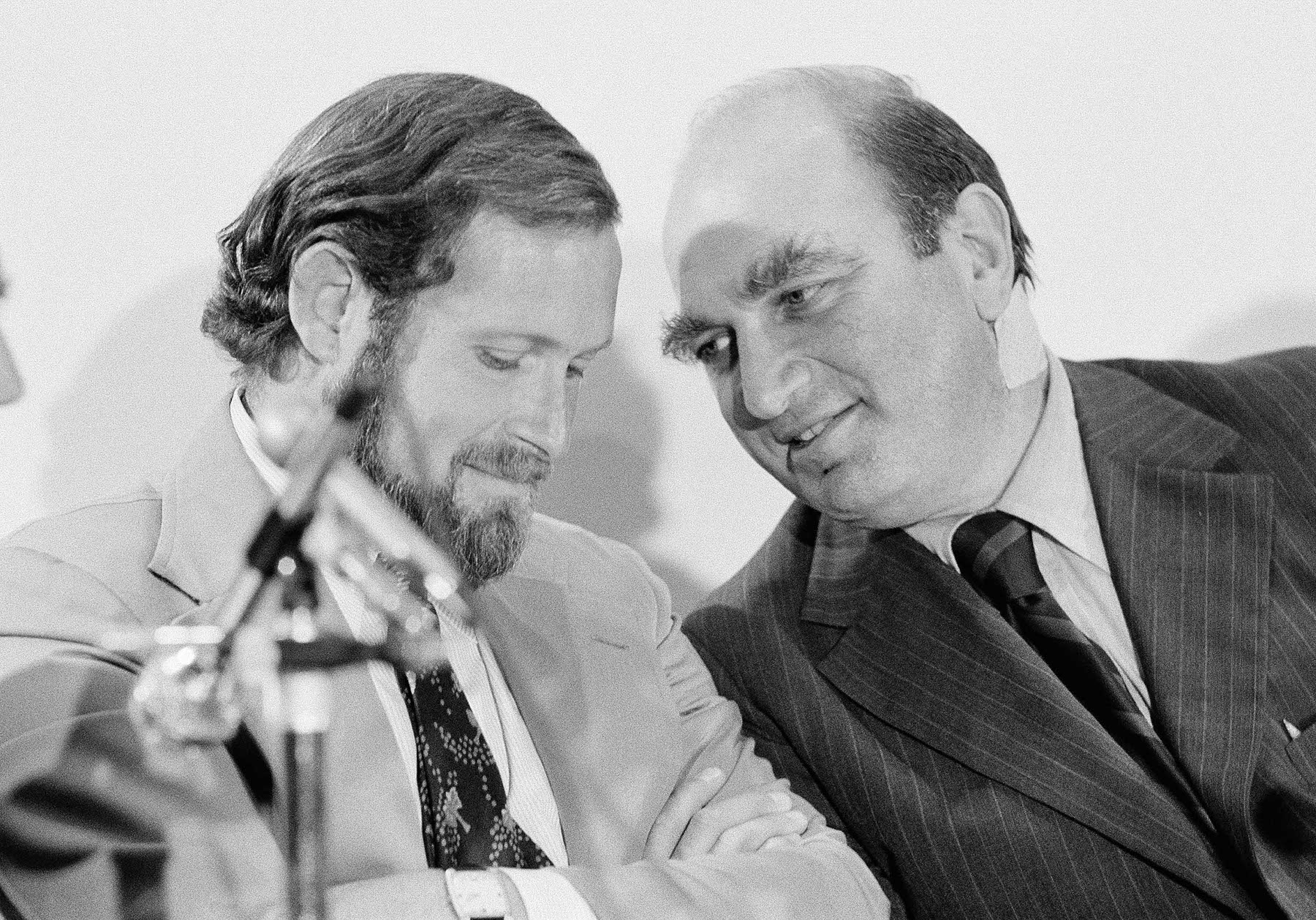
Norman Dorsen, Attorney Who Spearheaded ACLU's Amicus Brief in United States v. Nixon, During a Press Conference
In the 1974 case, United States v. Nixon, Norman Dorsen and Melvin L. Wulf filed a prominent amicus curiae brief on behalf of the ACLU, arguing that President Nixon could not claim an absolute executive privilege to withhold subpoenaed materials. In this critical case, the ACLU argued: "There is no proposition more dangerous to the health of a constitutional democracy than the notion that an elected head of state is above the law and beyond the reach of judicial review." The Court agreed and ordered Nixon to hand over crucial Watergate tapes to the special prosecutor.
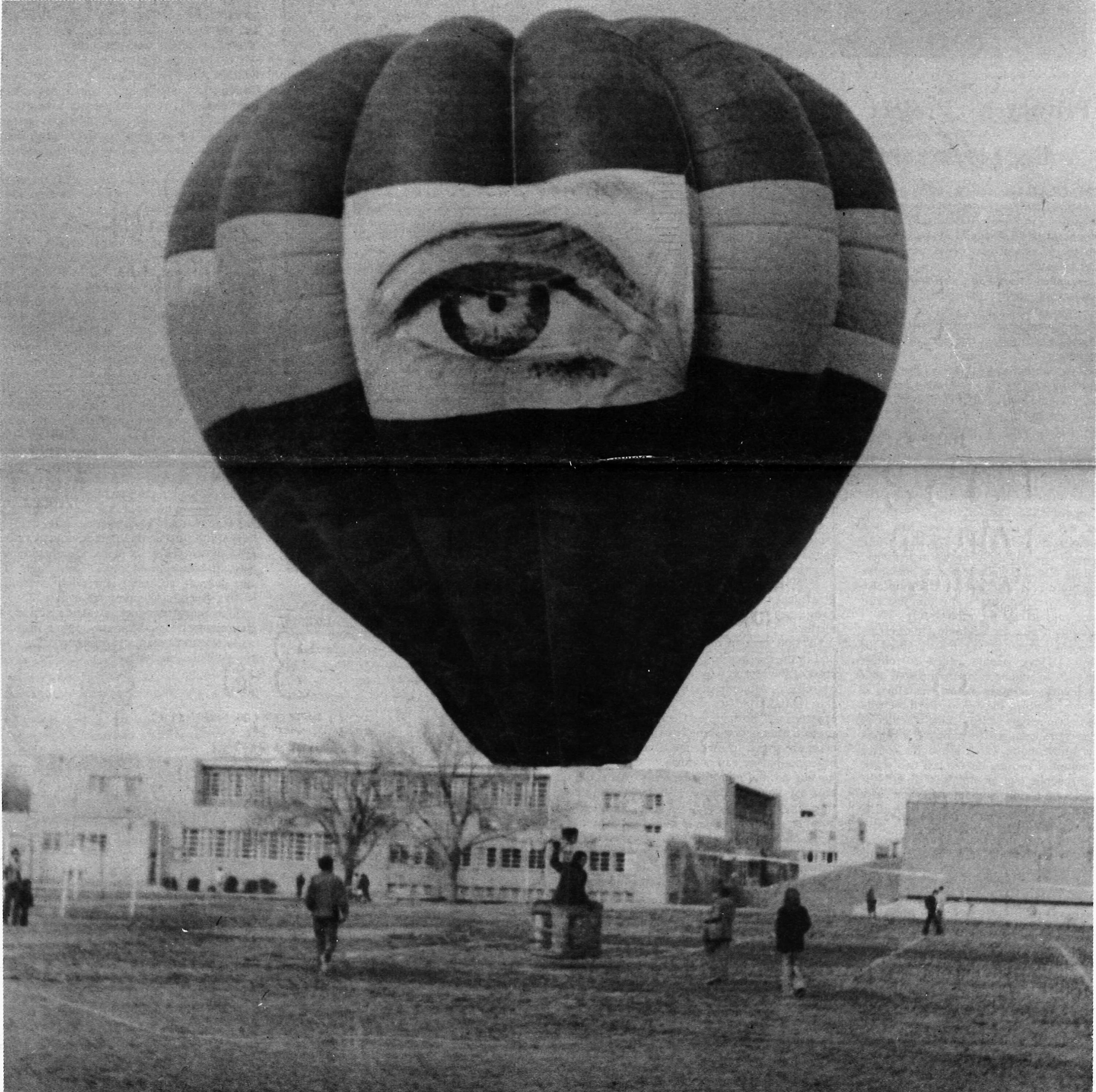
ACLU of New Mexico's Government Surveillance Hot Air Balloon
In the 1970s, as it came to light that local police and federal law enforcement were regularly engaging in domestic spying against so-called “radical” community groups, the ACLU of New Mexico launched a campaign to raise awareness about government surveillance and citizens’ privacy rights. This hot air balloon featuring an image of a giant eye was launched over the University of New Mexico.
1975

ACLU's 1975 Annual Report
In 1975, ACLU Executive Director Aryeh Neier wrote in the annual report: "For the last several years, the ACLU has made control of information a major emphasis. Information, we have contended, is power. If citizens are informed about their government, they have power over it.”
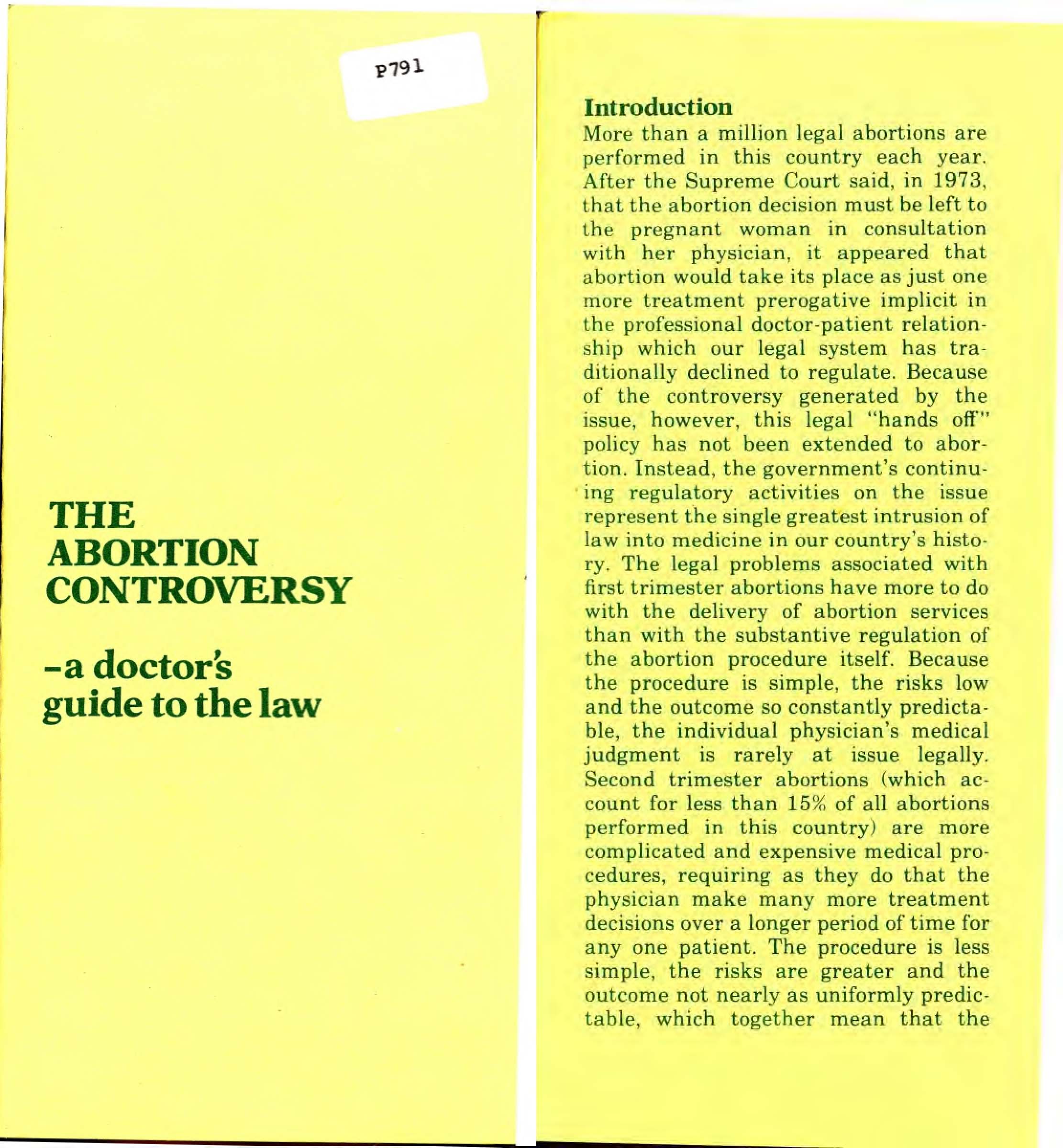
ACLU Educating Doctors on What Roe v. Wade Meant In Practice
This 1975 pamphlet prepared by Judith Mears, the director of the ACLU’s Reproductive Freedom Project, provided general legal guidance for doctors after the Supreme Court released its landmark decision in Roe v. Wade in 1973, recognizing the constitutional right to abortion.
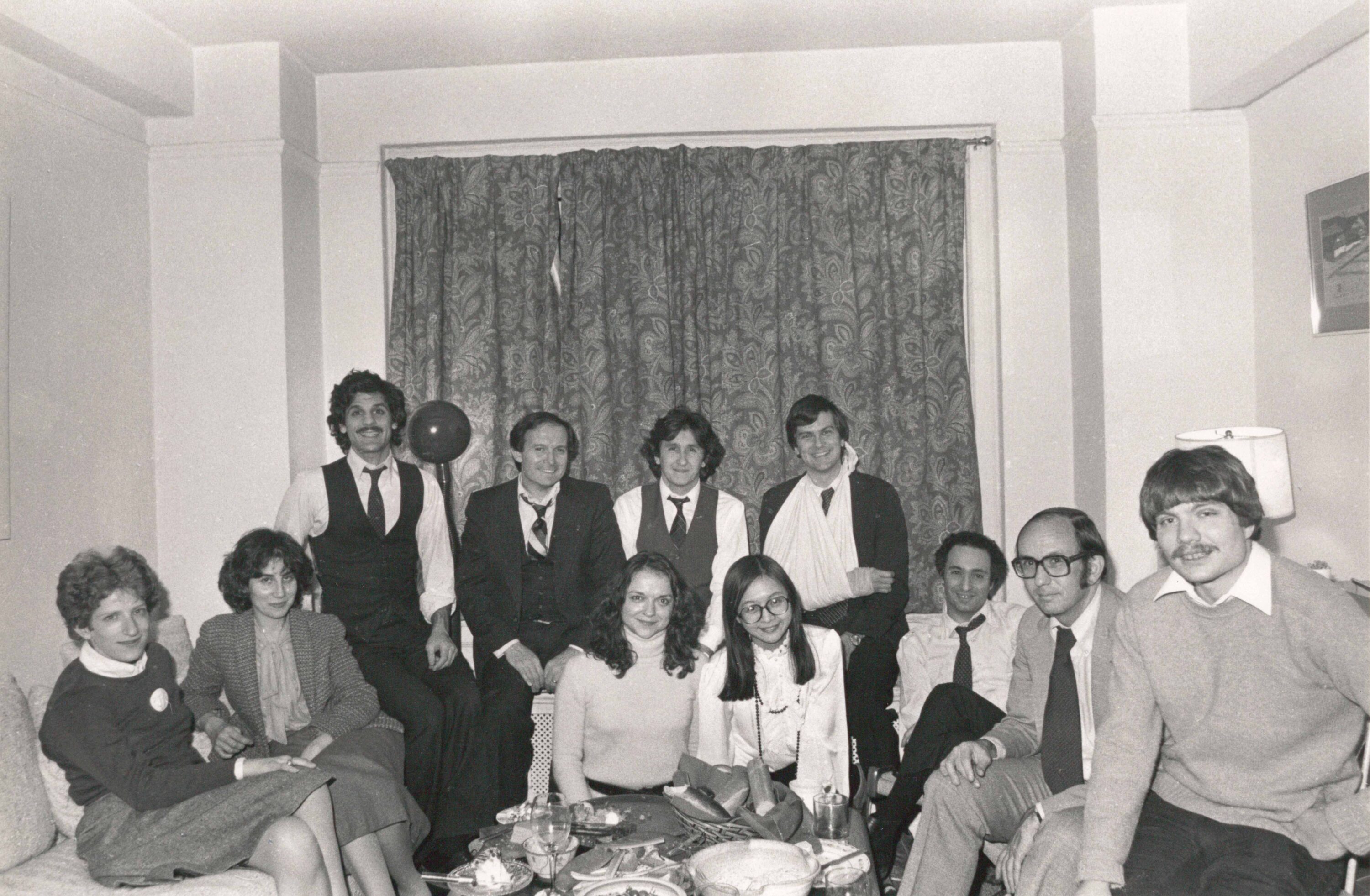
Photograph of the Willowbrook Trial Team Who Would Defend the Rights and Dignity of Individuals With Developmental Disabilities
In 1972, the New York Civil Liberties Union and the Legal Aid Society led a historic civil rights lawsuit challenging inhumane conditions for children and adults with disabilities held at Willowbrook State School in Staten Island. This photograph shows the successful trial team that established that people with developmental and intellectual disabilities have the right to be safe from harm. This photograph shows the trial team, including from left to right: Elizabeth Koltun, Helen Hershkoff (then at Paul, Weiss, later ACLU Assistant Legal Director), Robert Levy (NYCLU), Murray Schneps, Henry Weintraub (Legal Aid), Chris Hansen, Jonathan Sigfried, Michael Lottman, Timothy Cook, front row: Marnie Loomis (NYCLU), Diana Tanaka (NYCLU).
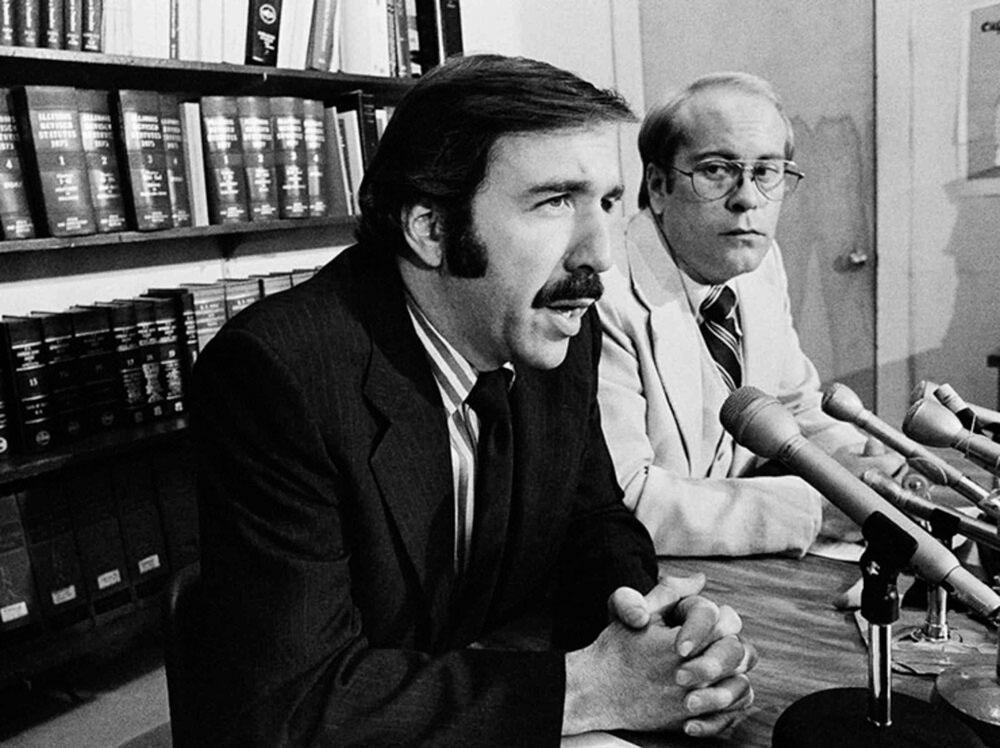
ACLU Legal Director David Goldberger with ACLU Executive Director David M. Hamlin Discussing Significance of Skokie Case
In the 1977 case, National Socialist Party of America v. Village of Skokie, the ACLU controversially and successfully defended the right of a neo-Nazi group to march in Skokie, a Chicago suburb with a large Jewish population and thousands of Holocaust survivors, establishing that freedom of speech and assembly protects all Americans and all viewpoints. In this image, ACLU Legal Director David Goldberger, left, appears at a Chicago press conference with ACLU Executive Director David M. Hamlin.
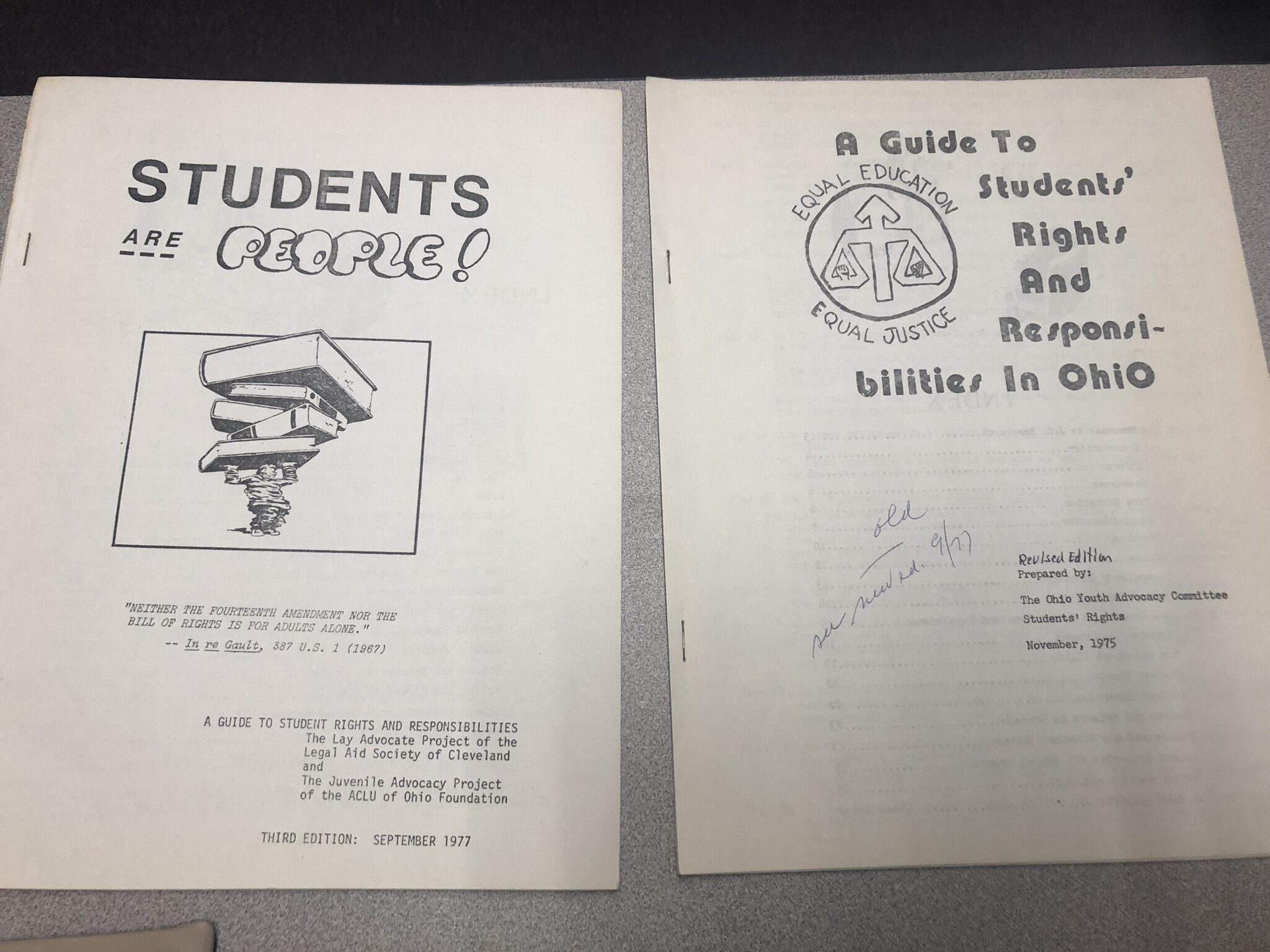
ACLU of Ohio's Students' Rights Guides of the 1970s
This image shows the 1975 and 1977 editions of ACLU of Ohio's annually released Students' Rights Guide.
1976
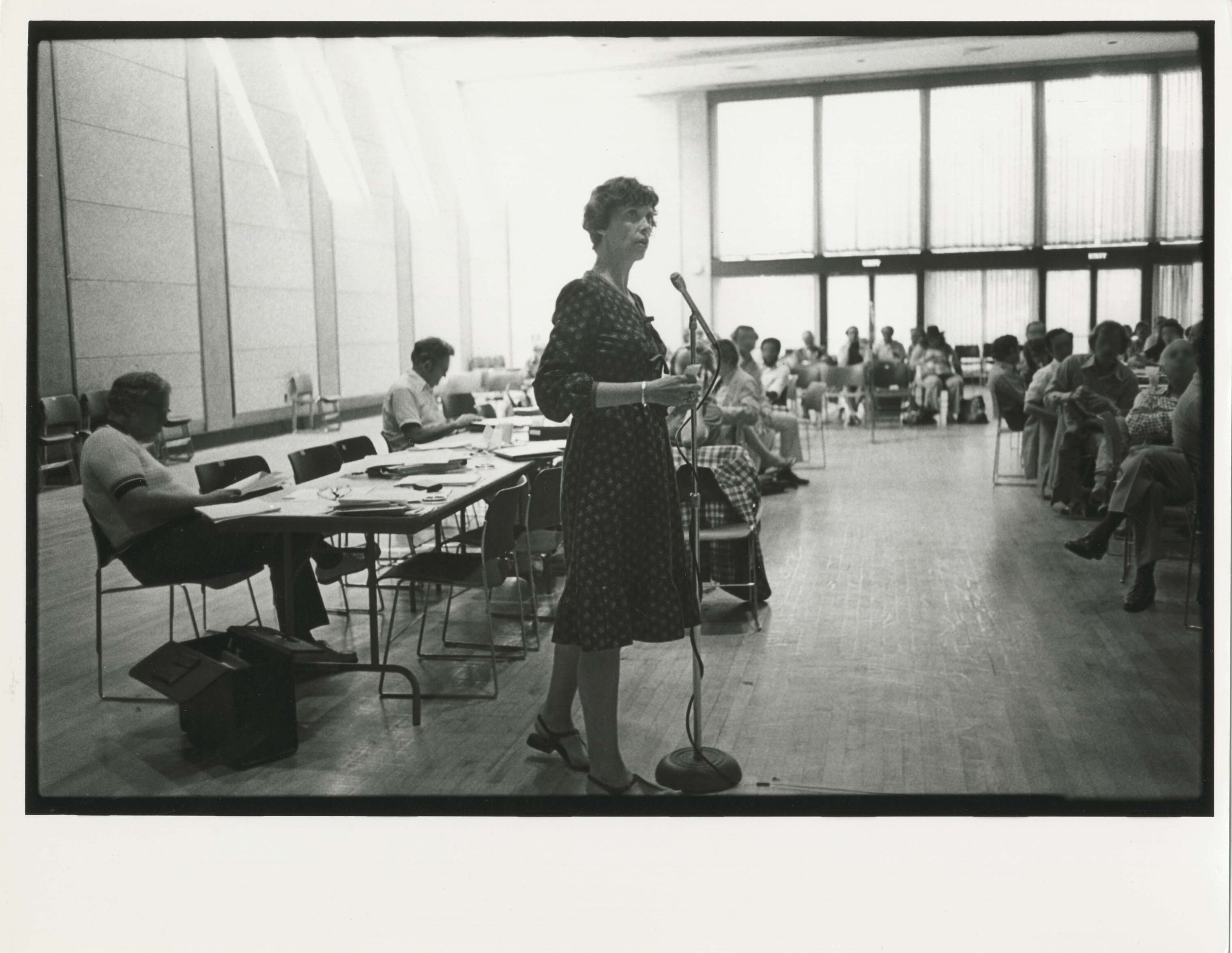
Pat Derian, Assistant Secretary of State for Human Rights and Humanitarian Affairs, Speaking to 1976 Biennial Conference
Patricia Derian, a member of the ACLU Board and National Executive Committee, was appointed by President Jimmy Carter to be Assistant Secretary of State for Human Rights and Humanitarian Affairs. In this photograph, she speaks at the ACLU’s 1976 Biennial Conference.
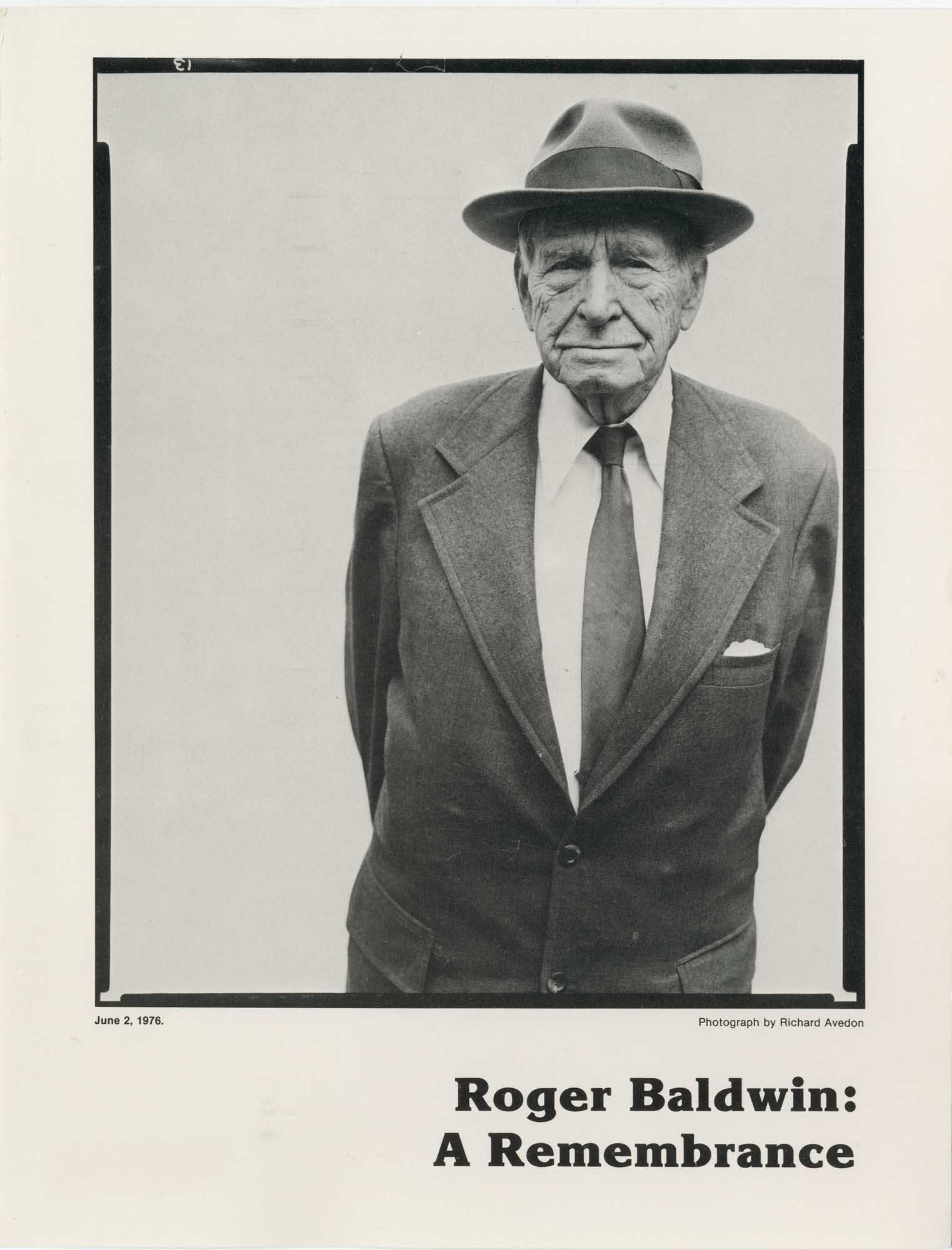
Photograph of ACLU Founder Roger Baldwin
ACLU founder Roger Baldwin photographed in 1976.
1977
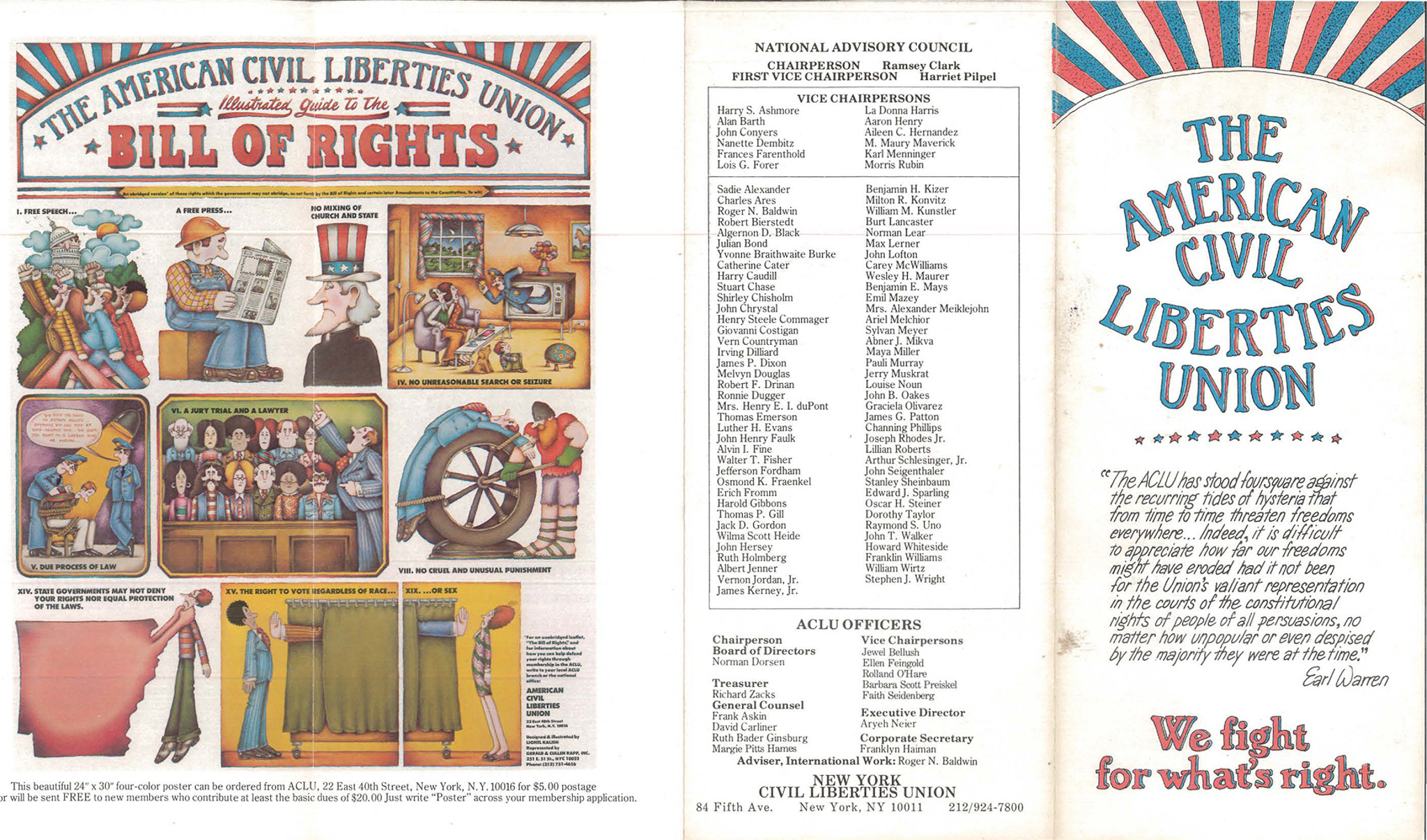
ACLU Educating Audiences on Bill of Rights
This 1977 ACLU brochure advertises a beautifully illustrated guide to the Bill of Rights.
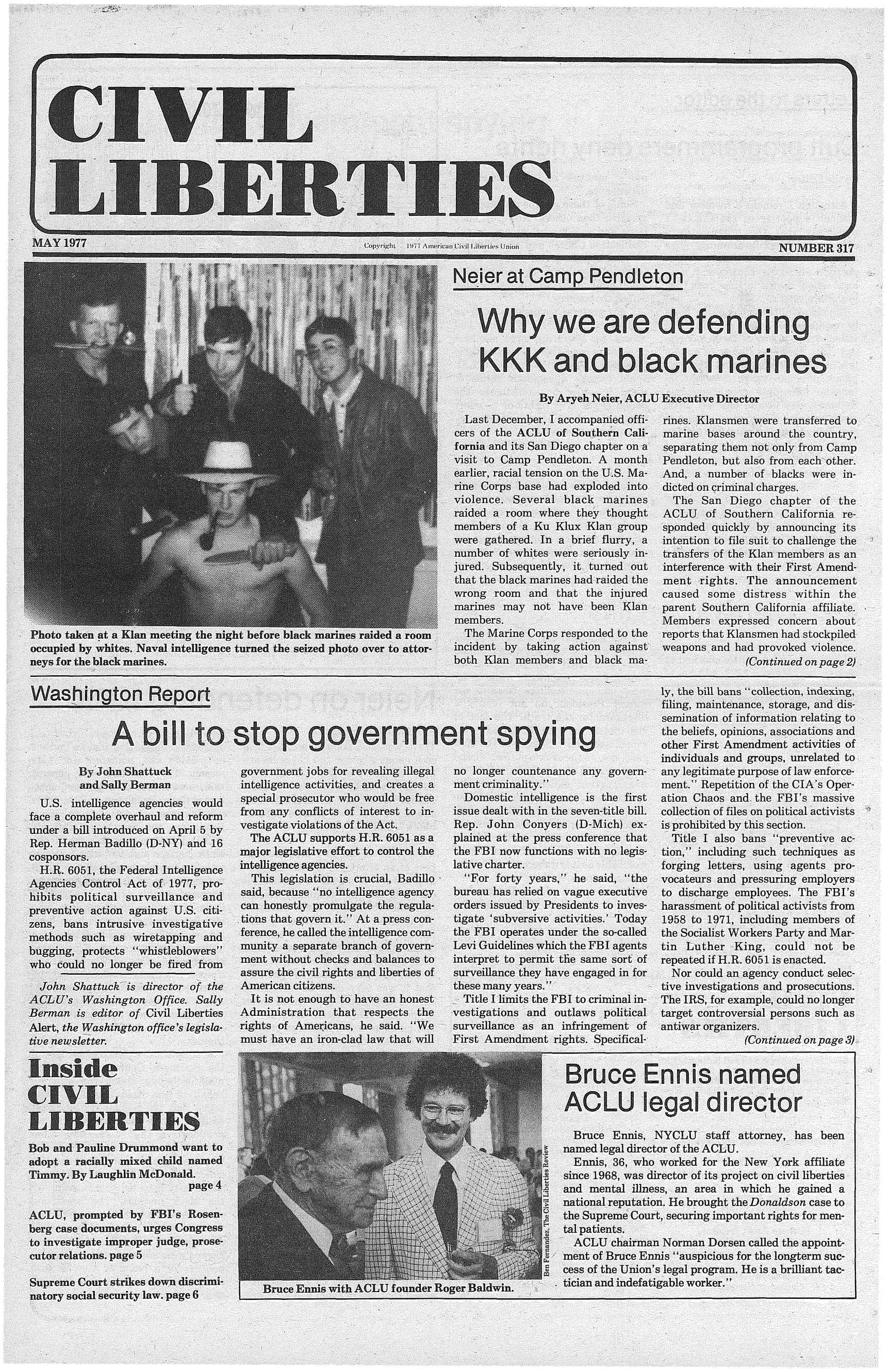
ACLU Civil Liberties Newsletter "Why We're Defending KKK and Black Marines"
This newsletter from 1977 documents one controversial case in which the ACLU of Southern California and its San Diego chapter stepped in to defend the civil rights of both Black Marines and Ku Klux Klan members involved in a conflict at Camp Pendleton.
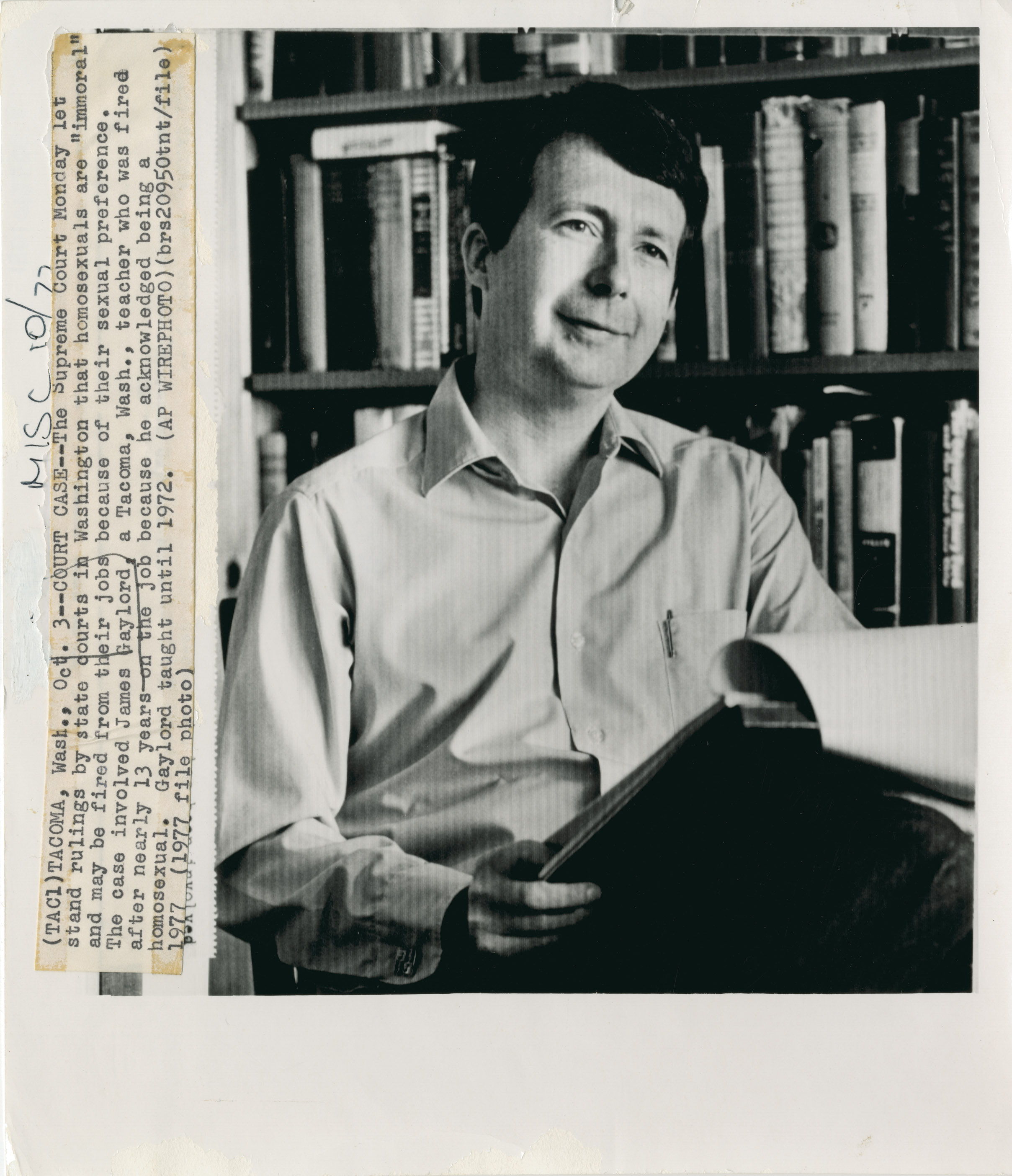
ACLU Client James Gaylord, a Teacher Fired for Acknowledging He Was Gay
James Gaylord, a teacher in Tacoma, Washington, was fired from his job after acknowledging he was gay. In 1973, the ACLU appealed his firing all the way to the Washington State Supreme Court, which unfortunately upheld his firing. Gaylord finally received an apology from the local school board 42 years later in 2014.
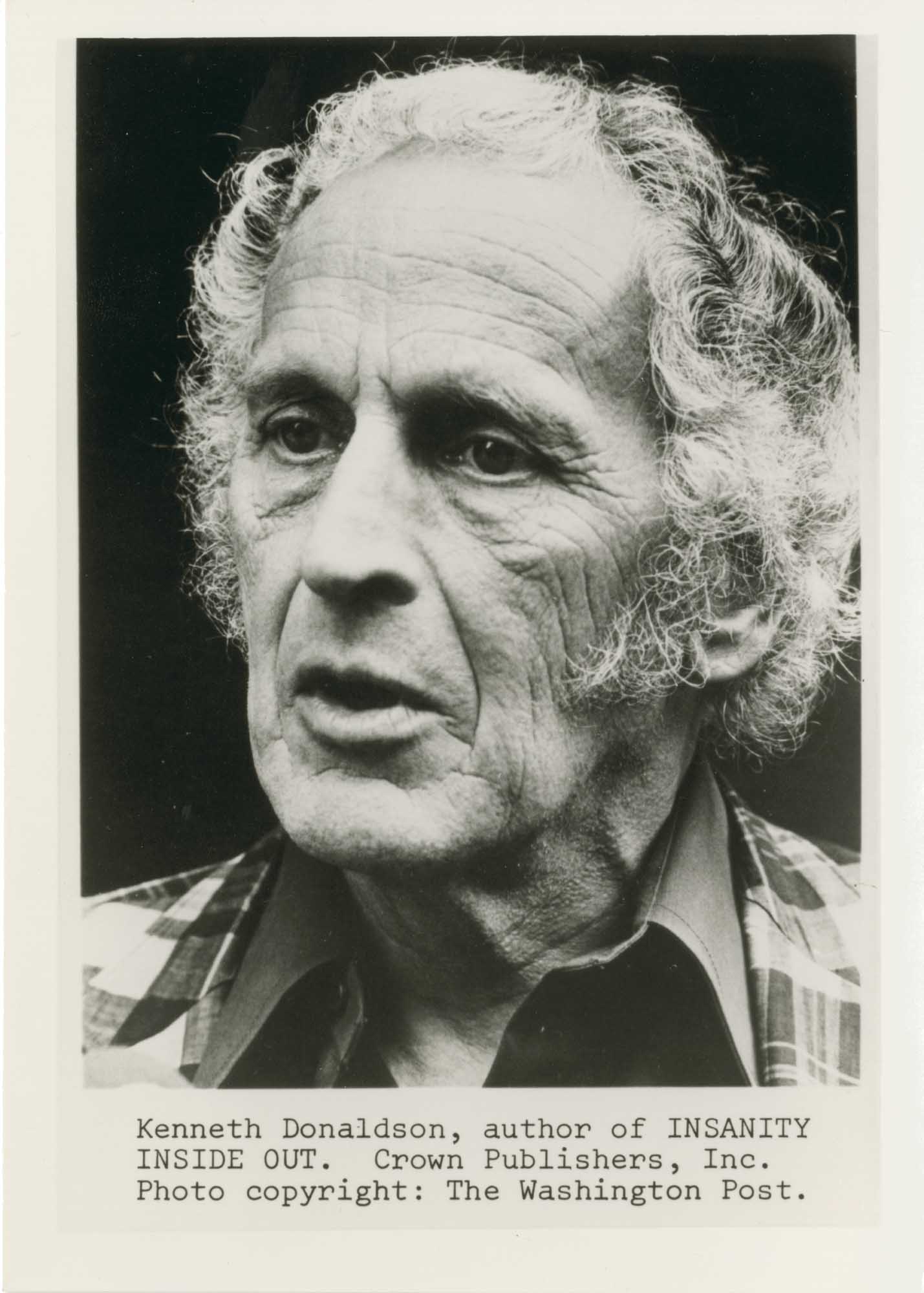
Kenneth Donaldson, Defendant in ACLU Case, O'Connor v. Donaldson, a Successful Involuntarily Commitment Case, and Author of "Insanity Inside Out"
Kenneth Donaldson had been involuntarily confined in a Florida state hospital for 15 years, despite receiving no medical treatment and posing no danger to himself or others. After years of pleading for his release, Donaldson’s requests were ignored. With the help of then ACLU Legal Director Bruce Ennis, Donaldson took his case to the Supreme Court in O'Connor v. Donaldson. In a landmark 1975 decision, the Court unanimously ruled that people diagnosed with mental illness who pose no threat to themselves or others cannot be locked away without treatment, affirming a powerful principle: dignity must entail freedom and self-determination.
1978
ACLU on What Roe v. Wade Meant for Reproductive Rights
After the Supreme Court released its landmark decision in Roe v. Wade in 1973, recognizing the constitutional right to abortion, the ACLU published this pamphlet to provide general guidance about the legal right to abortion and the restrictions that still existed.
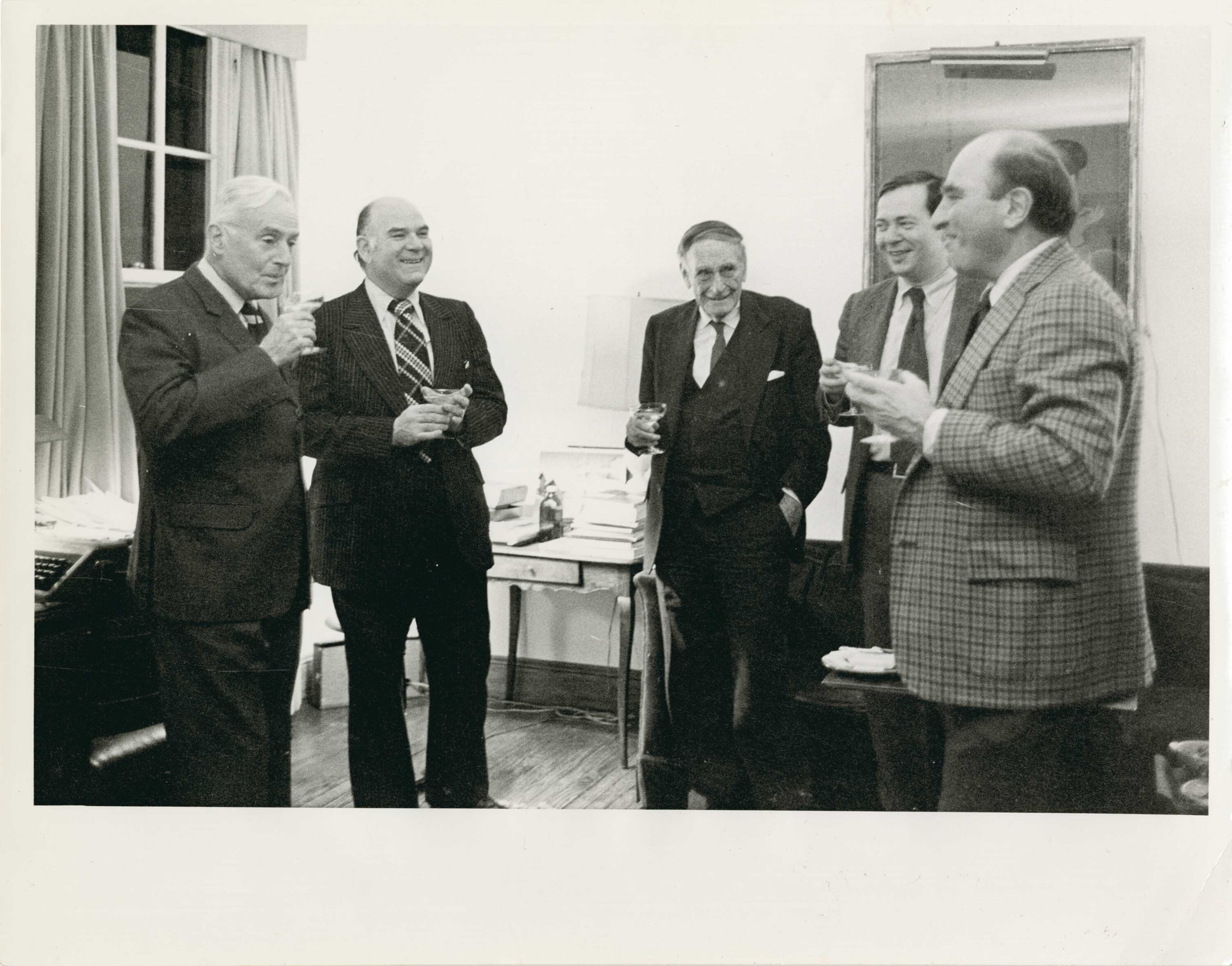
ACLU Founder Roger Baldwin's 94th Birthday
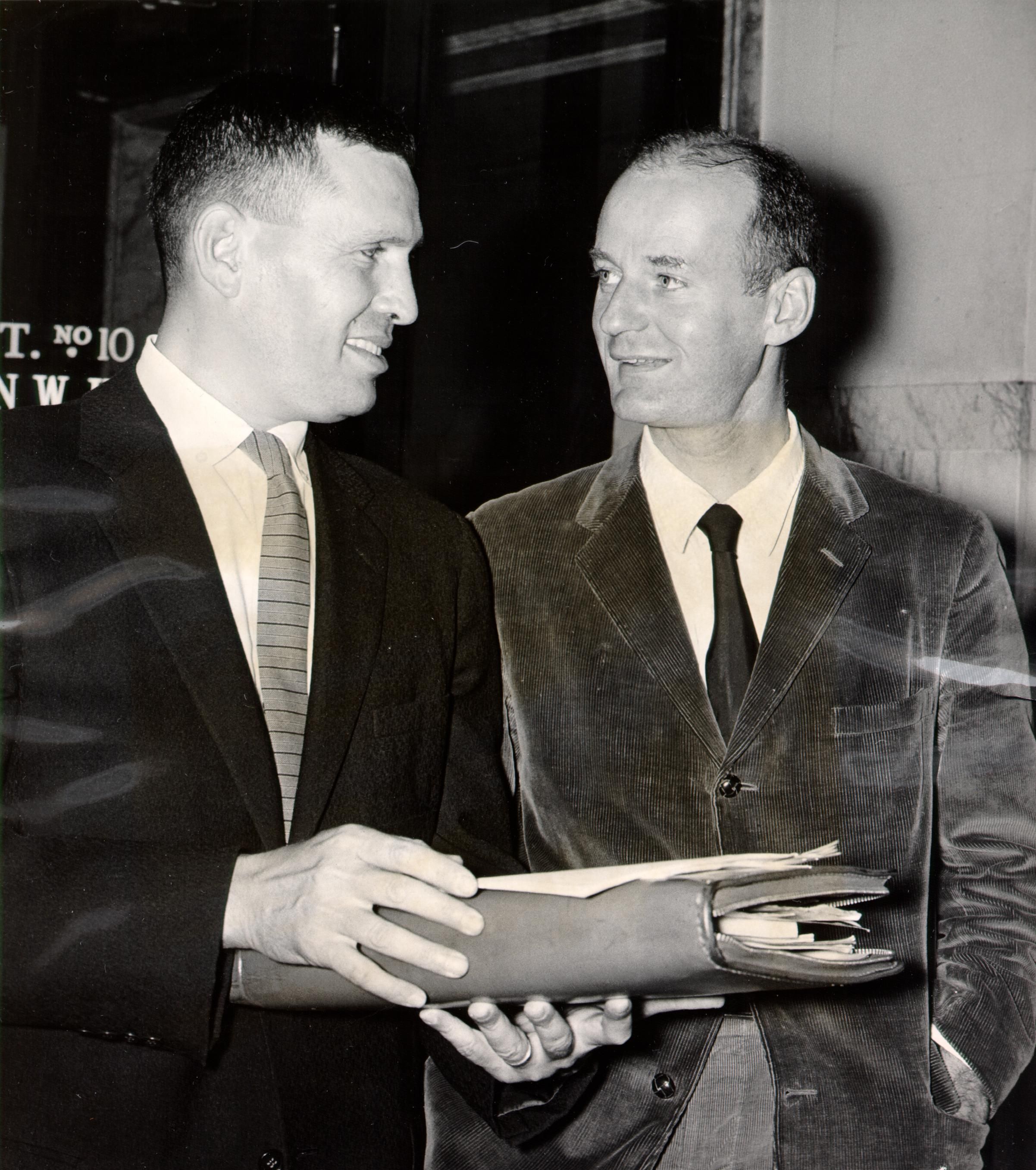
Edward Ennis, chairperson of the ACLU Board of Directors, Aryeh Neier, executive director of the ACLU, and Norman Dorsen, president of the ACLU, join ACLU founder Roger Baldwin to celebrate his 94th birthday in January 1978.
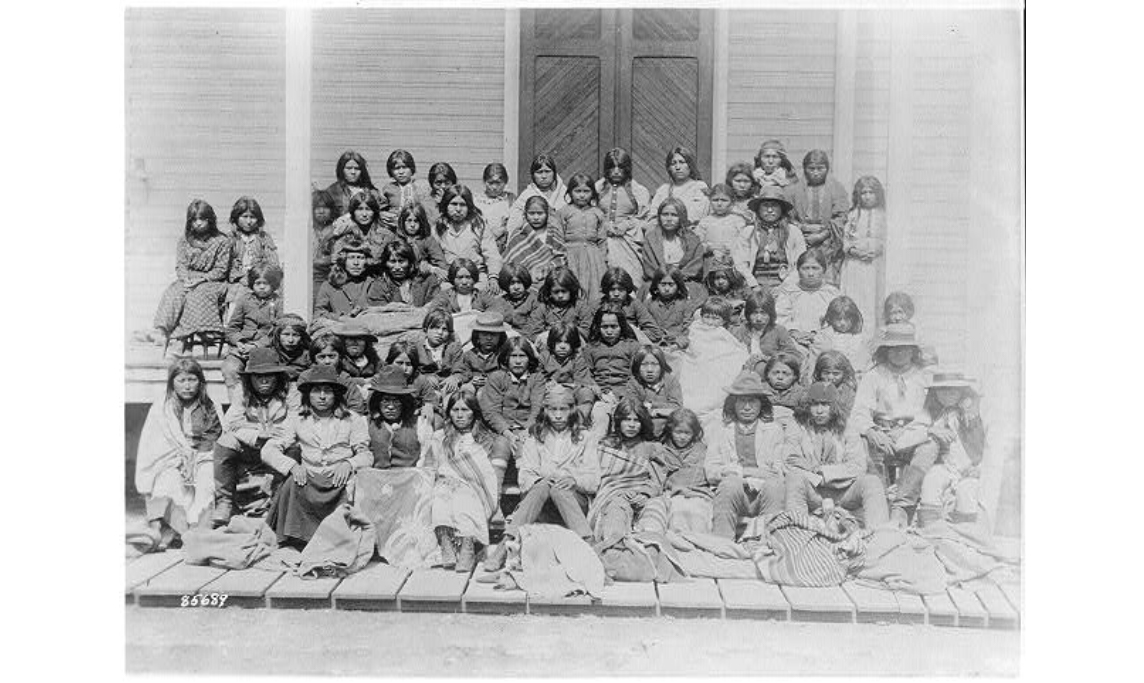
Congress Passes the Indian Child Welfare Act
This photograph features Ciricahua Apache children at the Carlisle Indian School in Pennsylvania in the 1880s. Indian federal boarding schools like this one forced Indigenous children to wear military-style uniforms, speak only English, and adopt Anglo-American names. In 1978, Congress passed the Indian Child Welfare Act (ICWA) to address the nationwide crisis of state child welfare agencies tearing Native children from their families, placing them in non-Native homes, and forcing them to assimilate and adopt white cultural norms. The ACLU has defended the ICWA as recently as 2022.
1979
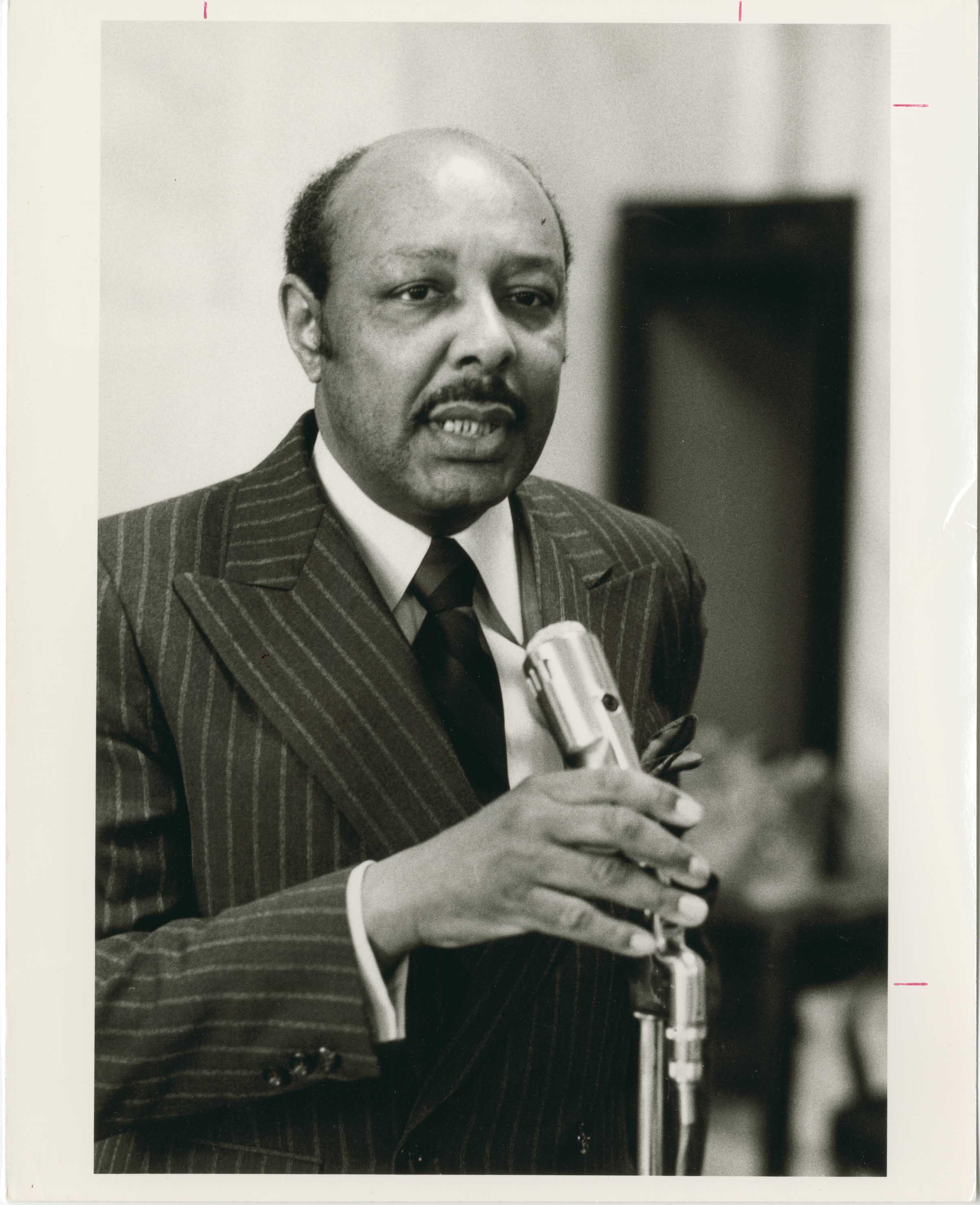
U.S. Rep. Louis Stokes (D-OH) Speaking to Delegates of the 1979 ACLU Biennial
U.S. Rep. Louis Stokes speaks to delegates of the 1979 ACLU Biennial Conference. In collaboration with the ACLU of Ohio, Stokes argued the seminal "stop and frisk" case of Terry v. Ohio before the U.S. Supreme Court in 1968. The ruling in the case does not provide blanket authority to intrude on an individual’s right to be left alone.
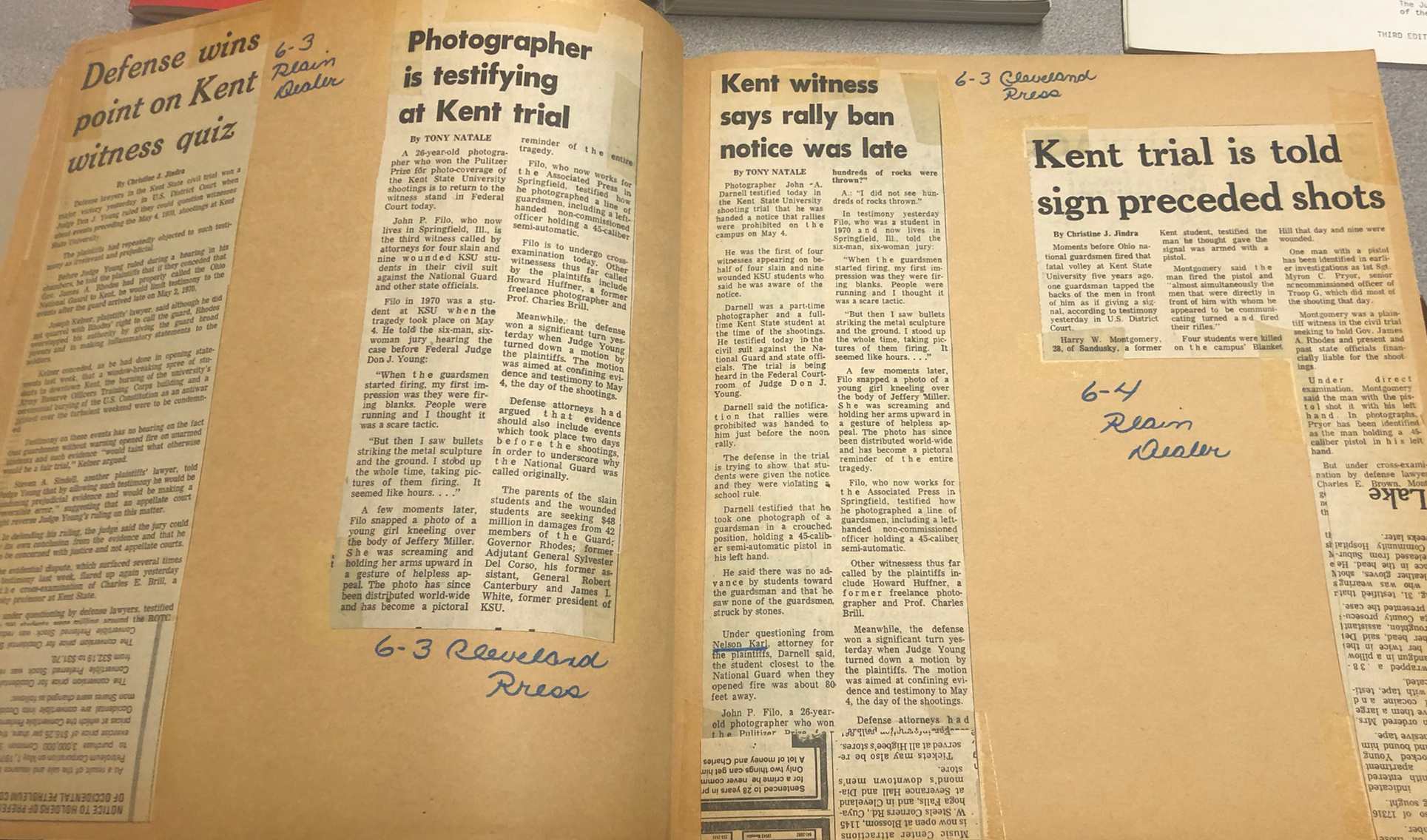
Response to Kent State University Tragedy
In May 1970, the National Guard was called to Kent State University in Ohio to disperse student protesters. On May 4, during a noon gathering, students faced down Guardsmen as they voiced their anger over the United States’ military involvement in Cambodia and Vietnam. While the details surrounding an order to shoot continue to be debated, at 12:24 p.m. a group of National Guardsmen turned and fired into the crowd of students, injuring nine and killing four. The ACLU was on campus within days of the shootings, addressing a variety of civil liberties violations faced by students on campus during the aftermath. For nearly a decade after the shootings, the ACLU worked for justice on behalf of the students who were killed or injured. Nine years later, the ACLU, led by volunteer attorney Sanford Jay Rosen in representing the victims and their families, reached a settlement in a civil suit. This collage by ACLU of Ohio staffers in the 1970s catalogues the organization's work in the years following the tragedy.