Fighting Voter Suppression

Common Cause v. U.S. Department of Justice
The U.S. Department of Justice has launched an unprecedented and unlawful effort to invade the privacy of millions of American voters and threaten their right to vote. It has demanded that every state and the District of Columbia turn over their entire voter database, including Social Security Numbers, political party affiliation, and voter participation history. And at least a dozen states have complied, submitting their voters’ information for federal review. But the Department of Justice has no authority to dictate when a voter registration should be cancelled, and we are suing to stop the federal government’s overreach and ensure that voters’ information remains secure and free from unlawful interference.
Status: Ongoing
View Case
Learn About Fighting Voter Suppression
Featured
Massachusetts
Sep 2026
Fighting Voter Suppression
League of Women Voters of Massachusetts v. Trump
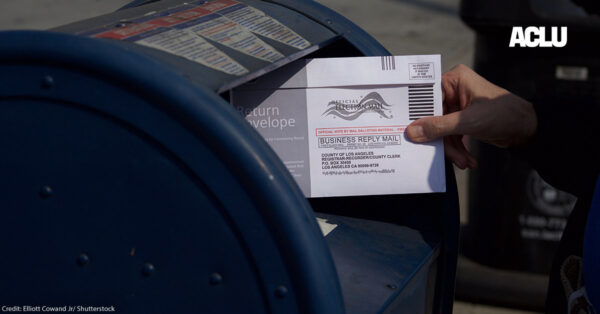
On March 31, 2026, President Trump issued a sweeping Executive Order titled “Ensuring Citizen Verification and Integrity in Federal Elections,” seeking once again to seize control of election administration from Congress and the states. The Order directs federal agencies to compile lists of U.S. citizens and transmit them to states before every election, directs the U.S. Postal Service — an independent agency established by Congress — to create a list of “approved” mail voters, and instructs USPS to refuse to deliver ballots from voters not on that federally created list. If implemented, the Order would threaten the ability of millions of eligible citizens to cast their ballots, particularly military members, overseas citizens, the elderly, recently naturalized citizens, and voters with disabilities who rely on mail voting.
Washington, D.C.
Oct 2025
Fighting Voter Suppression
League of Women Voters Education Fund v. Trump
On March 25, 2025, in a sweeping and unprecedented Executive Order, President Trump attempted to usurp the power to regulate federal elections from Congress and the States. Among other things, the Executive Order directs the Election Assistance Commission—an agency that Congress specifically established to be bipartisan and independent—to require voters to show a passport or other citizenship documentation in order to register to vote in federal elections. If implemented, the Executive Order would threaten the ability of millions of eligible Americans to register and vote and upend the administration of federal elections.
On behalf of leading voter registration organizations and advocacy organizations, the ACLU and co-counsel filed a lawsuit to block the Executive Order as an unconstitutional power grab.
All Cases
103 Fighting Voter Suppression Cases
South Carolina
Aug 2026
Fighting Voter Suppression
South Carolina Republican Party v. Bolchoz
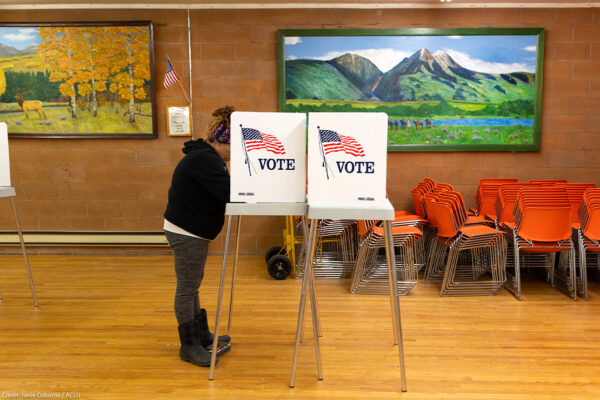
The South Carolina Republican Party has sued state election officials seeking to close South Carolina’s primary elections, excluding independent and unaffiliated voters from participating in what are often the only meaningful elections in their communities. Veterans for All Voters and The Chamberlain Network, two nonpartisan veterans’ organizations, have moved to intervene as defendants to protect their members’ right to vote in the primary of their choice and to ensure the State does not settle the case in a way that extinguishes those rights.
Explore case
South Carolina
Aug 2026
Fighting Voter Suppression
South Carolina Republican Party v. Bolchoz
The South Carolina Republican Party has sued state election officials seeking to close South Carolina’s primary elections, excluding independent and unaffiliated voters from participating in what are often the only meaningful elections in their communities. Veterans for All Voters and The Chamberlain Network, two nonpartisan veterans’ organizations, have moved to intervene as defendants to protect their members’ right to vote in the primary of their choice and to ensure the State does not settle the case in a way that extinguishes those rights.
New Jersey
Jul 2026
Fighting Voter Suppression
United States v. Caldwell
The Department of Justice (DOJ) sued the State of New Jersey, seeking private, confidential voter data. DOJ’s efforts appear to be part of an effort to build a national voter database without congressional authorization and to improperly question the validity of state voter rolls.
Explore case
New Jersey
Jul 2026
Fighting Voter Suppression
United States v. Caldwell
The Department of Justice (DOJ) sued the State of New Jersey, seeking private, confidential voter data. DOJ’s efforts appear to be part of an effort to build a national voter database without congressional authorization and to improperly question the validity of state voter rolls.
Kentucky
Jul 2026
Fighting Voter Suppression
United States v. Adams
The Trump administration’s Department of Justice has taken Kentucky to court in an attempt to obtain sensitive, non-public information from the state’s voter registration database — including Social Security numbers, driver’s license numbers, dates of birth, and home addresses. This lawsuit is one of nearly three dozen similar actions filed against states across the country, and reporting suggests the underlying goal is to construct an unauthorized federal voter database and use error-prone data-matching tools to target registered voters — including naturalized citizens — for potential removal from the rolls.
Explore case
Kentucky
Jul 2026
Fighting Voter Suppression
United States v. Adams
The Trump administration’s Department of Justice has taken Kentucky to court in an attempt to obtain sensitive, non-public information from the state’s voter registration database — including Social Security numbers, driver’s license numbers, dates of birth, and home addresses. This lawsuit is one of nearly three dozen similar actions filed against states across the country, and reporting suggests the underlying goal is to construct an unauthorized federal voter database and use error-prone data-matching tools to target registered voters — including naturalized citizens — for potential removal from the rolls.
Connecticut
Jul 2026
Fighting Voter Suppression
United States v. Thomas
The U.S. Department of Justice (DOJ) sued the State of Connecticut, seeking private, confidential voter data. DOJ’s efforts appear to be part of an effort to build a national voter database without congressional authorization and to improperly question the validity of state voter rolls.
Explore case
Connecticut
Jul 2026
Fighting Voter Suppression
United States v. Thomas
The U.S. Department of Justice (DOJ) sued the State of Connecticut, seeking private, confidential voter data. DOJ’s efforts appear to be part of an effort to build a national voter database without congressional authorization and to improperly question the validity of state voter rolls.
Virginia
Jul 2026
Fighting Voter Suppression
United States v. Koski
The Department of Justice (DOJ) sued the State of Virginia, seeking private, confidential voter data. DOJ’s efforts appear to be part of an effort to build a national voter database without congressional authorization and to improperly question the validity of state voter rolls.
Explore case
Virginia
Jul 2026
Fighting Voter Suppression
United States v. Koski
The Department of Justice (DOJ) sued the State of Virginia, seeking private, confidential voter data. DOJ’s efforts appear to be part of an effort to build a national voter database without congressional authorization and to improperly question the validity of state voter rolls.