Fighting Voter Suppression

Common Cause v. U.S. Department of Justice
The U.S. Department of Justice has launched an unprecedented and unlawful effort to invade the privacy of millions of American voters and threaten their right to vote. It has demanded that every state and the District of Columbia turn over their entire voter database, including Social Security Numbers, political party affiliation, and voter participation history. And at least a dozen states have complied, submitting their voters’ information for federal review. But the Department of Justice has no authority to dictate when a voter registration should be cancelled, and we are suing to stop the federal government’s overreach and ensure that voters’ information remains secure and free from unlawful interference.
Status: Ongoing
View Case
Learn About Fighting Voter Suppression
Featured
Massachusetts
Sep 2026
Fighting Voter Suppression
League of Women Voters of Massachusetts v. Trump
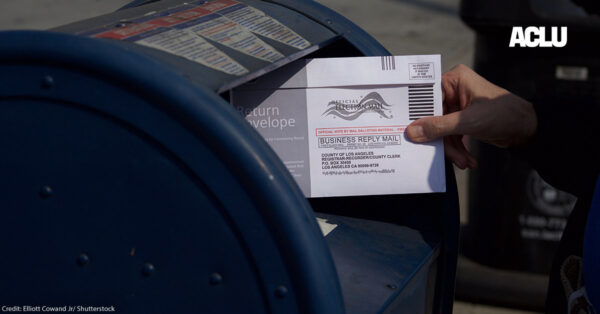
On March 31, 2026, President Trump issued a sweeping Executive Order titled “Ensuring Citizen Verification and Integrity in Federal Elections,” seeking once again to seize control of election administration from Congress and the states. The Order directs federal agencies to compile lists of U.S. citizens and transmit them to states before every election, directs the U.S. Postal Service — an independent agency established by Congress — to create a list of “approved” mail voters, and instructs USPS to refuse to deliver ballots from voters not on that federally created list. If implemented, the Order would threaten the ability of millions of eligible citizens to cast their ballots, particularly military members, overseas citizens, the elderly, recently naturalized citizens, and voters with disabilities who rely on mail voting.
Washington, D.C.
Oct 2025

Fighting Voter Suppression
League of Women Voters Education Fund v. Trump
On March 25, 2025, in a sweeping and unprecedented Executive Order, President Trump attempted to usurp the power to regulate federal elections from Congress and the States. Among other things, the Executive Order directs the Election Assistance Commission—an agency that Congress specifically established to be bipartisan and independent—to require voters to show a passport or other citizenship documentation in order to register to vote in federal elections. If implemented, the Executive Order would threaten the ability of millions of eligible Americans to register and vote and upend the administration of federal elections.
On behalf of leading voter registration organizations and advocacy organizations, the ACLU and co-counsel filed a lawsuit to block the Executive Order as an unconstitutional power grab.
All Cases
103 Fighting Voter Suppression Cases
Montana
May 2026
Fighting Voter Suppression
Montana Federation of Public Employees v. Montana
Representing Western Native Voice and four sovereign tribal nations in Montana, the American Civil Liberties Union, ACLU of Montana, and Native American Rights Fund (NARF) challenged the latest in a line of Montana laws that hinder Native American participation in the state’s electoral process — SB 490, which drastically limits access to Election Day voter registration (EDR) in Montana. These laws violate a number of provisions in the Montana Constitution: the right to vote, equal protection, and due process.
Explore case
Montana
May 2026
Fighting Voter Suppression
Montana Federation of Public Employees v. Montana
Representing Western Native Voice and four sovereign tribal nations in Montana, the American Civil Liberties Union, ACLU of Montana, and Native American Rights Fund (NARF) challenged the latest in a line of Montana laws that hinder Native American participation in the state’s electoral process — SB 490, which drastically limits access to Election Day voter registration (EDR) in Montana. These laws violate a number of provisions in the Montana Constitution: the right to vote, equal protection, and due process.

Alaska
May 2026
Fighting Voter Suppression
League of Women Voters of Alaska v. Nancy Dahlstrom
On behalf of the League of Women Voters of Alaska, the Alaska Black Caucus, and the Alaska Public Interest Research Group, the ACLU Voting Rights Project, the ACLU of Alaska, and the Electronic Privacy Information Center have filed a lawsuit against the Lieutenant Governor of Alaska and the Director of Alaska’s Division of Elections over the state’s compliance with the U.S. Department of Justice’s request for Alaska’s full, unredacted voter file. The Department of Justice demanded the complete voter record, which includes voters’ sensitive personal data, such as drivers’ license numbers and partial Social Security numbers.
Explore case
Alaska
May 2026
Fighting Voter Suppression
League of Women Voters of Alaska v. Nancy Dahlstrom
On behalf of the League of Women Voters of Alaska, the Alaska Black Caucus, and the Alaska Public Interest Research Group, the ACLU Voting Rights Project, the ACLU of Alaska, and the Electronic Privacy Information Center have filed a lawsuit against the Lieutenant Governor of Alaska and the Director of Alaska’s Division of Elections over the state’s compliance with the U.S. Department of Justice’s request for Alaska’s full, unredacted voter file. The Department of Justice demanded the complete voter record, which includes voters’ sensitive personal data, such as drivers’ license numbers and partial Social Security numbers.
Louisiana
Apr 2026
Fighting Voter Suppression
State of Louisiana v. U.S. Election Assistance Commission
Voting rights groups should be allowed to intervene as defendants in Louisiana’s suit against the U.S. Election Assistance Commission through which the state seeks to require additional proof of citizenship, argued the League of Women Voters of Louisiana and others in a motion to intervene in the U.S. District Court for the Western District of Louisiana.
Explore case
Louisiana
Apr 2026
Fighting Voter Suppression
State of Louisiana v. U.S. Election Assistance Commission
Voting rights groups should be allowed to intervene as defendants in Louisiana’s suit against the U.S. Election Assistance Commission through which the state seeks to require additional proof of citizenship, argued the League of Women Voters of Louisiana and others in a motion to intervene in the U.S. District Court for the Western District of Louisiana.
Ohio
Apr 2026
Fighting Voter Suppression
League of Women Voters of Ohio v. LaRose
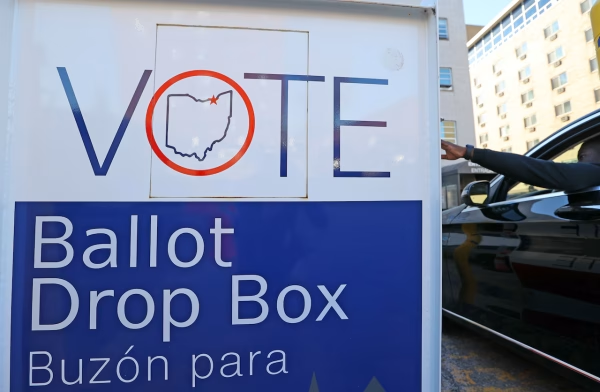
Voting-rights and civil-rights organizations filed a federal lawsuit challenging a new Ohio law that threatens to wrongly strip eligible citizens—particularly naturalized citizens—of their right to vote.
The case arises from Ohio Senate Bill 293 (SB 293), a law that mandates aggressive, automated purges of Ohio’s voter rolls based on flawed citizenship data. Under SB 293, state officials are required to conduct frequent database checks and cancel voter registrations for people flagged as “noncitizens”—often without advance notice or a meaningful opportunity to correct mistakes.
Plaintiffs brought this case to stop a system that places thousands of eligible voters at risk of disenfranchisement and undermines fundamental protections guaranteed by federal law and the U.S. Constitution.
Explore case
Ohio
Apr 2026
Fighting Voter Suppression
League of Women Voters of Ohio v. LaRose
Voting-rights and civil-rights organizations filed a federal lawsuit challenging a new Ohio law that threatens to wrongly strip eligible citizens—particularly naturalized citizens—of their right to vote.
The case arises from Ohio Senate Bill 293 (SB 293), a law that mandates aggressive, automated purges of Ohio’s voter rolls based on flawed citizenship data. Under SB 293, state officials are required to conduct frequent database checks and cancel voter registrations for people flagged as “noncitizens”—often without advance notice or a meaningful opportunity to correct mistakes.
Plaintiffs brought this case to stop a system that places thousands of eligible voters at risk of disenfranchisement and undermines fundamental protections guaranteed by federal law and the U.S. Constitution.
California
Apr 2026
Fighting Voter Suppression
United States v. Weber
Representing the League of Women Voters of California, the ACLU Voting Rights Project, ACLU of Northern California, and ACLU of Southern California have filed a motion to intervene in a federal lawsuit over the federal government’s demand that California turn over its entire voter registration rolls, including with voters’ sensitive personal data such as drivers’ license numbers and partial social security numbers.
Explore case
California
Apr 2026
Fighting Voter Suppression
United States v. Weber
Representing the League of Women Voters of California, the ACLU Voting Rights Project, ACLU of Northern California, and ACLU of Southern California have filed a motion to intervene in a federal lawsuit over the federal government’s demand that California turn over its entire voter registration rolls, including with voters’ sensitive personal data such as drivers’ license numbers and partial social security numbers.