Fighting Voter Suppression

Common Cause v. U.S. Department of Justice
The U.S. Department of Justice has launched an unprecedented and unlawful effort to invade the privacy of millions of American voters and threaten their right to vote. It has demanded that every state and the District of Columbia turn over their entire voter database, including Social Security Numbers, political party affiliation, and voter participation history. And at least a dozen states have complied, submitting their voters’ information for federal review. But the Department of Justice has no authority to dictate when a voter registration should be cancelled, and we are suing to stop the federal government’s overreach and ensure that voters’ information remains secure and free from unlawful interference.
Status: Ongoing
View Case
Learn About Fighting Voter Suppression
Featured
Massachusetts
Sep 2026
Fighting Voter Suppression
League of Women Voters of Massachusetts v. Trump
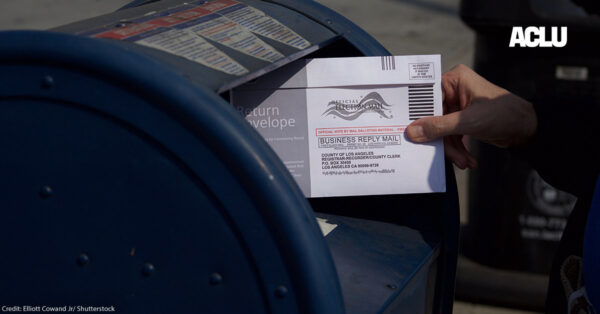
On March 31, 2026, President Trump issued a sweeping Executive Order titled "Ensuring Citizen Verification and Integrity in Federal Elections," seeking once again to seize control of election administration from Congress and the states. The Order directs federal agencies to compile lists of U.S. citizens and transmit them to states before every election, directs the U.S. Postal Service -- an independent agency established by Congress -- to create a list of "approved" mail voters, and instructs USPS to refuse to deliver ballots from voters not on that federally created list. If implemented, the Order would threaten the ability of millions of eligible citizens to cast their ballots, particularly military members, overseas citizens, the elderly, recently naturalized citizens, and voters with disabilities who rely on mail voting.
Washington, D.C.
Oct 2025
Fighting Voter Suppression
League of Women Voters Education Fund v. Trump
On March 25, 2025, in a sweeping and unprecedented Executive Order, President Trump attempted to usurp the power to regulate federal elections from Congress and the States. Among other things, the Executive Order directs the Election Assistance Commission—an agency that Congress specifically established to be bipartisan and independent—to require voters to show a passport or other citizenship documentation in order to register to vote in federal elections. If implemented, the Executive Order would threaten the ability of millions of eligible Americans to register and vote and upend the administration of federal elections.
On behalf of leading voter registration organizations and advocacy organizations, the ACLU and co-counsel filed a lawsuit to block the Executive Order as an unconstitutional power grab.
All Cases
103 Fighting Voter Suppression Cases
Maryland
Oct 2026
Fighting Voter Suppression
United States v. DeMarinis
The Department of Justice (“DOJ”) sued Maryland demanding the release of its full, unredacted voter file, which includes the highly sensitive and personal data of every voter in the state. This suit appears to be part of DOJ’s effort to build a national voter database without congressional authorization, improperly question the validity of state voter rolls, and intimidate eligible voters in Maryland and around the country.
Explore case
Maryland
Oct 2026
Fighting Voter Suppression
United States v. DeMarinis
The Department of Justice (“DOJ”) sued Maryland demanding the release of its full, unredacted voter file, which includes the highly sensitive and personal data of every voter in the state. This suit appears to be part of DOJ’s effort to build a national voter database without congressional authorization, improperly question the validity of state voter rolls, and intimidate eligible voters in Maryland and around the country.
South Carolina
Sep 2026
Fighting Voter Suppression
NAACP South Carolina State Conference v. Wilson
All voters with disabilities have the right to receive assistance voting from a person of their choice. South Carolina prohibits some voters with disabilities from receiving assistance and limits who voters can rely on for assistance. Voters with disabilities and the NAACP South Carolina State Conference sued to challenge those laws under Section 208 of the Voting Rights Act and protect disabled voters’ right to assistance.
Explore case
South Carolina
Sep 2026
Fighting Voter Suppression
NAACP South Carolina State Conference v. Wilson
All voters with disabilities have the right to receive assistance voting from a person of their choice. South Carolina prohibits some voters with disabilities from receiving assistance and limits who voters can rely on for assistance. Voters with disabilities and the NAACP South Carolina State Conference sued to challenge those laws under Section 208 of the Voting Rights Act and protect disabled voters’ right to assistance.

Texas
Sep 2026
Fighting Voter Suppression
Crystal Mason v. State of Texas
Crystal Mason thought she was performing her civic duty by filling out a provisional ballot in the 2016 election. She didn't know it would land her a five-year prison sentence, upending her family and the life she had built. At the time, Ms. Mason was on federal supervised release, a preliminary period of freedom for individuals who have served their full time of incarceration in federal prison. Ms. Mason didn’t know, and nobody told her, that the state considered her ineligible to vote while on supervised release. Because her name didn’t appear on voter rolls, she filed a provisional ballot, consistent with federal law. The state never counted her ballot but has still sought to send her to prison for an innocent mistake.
Explore case
Texas
Sep 2026
Fighting Voter Suppression
Crystal Mason v. State of Texas
Crystal Mason thought she was performing her civic duty by filling out a provisional ballot in the 2016 election. She didn't know it would land her a five-year prison sentence, upending her family and the life she had built. At the time, Ms. Mason was on federal supervised release, a preliminary period of freedom for individuals who have served their full time of incarceration in federal prison. Ms. Mason didn’t know, and nobody told her, that the state considered her ineligible to vote while on supervised release. Because her name didn’t appear on voter rolls, she filed a provisional ballot, consistent with federal law. The state never counted her ballot but has still sought to send her to prison for an innocent mistake.

Alaska
Sep 2026
Fighting Voter Suppression
Racial Justice
Smith v. State of Alaska (Amicus)
The ACLU and ACLU of Alaska have filed an amicus in support of Tupe Smith, a woman born in American Samoa who now lives in Whittier, Alaska charged with falsely affirming that she was a U.S. citizen when she registered to vote. But Tupe Smith is not an “alien” under the law. People, like her, born in the U.S. territory of American Samoa are the only remaining individuals recognized as “non-citizen U.S. nationals,” a unique status that falls short of “citizen” but nonetheless recognizes that American Samoa has been part of the United States for over 125 years.
All evidence indicates that Ms. Smith believed that, as a non-citizen U.S. national, she was eligible to vote in local elections when she registered to vote. In fact, local election officials encouraged her to check the box labeled "U.S. citizen" when she registered, given the fact that there was no option for "U.S. national."
Our amicus brief urges Alaska’s Court of Appeals to dismiss Tupe Smith’s indictment because of well-settled principles that election-crime statutes should be construed to avoid punishing innocent mistakes. Separately, we warn that upholding a different view of the law would make Alaska an outlier among the states.
Explore case
Alaska
Sep 2026
Fighting Voter Suppression
Racial Justice
Smith v. State of Alaska (Amicus)
The ACLU and ACLU of Alaska have filed an amicus in support of Tupe Smith, a woman born in American Samoa who now lives in Whittier, Alaska charged with falsely affirming that she was a U.S. citizen when she registered to vote. But Tupe Smith is not an “alien” under the law. People, like her, born in the U.S. territory of American Samoa are the only remaining individuals recognized as “non-citizen U.S. nationals,” a unique status that falls short of “citizen” but nonetheless recognizes that American Samoa has been part of the United States for over 125 years.
All evidence indicates that Ms. Smith believed that, as a non-citizen U.S. national, she was eligible to vote in local elections when she registered to vote. In fact, local election officials encouraged her to check the box labeled "U.S. citizen" when she registered, given the fact that there was no option for "U.S. national."
Our amicus brief urges Alaska’s Court of Appeals to dismiss Tupe Smith’s indictment because of well-settled principles that election-crime statutes should be construed to avoid punishing innocent mistakes. Separately, we warn that upholding a different view of the law would make Alaska an outlier among the states.
U.S. Supreme Court
Aug 2026
Fighting Voter Suppression
OCA-Greater Houston v. Paxton
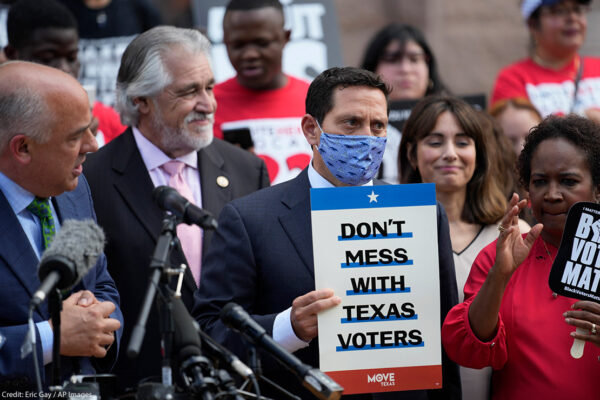
Texas has growing Hispanic and Black populations that helped propel record voter turnout in the November 2020 election. The Texas Legislature responded to this increased civic participation with an omnibus election bill titled Senate Bill 1—SB 1 for short—that targeted election practices that made voting more accessible to traditionally marginalized voters like voters of color, voters with disabilities, and voters with limited English proficiency. Since 2021, SB 1 has resulted in tens of thousands of lawful votes being rejected, and it remains a threat to democracy in Texas.
Explore case
U.S. Supreme Court
Aug 2026
Fighting Voter Suppression
OCA-Greater Houston v. Paxton
Texas has growing Hispanic and Black populations that helped propel record voter turnout in the November 2020 election. The Texas Legislature responded to this increased civic participation with an omnibus election bill titled Senate Bill 1—SB 1 for short—that targeted election practices that made voting more accessible to traditionally marginalized voters like voters of color, voters with disabilities, and voters with limited English proficiency. Since 2021, SB 1 has resulted in tens of thousands of lawful votes being rejected, and it remains a threat to democracy in Texas.