Privacy & Technology
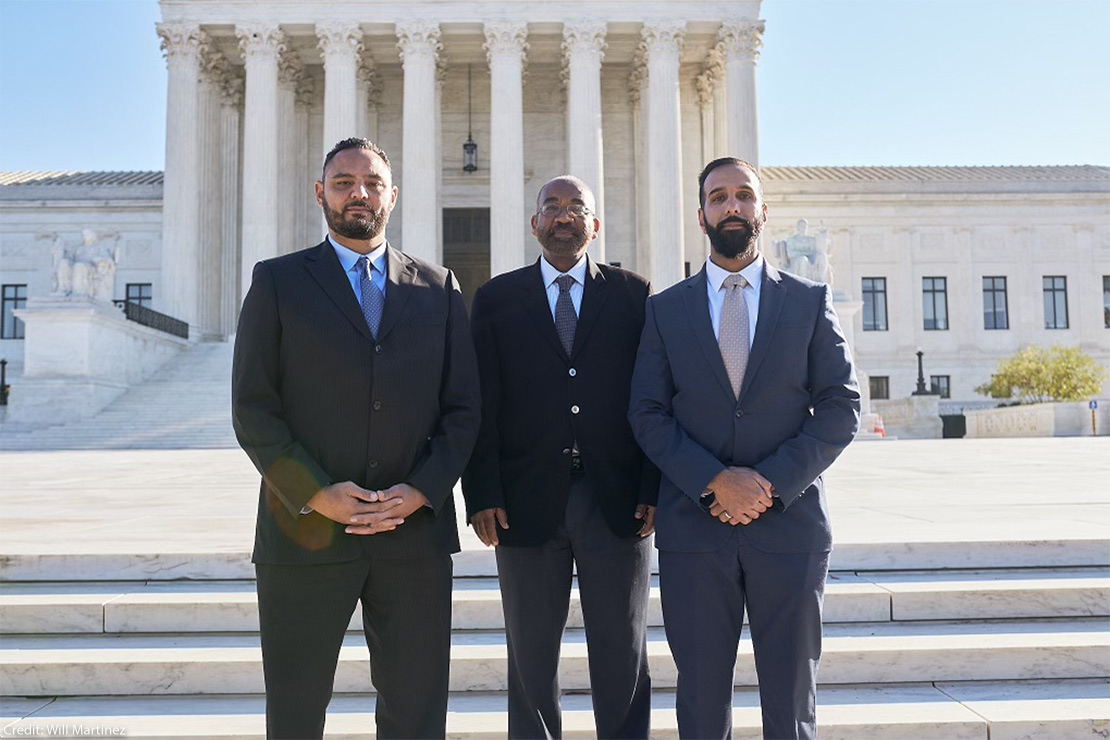
FBI v. Fazaga
In a case scheduled to be argued before the U.S. Supreme Court on November 8, 2021, three Muslim Americans are challenging the FBI’s secret spying on them and their communities based on their religion, in violation of the Constitution and federal law. In what will likely be a landmark case, the plaintiffs — Yassir Fazaga, Ali Uddin Malik, and Yasser Abdelrahim — insist that the FBI cannot escape accountability for violating their religious freedom by invoking “state secrets.” The plaintiffs are represented by the Center for Immigration Law and Policy at UCLA School of Law, the ACLU of Southern California, the American Civil Liberties Union, the Council for American Islamic Relations, and the law firm of Hadsell Stormer Renick & Dai.
Status: Closed (Judgment)
View Case
Learn About Privacy & Technology
Featured
U.S. Supreme Court
Jun 2018

Privacy & Technology
Carpenter v. United States
The Supreme Court ruled that the government needs a warrant to access a person’s cellphone location history. The court found in a 5 to 4 decision that obtaining such information is a search under the Fourth Amendment and that a warrant from a judge based on probable cause is required.
Court Case
Dec 2016

Privacy & Technology
Sarkar v. Doe - PubPeer Subpoena Challenge
The ACLU filed a motion in Michigan state court challenging the constitutionality of a subpoena issued to the website PubPeer demanding that it turn over the identities of anonymous commenters. In March 2015, the trial judge ruled that PubPeer had to unmask one – but only one – of the commenters. Both PubPeer and the researcher appealed, and the ruling was upheld in December 2016.
All Cases
77 Privacy & Technology Cases

Maryland
Apr 2026
Privacy & Technology
Kimberlee Williams Wrongful Arrest
Three administrative complaints seek to hold police departments in Maryland accountable for the wrongful arrest of a woman based on an , erroneous search result from facial recognition technology.
Explore case
Maryland
Apr 2026
Privacy & Technology
Kimberlee Williams Wrongful Arrest
Three administrative complaints seek to hold police departments in Maryland accountable for the wrongful arrest of a woman based on an , erroneous search result from facial recognition technology.
California
Apr 2026
Privacy & Technology
Free Speech
Amazon v. Perplexity
Explore case
California
Apr 2026
Privacy & Technology
Free Speech
Amazon v. Perplexity
Virginia
Mar 2026
Privacy & Technology
United States v. Chatrie
Whether law enforcement agencies can conduct searches using geofence warrants, a novel and invasive dragnet surveillance technique.
Explore case
Virginia
Mar 2026
Privacy & Technology
United States v. Chatrie
Whether law enforcement agencies can conduct searches using geofence warrants, a novel and invasive dragnet surveillance technique.
California
Jan 2026
Privacy & Technology
Free Speech
Doe v. DHS
On February 2, 2026, the ACLU, ACLU of Northern California, and the ACLU of Pennsylvania filed a motion in federal court to quash a Department of Homeland Security (“DHS”) administrative subpoena seeking Google subscriber records about our client, solely because he engaged in constitutionally protected speech criticizing DHS conduct.
Explore case
California
Jan 2026
Privacy & Technology
Free Speech
Doe v. DHS
On February 2, 2026, the ACLU, ACLU of Northern California, and the ACLU of Pennsylvania filed a motion in federal court to quash a Department of Homeland Security (“DHS”) administrative subpoena seeking Google subscriber records about our client, solely because he engaged in constitutionally protected speech criticizing DHS conduct.
Court Case
Dec 2025
Privacy & Technology
U.S. DOGE Service Access to Sensitive Agency Records Systems Multiagency FOIA
There are serious privacy concerns raised by reports that the United States DOGE (“Department of Government Efficiency”) Service (“USDS”) has gained access to federal agency systems, including those housing sensitive information like federal payment data, student loan data or federal employee records, and may be using artificial intelligence technology in analyzing them. The ACLU submitted a FOIA request to more than 40 federal agencies to provide the public with information on what federal records the agencies have provided to or been asked for by the USDS and if sensitive information and key decision-making has been outsourced to unvetted technology.
Explore case
Court Case
Dec 2025
Privacy & Technology
U.S. DOGE Service Access to Sensitive Agency Records Systems Multiagency FOIA
There are serious privacy concerns raised by reports that the United States DOGE (“Department of Government Efficiency”) Service (“USDS”) has gained access to federal agency systems, including those housing sensitive information like federal payment data, student loan data or federal employee records, and may be using artificial intelligence technology in analyzing them. The ACLU submitted a FOIA request to more than 40 federal agencies to provide the public with information on what federal records the agencies have provided to or been asked for by the USDS and if sensitive information and key decision-making has been outsourced to unvetted technology.