Surveillance Technologies
FBI v. Fazaga
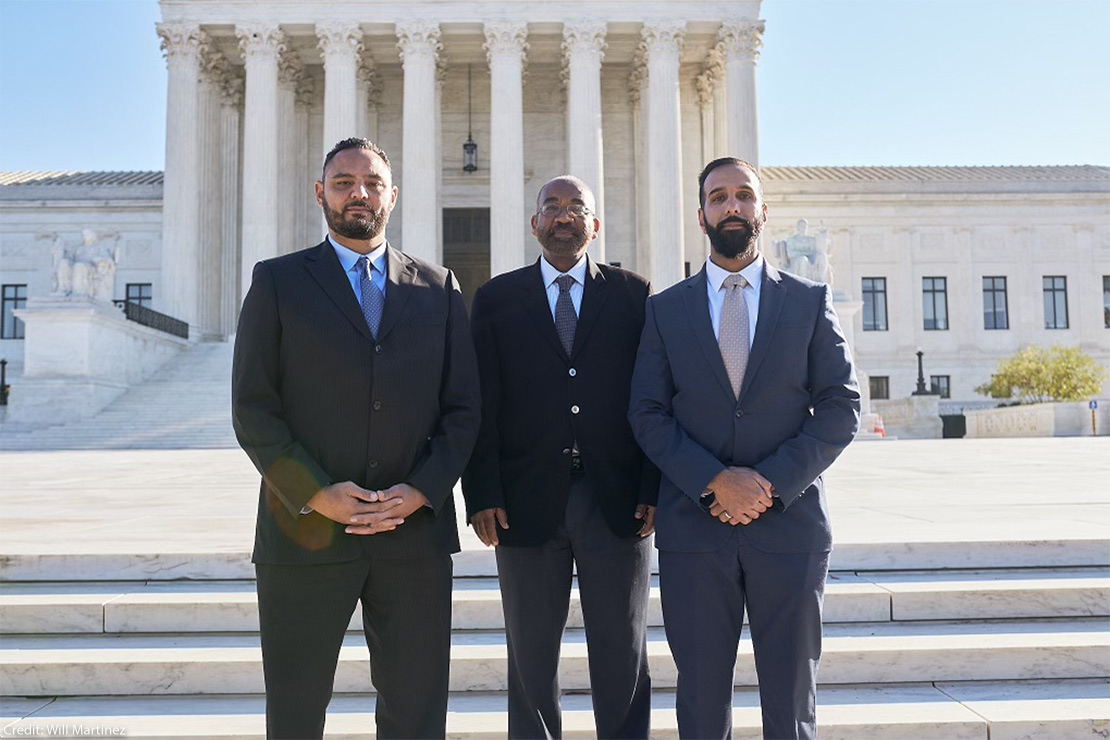
In a case scheduled to be argued before the U.S. Supreme Court on November 8, 2021, three Muslim Americans are challenging the FBI’s secret spying on them and their communities based on their religion, in violation of the Constitution and federal law. In what will likely be a landmark case, the plaintiffs — Yassir Fazaga, Ali Uddin Malik, and Yasser Abdelrahim — insist that the FBI cannot escape accountability for violating their religious freedom by invoking “state secrets.” The plaintiffs are represented by the Center for Immigration Law and Policy at UCLA School of Law, the ACLU of Southern California, the American Civil Liberties Union, the Council for American Islamic Relations, and the law firm of Hadsell Stormer Renick & Dai.
Status: Closed (Judgment)
View Case
Learn About Surveillance Technologies
All Cases
18 Surveillance Technologies Cases

Florida
Jun 2026
Surveillance Technologies
Dillon v. City of Jacksonville Beach
On June 10, 2026, the ACLU and ACLU of Florida, with the law firm of Hoguet Newman Regal & Kenney, LLP, filed a wrongful arrest suit on behalf of Robert Dillon, a Florida man who was wrongfully arrested after police relied on an incorrect result from facial recognition technology.
Explore case
Florida
Jun 2026
Surveillance Technologies
Dillon v. City of Jacksonville Beach
On June 10, 2026, the ACLU and ACLU of Florida, with the law firm of Hoguet Newman Regal & Kenney, LLP, filed a wrongful arrest suit on behalf of Robert Dillon, a Florida man who was wrongfully arrested after police relied on an incorrect result from facial recognition technology.
Maryland
Apr 2026
Surveillance Technologies
Kimberlee Williams Wrongful Arrest
Three administrative complaints seek to hold police departments in Maryland accountable for the wrongful arrest of a woman based on an erroneous search result from facial recognition technology.
Explore case
Maryland
Apr 2026
Surveillance Technologies
Kimberlee Williams Wrongful Arrest
Three administrative complaints seek to hold police departments in Maryland accountable for the wrongful arrest of a woman based on an erroneous search result from facial recognition technology.
California
Apr 2026
Surveillance Technologies
Privacy & Technology
Amazon v. Perplexity
Explore case
California
Apr 2026
Surveillance Technologies
Privacy & Technology
Amazon v. Perplexity
Michigan
Dec 2024
Surveillance Technologies
Woodruff v. Oliver
On December 5, 2024, the ACLU and the ACLU of Michigan filed an amicus brief in Woodruff v. Oliver, a wrongful arrest lawsuit in the United States District Court for the Eastern District of Michigan, arguing that the Detroit Police Department’s (DPD) reliance on flawed facial recognition technology (FRT) impermissibly tainted the investigation and failed to establish probable cause for the plaintiff’s arrest.
Explore case
Michigan
Dec 2024
Surveillance Technologies
Woodruff v. Oliver
On December 5, 2024, the ACLU and the ACLU of Michigan filed an amicus brief in Woodruff v. Oliver, a wrongful arrest lawsuit in the United States District Court for the Eastern District of Michigan, arguing that the Detroit Police Department’s (DPD) reliance on flawed facial recognition technology (FRT) impermissibly tainted the investigation and failed to establish probable cause for the plaintiff’s arrest.
New Jersey
Jan 2024
Surveillance Technologies
Parks v. McCormac
On January 29, 2024, the ACLU and the ACLU of New Jersey filed an amicus brief in the U.S. District Court for the District of New Jersey in support of Plaintiff Nijeer Parks. The brief argues that law enforcement’s wrongful arrest of Mr. Parks due to police reliance on unreliable facial face recognition technology violated Mr. Parks’s constitutional rights.
Explore case
New Jersey
Jan 2024
Surveillance Technologies
Parks v. McCormac
On January 29, 2024, the ACLU and the ACLU of New Jersey filed an amicus brief in the U.S. District Court for the District of New Jersey in support of Plaintiff Nijeer Parks. The brief argues that law enforcement’s wrongful arrest of Mr. Parks due to police reliance on unreliable facial face recognition technology violated Mr. Parks’s constitutional rights.