This piece originally appeared at TIME.
Last summer, in the wake of the arrest and tragic death of Sandra Bland, following what should have been a routine traffic stop in Prairie View, Texas, I encouraged readers to understand their legal rights, but cautioned them not to “give the police an excuse to mistreat [them] or pile on additional charges.”
Among my suggestions were the reminders that you have the right to remain silent, you don’t have to consent to have your car searched, you have the right to ask the police whether you’re free to go if you haven’t been arrested, and if you are arrested, you have the right to ask for an attorney — which you should do immediately. I also stressed the importance of staying calm.
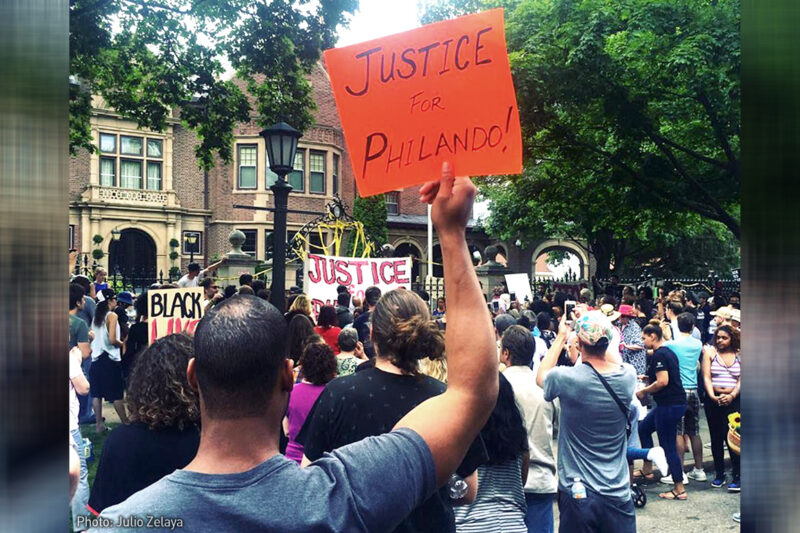
While I stand by that advice, the killing of Philando Castile outside of St. Paul, Minn., last week — again in the context of a routine traffic stop — serves as a gut-wrenching and infuriating reminder that, particularly for Black men in this country, playing by the rules is often not enough.
The sad irony of Mr. Castile’s death is that, if asked how motorists should conduct themselves if they are legally armed when the police pull them over for a suspected traffic violation, my answer would be to do essentially what Mr. Castile reportedly did.
To finish reading this piece, click here.
Related Issues
Related Content
-
Press ReleaseOct 2026

Immigrants' Rights
+3 Issues
New Aclu Report Sounds The Alarm On How Trump Administration’s Mass Deportation Agenda Is Eroding Democracy. Explore Press Release.New ACLU Report Sounds the Alarm on How Trump Administration’s Mass Deportation Agenda is Eroding Democracy
WASHINGTON — The American Civil Liberties Union today released a new report, 76 Ways Mass Deportation is Breaking Our Democracy, detailing how the Trump administration is using mass deportation as the pretext and mechanism to attack civil liberties and structural democratic safeguards at an unparalleled scale and speed. The report comes as Immigration and Customs Enforcement (ICE) arrests have hit a record high, as the Trump administration has shifted its approach from mass raids to more discrete arrests following widespread outrage. From the deployment of federal agents and military troops for immigration enforcement in U.S. cities, to the mass revocation of visas and other forms of lawful status, and the targeting of immigrants’ rights protesters, the Trump administration has repeatedly used immigration policy as a trojan horse for attacks on core pillars of U.S. democracy. Notably, the report categorizes the dizzying array of abuses into three major categories, which often overlap: Attacks on civil rights and liberties, as the Trump administration has used mass deportations as both a pretext and distraction for its assault on myriad constitutional rights – including the rights to free speech and freedom of assembly and due process – impacting citizens and noncitizens alike. Attacks on democratic checks and balances, as the administration expands its federal deportation police and executive power, eviscerating due process for immigrants and normalizing ICE’s violence, while evading and even defying court orders. Attacks on multiracial, pluralistic democracy, as the administration continues to gut existing legal protections and introduce new policies targeting people who are immigrants – including through visa and entry bans and efforts to end birthright citizenship and Temporary Protected Status (TPS) – in what appears to be a calculated attempt to change the racial makeup of the U.S. now and into the future. “For the past year and a half, the ACLU and advocates have warned that the Trump administration’s mass deportation agenda pulls straight from an authoritarian playbook – and now, we’re seeing the devasting impacts of those policies, with citizens and noncitizens alike paying the price and the state of our democracy in crisis,” said Naureen Shah, director of immigration policy and government affairs at the ACLU. “This report is a clarion call to members of Congress to strengthen and repair our pluralistic, multiracial democracy by passing meaningful immigration reforms. That must include creating a broad path to citizenship for immigrants who contribute to our communities and our economy.” Within the report, the ACLU also calls on members of Congress to restore and defend democratic rights and norms through transformative immigration reform, including by creating a broad path to citizenship and modernization of border processing and policies. It also calls on lawmakers to build stronger accountability, transparency and oversight measures to effectively compel the executive branch to uphold civil rights and civil liberties. “From the cancellation of Congressionally mandated protections like TPS to the arrest of noncitizen students for exercising their First Amendment rights, the Trump administration has repeatedly violated bedrock democratic principles under the guise of immigration enforcement,” said Sarah Mehta, deputy director of immigration policy and government affairs at the ACLU. “As this administration has shown, no one is safe from its extreme mass deportation agenda. Our elected officials – and the state of our democracy – cannot afford to allow this lawlessness to continue. The time to act is now.” This report is the fourth in the ACLU’s affirmative immigration vision series, in which policy and legal experts explore how the Trump administration’s immigration agenda has harmed communities nationwide, undermined our democracy, and wreaked havoc on key industries and weakened the American workforce. The series will also outline steps that members of Congress, as well as state and local policymakers, can take to reform the U.S. immigration system and inoculate against future attacks on core rights and safety. You can read the full report here: https://www.aclu.org/publications/76-ways-mass-deportation-is-breaking-our-democracy -
Press ReleaseOct 2026
Criminal Law Reform
Prisoners' Rights
Supreme Court Rejects Arizona’s Attempt To Halt Court-ordered Oversight Of Prison Health Care. Explore Press Release.Supreme Court Rejects Arizona’s Attempt to Halt Court-Ordered Oversight of Prison Health Care
WASHINGTON – The Supreme Court today rejected Arizona’s request to stop a court-appointed receiver from assuming control and management of health care provided to more than 25,000 people incarcerated in Arizona Department of Corrections, Rehabilitation, and Reentry (ADCRR) prisons. The decision allows the receivership ordered by a federal judge to move forward after a decade of litigation over unconstitutional and deadly conditions in Arizona prisons. The lawsuit, Jensen v. Thornell, was filed in 2012 by the Prison Law Office, the American Civil Liberties Union (ACLU), ACLU of Arizona, and Disability Rights Arizona. For more than a decade, ADCRR has been on notice about the systemic health care failures in its prisons and has yet to address the issue, despite multiple court orders and interventions. In July 2026, after years of reporting from independent experts detailing the deadly consequences of the state’s failure to comply, Judge Silver ordered a receiver to oversee prison health care. “Arizona has spent years fighting accountability at every turn while people in its prisons continue to suffer and die from preventable causes,” said Corene Kendrick, deputy director of the ACLU’s National Prison Project. “During that time, the state has paid millions of dollars in fines and spent enormous sums litigating this case, and people in ADCRR custody pay the highest price of all. The question is not whether there is a crisis – that has been documented time and time again. The question is whether Arizona will stop fighting and start fixing it. Today’s decision clears the way for a receiver to do what the state has failed to do for more than a decade. Court-appointed independent monitors have repeatedly documented preventable deaths, permanent injuries, and needless suffering because of the state’s failure to comply with court orders. In one case, a man died after ADCRR discontinued his necessary anti-seizure medication without reviewing his medical history. In another, a man who suffered a heart attack and underwent heart surgery died after the state failed to provide him follow up care or properly manage his medication. Monitors also documented five suicides in the first three months of 2024 that they concluded may have been prevented had the state followed the court’s orders. Additional quotes are as follows: “This outcome will allow the critical and long-awaited work of the receiver to move forward, and for class members to obtain the relief the district court ordered years ago,” said Maya Abela, deputy legal director at Disability Rights Arizona. “Further delay would have only served to increase the risk of harm to incarcerated people in Arizona’s state-operated prisons, and we are glad the Court recognized that this must not be allowed to occur.” “The decision from the Supreme Court confirms what we’ve known — a court-ordered receiver must be allowed to step in and address the serious deficiencies within the state prison system and ensure ADCRR is being held accountable to their constitutional duties,” said Tara DeGeorge, legal director at the ACLU of Arizona. “For far too long, people in ADCRR custody have been unjustly subject to inadequate medical and mental health care resulting in unnecessary medical complications and even death. ADCRR has had more than enough time to address the dire crisis — the only option left for successful reform is through a receivership.” “Despite more than a decade of litigation, Arizona’s prisons continue to be plagued by widespread and shocking medical and mental health neglect. We are relieved that the Supreme Court’s decision today will allow the receiver to begin the necessary, life-saving work of reforming the prisons’ healthcare system,” said Sophie Hart, managing attorney at the Prison Law Office. -
Press ReleaseSep 2026
Criminal Law Reform
+2 Issues
Federal Court Rules Washington, D.c. Parole And Supervised Release System Discriminates Against People With Disabilities. Explore Press Release.Federal Court Rules Washington, D.C. Parole and Supervised Release System Discriminates Against People with Disabilities
WASHINGTON – A federal court ruled last week that the federal agencies responsible for parole and supervised release in Washington, D.C. violated federal disability law by systematically failing to meaningfully consider and accommodate people with disabilities. The class action lawsuit was brought by two D.C. residents with disabilities, represented by the American Civil Liberties Union, ACLU of D.C., Public Defender Service for the District of Columbia, and Latham & Watkins LLP. Plaintiffs challenged the federal government’s post-conviction supervision system in Washington, D.C. for ignoring the needs of people with disabilities, thereby putting them at constant risk of sanctions, including incarceration. The court’s decision granted plaintiffs’ motion for summary judgment on liability. “This decision makes clear that failing to provide people with all types of disabilities the accommodations they need to comply with supervision is discrimination, plain and simple,” said Allison Frankel, senior staff attorney at the ACLU’s Criminal Law Reform Project. “People with disabilities should have a fair chance to comply with the myriad supervision rules and remain in their communities, instead of being set up to fail from the start. We are celebrating this victory for our clients, and we are committed to continue fighting to ensure that people with disabilities on supervision across the country receive the accommodations they are legally entitled to.” For D.C. residents, a criminal sentence can extend for years beyond their time behind bars through parole or supervised release, which requires people to comply with myriad and onerous conditions. Failing to follow conditions, like missing a single appointment, can land a person back in jail or prison, even when no new criminal conduct is alleged. In 2021 and 2022, 10 percent of all individuals under supervision in D.C. faced violation proceedings solely for technical violations of release conditions. Among people with disabilities, the percentage was nearly twice as high (18 percent). People with disabilities are over-represented among the supervision population and face heightened barriers to meeting supervision requirements. “Discrimination against people with disabilities is incompatible with justice,” said Laura Follansbee, staff attorney at the ACLU of D.C. “This ruling is an important victory for equal access, and it affirms that people with disabilities must have a genuine opportunity to succeed on parole and supervised release in D.C.” The ACLU has documented similar barriers that people with disabilities under supervision face across the country. In 2024, the organization released a report providing guidance for people with disabilities seeking accommodations, as well as tools for advocates working to challenge systemic barriers. “For years, the government has failed to accommodate individuals with disabilities on parole and supervised release in D.C., as required by law,” said Christine Smith, associate at Latham & Watkins, who argued the motion. “This ruling is a significant step toward securing lasting institutional reform and ensuring that all people have an equal opportunity to succeed on supervision.” The decision is here: https://www.aclu.org/cases/mathis-v-united-states-parole-commission?document=Memorandum-Opinion-Granting-Summary-Judgment-on-Liability -
Press ReleaseSep 2026
Criminal Law Reform
Immigrants' Rights
Aclu Urges Court To Allow Lawsuit Challenging Violent Idaho Immigration Raid To Proceed. Explore Press Release.ACLU Urges Court to Allow Lawsuit Challenging Violent Idaho Immigration Raid to Proceed
BOISE – The American Civil Liberties Union, the ACLU of Idaho, Stoel Rives, and Cooley LLP filed an opposition brief today on behalf of their clients, urging a federal court to allow a lawsuit challenging the violent mass detention of hundreds of Latino people for an immigration dragnet at a family horse-racing event in Wilder, Idaho to proceed. The lawsuit, Rodriguez et al. v. Porter et al., was filed earlier this year on behalf of three Latino families and a proposed class of people who were at La Catedral Arena on October 19, 2025, when more than 200 federal, state, and local law enforcement officers descended on an otherwise peaceful family event. Law enforcement arrived in armored trucks and a helicopter with flashbang grenades and guns drawn and detained approximately 400 spectators – including U.S. citizens and children – for four hours of detention in inhumane conditions before subjecting everyone to suspicionless immigration interrogations. In their motions to dismiss, defendants continue to characterize the operation as a routine execution of warrants for five people accused of non-violent unlicensed gambling. The ACLU’s brief filed today makes clear that hundreds of heavily-armed officers detaining hundreds of people with no connection to the gambling allegations – and prolonging their detention to investigate everyone's immigration status – was anything but routine. “Our clients are still living with the physical and emotional scars from that day, and yet the defendants continue to try to rewrite what happened,” said Allison Frankel, senior staff attorney at the ACLU’s Criminal Law Reform Project. “Warrants for five people accused of unlicensed gambling do not give police a blank check to round up hundreds of people, hold families at gunpoint, or target people based on their perceived ethnicity. We know what happened at La Catedral, and we’re going to keep fighting to hold those responsible accountable and make clear that law enforcement is not above the law.” Juana Rodriguez, one of the lead plaintiffs, is a U.S. citizen who was at the racetrack with her 3-year-old son. After being violently rounded up with hundreds of other families, Rodriguez was placed in zip ties and detained for several hours without food or water. Law enforcement instructed her toddler to hold onto her pocket, which they had turned inside out, while Rodriguez remained zip tied and unable to comfort her son as he cried out for water. "The cruelty that occurred in Wilder is a tragic example of a government operating with reckless violence and unrestricted power," said Paul Carlos Southwick, legal director for the ACLU of Idaho. "The human cost of this operation is unacceptable. Law enforcement must answer for the large-scale civil rights abuses that took place so we can ensure this never happens again.” The lawsuit alleges that federal, state and local law enforcement used the criminal warrants as a cover to conduct a sweeping immigration dragnet targeting an event where they knew the attendees would be predominantly Latino. The complaint centrally claims that these federal, state and local actors conspired to deprive those detained of their Fourth Amendment rights against unreasonable detentions, and their right to equal protection regardless of ethnicity. The complaint is brought under laws created after the Civil War to prevent racialized government violence. The conspiracy claims provide a path to hold federal actors accountable for civil rights violations. The brief is available here: https://www.aclu.org/cases/rodriguez-et-al-v-porter-et-al?document=Plaintiffs-Opposition-to-Defendants-Motions-to-Dismiss