Business as Usual: House Leadership Uses DHS Spending Bill to Try to Kill President’s Executive Action on Immigration
There is already a clear picture of the House majority's agenda – block the immigration executive actions announced last November by President Barack Obama.
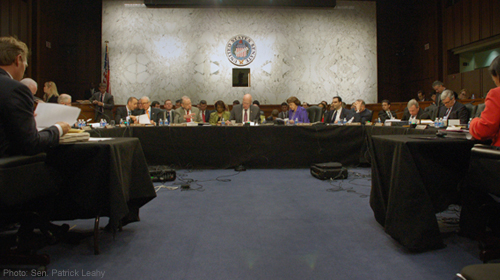
The House of Representatives on Wednesday passed a spending bill to fund the Department of Homeland Security (DHS) that included a package of amendments seeking to overturn the president's executive actions and to end the existing 2012 Deferred Action for Childhood Arrivals (DACA) program for DREAMers.
The harshest of the amendments include:
- The Aderholt Amendment, introduced by Rep. Robert Aderholt (R-Ala.), prohibits funds or fees to be used for the newly announced Deferred Action for Parental Accountability (DAPA) program and aims to undo the majority of the executive actions announced in November 2014. Repealing the DHS enforcement priorities would amount to a mass deportation strategy that would require DHS to treat all 11 million undocumented people as equal priorities for removal without regard to individualized circumstances.
- The Blackburn Amendment, introduced by Rep. Marsha Blackburn (R-Tenn.), freezes DACA, forcing hundreds of thousands of DREAMers back into the shadows and underground economy. It could also subject all DREAMers to deportation.
- The DeSantis Amendment, introduced by Rep. Ron DeSantis (R-Fla.), prevents ICE from setting enforcement priorities according to the November 2014 guidelines and could result in the deportation of victims of domestic violence.
The bill would also provide continued funding to maintain 34,000 immigration detention beds. The detention bed quota is completely arbitrary and perpetuates fiscally wasteful and irresponsible spending. Instead of funding immigration detention, Congress should appropriate money for community-based alternatives to detention with case management services, which have been proven to be effective and cost-efficient.
The immigrant community achieved a landmark victory in November. The amendments passed on the House DHS spending bill are aimed at scaring and confusing immigrant communities who stand to benefit from the new deferred action initiatives.
The Senate is expected to take up a DHS spending bill in early February. We urge the Senate to oppose these amendments which attempt to throw immigrant families back into the shadows of deportation.
Learn more about immigration reform and other civil liberty issues: Sign up for breaking news alerts, follow us on Twitter, and like us on Facebook.
Learn More About the Issues on This Page
Related Content
-
Press ReleaseMay 2026
Free Speech
Immigrants' Rights
After New Evidence Of Doj Misconduct, Mahmoud Khalil Calls On Board Of Immigration Appeals To Terminate Case. Explore Press Release.After New Evidence of DOJ Misconduct, Mahmoud Khalil Calls On Board of Immigration Appeals to Terminate Case
NEW YORK — In light of new evidence of misconduct by the Trump Administration, Mahmoud Khalil’s legal team is asking the Board of Immigration Appeals (BIA) to re-open his immigration case and terminate proceedings. The new evidence suggests that the Trump Administration secretly engineered the outcome of his immigration case to make an example of him. The motion includes declarations from former immigration judges, as well as former members of the BIA, testifying to the weaponization of the immigration court system to achieve the Trump administration’s political goals and the apparent procedural abnormalities in Mr. Khalil’s case. The filing shows that the BIA, which is controlled by the Trump administration’s Department of Justice, improperly influenced the lower immigration court’s decision, fast-tracked his proceedings, bypassed the normal channels through which immigration appeals are docketed and adjudicated, and ultimately reached a decision in an unheard-of nine days. The administration pressed all of this forward in open defiance of a federal district court order barring the government from using the “foreign policy ground”— the original pretext for Mr. Khalil's arrest — to detain or remove him. “The administration wants to arrest, detain, and deport me to intimidate everyone speaking out for Palestine across this country, and they are willing to violate longstanding U.S. rules and procedures to do it,” said Mahmoud Khalil. “This is the performance of due process the administration is offering me: putting me through a sham immigration process while guaranteeing the outcome in advance. But no lies, corruption, or ideological persecution will stop me from advocating for Palestine and for everyone's right to free speech.” The new evidence also includes reports that at least three judges on the BIA recused themselves from voting on the decision in his case, a highly unusual move that suggests they may have played a role in the immigration judge’s rulings from behind the scenes — despite the judge being legally obligated to exercise her own independent judgment. Allegations of misconduct in Mr. Khalil’s case are corroborated by growing evidence that the Executive Office of Immigration Review leadership and other top government officials pressured judges to issue predetermined decisions and expedite deportations — particularly in high-profile cases like Mr. Khalil’s — despite the agency being legally obligated to provide noncitizens a full and fair hearing on their claims. “It’s clear that the revelations of DOJ misconduct corroborate what we have known since Mahmoud was arrested–that the administration has reverse-engineered its desired outcome by weaponizing a farcical proceeding littered with abnormalities,” said Johnny Sinodis, partner at Van Der Hout LLP. “The administration has to be held to account, and the government’s case against Mahmoud must be thrown out. Transparency also dictates that the government produce any records regarding the handling and adjudication of Mahmoud’s case. The apparent interference with the Immigration Judge’s decision making is not only unconstitutional but also violates the government’s own rules and procedures.” This filing with the BIA comes as Mr. Khalil waits for the full Third Circuit Court of Appeals to decide whether they will re-hear the government’s appeal of the district court’s orders prohibiting his detention and deportation. While that is pending, the Third Circuit panel’s order overturning the district court’s orders is not currently in effect and the Trump administration cannot lawfully re-detain nor deport Mr. Khalil at this time. Last weekend, Mr. Khalil’s legal team also filed an appeal with the Fifth Circuit Court of Appeals, urging it to reverse the BIA’s removal order and terminate the proceedings entirely. As the legal team has repeatedly made clear, the immigration judge rushed to a decision without considering relevant evidence and refused to consider the constitutional challenges to his deportation, and improperly sustained false, after-the-fact charges that the Trump administration brought in retaliation for Mr. Khalil’s speech. This Fifth Circuit appeal will proceed regardless of whether the stay of the mandate is granted in the Third Circuit. Mr. Khalil is represented by Van Der Hout LLP, Dratel & Lewis, the Center for Constitutional Rights, CLEAR, Washington Square Legal Services, the American Civil Liberties Union (ACLU), the New York Civil Liberties Union (NYCLU), the ACLU of New Jersey, and the ACLU of Louisiana. The motion can be viewed here.Court Case: Khalil v. TrumpAffiliates: New York, New Jersey -
Press ReleaseMay 2026
Immigrants' Rights
Federal Court Blocks Key Provisions Of S.b. 4, Texas’ Extreme Anti-immigration Law. Explore Press Release.Federal Court Blocks Key Provisions of S.B. 4, Texas’ Extreme Anti-Immigration Law
AUSTIN, Texas — The U.S. District Court for the Western District of Texas granted provisional class certification and a motion for preliminary injunction Thursday blocking four key provisions of Texas Senate Bill 4 (88-4). In his order, the judge states that “S.B. 4 could open the door to each state passing its own version of immigration laws. The effect would moot the uniform regulation of immigration throughout the country and force the federal government to navigate a patchwork of inconsistent regulations.” The 2023 law is one of the most extreme anti-immigrant laws ever passed by any state legislature in the country. The American Civil Liberties Union of Texas, ACLU, and the Texas Civil Rights Project filed the class-action lawsuit on May 4. The following provisions remain blocked: The reentry crime that would apply to anyone living in or traveling through Texas who reentered the United States — even if the person had federal permission to reenter or has since obtained lawful immigration status such as a green card. The power given to magistrates — who don’t know the intricacies of immigration law — to issue deportation orders. The crime of failing to comply with the magistrate’s removal orders. The requirement that magistrates continue a prosecution even when a person has a pending immigration case under federal law. The illegal entry provision will go into effect May 15. While not a formal part of this suit, the provision suffers from the same constitutional problems as the rest of the law. The following is a joint statement from legal counsel: “The court's decision reaffirms what every court that has reviewed the merits of S.B. 4 and laws like it has held: Immigration enforcement is exclusively a federal issue and not up to the states. S.B. 4 would instill fear in our communities, cause widespread racial profiling, and subject lawfully present immigrants to arrest, detention, and deportation. Texas cannot override the U.S. Constitution and should stop wasting time attempting to do so.” The individual plaintiffs in the class action lawsuit now represent thousands of people across the state who may be criminally prosecuted for violating the reentry provision of S.B. 4. One plaintiff is a lawful permanent resident. A second plaintiff was provisionally approved for a lawful U Visa, a step on the path toward citizenship, which she was found eligible for after becoming the victim of a crime and helping law enforcement resolve the case. The district court ruling comes shortly after the en banc 5th Circuit Court of Appeals vacated a preliminary injunction in Las Americas Immigrant Advocacy Center et al v. Steven C. McCraw et al solely on the grounds that plaintiffs El Paso County, Las Americas Immigrant Advocacy Center, and American Gateways lacked standing — reversing its own three-judge panel decision from July 2025, which had found standing and held S.B. 4 to be preempted by federal law. This new lawsuit addresses the 5th Circuit's procedural concerns. Access the court order here.Court Case: LML v. Martin -
Press ReleaseMay 2026
Immigrants' Rights
Aclu Applauds U.s. Appellate Court Decision Upholding Detained Immigrants’ Right To Bond Hearings. Explore Press Release.ACLU Applauds U.S. Appellate Court Decision Upholding Detained Immigrants’ Right to Bond Hearings
The American Civil Liberties Union and ACLU of Michigan applauds today’s federal appeals court decision holding that U.S. Immigration and Customs Enforcement (ICE) is illegally detaining immigrants without access to bond hearings. The decision is expected to affect thousands of people in Michigan, Ohio, Tennessee, and Kentucky illegally detained by ICE. The court rejected the government’s argument that it should “subject long-term law-abiding residents of the United States, such as Petitioners, to the hardship of mandatory detention without due process.” The Court found that such detention is contrary to the Constitution, immigration law, and “almost three decades of [government] practice” of providing bond hearings. Issued by the Sixth District Court of Appeals, the 2-1 decision in Lopez-Campos v. Raycraft reflects arguments made by the ACLU and others in four consolidated cases centering on a Trump administration directive that denies detained noncitizens their right to bond hearings that provide the opportunity for release, all in violation of the federal immigration statute and the Constitution. The administration’s directive reverses a decades-long practice of providing noncitizens who were living in the United States when detained by ICE the right to go before an immigration court judge and ask to return home while their case proceeds (which can take months or even years). The appeals court decision upholds four separate decisions issued last year by federal district court judges in Michigan, who ruled that long-time residents of the U.S. — many of whom have U.S. citizen families and some of whom have lived here since infancy — were unlawfully and unconstitutionally being denied access to bond hearings. Hundreds of federal judges have issued similar rulings in thousands of cases around the country. As the decision concludes: “Petitioners are more than just names on a pleading... Petitioners have lived in the United States for years or decades... All appear to contribute to their neighborhoods and local communities. Many are the primary breadwinners or essential caregivers for their families, which include their children who were born here and are citizens of the United States.” The following is reaction to the ruling: Miriam Aukerman, director of strategic litigation for the ACLU of Michigan: “We are delighted that our clients will be able to remain at home with their families where they belong. The goal of the Trump administration’s cruel detention policy is to lock people up, break their spirits, and make them so desperate that they agree to leave their loved ones. The cruelty of this policy is no accident. Cruelty is the point. We are heartened by the court’s decision which stops this needless suffering and forces the administration to abide by the law.” My Khanh Ngo, senior staff attorney with the ACLU’s Immigrants’ Rights Project, who argued the appeal: “The courts have yet again correctly rejected the Trump administration’s inhumane mandatory detention policy, concluding its reinterpretation of our country’s detention laws is illegal. We are thrilled for our clients and their families.” Ramis Wadood, ACLU of Michigan staff attorney: “Today’s decision is good news, not just for immigrants and their families, but for everyone who believes in the rule of law and the Constitution. With freedom from detention at stake for potentially millions of people, this decision helps guide us back to the approach that had been in place for decades: the opportunity for immigrants to fight for their right to stay in this country, at home, where they can take care of their families and contribute to their communities.” The ruling is here.Affiliate: Michigan -
Press ReleaseMay 2026
Immigrants' Rights
Aclu, Partners File New Lawsuit Challenging s.b. 4, texas’ deportation scheme . Explore Press Release.ACLU, Partners File New Lawsuit Challenging S.B. 4, Texas’ Deportation Scheme
The legal team is seeking emergency relief to block several provisions of the law from taking effect May 15 AUSTIN, Texas — The American Civil Liberties Union, ACLU of Texas, and the Texas Civil Rights Project have filed a class-action lawsuit seeking a temporary restraining order and preliminary injunction to block several provisions of Senate Bill 4 (88-4) from going into effect May 15. The 2023 law is one of the most extreme anti-immigrant laws ever passed by any state legislature in the country. S.B. 4 would allow local and state law enforcement to arrest, detain, and remove people they suspect to have entered Texas from another country without federal authorization. The organizations are specifically seeking to prevent four different provisions of the law from going into effect, including: The reentry crime that would apply to anyone living in or traveling through Texas who reentered the United States without federal authorization — even if the person had federal permission to reenter or has since obtained lawful immigration status such as a green card. The power given to magistrates — who don’t know the intricacies of immigration law — to issue deportation orders. The crime of failing to comply with the magistrate’s removal orders. The requirement that magistrates continue a prosecution even when a person has a pending immigration case under federal law. Advocates have warned that the law will separate families and directly lead to racial profiling, subjecting thousands of Black and Brown Texans to the state prison system, which is rife with civil rights abuses. “S.B. 4 would transform our police and judges into immigration agents — threatening neighbors who have families here, who have lived here for years, even those who have legal status,” said Adriana Piñon, legal director at the ACLU of Texas. “Immigration enforcement is exclusively the federal government's arena, and no state has ever claimed the power Texas threatens to wield here. We are taking this back to court to defend our Texas communities.” The individual plaintiffs in the class-action lawsuit seek to represent thousands of people across the state who may be held liable for violating the reentry provision of S.B. 4. One plaintiff is a lawful permanent resident. A second plaintiff has been approved for a lawful U Visa, a step on the path toward citizenship, which she received after becoming the victim of a crime and helping law enforcement resolve the case. “Every court to have reached the merits of laws like S.B. 4 has found them to be unconstitutional,” said Cody Wofsy, deputy director of the ACLU’s Immigrants’ Rights Project. “S.B. 4 is cruel and illegal, and we will keep fighting it until it is permanently struck down.” The new filing comes shortly after the en banc Fifth Circuit Court of Appeals vacated a preliminary injunction in Las Americas Immigrant Advocacy Center et al v. Steven C. McCraw et al solely on the grounds that plaintiffs El Paso County, Las Americas, and American Gateways lacked standing — reversing its own three-judge panel decision from July 2025, which had found standing and held S.B. 4 to be preempted by federal law. This new lawsuit addresses the Fifth Circuit's procedural concerns. “Our fight against S.B. 4 isn’t over until justice wins,” said Kate Gibson Kumar, Beyond Borders staff attorney at Texas Civil Rights Project. “S.B. 4 is not only unconstitutional, but a vile law that uses our Texas resources to harm communities across our state. The Texas Civil Rights Project will keep fighting to protect Texas communities from the wrath of S.B. 4.” The en banc Fifth Circuit did not reach the constitutional questions at the heart of this case: whether S.B. 4 violates the Supremacy Clause of the U.S. Constitution and unconstitutionally strips the federal government of its exclusive authority over immigration enforcement. The complaint is here. The motion for a temporary restraining order and preliminary injunction is here.Court Case: LML v. Martin