Children Describe 'Despair, Loneliness, and Boredom' at Colorado Juvenile Detention Centers
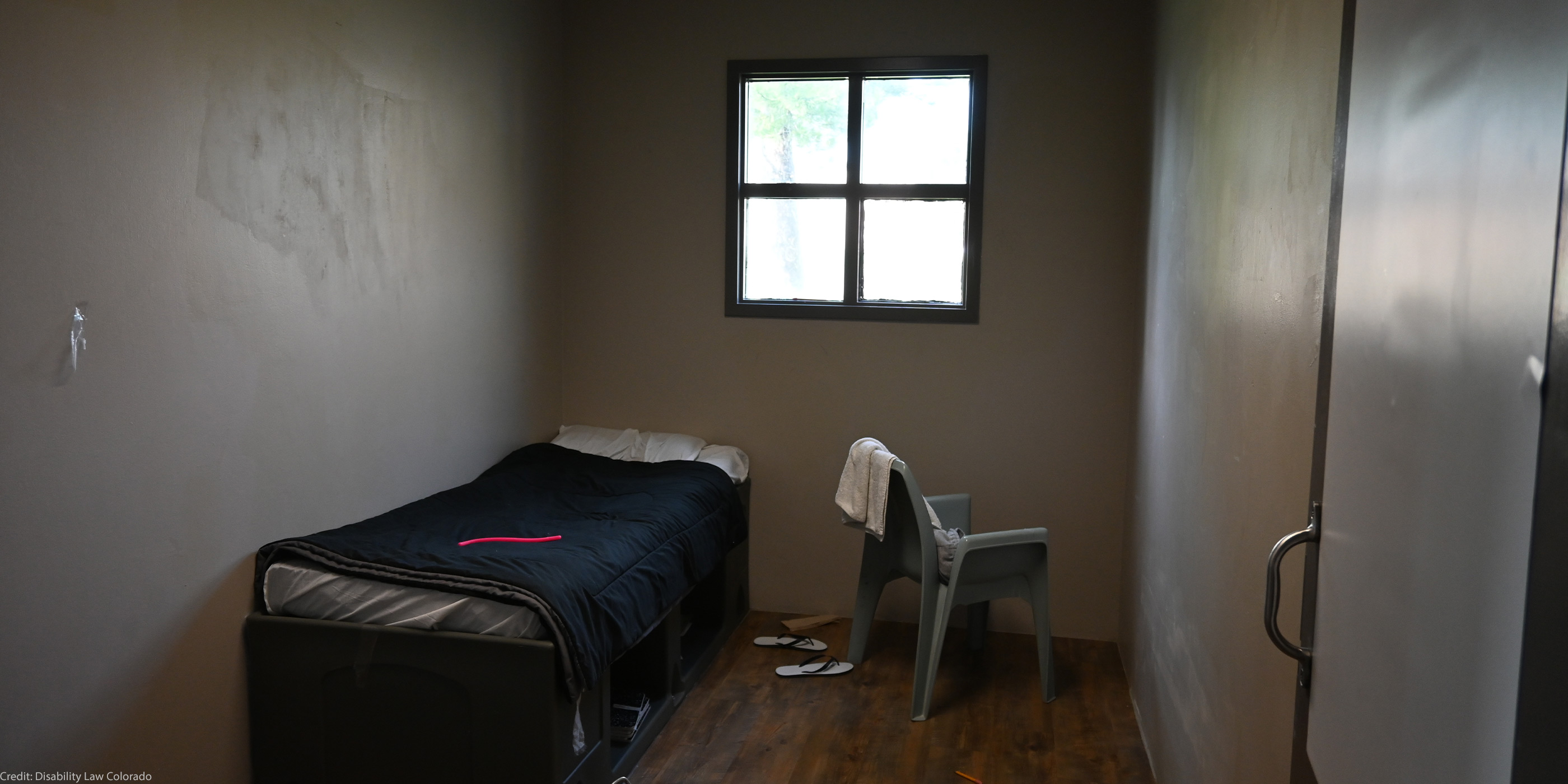
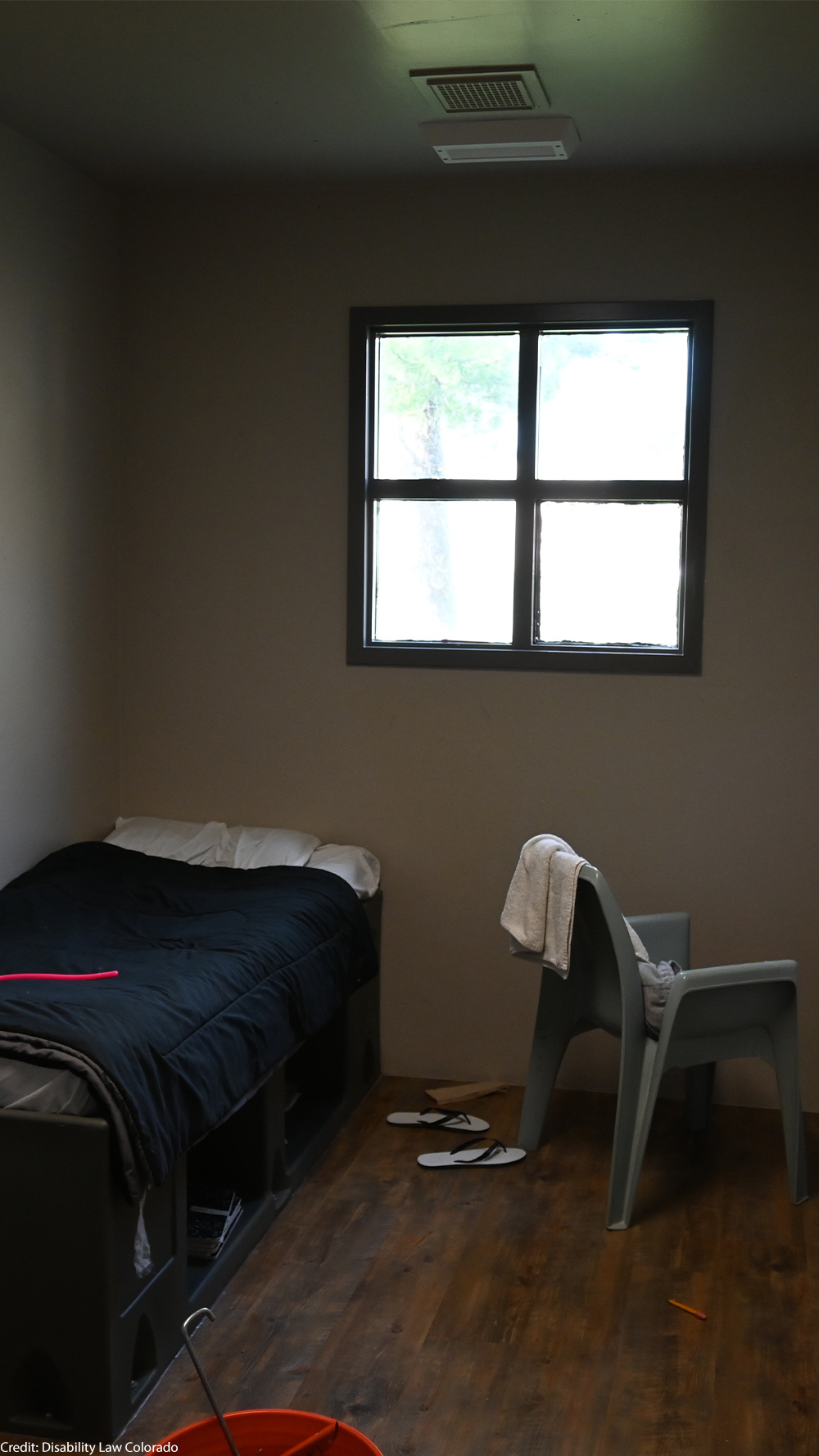
*Editor's Note: This photo was originally published by Disability Law Colorado in its recent report: Breaking Point: Conditions in the Colorado Division of Youth Services (2021–2025)
Tony S. is 12 years old and has been locked up for over six months, even though a Colorado judge in his delinquency case said he should be released. Tony has been diagnosed with autism spectrum disorder and a medical condition that causes cognitive impairments, behavioral issues, and developmental delays. He is scared to go to court in handcuffs. He wants to listen to country music and play board games, like other kids his age.
Tony, who's named using a pseudonym due to his status as a minor, is a named plaintiff in a class-action lawsuit filed in March by the ACLU National Prison Project, the ACLU of Colorado, advocacy organizations Children’s Rights and Disability Law Colorado, and the law firm Ropes & Gray. For hundreds of children like Tony, the judges in their delinquency cases have specifically said that they should not be locked up in detention but rather, released to a foster placement or back home, with services like therapy. Yet, these children languish for days, weeks, or months locked in detention facilities simply because of Colorado’s failure to find any other place for them. Children with disabilities and foster children are at particular risk of this unlawful detention.
The state’s failure to release children from jail to a more suitable, community-based setting violates their constitutional and statutory rights. For kids with disabilities, confining them in an institution when they could be in a community setting is a violation of the Americans with Disabilities Act. The Fourteenth Amendment also protects the right to be free from detention while a judge is deciding their case, a heightened protection afforded to children.
The conditions at a Division of Youth Services (DYS) Residential Youth Center in Colorado look shockingly like an adult jail. The doors are always locked. There’s barbed wire around the perimeter of the campus. The cell-like bedrooms have a bed, a plastic chair, and maybe a desk. There’s an overhead light that stays turned on all night so that staff can see through the window of the cell door. Kids are handcuffed when they leave the building, including when going to court. To the extent that there is any education, kids ages 12 to 17 are in the same classroom. Kids are often subject to strip searches and violent restraint tactics.
Kids here describe their days as filled with despair, loneliness, and boredom. In one video call, another 12-year-old boy said he spent his spring break doing very little — to his dismay. The break simply meant there were no classes, despite there being little else for kids to do in detention besides school. Instead, he taught himself how to shuffle a deck of cards. He asked if we could teach him the bridge part if we visited.
Any time that a child spends in detention can have long-term harmful effects. The harm is especially pronounced for kids who spend weeks and months in these restrictive settings. Research has shown that detention harms children physically, neurologically, psychologically, socially, developmentally, and academically. Time in detention derails education, disrupts relationships, limits kids’ future opportunities, and increases the likelihood a child remains involved with the system. This is not news to Colorado officials: The state has repeatedly acknowledged the harmful effects of detention on kids and has long been on notice of its failure to timely release children from detention to more community-integrated settings, as required by law.
Colorado is not an aberration. Many states are guilty of incarcerating children simply because it’s the easiest place to keep them. Instead of investing in community-based services and wraparound supports, states leave children to sit in detention, isolating them from their friends and families. Just this month, U.S. Senator Jon Ossoff and Representative Jen Kiggans issued a bipartisan Congressional report documenting this grim reality in several states. Last month, a proposed bill was introduced in the Tennessee Legislature that would allow locking foster children in detention for no other reason than the shortage of foster homes.
There are many places kids should be: in school, at a park with their friends, at sports practice, home with their siblings or parents, at a summer camp, or ballet class. Jail is no place for kids. Communities are where kids belong. Our lawsuit serves as a warning to states nationwide: The way governments treat and care for their most vulnerable children does not go unnoticed. Colorado must immediately invest in adequate processes and an array of placements and services to support children living in home settings, not in detention.
Related Issues
Related Content
-
Press ReleaseMar 2026

Juvenile Justice
Colorado Confines Hundreds Of Children In Dangerous Detention Facilities Instead Of Providing Legally Required Community Services, Lawsuit Alleges. Explore Press Release.Colorado Confines Hundreds of Children in Dangerous Detention Facilities Instead of Providing Legally Required Community Services, Lawsuit Alleges
Denver, CO – According to a federal class action lawsuit filed today, state officials are knowingly incarcerating children in highly-restrictive detention facilities, often for weeks or months on end, in violation of their Constitutional and statutory rights. The state is incarcerating children despite the fact that juvenile court judges have specifically found that these youth should be released to the community. For years, the lawsuit asserts, Colorado officials have known that they confine some of the State’s most vulnerable children, placing them at substantial risk. A vast body of research confirms that incarceration has uniquely harmful impacts on children, including physically, neurologically, psychologically, socially and academically. These harms often last into adulthood. Colorado's own statutes recognize the negative impacts of detention on the mental and physical well-being of children, including making it "more likely that the child or juvenile will reoffend." "When the state locks up children after a court has said they may be released, it sends a devastating message that they are problems to be contained rather than young people deserving care, support, and a real chance to thrive,” said Nancy Rosenbloom, senior litigation advisor at the ACLU’s National Prison Project. “Colorado officials have long known that judges have said these children should be released and can be safely supported in their communities, yet they continue to confine them in punitive, dangerous, harmful facilities. Instead of locking up releasable kids away from their families, teachers, and peers, the state must commit to programs and services that nurture young people and give every child the opportunity to succeed." The lawsuit names as defendants Colorado Governor Jared Polis and Michelle Barnes, Executive Director of the Colorado Division of Human Services (CDHS). It is brought by Disability Law Colorado, the American Civil Liberties Union (ACLU), ACLU of Colorado, Children’s Rights, and pro bono attorneys with Ropes & Gray LLP. Despite its own acknowledgements and repeated community calls for action, CDHS continues to let hundreds of young people who could be safely released to the community languish in confinement each year instead of providing placement and other services that can meet their needs. Many of these children are locked up for minor charges solely because they are already in foster care, and the State has not found them a placement or appropriate services. The majority of releasable children have disabilities, making it imperative they have access to therapeutic care in a non-segregated community-based setting. Colorado’s juvenile detention facilities are the functional equivalent of adult jails. All living, sleeping, and recreation areas are locked and guarded. Children are not free to move around. Staff may use physical restraints, confinement, or isolation when they think necessary for security. Children are not allowed to wear their own clothes and are issued standard uniforms, and are routinely strip searched for the most mundane of reasons. Internal records, state reports, and youth interviews describe facilities as dangerous places for children, with staff using excessive force to subdue them. One youth reported a staff member slammed him to the point of losing consciousness. The story of 17-year-old named plaintiff Isaac N. is all too familiar. He has been in a juvenile detention facility for almost two months despite a judge’s ruling that he could be returned to his community, where services that can be provided at home already exist to give him the treatment and therapy he needs to heal. Instead, during his confinement he watched seven adult staff members “take down” one youth, and heard staff use racial slurs against others. Isaac N. just wants to go to the movies and be a teenager. He hopes to finish his GED and pursue a trade, like HVAC. He wants to follow the example of positive adult role models in his life. Isaac N. says he does not understand why he is “stuck” inside a place that is hurting him instead of helping him. “Youth with disabilities are among the most vulnerable in detention facilities and face some of the greatest harm when systems fail. This lawsuit underscores Colorado’s failure to provide the community-based services these children need,” said Emily Harvey, co-legal director for Disability Law Colorado. “Far too many children have languished pretrial in dangerous facilities for far too long. Now, we seek an end to this untenable status quo,” said Emma Mclean-Riggs, senior staff attorney at the ACLU of Colorado. “Jails and handcuffs are not acceptable substitutes for foster homes and therapeutic care." "Colorado is incarcerating releasable children, when what they need is services and care. Shockingly, this includes foster children, whom the state is supposed to be keeping safe, but is instead leaving in dangerous detention facilities for long periods of time. In fact, foster children are staying in detention longer than other youth -- often double the average,” said Stephanie Persson, senior staff attorney at Children’s Rights. “It's time for the State to take the steps necessary to ensure these children’s safety and bring them home to their communities, where they have a chance at a decent childhood and of growing into a healthy and productive adult." “We are honored to join with Disability Law Colorado, the ACLU, and Children's Rights to advocate on behalf of Colorado's most vulnerable young people,” said Timothy Farrell, Ropes & Gray partner. “We remain hopeful that this action will stop the State’s practice of indiscriminate incarceration of young people in favor of settings where they have access to the services, support, and therapeutic care they need to thrive.” -
Press ReleaseJul 2025
Juvenile Justice
Aclu Of Wisconsin Files Brief In Case Advocating For The Rights Of Students During School Interrogations. Explore Press Release.ACLU of Wisconsin Files Brief in Case Advocating For the Rights of Students During School Interrogations
MADISON — The ACLU of Wisconsin and co-counsel from the national American Civil Liberties Union’s State Supreme Court Initiative filed an amicus brief asking the Wisconsin Supreme Court to protect students' constitutional rights when police question them at school. The case centers on a police interrogation of a 12-year-old student who was pulled out of class and brought to a school office, where a school resource officer questioned him. In contrast, a fully uniformed and armed police officer stood between him and the closed door. The student, who had no prior experience with the police, was subjected to confrontational and accusatory questioning and never read his Miranda rights. In the brief, the ACLU of WI argues that questioning a student in this manner violates the Wisconsin Constitution. The brief further urges the Court to decide this case under the Wisconsin Constitution, instead of or in addition to the U.S. Constitution, to fully protect Wisconsinites from eroding civil rights on the federal level. Numerous courts in other states have ruled that questioning students in similar situations violated the students’ Fifth Amendment rights against self-incrimination, Fourteenth Amendment due process rights, and similar provisions in their state constitutions. It is time that the Wisconsin Supreme Court does the same. “Far too often, children entangled in the criminal legal system are questioned without a parent or attorney present. As a result, they face criminal charges, prosecution, and incarceration without the fundamental due process rights that adults are entitled to,” said Ryan Cox, legal director of the ACLU of Wisconsin. Broad protections for school children interacting with law enforcement are especially vital in Wisconsin, where students encounter law enforcement while at school significantly more than the national average. Wisconsin schools refer students to the police at the fourth-highest rate in the nation. In the 2019-2020 school year, Wisconsin students were referred to the police while at school at 200% of the national rate,” Cox said. “While these statistics are concerning on their own, the situation is particularly dire for Black and Brown children and children with disabilities,” said Bridget Lavender, Legal Fellow with the ACLU’s State Supreme Court Initiative. “The data confirms what many Wisconsin students and parents already know: these students are significantly overpoliced and punished more harshly at school.” “Students retain their constitutional rights, including the right to remain silent and seek counsel when interacting with law enforcement, even in the school environment. Police are not exempt from their responsibilities to uphold the rights of a person simply because the student is a minor in a school environment,” Cox said. “The ACLU of Wisconsin’s amicus brief asks the Wisconsin Supreme Court to reaffirm this fundamental principle and protect Wisconsin students across the state from coercive and unconstitutional police conduct.” -
Wisconsin Supreme CourtJul 2025

Civil Liberties
+2 Issues
State V. K.r.c.. Explore Case.State v. K.R.C.
This case asks whether a 12-year-old boy was in custody and entitled to Miranda warnings during a closed-door police interrogation by a school resource officer in the school building. The court of appeals held that he was not in custody, not entitled to Miranda warnings, and voluntarily incriminated himself. The ACLU’s State Supreme Court Initiative and the ACLU of Wisconsin filed an amicus brief arguing that admitting the boy’s statements into evidence not only violated the Fifth Amendment to the U.S. Constitution but Article I, Section 8 of the Wisconsin Constitution, and urging the Wisconsin Supreme Court to rest its decision on the state charter to better protect Wisconsinites’ civil liberties. -
Montana Supreme CourtAug 2026
Juvenile Justice
+2 Issues
Held V. State. Explore Case.Held v. State
In 2020, in Held v. Montana, sixteen youth plaintiffs challenged Montana’s energy policy as violating the Montana Constitution. After several years of litigation, the Montana Supreme Court affirmed that Montanans have a constitutional right to a clean and healthful environment. In January 2026, Montana youth filed a second case, Held II, to enforce the Court’s decision after the Legislature enacted new laws that the plaintiffs contend undermine the constitutional protections recognized in the Court’s earlier decision and permit continued approval of fossil fuel projects that worsen climate harms. The State moved to transfer Held II to a different district under SB 97, a law that gives the government a special right to forum shop in cases challenging new laws and makes it significantly harder for Montanans to pursue such challenges. SB 97 thus raises serious access-to-justice concerns in this case and any others in which people are seeking relief from allegedly unconstitutional laws.