ICE Agents to Wear Body Cameras But the Fix is In
Subscribe to the Free Future Newsletter
Or get immediate notifications of new posts via Substack
Free Future home
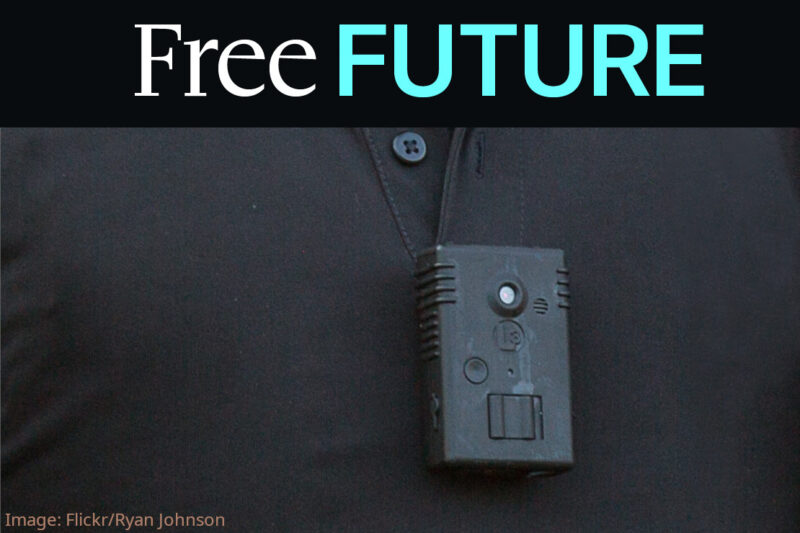
After years of delays, ICE has announced that it will equip all officers with body cameras. But, the agency’s policy says that it will retain broad control over what videos are released to the public — and that in particular it will only release footage of serious bodily injuries and deaths in custody if “it is in the best interests of the agency.” This is exactly the opposite of a policy that will make body cameras an effective oversight and accountability measure.
At the ACLU we’ve been saying from the beginning that body cameras won’t be an effective accountability measure unless they’re accompanied by good policies on exactly how they’re used — and that foremost among those policies must be ensuring appropriate public release of recordings. Without good policies, police body cameras are reduced to yet more government surveillance devices, with all that implies (such as over-policing and prosecution), and to propaganda systems that let agencies publicize videos showing officers in a positive light while burying those that don’t.
Some states and cities certainly have good policies and practices for the appropriate release of body camera videos where the public has a compelling interest in such access (such as after a shooting, as opposed to recordings of privacy-invasive situations where the public’s interest is low — see our model policy for details). But the failure of many states and municipalities to enact such policies has been a big reason why the technology has been substantively ineffective at reducing police shootings and abuses.
Most police departments trying to bury footage at least attempt to make bogus claims about the public interest, such as by citing the needs of “an active investigation.” With characteristic Trump Administration arrogance, however, ICE is not even trying to pretend that blocking release of body camera footage will be in the best interests of the public or of the nation — they explicitly say that they will release footage only when it’s in the best interests of the agency.
This immediately brings to mind the brilliant Pournelle’s Law, which says that “In any bureaucratic organization, there will be two kinds of people: those who work to further the actual goals of the organization and those who work for the organization itself,” and that “the second group will always gain control.” That’s a recognition that the narrow protective bureaucratic instincts and actions of an agency not only don’t necessarily match the public good, they often don’t even match the agency’s mission.
And we know what those protective instincts look like: burying videos showing abuse. After more than 6 months, DHS has still not released footage from the body cameras worn by four officers at the Minneapolis shooting of Alex Pretti. There have also been serious problems with compliance with and enforcement of body camera rules. Last year, a Chicago judged ordered immigration agents to use body cameras in their operations there, but compliance was questionable. In one high-profile incident, only one of three Border Patrol agents at the scene activated their camera, for example. This is something that we’ve seen for years at the local level — and all indications are that the lawless and undisciplined DHS immigration agencies are likely to match the worst rather than the best US police departments on that score.
DHS and other federal police agencies generally lack good body camera policies or federal legal requirements, including around the release of video. Of course, even with bad or absent policies, some incidents have been recorded with body cameras that have saved people from charges based on lies by federal agents. Certainly, many wish there was body camera video of recent DHS agency shooting deaths in Texas and Maine. But overall, without good rules, body cameras can be worse than nothing by giving agencies footage to use and misuse as they like.
The larger issue
The new body camera deployment comes in a context of frequent and ongoing violations of human rights and the Constitution by ICE and other DHS agencies. Even with good policies, no amount of body cameras are likely to rein in the chaos and cruelty of our growing national deportation policing force. Far deeper reforms are needed. US lawmakers need to go beyond calling for masks to come off and body cameras to go on, and enact much more far-reaching reforms of agencies that are fast-becoming a blueprint for authoritarianism in the United States.
In particular, as my colleagues recently outlined in a major ACLU report, Congress should enact such measures as a restructuring of the immigration agencies, a repeal of legal immunities they enjoy, an end to mass immigrant detention, and the creation of fair, dignified, and efficient citizenship and immigration rules.
Instead of focusing on just trying to get DHS agencies to record their violence and abuse, Congress should be more focused on ending it. The idea of body cameras is appealing to many, but in the end it is only a band-aid — and they only work if they constrain the power of law enforcement. We have seen locally that in too many departments, police officers do not want to be so constrained, and their management is not inclined to force them to be. When it comes to deployment of this technology at the federal level, it’s pretty clear that here, too, the fix is in.
Related Issues
Related Content
-
Oregon Supreme CourtAug 2026

Privacy & Technology
State V. Lane. Explore Case.State v. Lane
Oregon law enforcement, without a warrant, installed surveillance cameras on two telephone poles near Petitioner’s home and recorded activity there for a month. The State argues that police can continuously surveil our most private spaces—our homes—without judicial oversight. The ACLU's Speech, Privacy, and Technology Project and State Supreme Court Initiative, alongside the ACLU of Oregon and the Oregon Criminal Defense Lawyers Association, filed an amicus brief arguing that police were required to obtain a warrant before conducting the extensive pole-camera surveillance at issue this case. -
Press ReleaseSep 2026

Privacy & Technology
Aclu Urges Senate To Block Ai Experimentation Provision In Crypto Bill. Explore Press Release.ACLU Urges Senate to Block AI Experimentation Provision in Crypto Bill
WASHINGTON — The Senate will take a procedural vote on the Clarity Act today, which includes a provision that would give companies a free pass to experiment on “AI test projects” without transparency or oversight. The American Civil Liberties Union argues that this is unneeded both because of how fast artificial intelligence is already growing, and also because of the harm it could cause to individuals’ rights. “Companies have plenty of freedom to do basic research on AI. But they shouldn’t have the freedom to use the American people as guinea pigs by subjecting them to harmful experiments that violate existing laws meant to protect people,” said Jina John, senior policy counsel on AI at the ACLU. “At the very moment that AI leaders are warning of catastrophic risks and urging Congress to regulate AI, Congress must not pass any law that would endanger people’s rights and liberties for the sake of AI experimentation.” Section 509 of the bill would establish a scheme for companies to seek waivers from any regulation from a financial regulator, including those related to privacy, security, consumer protection, and civil rights. That means companies could conduct AI experiments that risk exposing consumers’ financial data or be used to develop products that make decisions about lending, housing, and other important areas without providing notice about adverse actions or considering the potential for discrimination, all without oversight. The ACLU and a coalition of other rights groups recently sent a letter to Congress outlining the dangers of this provision for privacy rights and the right to be free from discrimination in key economic transactions. -
Press ReleaseSep 2026
Free Speech
Privacy & Technology
Aclu, Aclu Of D.c., And National Press Photographers Association Tell Court That Blocking Drone Photography Of Dhs Operations Violates First Amendment. Explore Press Release.ACLU, ACLU of D.C., and National Press Photographers Association Tell Court that Blocking Drone Photography of DHS Operations Violates First Amendment
WASHINGTON – Today, the American Civil Liberties Union (ACLU), the ACLU of D.C., and the National Press Photographers Association filed an amicus brief in support of a Minnesota photojournalist’s lawsuit challenging the Federal Aviation Administration's (FAA) Temporary Flight Restrictions (TFR). Earlier this year, as ICE was carrying out brutal immigration raids across the country, the FAA dramatically expanded restrictions on drone flights, banning such flights over any Department of Homeland Security (DHS) facility or “mobile asset,” which included any DHS vehicle. As the amicus explains, the TFR made it functionally impossible for journalists to use drones to gather news in any area where immigration enforcement agents were deployed, violating the First Amendment right to record public officials performing their duties in public. “The FAA’s restriction forced journalists reporting on immigration enforcement activity to ground their drones or risk criminal charges. This choice is unacceptable, unconstitutional, and runs roughshod over the First Amendment right to gather news,” said Scarlet Kim, senior staff attorney with ACLU’s Speech, Privacy, and Technology Project. The brief explains that the FAA’s restriction was not about public safety or national security. Journalists were previously already advised and generally adhered to avoiding airspace around sensitive locations, such as active military bases, airports, and aircraft carriers. Moreover, press drones weren’t interfering with official activity or putting anyone at risk by capturing immigration enforcement activity unfolding in public. "Under Trump, even the Federal Aviation Administration has become a political censor,” said Arthur Spitzer, senior counsel at ACLU-D.C. “The agency should be protecting the safety of the flying public, not protecting ICE from unfavorable news coverage.” The brief further explains that journalists were effectively being censored beyond their DHS coverage, since the unpredictability of where any DHS vehicle may be traveling made it functionally impossible for journalists to use drones for any newsgathering in areas where immigration enforcement agents were deployed without putting themselves at risk of severe legal and financial penalties. “Drones have become essential, safe, and economical tools for documenting government activity and other matters of public concern. By creating an unpredictable moving exclusion zone around DHS assets, the FAA forced visual journalists to choose between abandoning lawful newsgathering and risking severe penalties,” said Mickey H. Osterreicher, general counsel for the National Press Photographers Association. “Safety restrictions must be narrowly tailored and consistent with the First Amendment, especially when they limit the public’s ability to observe government officials performing their duties.” -
New HampshireSep 2026
Privacy & Technology
Lavalley V. Concord Housing And Redevelopment Authority. Explore Case.LaValley v. Concord Housing and Redevelopment Authority
On September 2, 2026, the ACLU, ACLU of New Hampshire and New Hampshire Legal Assistance brought a class action lawsuit against the Concord Housing and Redevelopment Authority for installing and operating surveillance devices in tenants’ apartments. The devices collected hundreds of millions of data points recording movement, sound levels, and other information from inside tenants’ homes.