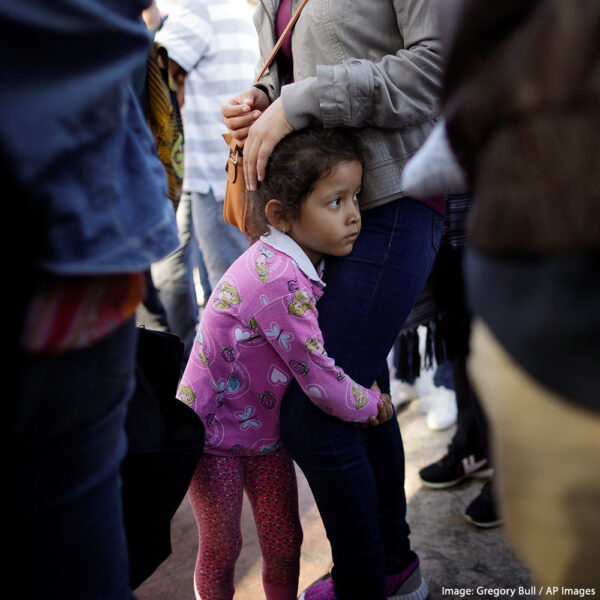
Why Is America So Keen on Separating Families?
January 27, 2022
This week we’re going to talk about families, and a uniquely American hypocrisy surrounding them. On the one hand, politicians are always talking about supporting strong, nuclear families, and in some ways, we do. We give tax breaks to people who get married and have children. Kids eat free at Denny’s on Tuesdays. Yet, also in America, government officials at the federal, state, and local levels are tearing families apart by the thousands under the cover of our laws.
For example, in the Trump administration, the Department of Homeland Security forcibly separated more than 5,000 migrant parents from their children – some as young as 4 months old – under Trump’s “zero tolerance” border policy. To this day, a thousand children and maybe more are yet to be reunited with their families. They remain stranded and alone.
Candidate Joe Biden had called the policy “criminal. But in December the Justice Department walked away from settlement talks with lawyers representing those families.
And immigration enforcement isn’t the only way we destroy families. The criminal justice system and the child welfare system do it too, in astonishing numbers, and usually to the most vulnerable among us.
To discuss this double-standard–propping up some families while destroying others–the and the continued trauma and ongoing battle of separated families is Lee Gelernt, deputy director of the ACLU’s Immigrants’ Rights Project, who has steered the border separation litigation from the beginning. Joining him is Shanta Trivedi, assistant professor at the University of Baltimore Law School and faculty director of the Meyerhoff Center for Families, Children, and the Courts – a foremost expert on the law around family trauma.
In this episode
Somil Trivedi


Shanta Trivedi

This Episode Covers the Following Issues
Related Content
-
Press ReleaseOct 2026

Human Rights
Aclu Congratulates Navanethem ‘navi’ Pillay For Winning Nobel Peace Prize. Explore Press Release.ACLU Congratulates Navanethem ‘Navi’ Pillay for Winning Nobel Peace Prize
NEW YORK – Today, the American Civil Liberties Union applauded the Norwegian Nobel Committee's decision to award Navanethem, 'Navi', Pillay the Nobel Peace Prize for 2026 for her tireless championing and enforcement of international law. The Norwegian Nobel Committee designated this year’s laureate in acknowledgement of her impact on international law. Ms. Pillay has served as a judge on the High Court in South Africa, the International Criminal Tribunal for Rwanda, and the International Criminal Court (ICC). Previously, she was the United Nations (UN) High Commissioner for Human Rights and, until recently, chaired the UN Independent International Commission of Inquiry on the Occupied Palestinian Territory. Today, Navi Pillay is a judge on the International Court of Justice. "At a time of rising authoritarianism at home and abroad, it is more important to recognize the heroes who are protecting human rights and upholding international law," said Anthony D. Romero, executive director of the ACLU. "Ms. Pillay's commitment to the rule of law and pursuit of justice, and the impact of her work in the United States and across the globe, make her uniquely qualified for the Nobel Peace Prize." The acknowledgement of Ms. Pillay’s human rights work comes at a time when the Trump administration has pursued efforts to erode pathways of international accountability and justice, including sanctions against the International Criminal Court. The celebration of her work underscores the importance of preserving and recognizing global justice and human rights accountability bodies. "The decision to recognize and honor Ms. Pillay comes at a time when the United States under the Trump administration continues to flout international law and is attempting to dismantle global justice institutions that provide accountability for human rights violations," said Jamil Dakwar, director of the ACLU's Human Rights Program. "We greatly welcome this recognition of Ms. Pilay and hope her extraordinary career and work for justice serves as an example for leaders in the United States and around the world to uphold their human rights obligations and pursue justice for all." -
Press ReleaseOct 2026
Human Rights
Aclu Statement On President Trump’s Latest Attack On The International Criminal Court. Explore Press Release.ACLU Statement on President Trump’s Latest Attack on the International Criminal Court
NEW YORK - Today, the Trump administration announced sanctions on the entire International Criminal Court, only hours after one of the court’s former judges won the Nobel Peace Prize. Previously, the United States had sanctioned specific ICC officials, a UN human rights expert, and three Palestinian human rights groups. The international community, including the United States, established the ICC in 1998 to help maintain international peace and security. The ICC investigates and prosecutes atrocity crimes when domestic legal systems are unwilling or unable to do so. 125 countries have joined the international treaty creating the ICC, known as the “Rome Statute.” While the United States has not ratified the Rome Statute, it has supported the ICC’s critical work on a wide range of matters under both Democratic and Republican administrations. “The Trump administration's continued attempts to dismantle the International Criminal Court are disastrous for global justice and human rights accountability,” said Jamil Dakwar, director of the ACLU's Human Rights Program. “We condemn the latest sanctions, which could undercut the ICC's ability to investigate and prosecute atrocities such as genocide, crimes against humanity, and war crimes, and make it even harder for survivors to get justice. We cannot move backwards and let the Trump administration take the world further down a path of impunity and injustice." The ACLU represents two U.S. human rights advocates in a federal lawsuit challenging President Trump’s initial sanctions targeting the ICC on Feb. 6, 2025. As the lawsuit explains, the sanctions violate the First Amendment by prohibiting the advocates, and other Americans like them, from communicating with the ICC, including by providing legal advice, expert analysis, and evidence. In August, the ACLU and 10 other civil liberties and human rights organizations belonging to the International Network of Civil Liberties Organizations (INCLO) called on the European Commission to protect individuals and organizations targeted by U.S. ICC sanctions from their extra-territorial reach by immediately activating the Council of Europe Regulation (EC) No 2271/96 (‘the Blocking Statute’). -
Press ReleaseOct 2026
Immigrants' Rights
+3 Issues
New Aclu Report Sounds The Alarm On How Trump Administration’s Mass Deportation Agenda Is Eroding Democracy. Explore Press Release.New ACLU Report Sounds the Alarm on How Trump Administration’s Mass Deportation Agenda is Eroding Democracy
WASHINGTON — The American Civil Liberties Union today released a new report, 76 Ways Mass Deportation is Breaking Our Democracy, detailing how the Trump administration is using mass deportation as the pretext and mechanism to attack civil liberties and structural democratic safeguards at an unparalleled scale and speed. The report comes as Immigration and Customs Enforcement (ICE) arrests have hit a record high, as the Trump administration has shifted its approach from mass raids to more discrete arrests following widespread outrage. From the deployment of federal agents and military troops for immigration enforcement in U.S. cities, to the mass revocation of visas and other forms of lawful status, and the targeting of immigrants’ rights protesters, the Trump administration has repeatedly used immigration policy as a trojan horse for attacks on core pillars of U.S. democracy. Notably, the report categorizes the dizzying array of abuses into three major categories, which often overlap: Attacks on civil rights and liberties, as the Trump administration has used mass deportations as both a pretext and distraction for its assault on myriad constitutional rights – including the rights to free speech and freedom of assembly and due process – impacting citizens and noncitizens alike. Attacks on democratic checks and balances, as the administration expands its federal deportation police and executive power, eviscerating due process for immigrants and normalizing ICE’s violence, while evading and even defying court orders. Attacks on multiracial, pluralistic democracy, as the administration continues to gut existing legal protections and introduce new policies targeting people who are immigrants – including through visa and entry bans and efforts to end birthright citizenship and Temporary Protected Status (TPS) – in what appears to be a calculated attempt to change the racial makeup of the U.S. now and into the future. “For the past year and a half, the ACLU and advocates have warned that the Trump administration’s mass deportation agenda pulls straight from an authoritarian playbook – and now, we’re seeing the devasting impacts of those policies, with citizens and noncitizens alike paying the price and the state of our democracy in crisis,” said Naureen Shah, director of immigration policy and government affairs at the ACLU. “This report is a clarion call to members of Congress to strengthen and repair our pluralistic, multiracial democracy by passing meaningful immigration reforms. That must include creating a broad path to citizenship for immigrants who contribute to our communities and our economy.” Within the report, the ACLU also calls on members of Congress to restore and defend democratic rights and norms through transformative immigration reform, including by creating a broad path to citizenship and modernization of border processing and policies. It also calls on lawmakers to build stronger accountability, transparency and oversight measures to effectively compel the executive branch to uphold civil rights and civil liberties. “From the cancellation of Congressionally mandated protections like TPS to the arrest of noncitizen students for exercising their First Amendment rights, the Trump administration has repeatedly violated bedrock democratic principles under the guise of immigration enforcement,” said Sarah Mehta, deputy director of immigration policy and government affairs at the ACLU. “As this administration has shown, no one is safe from its extreme mass deportation agenda. Our elected officials – and the state of our democracy – cannot afford to allow this lawlessness to continue. The time to act is now.” This report is the fourth in the ACLU’s affirmative immigration vision series, in which policy and legal experts explore how the Trump administration’s immigration agenda has harmed communities nationwide, undermined our democracy, and wreaked havoc on key industries and weakened the American workforce. The series will also outline steps that members of Congress, as well as state and local policymakers, can take to reform the U.S. immigration system and inoculate against future attacks on core rights and safety. You can read the full report here: https://www.aclu.org/publications/76-ways-mass-deportation-is-breaking-our-democracy -
Press ReleaseSep 2026
Immigrants' Rights
Human Rights
District Court Grants Order Prohibiting Ice From Detaining Immigrants In Abusive Conditions At 26 Federal Plaza . Explore Press Release.District Court Grants Order Prohibiting ICE from Detaining Immigrants in Abusive Conditions at 26 Federal Plaza
NEW YORK – A U.S. District Court granted a permanent injunction today that requires Immigration and Customs Enforcement (ICE) to improve detention conditions and mitigate overcrowding at 26 Federal Plaza. Notably, the order prohibits ICE from detaining people in overcrowded holding rooms and also requires that ICE provide adequate sanitation and hygiene, as well as adequate meals and medical care for all people detained at the facility. It also orders ICE to allow all detained people to make confidential, unmonitored, and free telephone calls to their attorneys within an hour of arriving at the facility, among other protections. In September of 2025, the court granted a preliminary injunction prohibiting ICE from holding people in abusive conditions at 26 Federal Plaza after the American Civil Liberties Union, New York Civil Liberties Union, Make the Road New York, and Wang Hecker LLP filed a class action lawsuit. Despite the order, damning evidence presented at a bench trial in May 2026 showed that ICE repeatedly violated the preliminary injunction and exceeded the court-imposed capacity limits in temporary holding rooms at the facility. The temporary holding facility became a flashpoint in the Trump administration’s aggressive mass deportation and detention campaign last summer, after ICE held more than 100 people, sometimes for weeks, in inhumane, overcrowded, and unsanitary conditions without beds, showers, or adequate medical support. The government also banned in-person legal visitation, any confidential phone or video communication, and confidential exchange of written documents, in violation of people’s First and Fifth Amendment rights. Quotes from co-counsel are as follows: “While we applaud the court’s decision to issue permanent protections requiring ICE to improve conditions at 26 Federal Plaza, it shouldn’t take a federal lawsuit to get the government to comply with the law,” said Carmen Iguina Gonzalez, deputy director of immigration detention for the ACLU’s National Prison Project. “As our legal teams have argued before, the conditions at this facility were entirely a crisis of ICE’s own making. We will continue to hold ICE accountable and ensure that people’s rights are upheld.” “Today’s order rightly affirms that ICE cannot continue subjecting people to dehumanizing, abusive conditions at 26 Federal Plaza,” said Molly Biklen, Legal Director at the New York Civil Liberties Union. “We’ll continue to hold the Trump administration accountable and fight to end ICE’s cruel, unconstitutional detention conditions across New York.” “The horrific detention conditions inside 26 Federal Plaza are emblematic of this administration's contempt for the rule of law and hostility toward immigrants. Today's decision is a testament to the courage of those who endured and spoke out against conditions no human being should ever be forced to bear: severely overcrowded cells, a lack of medical care, and the denial of basic hygiene and human dignity. Thanks to the bravery of those who came forward to support this lawsuit, this ruling will help ensure that no one else is forced to endure the same inhumane treatment at 26 Federal Plaza. At the same time, we are clear-eyed that these abuses did not occur in isolation. They are part of a broader pattern of cruelty and lawlessness that has characterized this administration's treatment of immigrants over the past year, fueling fear, inflicting profound harm on communities, and undermining the rights and safety of citizens and noncitizens alike. Today's decision is a firm reminder that the Constitution demands better,” said Harold Solis, Co-Legal Director of Make the Road New York. "We are thrilled that the Court has imposed permanent, expanded protections to ensure that nobody will ever again have to experience the inhumane, traumatizing, and punitive conditions that our clients were subjected to at 26 Federal Plaza," said Heather Gregorio, a partner at Wang Hecker LLP. "We will stay vigilant to make sure that ICE complies.” The full order and opinion are available here: https://www.aclu.org/cases/barco-mercado-v-noem