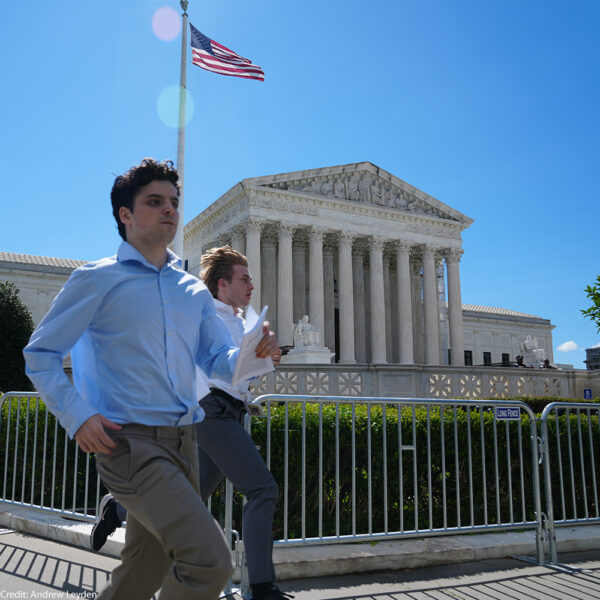
The Supreme Court Ruled, What Now?
July 8, 2024
Another Supreme Court term has come to a close. This year, the court delivered major decisions on reproductive freedom, voting rights, free speech, this women’s rights, gun rights, and presidential immunity, among other decisions. The ACLU was involved in cases throughout the term, and as far as wins and losses, we’re coming out somewhere in the middle.
Here to discuss it all and help us reconcile this term’s decisions is returning favorite David Cole, the ACLU’s national legal director.
Kendall Ciesemier
Former Host of At Liberty and Senior Executive Producer of Multimedia

David Cole
Former ACLU Legal Director
This Episode Covers the Following Issues
Related Content
-
Michigan Supreme CourtOct 2026

Civil Liberties
Criminal Law Reform
People V. Taylor. Explore Case.People v. Taylor
In 2013, Michigan passed the Michigan Indigent Defense Commission Act (MIDCA) to ensure that indigent criminal defendants—that is, those who cannot afford to pay for counsel themselves—received constitutionally adequate counsel, paid for by the state. This case concerns whether and under what circumstances trial courts can, consistent with MIDCA, order indigent criminal defendants to pay the state back for their attorneys. The ACLU’s State Supreme Court Initiative, the ACLU of Michigan, and the Michigan State Planning Body filed an amicus brief in the Michigan Supreme Court arguing that MIDCA, properly construed, partially abrogated a different statute authorizing trial courts to assess attorney fees against indigent defendants and explaining that allowing such orders would undermine Michiganders’ right to counsel. -
Press ReleaseOct 2026

Civil Liberties
Aclu Voter Education Fund And Aclu Of Georgia Launch $250k Campaign To Educate Georgia Voters Ahead Of Midterms. Explore Press Release.ACLU Voter Education Fund and ACLU of Georgia Launch $250K Campaign to Educate Georgia Voters Ahead of Midterms
ATLANTA – The ACLU of Georgia and the ACLU Voter Education Fund are spending $250,000 in select Georgia House races to inform voters that their civil rights and liberties, including voting rights and abortion, are on the ballot this November. The ACLU Voter Education Fund will send over 225,000 mail pieces to educate voters about candidates in State House Districts 48, 53, and 105. These state races include communities like Lawrenceville, Peachtree Corners, and Sandy Springs and are highly contested. The ACLU Voter Education Fund is investing in these races because the elected candidates will influence civil rights and liberties statewide for at least two years. Their decisions will affect voting rights, reproductive rights, privacy, and other fundamental liberties. On the voter guides, residents will see candidates’ responses to questions about those issues, such as whether they would vote to repeal Georgia’s six-week abortion ban or whether they will work to prevent unnecessary restrictions on early and absentee voting. “Georgia voters have a right to know the positions that the candidates take on the rights and freedoms that shape their lives,” said Christopher Bruce, deputy executive director, ACLU of Georgia. “We’re making sure voters get the information they need to understand the issues in these elections and what the candidates would do if they had the power of the Georgia House. From reproductive freedom and voting rights to safeguarding privacy and other liberties, the choices made under the Gold Dome can have a lasting impact on our communities.” While the ACLU Voter Education Fund does not endorse or oppose any candidates, the six-figure campaign will educate voters about the candidates’ positions on key civil rights issues, including abortion, birth control, marriage equality, and voting rights for Indigenous communities, through direct mail, radio ads, and digital ads. -
Minnesota Supreme CourtOct 2026
Civil Liberties
Housing First Minn. V. City Of Corcoran And Housing First Minn. V. City Of Dayton. Explore Case.Housing First Minn. v. City of Corcoran and Housing First Minn. v. City of Dayton
When a court rules that an issue is a “political question,” that issue becomes “nonjusticiable.” In other words, courts close their doors to political questions, even when an injured plaintiff seeks relief that a court could provide. The ACLU’s State Supreme Court Initiative and the ACLU of Minnesota filed an amicus brief in the Minnesota Supreme Court arguing that the Court should narrow, or at a minimum, not expand, the political question doctrine under the Minnesota Constitution. The brief urges the Court to preserve the justiciability of legal issues and thus ensure that provisions of the state Constitution are not just words on paper but meaningful guarantees for the people of Minnesota. -
News & CommentaryOct 2026
Civil Liberties
What 'let The Record Show' Reveals About A 200-year-old Petty Paperwork Problem That Gave Courts Its Power Today. Explore News & Commentary.What 'Let the Record Show' Reveals About a 200-Year-Old Petty Paperwork Problem That Gave Courts Its Power Today
In “Let the Record Show,” the ACLU’s newest podcast, we discuss how office politics gave courts the power to decide if political decisions are constitutional. It’s led to an array of landmark decisions that continue to protect our civil liberties today.