Religious Liberty
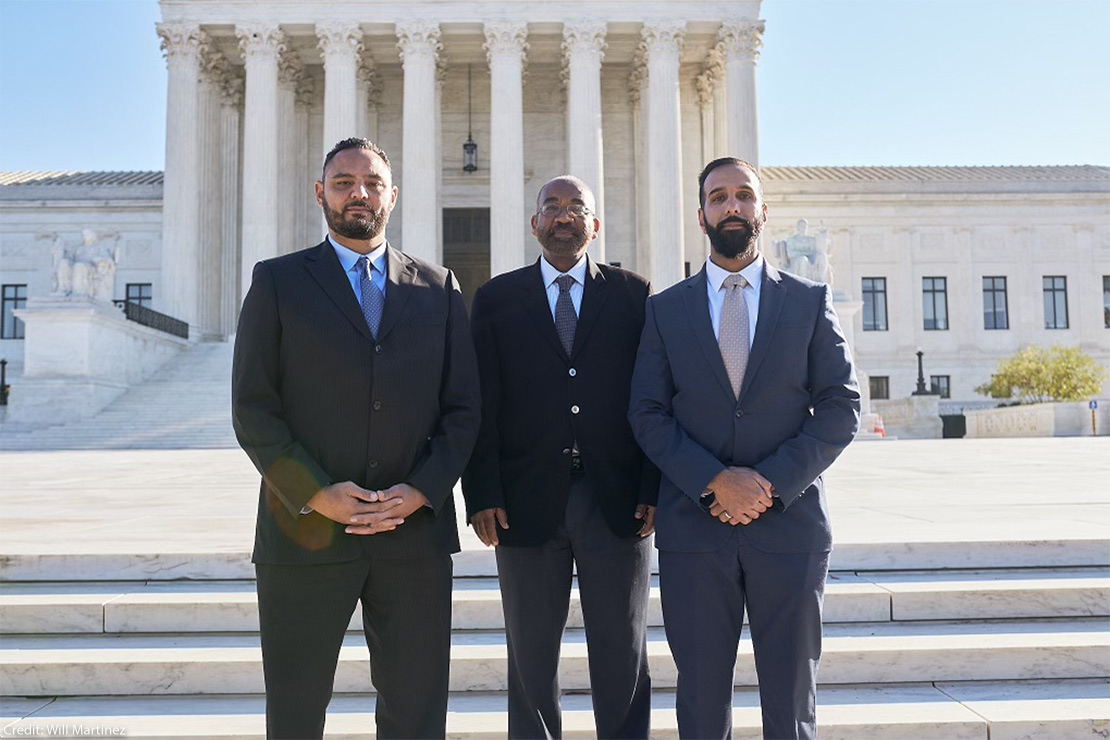
FBI v. Fazaga
In a case scheduled to be argued before the U.S. Supreme Court on November 8, 2021, three Muslim Americans are challenging the FBI’s secret spying on them and their communities based on their religion, in violation of the Constitution and federal law. In what will likely be a landmark case, the plaintiffs — Yassir Fazaga, Ali Uddin Malik, and Yasser Abdelrahim — insist that the FBI cannot escape accountability for violating their religious freedom by invoking “state secrets.” The plaintiffs are represented by the Center for Immigration Law and Policy at UCLA School of Law, the ACLU of Southern California, the American Civil Liberties Union, the Council for American Islamic Relations, and the law firm of Hadsell Stormer Renick & Dai.
Status: Closed (Judgment)
View Case
Learn About Religious Liberty
Featured
U.S. Supreme Court
May 2020

Religious Liberty
Little Sisters of the Poor v. Pennsylvania and New Jersey/Trump v. Pennsylvania and New Jersey
Whether the government had statutory authority under the Patient Protection and Affordable Care Act and the Religious Freedom Restoration Act of 1993 to expand the conscience exemption to the contraceptive-coverage mandate.
U.S. Supreme Court
Jun 2018

Religious Liberty
LGBTQ Rights
Masterpiece Cakeshop v. Colorado Civil Rights Commission
Whether a business open to the public has a constitutional right to discriminate.
Oklahoma
May 2017

Religious Liberty
Fatihah v. Neal
The American Civil Liberties Union of Oklahoma, the national ACLU, and the Council on American-Islamic Relations Oklahoma Chapter filed a lawsuit against a "Muslim free" business on behalf of a U.S. Army Reserve member denied service. The lawsuit seeks equal access to public accommodations for Oklahomans of all faiths.
All Cases
81 Religious Liberty Cases
U.S. Supreme Court
Aug 2026
Religious Liberty
Nathan v. Alamo Heights Independent School District
A group of Texas families are challenging a 2025 Texas law, S.B. 10, that requires public schools to conspicuously display a state-selected, Protestant version of the Ten Commandments in every classroom. Nearly 50 years ago, the Supreme Court overturned a similar Kentucky law because it violated the First Amendment. After an appellate court ruled that S.B. 10 does not violate the Constitution, the Christian, Jewish, Hindu, and nonreligious families involved in the lawsuit are asking the Supreme Court to hear their case and to block the law. The First Amendment prohibits states from forcing scripture on public-school students, and it guarantees families — not politicians or the government — the right to guide children’s religious belief and education.
Explore case
U.S. Supreme Court
Aug 2026
Religious Liberty
Nathan v. Alamo Heights Independent School District
A group of Texas families are challenging a 2025 Texas law, S.B. 10, that requires public schools to conspicuously display a state-selected, Protestant version of the Ten Commandments in every classroom. Nearly 50 years ago, the Supreme Court overturned a similar Kentucky law because it violated the First Amendment. After an appellate court ruled that S.B. 10 does not violate the Constitution, the Christian, Jewish, Hindu, and nonreligious families involved in the lawsuit are asking the Supreme Court to hear their case and to block the law. The First Amendment prohibits states from forcing scripture on public-school students, and it guarantees families — not politicians or the government — the right to guide children’s religious belief and education.
U.S. Supreme Court
Aug 2026
Religious Liberty
Cribbs Ringer v. Comal Independent School District
A group of Texas families are challenging a 2025 Texas law, S.B. 10, that requires public schools to conspicuously display a state-selected, Protestant version of the Ten Commandments in every classroom. Nearly 50 years ago, the Supreme Court overturned a similar Kentucky law because it violated the First Amendment. After an appellate court ruled that S.B. 10 does not violate the Constitution, the Baha’i, Christian, Jewish, Hindu, and nonreligious families involved in the lawsuit are asking the Supreme Court to hear their case and to block the law. The First Amendment prohibits states from forcing scripture on public-school students, and it guarantees families — not politicians or the government —the right to guide children’s religious belief and education.
Explore case
U.S. Supreme Court
Aug 2026
Religious Liberty
Cribbs Ringer v. Comal Independent School District
A group of Texas families are challenging a 2025 Texas law, S.B. 10, that requires public schools to conspicuously display a state-selected, Protestant version of the Ten Commandments in every classroom. Nearly 50 years ago, the Supreme Court overturned a similar Kentucky law because it violated the First Amendment. After an appellate court ruled that S.B. 10 does not violate the Constitution, the Baha’i, Christian, Jewish, Hindu, and nonreligious families involved in the lawsuit are asking the Supreme Court to hear their case and to block the law. The First Amendment prohibits states from forcing scripture on public-school students, and it guarantees families — not politicians or the government —the right to guide children’s religious belief and education.
Tennessee
Feb 2026
Religious Liberty
Wilberforce Academy of Knoxville v. Knox County Board of Education
ACLU, ACLU of Tennessee, and partners are representing six Knox County taxpayers dedicated to supporting public education and the separation of church and state who oppose Wilberforce Academy’s effort to force the county to authorize and fund it as a religious public charter school. The taxpayers, public school parents and faith and community leaders, object to their tax dollars funding a public charter school that will indoctrinate students into one religion, in violation of Tennessee and federal law and our nation’s longstanding commitment to the separation of church and state. They want to ensure that public schools remain secular and open to all.
Explore case
Tennessee
Feb 2026
Religious Liberty
Wilberforce Academy of Knoxville v. Knox County Board of Education
ACLU, ACLU of Tennessee, and partners are representing six Knox County taxpayers dedicated to supporting public education and the separation of church and state who oppose Wilberforce Academy’s effort to force the county to authorize and fund it as a religious public charter school. The taxpayers, public school parents and faith and community leaders, object to their tax dollars funding a public charter school that will indoctrinate students into one religion, in violation of Tennessee and federal law and our nation’s longstanding commitment to the separation of church and state. They want to ensure that public schools remain secular and open to all.
Maryland
Jan 2026
Religious Liberty
John Doe v. Catholic Relief Services
The ACLU and Americans United for Separation of Church and State filed an amicus brief with the U.S. Court of Appeals for the Fourth Circuit urging the court to affirm that religious employers such as Catholic Relief Services (CRS) are not exempt from complying with employment discrimination laws.
Explore case
Maryland
Jan 2026
Religious Liberty
John Doe v. Catholic Relief Services
The ACLU and Americans United for Separation of Church and State filed an amicus brief with the U.S. Court of Appeals for the Fourth Circuit urging the court to affirm that religious employers such as Catholic Relief Services (CRS) are not exempt from complying with employment discrimination laws.
U.S. Supreme Court
Jul 2025
Religious Liberty
Catholic Charities Bureau, Inc. v. Wisconsin Labor & Industry Review Comm'n
On March 5, 2025, the ACLU and its allies filed an amicus brief with the U.S. Supreme Court arguing that the First Amendment does not prohibit states from offering limited, categorical religious exemptions or from distinguishing between religious and nonreligious entities and activities in assessing the applicability of exemptions.
Explore case
U.S. Supreme Court
Jul 2025
Religious Liberty
Catholic Charities Bureau, Inc. v. Wisconsin Labor & Industry Review Comm'n
On March 5, 2025, the ACLU and its allies filed an amicus brief with the U.S. Supreme Court arguing that the First Amendment does not prohibit states from offering limited, categorical religious exemptions or from distinguishing between religious and nonreligious entities and activities in assessing the applicability of exemptions.