Criminal Law Reform

People v. Eatinger
In 2023, the State of Colorado admitted to the public that a state DNA analyst, Missy Woods, had manipulated data and tampered with evidence in potentially thousands of criminal cases. But the State did not learn of Woods’s malfeasance in 2023. In fact, Woods’s supervisors had been aware of it since 2014. Instead of investigating her fraud and disclosing it to defendants in affected cases, however, the supervisors covered it up and allowed her to continue working on cases—including Daniel Eatinger’s case here—for another decade.
The ACLU’s State Supreme Court Initiative, the ACLU of Colorado, and the Exoneration Project filed an amicus brief with the Colorado Supreme Court arguing that Woods and her supervisors violated their constitutional duty to disclose her misconduct, and that the Court should order systemic remedies for the thousands of defendants who have been harmed.
Status: Ongoing
View case
Learn About Criminal Law Reform
Featured
Colorado Supreme Court
Oct 2026
Criminal Law Reform
Civil Liberties
Daves v. Mosley
Section 131 of the newly enacted Enhance Law Enforcement Integrity Act gives Coloradans a cause of action to seek damages or equitable relief when state or local police officers violate the Colorado Constitution. In 2022, Christopher Mosley sued Officer Brendan Daves for conducting a warrantless search of his car, which Daves argued was lawful under the federal protective sweep doctrine. After Mosley prevailed at trial and the court of appeals affirmed, Daves appealed to the Colorado Supreme Court. The ACLU’s State Supreme Court Initiative and the ACLU of Colorado filed an amicus brief agreeing with Mosley’s argument that Daves has misapprehended the federal doctrine whilst focusing on a separate point: the Court’s interpretation of Section 131 is not bound by federal law.
Oregon
Feb 2024
Criminal Law Reform
Disability Rights
Disability Rights Oregon v. Washington County, Oregon
Arizona
Oct 2023
Criminal Law Reform
+2 Issues
Fund for Empowerment v. Phoenix, City of
Fund for Empowerment is a challenge to the City of Phoenix’s practice of conducting sweeps of encampments without notice, issuing citations to unsheltered people for camping and sleeping on public property when they have no place else to go, and confiscating and destroying their property without notice or process.
U.S. Supreme Court
Sep 2023
Criminal Law Reform
McElrath v. Georgia
Does the Double Jeopardy Clause bar an appellate court from reviewing and setting aside a jury’s verdicts of acquittal on the ground that the verdict is inconsistent with the jury’s verdict on other charges?
U.S. Supreme Court
Jun 2023
Criminal Law Reform
Pulsifer v. United States
This case involves the interpretation of a federal law that allows defendants to avoid mandatory minimum sentences for certain nonviolent drug crimes, allowing judges to impose sentences tailored to their individual circumstances.
Texas
Jul 2021
Criminal Law Reform
Prisoners' Rights
Sanchez et al v. Dallas County Sheriff et al
Decarceration has always been an emergency, a life and death proposition, but COVID-19 makes this effort intensely urgent. The ACLU has been working with our partners to litigate for the rights of those who are incarcerated and cannot protect themselves because of the policies of the institutions in which they are jailed.
All Cases
161 Criminal Law Reform Cases

Michigan
Feb 2020
Criminal Law Reform
Smart Justice
Hightower v. City of Grand Rapids
The American Civil Liberties Union of Michigan and the ACLU’s Criminal Law Reform Project filed a federal lawsuit in May of 2013, on behalf of Plaintiffs Gilbert Weber and Tyrone Hightower, challenging the Grand Rapids Police Department’s longstanding practice of arresting innocent people for criminal trespass on commercial property without warning and without the business owner’s knowledge. Even where those arrested are patronizing the business in question, police justify these illegal arrests by pointing to form letters signed by business owners months or years prior to the arrest agreeing to prosecute “trespassers.”
Explore case
Michigan
Feb 2020
Criminal Law Reform
Smart Justice
Hightower v. City of Grand Rapids
The American Civil Liberties Union of Michigan and the ACLU’s Criminal Law Reform Project filed a federal lawsuit in May of 2013, on behalf of Plaintiffs Gilbert Weber and Tyrone Hightower, challenging the Grand Rapids Police Department’s longstanding practice of arresting innocent people for criminal trespass on commercial property without warning and without the business owner’s knowledge. Even where those arrested are patronizing the business in question, police justify these illegal arrests by pointing to form letters signed by business owners months or years prior to the arrest agreeing to prosecute “trespassers.”
Oklahoma
Feb 2020
Criminal Law Reform
Smart Justice
White, et al. v. Hesse, et al.
In Oklahoma cash bail is being used keep poor people behind bars. In Canadian County, Oklahoma if you have the money, you get out of jail. If you are poor, you stay in. That’s why we sued.
Explore case
Oklahoma
Feb 2020
Criminal Law Reform
Smart Justice
White, et al. v. Hesse, et al.
In Oklahoma cash bail is being used keep poor people behind bars. In Canadian County, Oklahoma if you have the money, you get out of jail. If you are poor, you stay in. That’s why we sued.

Court Case
Nov 2019
Criminal Law Reform
Tucker, et al. vs. State of Idaho, et al.
The ACLU, the ACLU of Idaho, and Hogan Lovells LLP filed a class action lawsuit in 2015 against the State of Idaho over its defective public defense system.
Explore case
Court Case
Nov 2019
Criminal Law Reform
Tucker, et al. vs. State of Idaho, et al.
The ACLU, the ACLU of Idaho, and Hogan Lovells LLP filed a class action lawsuit in 2015 against the State of Idaho over its defective public defense system.
North Carolina
Nov 2019
Criminal Law Reform
Smart Justice
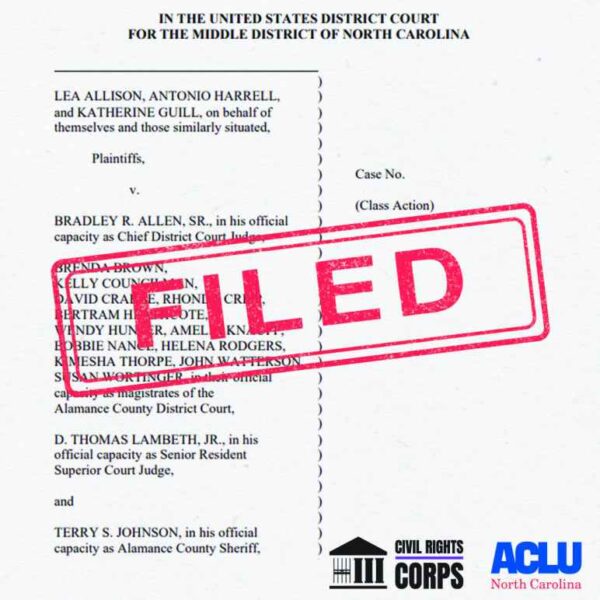
Allison, et al. v. Allen, et al.
Explore case
North Carolina
Nov 2019
Criminal Law Reform
Smart Justice
Allison, et al. v. Allen, et al.
California
Oct 2019
Criminal Law Reform
Cross v. SFPD
Our Constitution promises all people, regardless of their race, equal protection under the laws. Accordingly, courts have long recognized that the Fourteenth Amendment’s Equal Protection Clause prohibits selective enforcement of criminal laws based on race. Yet law enforcement officers of the City of San Francisco have repeatedly violated that clause, singling out Black people for enforcement.
Explore case
California
Oct 2019
Criminal Law Reform
Cross v. SFPD
Our Constitution promises all people, regardless of their race, equal protection under the laws. Accordingly, courts have long recognized that the Fourteenth Amendment’s Equal Protection Clause prohibits selective enforcement of criminal laws based on race. Yet law enforcement officers of the City of San Francisco have repeatedly violated that clause, singling out Black people for enforcement.