Civil Liberties

CAIR-Foundation, Inc and CAIR Florida, Inc. v. DeSantis et al.
The ACLU, the ACLU of Florida, the Southern Poverty Law Center, and their partners represent CAIR and CAIR-Florida in two federal lawsuits challenging Governor DeSantis’s unconstitutional and baseless designation of the nonprofits as “terrorist.” The lawsuits allege violations of CAIR and CAIR-Florida’s rights under the First Amendment and the due process clause of the Fourteenth Amendment.
Status: Ongoing
View Case
Learn About Civil Liberties
Featured
U.S. Supreme Court
May 2020
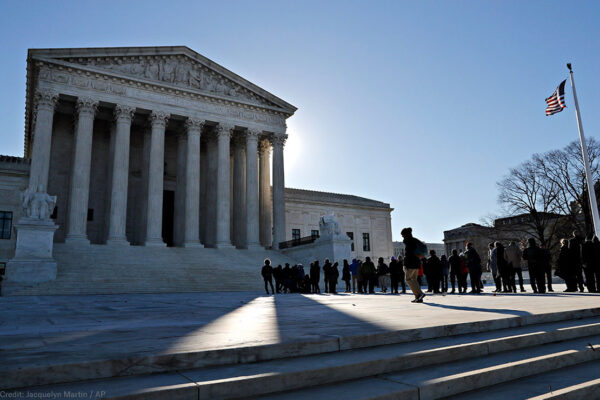
Civil Liberties
Trump v. Mazars/Trump v. Deutsche Bank AG
Whether President Trump should comply with congressional subpoenas and hand over his personal finance documents.
U.S. Supreme Court
May 2020
Civil Liberties
Trump v. Vance
Whether President Trump should comply with a grandy jury subpoena and hand over his personal finance documents.
All Cases
34 Civil Liberties Cases
New Mexico Supreme Court
Feb 2026
Civil Liberties
Atencio v. State
This case asks whether the State of New Mexico’s actions enabling pollution from oil and gas extraction, and its failure to control that pollution, violate the New Mexico Constitution’s Pollution Control Clause, Inherent Rights Clause, Due Process Clause, and Equal Protection Clause. The ACLU’s State Supreme Court Initiative, joined by the ACLU of New Mexico and the Brennan Center of Justice, filed an amicus brief urging the New Mexico Supreme Court to answer those questions by retiring its “interstitial approach” to state constitutional interpretation—which looks first to federal doctrine when interpreting state constitutional provisions that arguably have U.S. Constitutional analogues—and instead interpret the New Mexico Constitution holistically and independently. This independent approach, we explain, will ensure that New Mexicans can enjoy—and enforce—the rights guaranteed to them in their unique founding document.
Explore case
New Mexico Supreme Court
Feb 2026
Civil Liberties
Atencio v. State
This case asks whether the State of New Mexico’s actions enabling pollution from oil and gas extraction, and its failure to control that pollution, violate the New Mexico Constitution’s Pollution Control Clause, Inherent Rights Clause, Due Process Clause, and Equal Protection Clause. The ACLU’s State Supreme Court Initiative, joined by the ACLU of New Mexico and the Brennan Center of Justice, filed an amicus brief urging the New Mexico Supreme Court to answer those questions by retiring its “interstitial approach” to state constitutional interpretation—which looks first to federal doctrine when interpreting state constitutional provisions that arguably have U.S. Constitutional analogues—and instead interpret the New Mexico Constitution holistically and independently. This independent approach, we explain, will ensure that New Mexicans can enjoy—and enforce—the rights guaranteed to them in their unique founding document.
Utah Supreme Court
Jan 2026
Civil Liberties
Fuja v. Stephens
This case asks whether government officials who intentionally violate the law are immune from damages suits under a state statute governing such suits, and if so, whether the statute itself violates the Open Courts Clause of the Utah Constitution.
Utah’s Open Courts Clause, like similar provisions in thirty-nine other states across the country, protects an individual’s right to seek judicial remedies for wrongs committed against them. It therefore serves as an important tool that does not exist in the U.S. Constitution to hold government actors accountable.
Explore case
Utah Supreme Court
Jan 2026
Civil Liberties
Fuja v. Stephens
This case asks whether government officials who intentionally violate the law are immune from damages suits under a state statute governing such suits, and if so, whether the statute itself violates the Open Courts Clause of the Utah Constitution.
Utah’s Open Courts Clause, like similar provisions in thirty-nine other states across the country, protects an individual’s right to seek judicial remedies for wrongs committed against them. It therefore serves as an important tool that does not exist in the U.S. Constitution to hold government actors accountable.
New Mexico Supreme Court
Jan 2026
Civil Liberties
Prisoners' Rights
Franklin v. Martinez
This case raises the question whether New Mexico courts should retire their current, federal-centric approach to interpreting the New Mexico Constitution—a method known as the “interstitial approach”—and embrace an independent approach that would allow them to more readily diverge from federal courts in light of New Mexico’s own law, history, and values. The Court’s decision could have major implications for New Mexicans’ ability to vindicate their state constitutional rights. The ACLU’s State Supreme Court Initiative, alongside the ACLU of New Mexico and the Brennan Center for Justice, tendered an amicus brief to the New Mexico Supreme Court.
Explore case
New Mexico Supreme Court
Jan 2026
Civil Liberties
Prisoners' Rights
Franklin v. Martinez
This case raises the question whether New Mexico courts should retire their current, federal-centric approach to interpreting the New Mexico Constitution—a method known as the “interstitial approach”—and embrace an independent approach that would allow them to more readily diverge from federal courts in light of New Mexico’s own law, history, and values. The Court’s decision could have major implications for New Mexicans’ ability to vindicate their state constitutional rights. The ACLU’s State Supreme Court Initiative, alongside the ACLU of New Mexico and the Brennan Center for Justice, tendered an amicus brief to the New Mexico Supreme Court.
Kentucky Supreme Court
Dec 2025
Civil Liberties
Commonwealth v. Davis and Commonwealth v. Ky. Educ. Ass'n
This case asks whether Kentucky’s legislature can legally favor some unions by giving them preferential treatment and disfavor others. A recent law does just that: SB 7 prohibits public employers from allowing their employees to use payroll deductions for union dues yet expressly exempts law enforcement and fire protection unions from this prohibition. Two state circuit courts and the Court of Appeals have held that this law violates the Kentucky Constitution’s equal protection guarantee. The State now appeals to the Kentucky Supreme Court. The Court’s decision has important implications for equal protection, free speech, and labor rights in Kentucky.
Explore case
Kentucky Supreme Court
Dec 2025
Civil Liberties
Commonwealth v. Davis and Commonwealth v. Ky. Educ. Ass'n
This case asks whether Kentucky’s legislature can legally favor some unions by giving them preferential treatment and disfavor others. A recent law does just that: SB 7 prohibits public employers from allowing their employees to use payroll deductions for union dues yet expressly exempts law enforcement and fire protection unions from this prohibition. Two state circuit courts and the Court of Appeals have held that this law violates the Kentucky Constitution’s equal protection guarantee. The State now appeals to the Kentucky Supreme Court. The Court’s decision has important implications for equal protection, free speech, and labor rights in Kentucky.
Rhode Island Supreme Court
Oct 2025
Civil Liberties
Parente et al. v. Lefebvre et al.
This case asks whether state officials in Rhode Island can be held liable for their discriminatory acts under the Rhode Island Civil Rights Act (RICRA), a state anti-discrimination law. The State of Rhode Island asserts that it has sovereign immunity as to claims brought under the RICRA and therefore cannot be sued for damages for violating that law. The State Supreme Court Initiative and the ACLU of Rhode Island filed an amicus brief arguing that the State is wrong: discrimination claims under the RICRA are covered by the State Tort Claims Act’s broad waiver of state sovereign immunity for “all actions of torts.” Thus, state officials may be held liable when they engage in discrimination prohibited by the RICRA, allowing harmed Rhode Islanders to seek redress.
Explore case
Rhode Island Supreme Court
Oct 2025
Civil Liberties
Parente et al. v. Lefebvre et al.
This case asks whether state officials in Rhode Island can be held liable for their discriminatory acts under the Rhode Island Civil Rights Act (RICRA), a state anti-discrimination law. The State of Rhode Island asserts that it has sovereign immunity as to claims brought under the RICRA and therefore cannot be sued for damages for violating that law. The State Supreme Court Initiative and the ACLU of Rhode Island filed an amicus brief arguing that the State is wrong: discrimination claims under the RICRA are covered by the State Tort Claims Act’s broad waiver of state sovereign immunity for “all actions of torts.” Thus, state officials may be held liable when they engage in discrimination prohibited by the RICRA, allowing harmed Rhode Islanders to seek redress.